Create a smart pop-up
With our pop-up service, you can create smart pop-ups and show them to visitors based on a certain scenario. Make a personal offer at the right time, help your client choose a product or service, or capture subscribers to interact with them using SendPulse.
You can select a premade template and use it right away or customize it.
Let's talk about how to create a smart pop-up using a template and set up its appearance, elements, and display conditions.
Create a pop-up
You can create a pop-up from scratch or select a premade template and edit it.
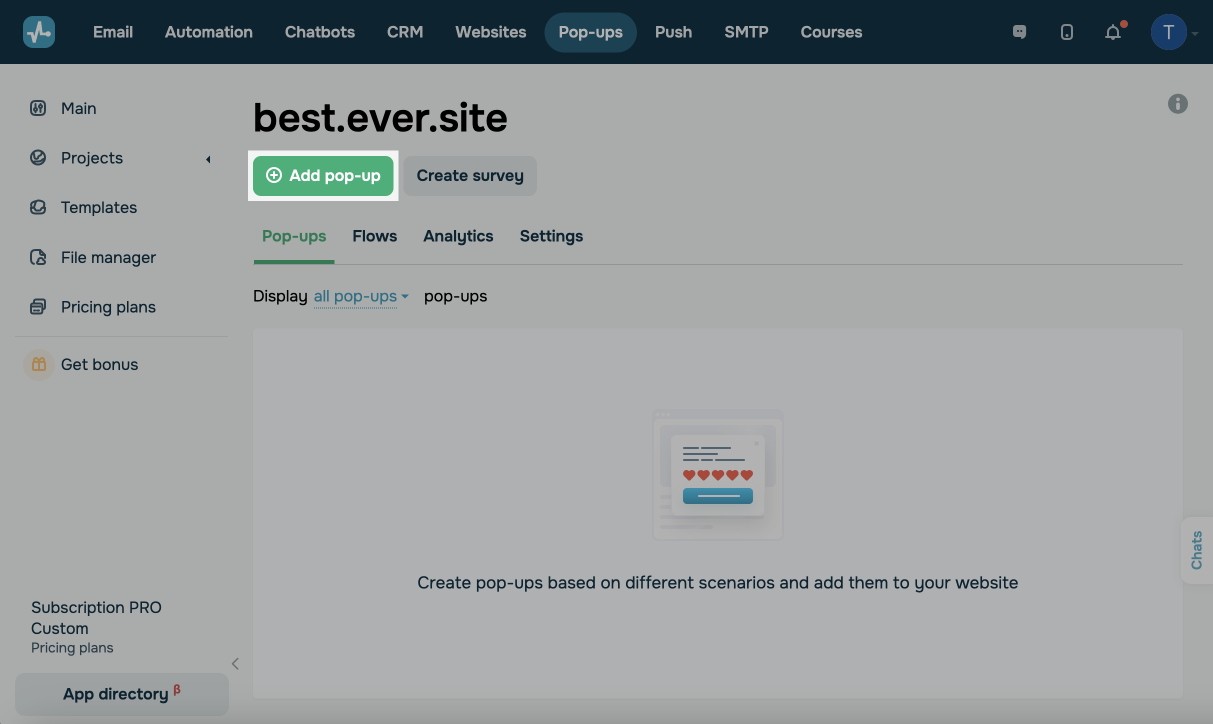
Go to your website in the Pop-ups tab, and click Create pop-up.
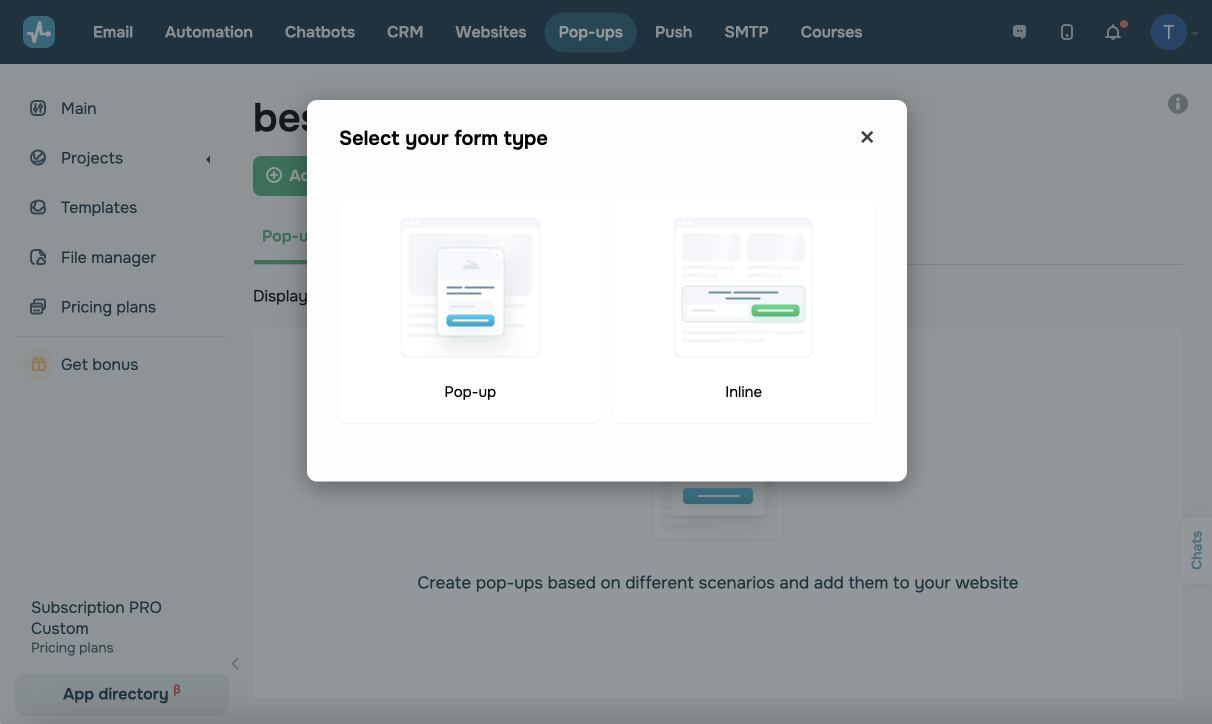
Select the popup form type:
| Pop-up | A widget that appears on top of the page and may overlay the site content. |
| Inline | An element displayed directly within the page content at a defined location and overlays other elements. |
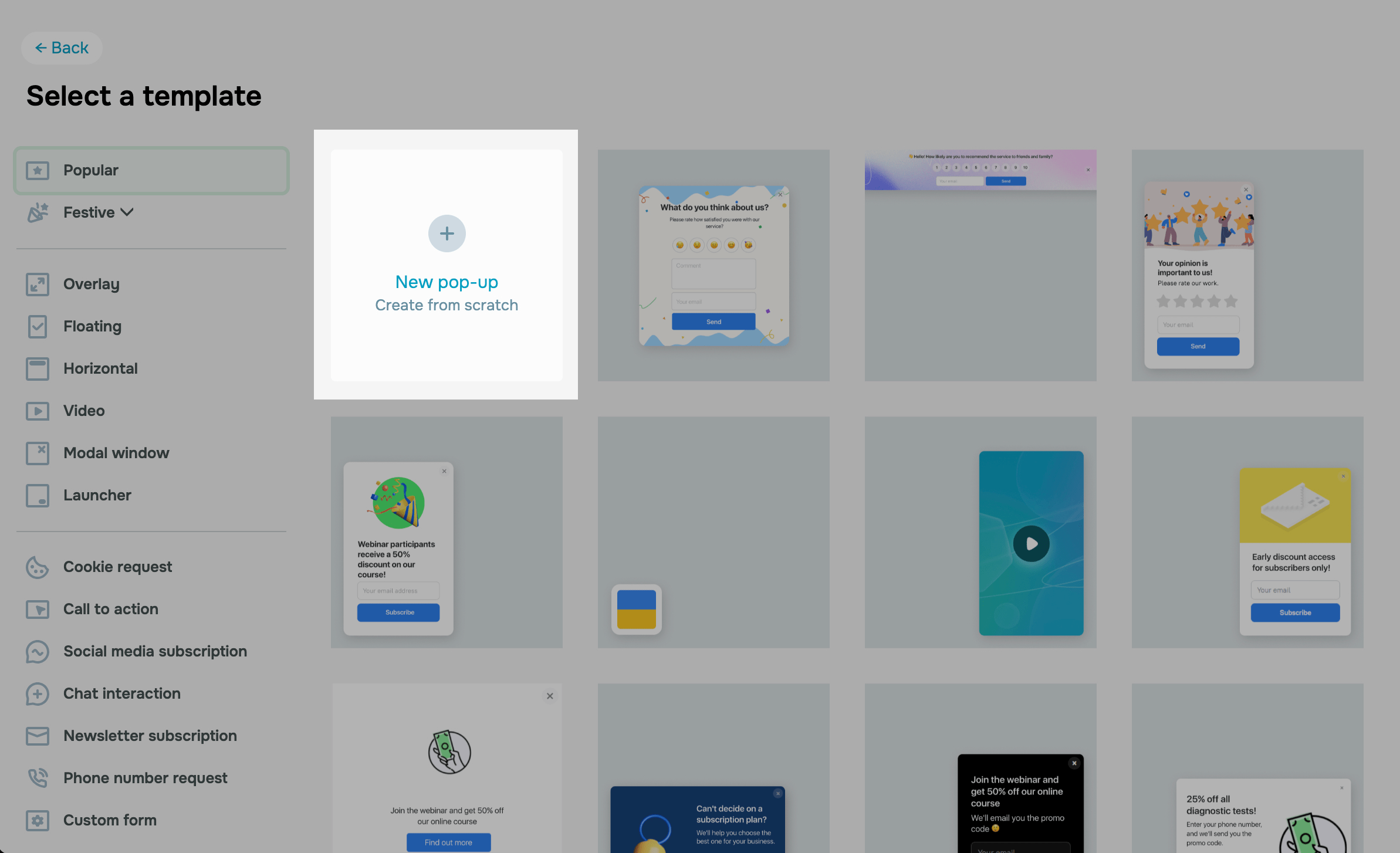
From scratch
To create your own pop-up using ready-made elements, click New pop-up.
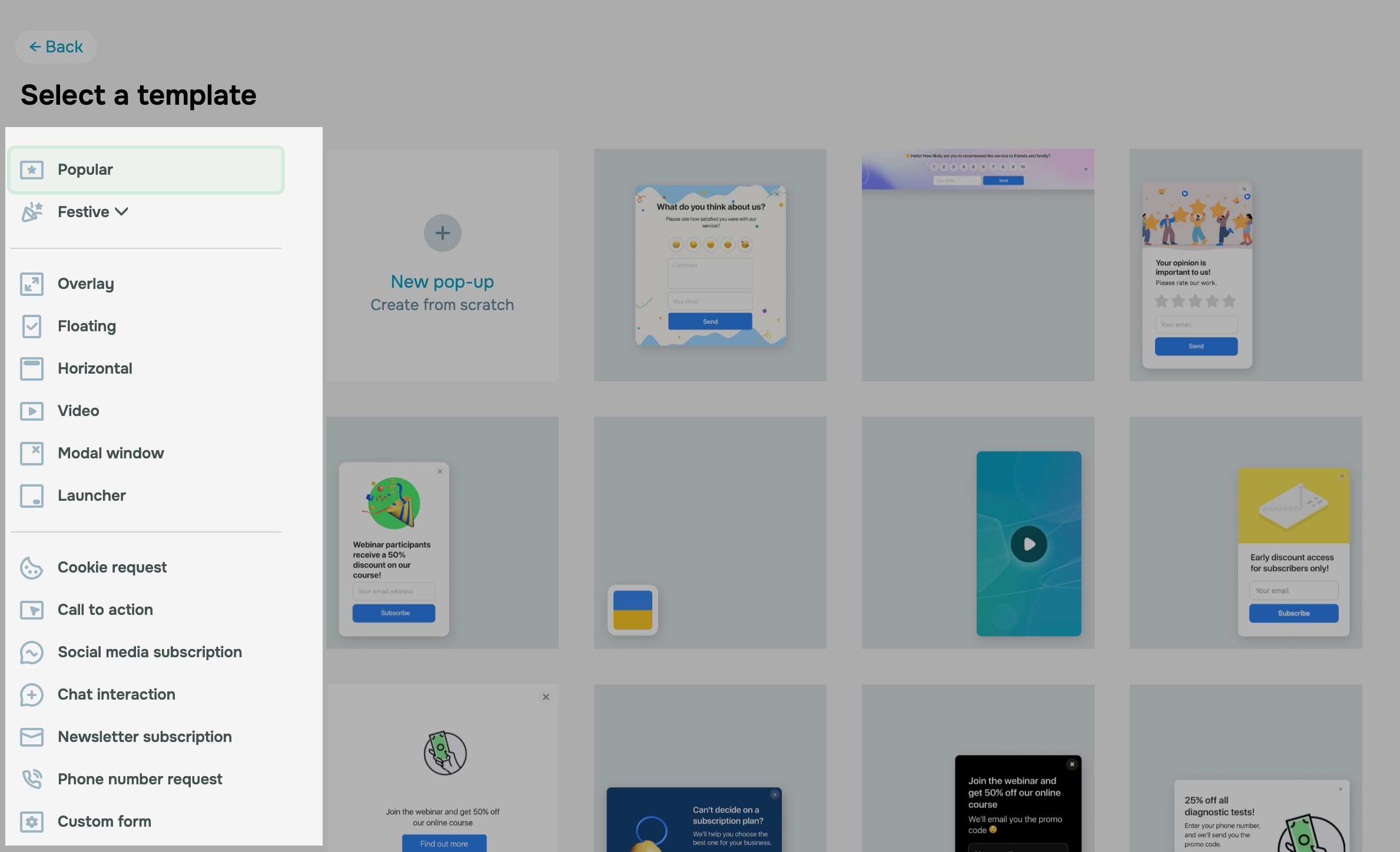
Using a template
A pop-up template is a widget with a predefined appearance and target action settings. You can select a template based on its theme, pop-up type, or elements.
You can select a template with a certain theme or a set of elements only during the first steps of creating a new pop-up. If you don’t select a template but want to create a similar one, check the elements it consists of, and select them in Design > Elements.
You can switch to another pop-up type later in Design > Style.
Select a category on the right and a template on the left.
Set up your pop-up elements
You can use AI to generate a pop-up draft, including its layout, elements, settings, and starter copy, to save time and focus on customization.
Learn more: How to generate a pop-up using AI.
Once you select a template, the pop-up builder will be opened in the Design tab, where you can edit your pop-up and its elements.
If you are creating a pop-up from scratch, click +Add element, and select an element.
You can add elements to pop-ups of the Overlay, Floating, Horizontal, and Modal window types.
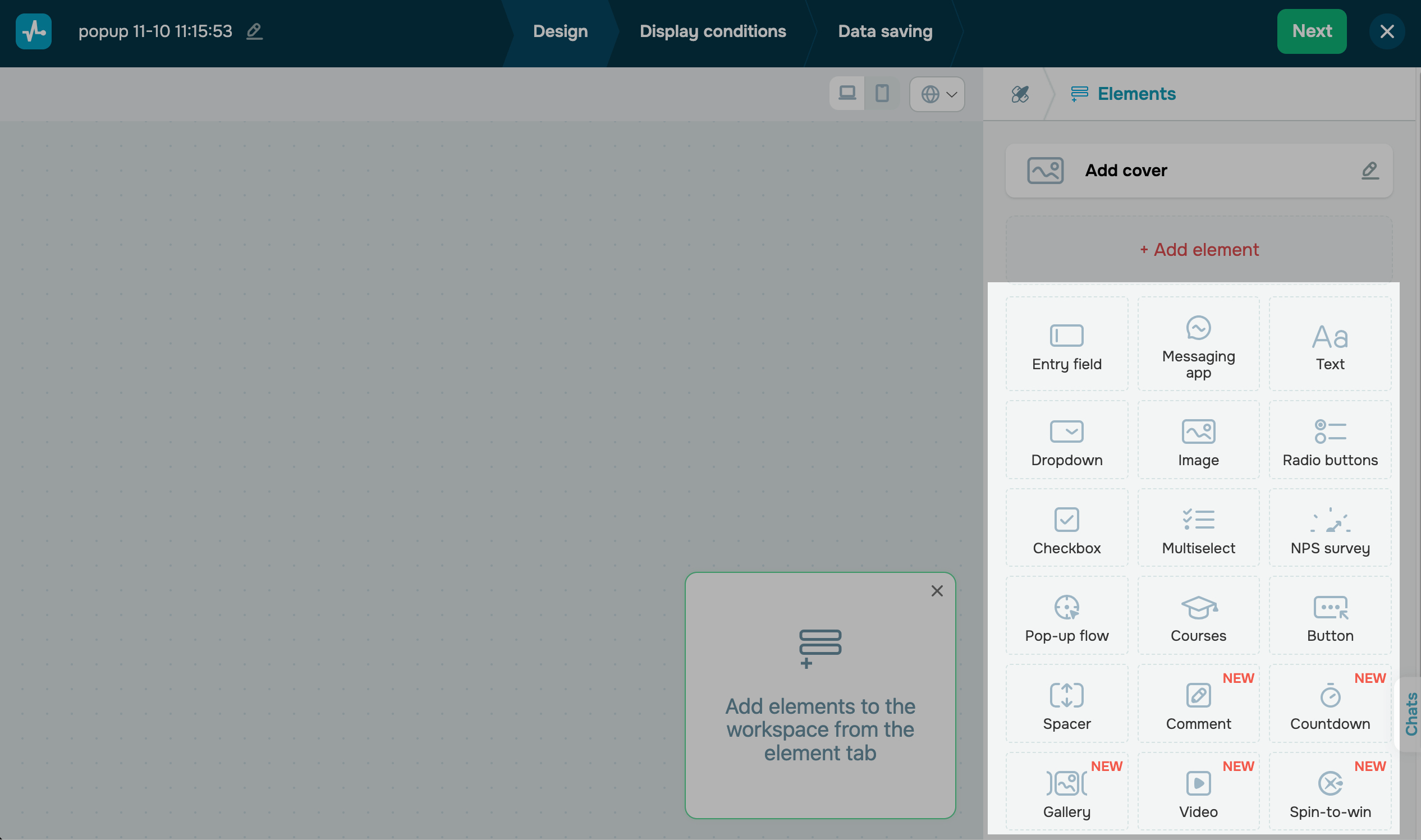
If you are creating a pop-up using a template, you can customize it. To edit an element, click the pencil icon next to it.
You can also start editing an element by clicking it. When you hover over an element or start editing it, it will be highlighted with a green frame.
Read more about each element below.
All elements are optional. You can add, delete, combine, and use them selectively.
However, if you use elements that save user data (Entry field, Dropdown, Radio buttons, Checkbox, Multiselect, and NPS), you need to add the Button element.
Cover
This element shows a pop-up image covering the entire area along your selected edge.
Select an image for the Cover element and customize it.
Entry field
This element requests user data you can save to variables, including names, email addresses, phone numbers, birth dates, and more, to create or update contacts.
Add the Entry field element. Choose a variable to save values to and customize the field name.
You can also automatically prefill pop-up fields, set up double opt-in subscription confirmation, add field names, and make fields required.
Messaging app
This element redirects users to a social media platform of your choice. You can add up to 10 social media icons to one pop-up. If you have a chatbot, you can link it to your pop-up to grow your chatbot audience and launch flows.
Add the Messaging app element. Select a social media icon and type in your button text. In the next field, add a link to your social media profile.
Text
This element shows text to your website visitors. Add a message tailored to your pop-up scenario to engage potential clients.
Add the Text element. Enter and format your text. You can also add links and emojis and personalize your message using variables.
Dropdown
This element allows users to select an item from the list, for example, a product category.
Add the Dropdown element. Choose a variable to save values to and configure other settings.
You can also mark an option that will appear as selected by default.
Button
This element allows users to submit forms and helps you send data from the filled fields to their contact cards.
Add the Button element. You can add buttons as text or images. Enter your text or upload an image, and select an on-click button action.
Image
This element adds more images to your pop-up. Unlike the Cover element, the Image element does not fill your pop-up.
Add the Image element. Click Upload Image and choose an image from the file manager.
To generate an image using AI, click the icon on the right side of the button.
Radio buttons
This element allows users to select an item from the list using a radio button.
Add the Radio buttons element. Select a variable to save values to. In every radio button, add your text in the Text field, and select the value you want to save to your variable in the Value field.
Checkbox
This element allows users to select a checkbox, for example, to consent to personal data processing.
Add the Checkbox element. Choose a variable to save values to and customize the text.
Multiselect
This element allows users to select multiple options using checkboxes, for example, to choose their preferred newsletter topics.
Add the Multiselect element. Select a variable to save values to. In every option, add your text in the Text field, and select the value you want to save to your variable in the Value field.
NPS survey
This is an element with a rating scale where users can provide their feedback and help you improve the quality of your service.
Add the NPS survey element. Select a variable to store values in. Choose a rating format (stars, emoticons, hearts, likes/dislikes, or numeric values). You can also enable a comment field and select its size.
Pop-up flow
This element launches another pop-up and is used to create flows, such as a series of forms or offers.
Add the Flow element. Select the pop-up you want to open and name the button that will trigger it. To add more buttons to launch pop-ups, add another element.
Courses
This element shows a free or paid course registration form.
Add the Courses element. Enable payments, then select a course and payment method. You can also allow students to apply a promo code.
Comment
This element allows users to type in up to 5,000 characters of text to leave a review or ask a question.
Add the Comment element. Select a variable to save values and type in a placeholder text.
Video
This element displays a video on your pop-up. For example, you can use it for a product presentation or tutorial.
Unlike the Video pop-up type, this element allows you to combine videos with other pop-up elements of your selected type.
Add the Video element. Paste the link and set a video display style.
Spin-to-win
This element adds a wheel that your website visitors can spin to win bonuses, discounts, or gifts.
Select the Spin-to-win element and customize its style.
Countdown
This element shows how much time is left until a specific event or a fixed date/time. For example, you can create a countdown to the end of a sale to create a sense of urgency and motivate visitors to take action.
Add the Countdown element and customize the dates and appearance.
Gallery
This element shows images one by one in a slideshow or on click.
Add the Gallery element. Click Upload image and select it from the file manager.
To generate an image using AI, click the icon on the right side of the button.
Accordion
This element hides other pop-up elements using an expandable space. It helps organize FAQs and other types of content in a concise layout so that users can expand relevant sections.
Add the Accordion element. Customize its style and add elements.
File upload
This element allows users to upload files, including images, documents, and videos. For example, you can use it to receive vouchers or document scans.
Add the File upload element. Select the type and size of expected files and customize your element’s style.
Scratch card
This element allows users to type in their contact information and scratch the virtual card to reveal a promo code. It can help gamify contact collection and enhance user experience.
Select the Scratch card element. Choose a variable to save values to, add a promo code, and customize your element’s style.
Pick a gift
This element adds an interactive gift box that users can open* to get a promo code. It can help gamify contact collection and enhance user experience.
* Gifts will unlock once users share their contact information through an entry field. To collect this information, make sure to add a required entry field.
Select the Pick a gift element. Choose a variable to save values to, add a promo code, and customize your element’s style.
Dice
This element adds a die that users can roll to get a promo code. It can help gamify contact collection and enhance user experience.
Select the Dice element. Choose a variable to save values to. Customize your element’s style and add a promo code.
Slot machine
This element adds a slot machine that users can spin to win a promo code. It can help gamify contact collection and enhance user experience.
Select the Slot machine element. Choose a variable to save values to. Customize your element’s style and add a promo code.
Thimbles
This element adds thimbles that users can shuffle to win a promo code. It can help gamify contact collection and enhance user experience.
Select the Thimbles element. Choose a variable to save values to. Customize your element’s style, set the number of attempts, and add a promo code.
Customize the style
To access style settings, click the first tab icon (Style). In this section, you can:
- Choose from various pop-up types to adjust your widget's style, page placement, and interaction method.
- Adjust the overall appearance of pop-up elements, such as positioning, colors, field sizes, and more.
- Add an animation for when your pop-up appears or disappears. You can select from various effects and set an animation direction.
Add a language version
You can add language versions and customize their content in one pop-up. Your website visitors will be able to choose the language they prefer.
Click the globe icon in the upper right corner of the workspace. Click Add default language, and select a language from the list — this language will be visible to all your website visitors. Then, click Add language version, select a language, and customize your pop-up content.
Read more: How to configure a multilingual pop-up.
Preview your pop-up
As you edit your pop-up, you can instantly preview how it will look on your website in real time. To view its mobile version, click the corresponding icon on the right.
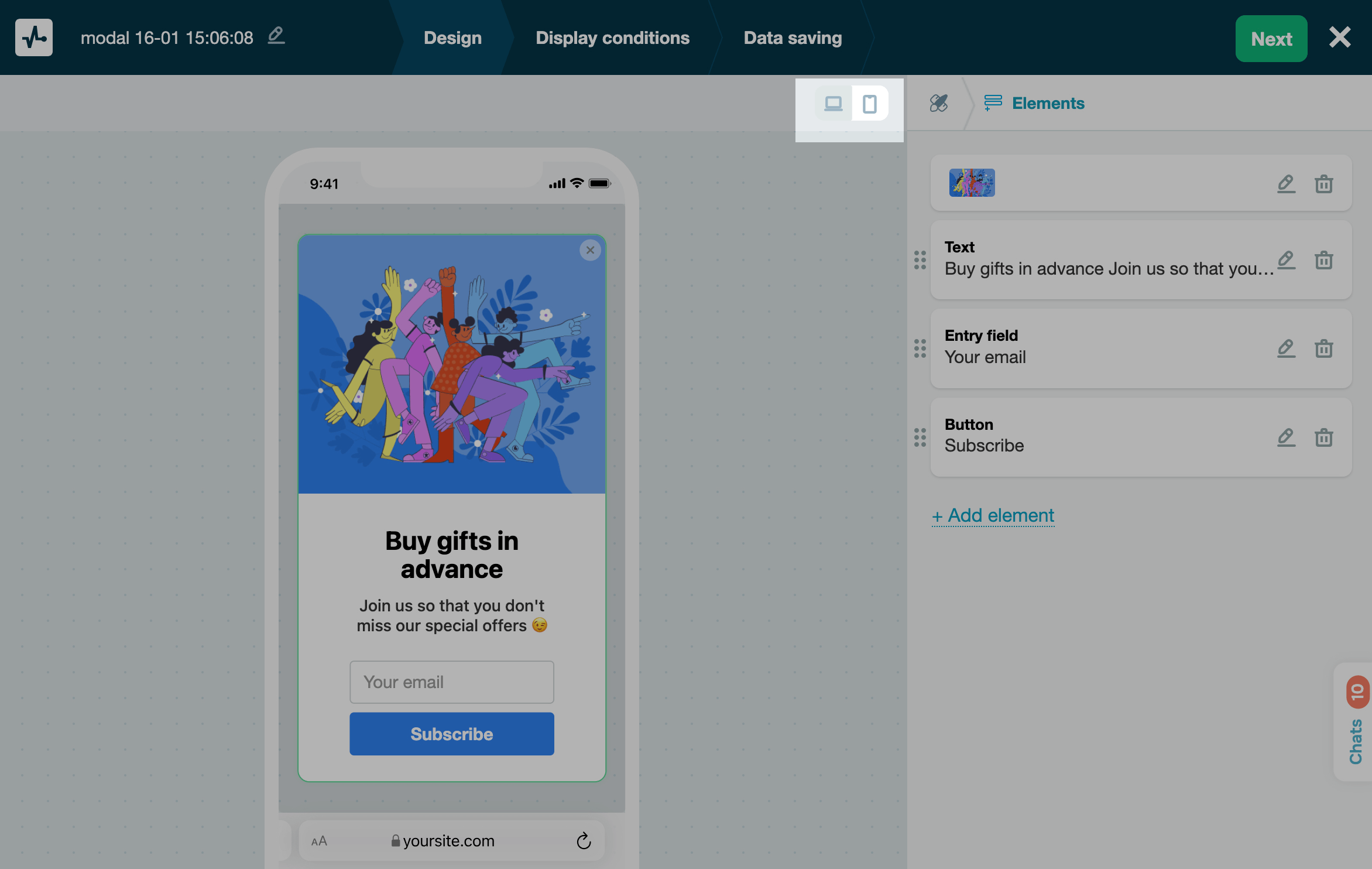
Once you finish customizing your pop-up design, click Next.
Set up pop-up display conditions
In the Display conditions tab, you can set your widget to appear when a user clicks the launcher or once visitor behavior tracking conditions are met.
To display a pop-up upon clicking the launcher, turn on the toggle, and select an existing pop-up of the Launcher type.
To display a pop-up based on a visitor behavior tracking condition, select the event you want to track and the condition operator, and enter the tracked value. You can also select multiple conditions and link them to operators.
For example, you can display your widget only when users perform a certain action, like scrolling to a certain part of the page or spending more than 40 seconds on your website.
Learn more: How to set up a pop-up display scenario and How to create a launcher pop-up.
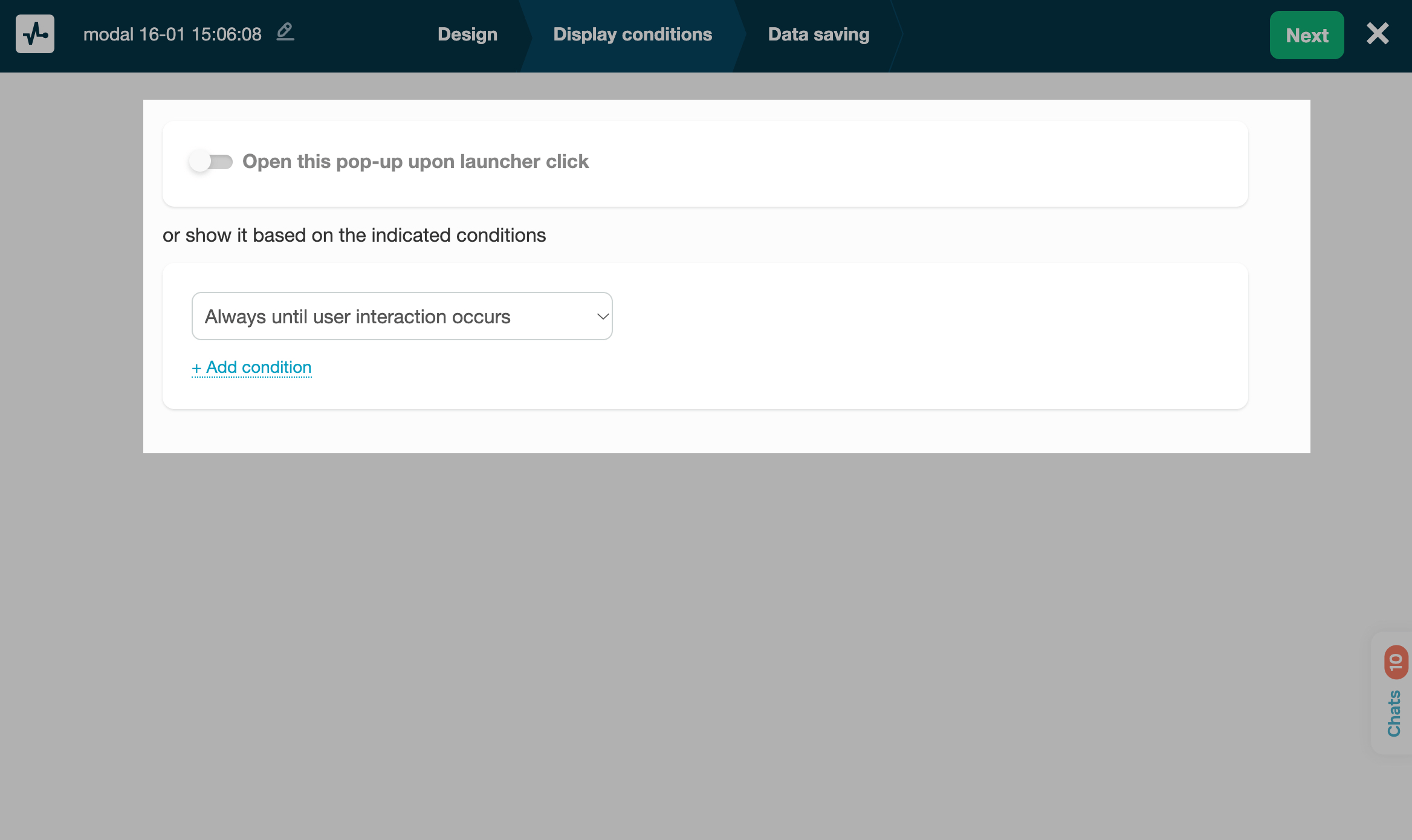
Once you configure your pop-up display conditions, click Next.
Configure data saving options
In the Data saving tab, you can select where to save subscriber data. Turn on a toggle, and select an option.
Read more: How to configure data saving
Name your pop-up
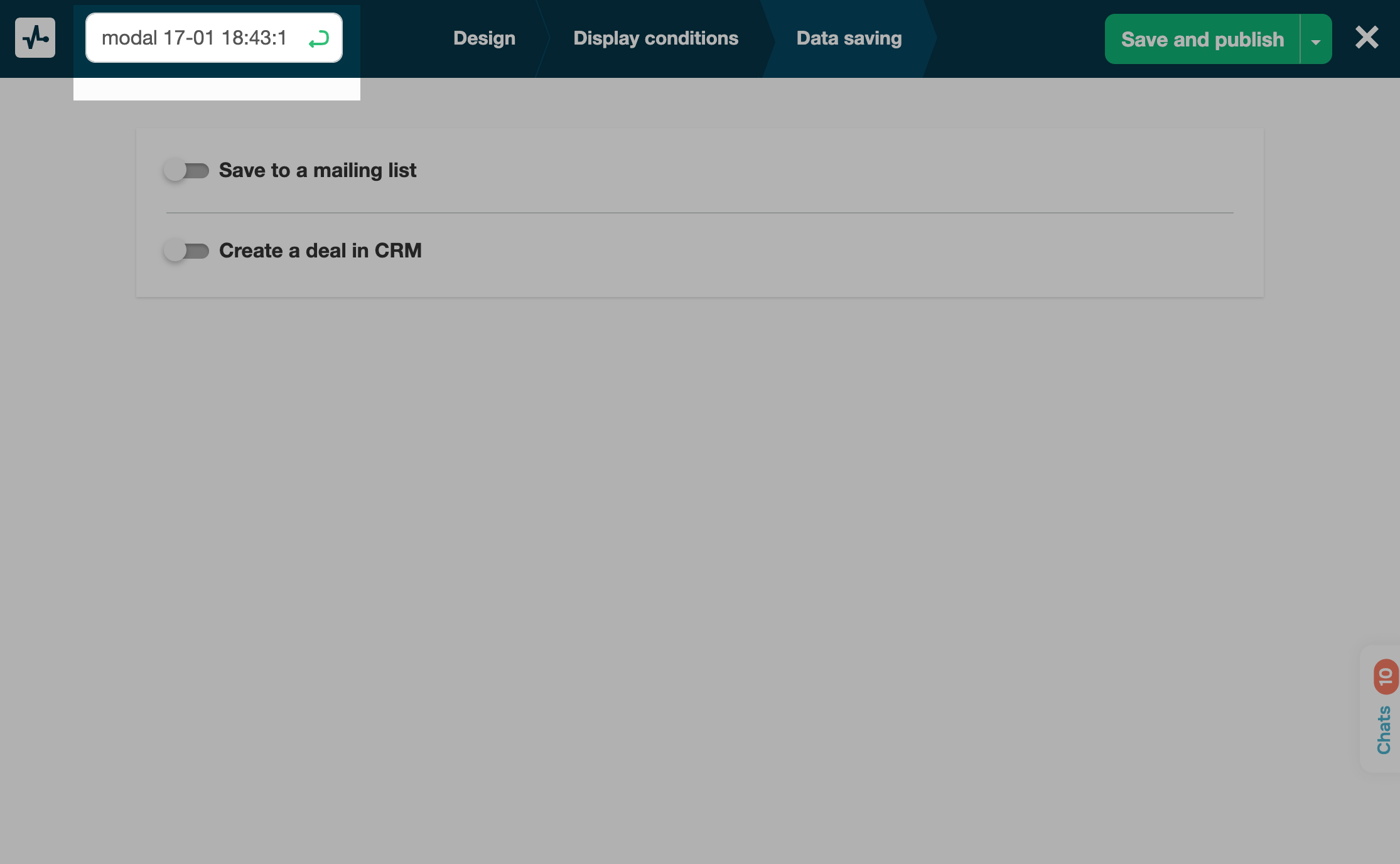
By default, your pop-up name is generated using the date and time when it was created. To rename your pop-up, click the corresponding icon, enter your text, and press Enter.
Publish your pop-up
Once you set up all the necessary conditions, click Save and publish or Save and close.
To make sure that all the changes are displayed in your browser, clear your browser cache and cookies after saving your pop-up.
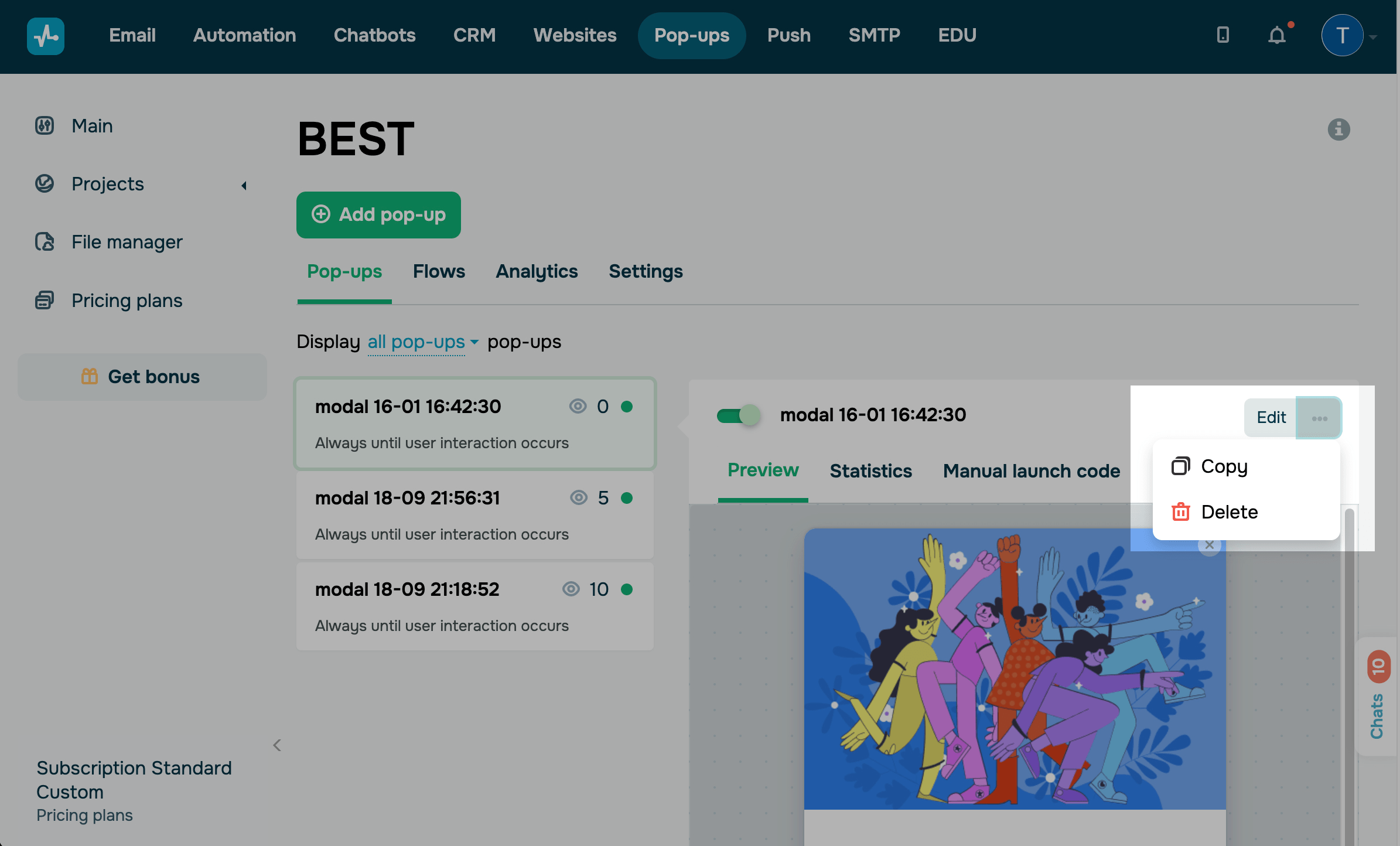
All of your pop-ups are displayed in the Pop-ups section as separate tabs. Once you create your pop-up, you will be able to view it, track its statistics, and edit it. However, you will not be able to change its pop-up type.
 Last Updated: 17.12.2024
or