Omnisend and ActiveCampaign are both very strong platforms that have a lot in common. But are they similar enough to be interchangeable, or does each have its own strengths? To answer these questions, we took the time to analyze, test, and compare them head-to-head. Here’s what we found.
How we scored this comparison: This review was created by the SendPulse team. As an email marketing platform ourselves, we work in the same space as the tools we test, which also means we understand the field deeply.
Each platform was evaluated across key categories using our independent methodology. Pricing (25%), ease of use (20%), and email and automation features (15% each) carry the most weight because they affect daily workflows the most. All scores reflect hands-on testing and analysis as of July 2026.
TL;DR Very brief Omnisend vs ActiveCampaign comparison
Below is a condensed summary of our findings, with each category described in a single phrase. If any aspect catches your attention, click on it to jump straight to the section where we analyze it in detail.
| Category |
Omnisend |
ActiveCampaign |
Winner |
| Best for |
eCommerce brands focused on growth |
Businesses needing advanced CRM and automation |
Depends on the use case |
| Pricing |
8/10
Transparent pricing with generous features on every plan |
7/10
Higher pricing, but broader business functionality |
Omnisend |
| Ease of use |
8.5/10
Simple, eCommerce-focused interface |
8.3/10
More powerful, but steeper learning curve |
Omnisend |
| Email design |
8.8/10
Fast builder with eCommerce-ready templates |
9.3/10
Flexible editor with deeper customization |
ActiveCampaign |
| Automation |
9.2/10
Powerful eCommerce automation made simple |
10/10
Industry-leading automation with CRM logic |
ActiveCampaign |
| SMS |
8.2/10
Strong SMS for eCommerce campaigns |
9.2/10
More advanced SMS with two-way messaging |
ActiveCampaign |
| Contact management |
9.2/10
Excellent segmentation for online stores |
9.5/10
Advanced CRM-driven customer management |
ActiveCampaign |
| Forms and pages |
8.6/10
High-converting pop-ups and signup forms |
7.2/10
Functional lead capture with CRM integration |
Omnisend |
| Integrations |
8.2/10
Strong eCommerce ecosystem |
9/10
Extensive integrations across business tools |
ActiveCampaign |
| AI features |
7.2/10
Helpful AI for everyday marketing tasks |
8.9/10
AI integrated across the entire platform |
ActiveCampaign |
| Deliverability |
10/10
Excellent monitoring and list protection |
10/10
Excellent deliverability with advanced guidance |
Tie |
| Reporting |
8.2/10
eCommerce-focused insights in real time |
8.4/10
More flexible reporting across marketing and sales |
ActiveCampaign |
| Customer support |
8.4/10
Responsive 24/7 support on all plans |
7.2/10
Strong onboarding and learning resources |
Omnisend |
| G2/Capterra rating |
4.6/4.7 |
4.4/4.6 |
Omnisend |
| Final score |
8.6/10 |
8.9/10 |
ActiveCampaign |
A 0.3-point difference is too small to declare a clear winner. Both platforms have categories where they excel. Read the full comparison to find out where ActiveCampaign has the edge and where Omnisend is the stronger choice.
Omnisend vs ActiveCampaign pricing and feature differences
How we tested: We signed up for both Omnisend and ActiveCampaign, then spent several weeks in July 2026 testing each one step by step. We looked at pricing, built email campaigns and automations, sent SMS messages, and made signup forms and landing pages. We also segmented contacts, checked out the template libraries and AI tools, and reviewed deliverability, reporting, and onboarding. To evaluate support quality, we read real user feedback on Capterra. All screenshots in this article come from our own hands-on testing.
We organized this comparison to begin with the factors that matter most when choosing an email marketing platform and end with the smaller details that can help you break the tie if both platforms seem equally good. Hopefully, by the end, you’ll have a clear winner.
Pricing plans
⭐ Omnisend: 8/10 | ActiveCampaign: 7/10
Disclaimer: Pricing changes frequently. All prices in this comparison were verified against Omnisend’s official pricing and ActiveCampaign’s official pricing as of July 28, 2026. Always confirm current costs on the official pages.
Price is one of the biggest deciding factors when choosing an email marketing platform, so we start our comparison there. To give you the full picture, we included multiple paid plans for both Omnisend and ActiveCampaign to show how costs increase as your contact list and feature requirements grow. We also added SendPulse as a benchmark to illustrate how these prices compare with one of the more affordable platforms on the market.
| Contacts |
Omnisend, Standard |
Omnisend, Pro |
ActiveCampaign, Starter |
ActiveCampaign, Plus |
SendPulse, Standard |
| Free plan |
250 contacts and 500 emails |
14-day free trial |
500 contacts and 15,000 emails |
| 1,000 |
$14/mo |
$41.30/mo |
$15/mo |
$49/mo |
$14.40/mo |
| 10,000 |
$92.40/mo |
$105/mo |
$149/mo |
$189/mo |
$62.40/mo |
| 25,000 |
$197.40/mo |
$280/mo |
$391/mo |
$389/mo |
$127.20/mo |
| 50,000 |
$289.10/mo |
$500.50/mo |
N/A |
$609/mo |
$224.80/mo |
| Note: Prices are monthly equivalents; ActiveCampaign and SendPulse bill annually, Omnisend quarterly. |
If you prefer graphs over tables, here are the same numbers presented visually:
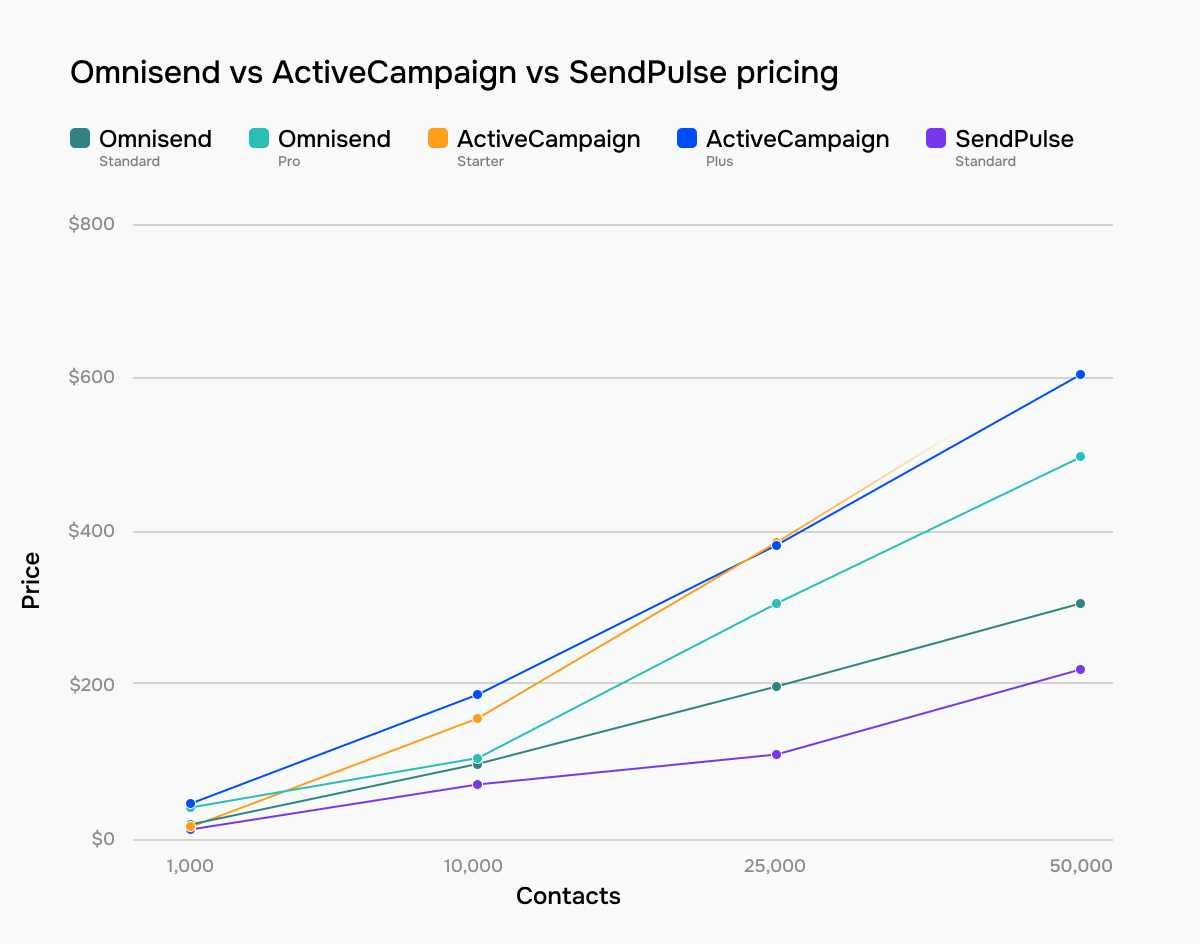 Omnisend, ActiveCampaign, and SendPulse prices comparison across tiers and contact list sizes
The lack of a free plan and overall higher prices make ActiveCampaign lose in this category. But are those prices justified? Does ActiveCampaign offer enough additional value to warrant the higher cost, or is it simply more expensive? Let’s find out as we compare Omnisend vs ActiveCampaign feature by feature.
Ease of use and interface
⭐ Omnisend: 8.5/10 | ActiveCampaign: 8.3/10
After testing dozens of email marketing platforms, we can say that ActiveCampaign is quite different from most of its competitors. Because of its more extensive feature set, it can feel more complex and overwhelming – both for marketers switching from another platform and for those using an email marketing platform for the first time. Here’s what you can expect when getting started with Omnisend and ActiveCampaign:
| Aspect |
Omnisend |
ActiveCampaign |
Winner |
| First-time experience |
Goals checklist guides users through store connection, sender verification, signup form creation, and the first campaign; store connection required before sending |
AI-powered guide walks users through brand setup, first campaign, and first automation with step-by-step prompts |
Tie |
| Daily navigation |
Simple left-side navigation focused on campaigns, automations, audience, forms, and reports; eCommerce-first interface with low feature density |
Two-level navigation with dedicated sections for email, automation, CRM, SMS, forms, and reporting; AI assistance available from every page |
Omnisend |
| Learning curve |
Easy for eCommerce users, with workflows built around common store scenarios |
Steeper learning curve due to CRM, sales, and automation features |
Omnisend |
| Mobile access |
Browser access only; no dedicated mobile app |
iOS and Android apps for contact management, campaign monitoring, CRM tasks, and resending campaigns to non-openers or new contacts; new campaigns can’t be created from mobile |
ActiveCampaign |
| Workflow efficiency once mastered |
Automates repetitive marketing tasks with reusable branding, automatic resends, pre-built eCommerce workflows, and a unified builder for email, SMS, and push notifications. |
Speeds up daily work with AI-assisted campaign creation, reusable workflows, community templates, and bulk contact management |
Tie |
| Total score |
8.5/10 |
8.3/10 |
Omnisend |
But does that feeling last for long? Not really. Here’s what you can expect in terms of how quickly you’ll feel comfortable using both platforms:
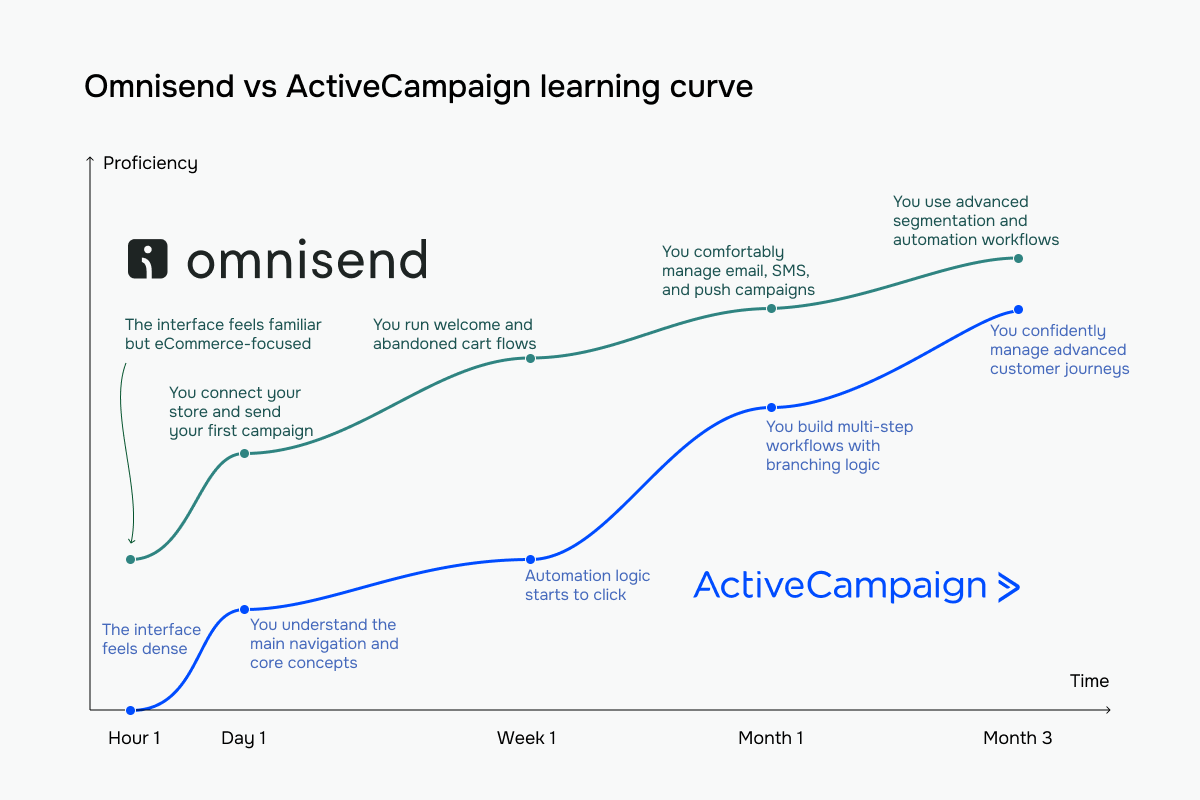 Omnisend vs ActiveCampaign learning curve based on our testing experience
Email builder and templates
Omnisend: 8.8/10 | ⭐ ActiveCampaign: 9.3/10
Both Omnisend and ActiveCampaign deliver a quite good email-building experience. Omnisend focuses on helping eCommerce businesses create product-driven campaigns, while ActiveCampaign prioritizes flexibility, personalization, and design control. Most online stores will likely build campaigns faster in Omnisend, thanks to its eCommerce-specific blocks and streamlined editor.
ActiveCampaign, on the other hand, offers more room for customization and optimization, making it a stronger choice for teams that want maximum control over every aspect of their emails. That’s enough to give it a narrow win, but neither platform is likely to disappoint.
| Aspect |
Omnisend |
ActiveCampaign |
Winner |
| Templates |
370+ templates |
125+ templates |
Omnisend |
| Drag-and-drop editor |
Visual, block-based editor with a live WYSIWYG canvas, reusable global branding, HTML support, and a simple editing workflow |
Hierarchical editor with structures, containers, and blocks with global design controls, HTML/CSS editing, and wider layout customization |
ActiveCampaign |
| Notable content blocks |
Product listings, AI product recommendations, and discount codes |
Countdown timer, full-width banners, and video |
Omnisend |
| Mobile responsiveness |
Mobile-first templates with device-specific visibility controls and desktop/mobile previews |
Responsive emails by default with configurable stacking order, mobile spacing, and per-element visibility controls |
ActiveCampaign |
| Sending time optimization |
Sends campaigns in each subscriber’s local time zone |
Predicts the best send time for each contact, suggests optimal send times based on account data, and provides industry benchmarks |
ActiveCampaign |
| Total score |
8.8/10 |
9.3/10 |
ActiveCampaign |
So, how does it feel to use these email builders in practice? What we noticed while testing them is that Omnisend’s email builder is built around consistency and speed. Every campaign uses the same interface, the same element library, and the same editing workflow, so once you’ve built one email, you’ve effectively learned the entire builder.
That consistency removes friction and makes campaign creation predictable, while eCommerce-focused blocks like product listing, product recommender, and discount let online stores assemble promotional emails without relying on custom layouts or external integrations.
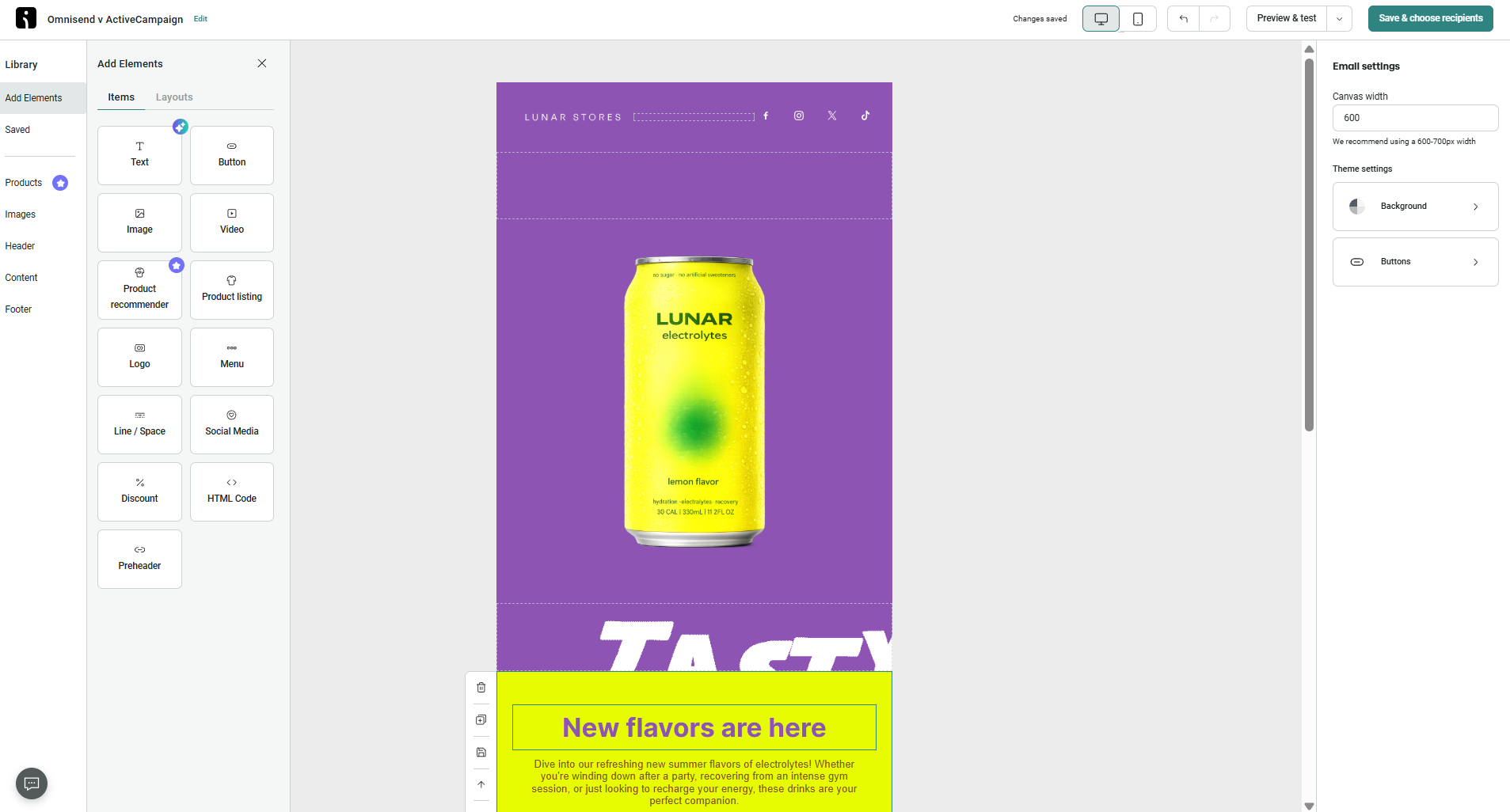 Testing the Omnisend email builder
ActiveCampaign’s builder is less like a marketing tool and more like a professional document editor. Instead of hiding formatting options in side panels, it uses a familiar word processor toolbar with always-visible personalization tags, making dynamic content easy to insert while you write.
The builder also introduces concepts rarely seen in email marketing platforms – containers, reusable modules, breadcrumb navigation, contact-level previews, and an inline AI assistant that generates copy directly inside each text block based on its purpose. Combined with per-block mobile controls and dedicated global design settings, it gives users much finer control over both personalization and layout than a typical drag-and-drop editor.
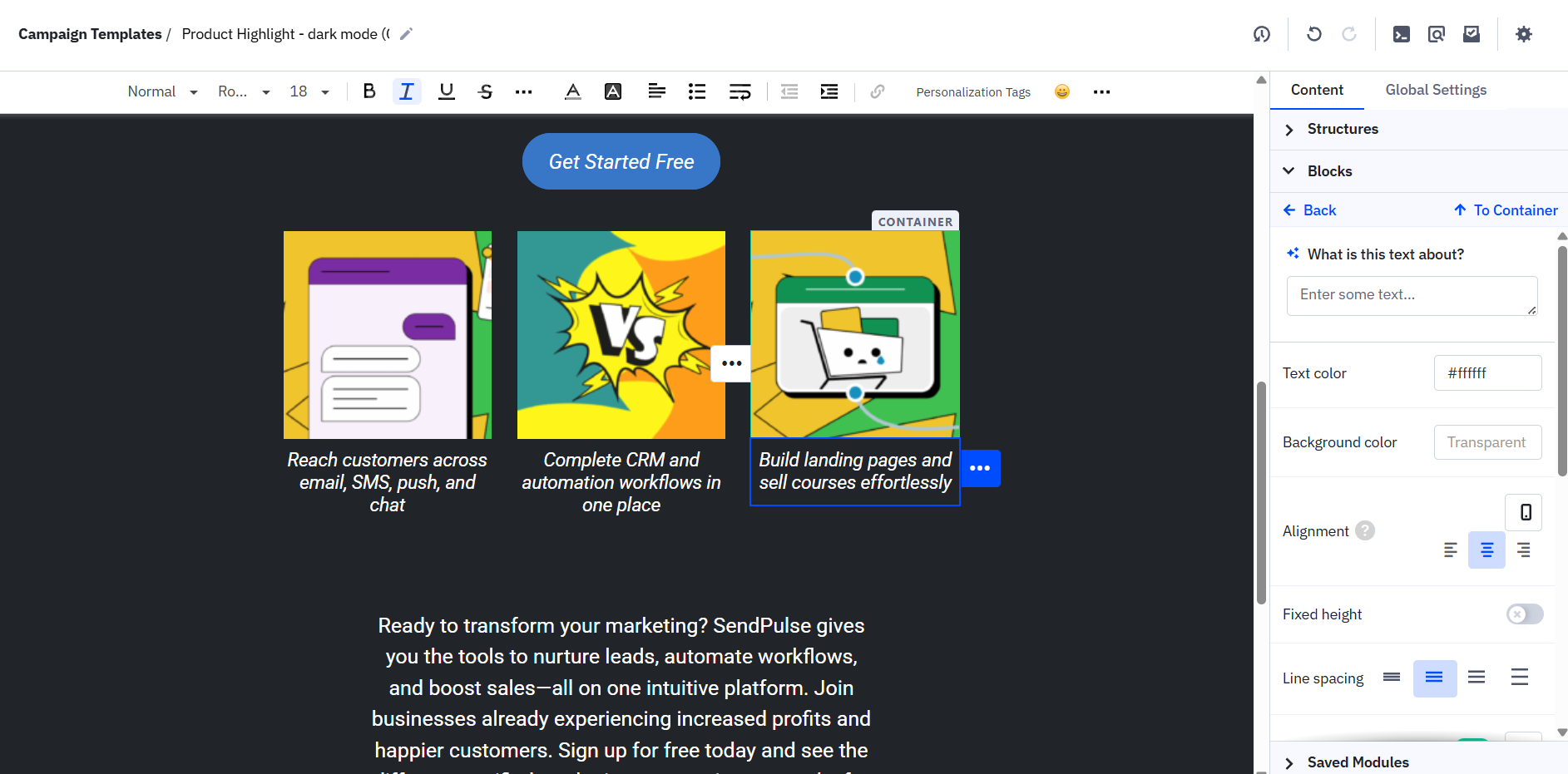 Hands-on look at the ActiveCampaign email builder
Overall, these builders reflect the philosophy of their platforms. If your priority is launching attractive product emails quickly, Omnisend is the more efficient tool. If your business relies on CRM data, personalized messaging, reusable content systems, and precise control over every element of an email, ActiveCampaign offers one of the most sophisticated builders on the market.
SMS capabilities
Omnisend: 8.2/10 | ⭐ ActiveCampaign: 9.2/10
For businesses that rely on SMS, choosing the right platform matters. Here’s how Omnisend and ActiveCampaign compare:
| Aspect |
Omnisend |
ActiveCampaign |
Winner |
| Plans that include SMS |
Available on the Pro plan only |
Available as a paid add-on starting from the Plus plan |
ActiveCampaign |
| Supported countries |
SMS campaigns and automations across the US, UK, EU, Canada, Australia, India, and most other countries |
Automated SMS in 150+ countries; broadcast (bulk) SMS limited to Australia, the UK, and the US |
Omnisend |
| Pricing model |
Volume- and country-based pricing starting at $0.007/SMS, with discounts for higher volumes |
Credit-based pricing that varies by destination country |
Omnisend |
| Compliance tools |
Supports TCPA and GDPR compliance, separate SMS consent, AI-powered opt-out detection, and quiet hours |
Supports TCPA compliance, quiet hours, mandatory sender registration, and manual compliance review for first-time senders |
Tie |
| SMS automation and keywords |
SMS can be added to automation workflows; supports SMS opt-in collection and automatic regional opt-out handling |
SMS actions available in automation workflows; supports SMS opt-in keywords and broadcast campaigns in supported countries |
Tie |
| Two-way messaging SMS |
No native two-way messaging; replies require a third-party integration |
Native two-way SMS inbox with conversation history, AI summaries, AI reply drafts, and agent replies |
ActiveCampaign |
| Total score |
8.2/10 |
9.2/10 |
ActiveCampaign |
Overall, Omnisend treats SMS as another eCommerce communication channel that complements email campaigns and automations. ActiveCampaign goes further, treating SMS as a conversation channel rather than just a broadcasting tool. Native two-way messaging, AI-assisted replies, and wider plan availability make it a stronger choice for businesses that actively communicate with customers through texting.
Marketing automation
Omnisend: 9.2/10 | ⭐ ActiveCampaign: 10/10
This is one of the few categories where there is a clear winner. Omnisend gives eCommerce businesses everything they need to build sophisticated marketing automations without unnecessary complexity. However, ActiveCampaign is on another level, as it turns automation into the core of the platform.
If your workflows involve CRM actions, lead scoring, sales pipelines, and customer lifecycle management alongside email marketing, ActiveCampaign offers capabilities that Omnisend just wasn’t designed to provide.
| Aspect |
Omnisend |
ActiveCampaign |
Winner |
| Availability by plan |
Multi-step automation workflows with all triggers and channels available on paid plans |
Starter plan limited to 5 actions per automation; advanced triggers and channels unlocked on higher plans or paid add-ons |
Omnisend |
| Automation builder |
Visual single-canvas builder with drag-and-drop steps, A/B testing, workflow debugging, and inline warnings before risky edits |
Freeform canvas with insert-anywhere steps, searchable actions, live validation, and revision/rollback history |
ActiveCampaign |
| Triggers available |
Subscription, eCommerce, date-based, segment, page view, and custom API events |
Extensive trigger library covering email, website, CRM, scoring, SMS, tasks, accounts, and third-party apps |
ActiveCampaign |
| Pre-built automations |
40 eCommerce workflows |
900+ pre-built automations |
ActiveCampaign |
| Channels supported |
Email, SMS, and web push notifications from the same workflow, with automatic channel selection based on subscription status |
Email, SMS, WhatsApp, site messages, and one-to-one CRM emails |
Tie |
| Automation complexity |
Conditional splits, audience filters, exit conditions, and up to 5 trigger filters; 1 entry trigger per workflow |
Loops, goals, multiple entry triggers, cross-workflow actions, conditional waits, and lead/deal scoring |
ActiveCampaign |
| Total score |
9.2/10 |
10/10 |
ActiveCampaign |
What are they like in practice? Omnisend’s automation builder is designed around delivering the right message at exactly the right moment. The builder shows a strong understanding of eCommerce operations. Frequency controls prevent customers from entering the same automation repeatedly, configurable exit conditions stop workflows after a purchase, and helpful inline warnings explain when editing a trigger will reset split logic or when a delay may be too short for reliable tracking.
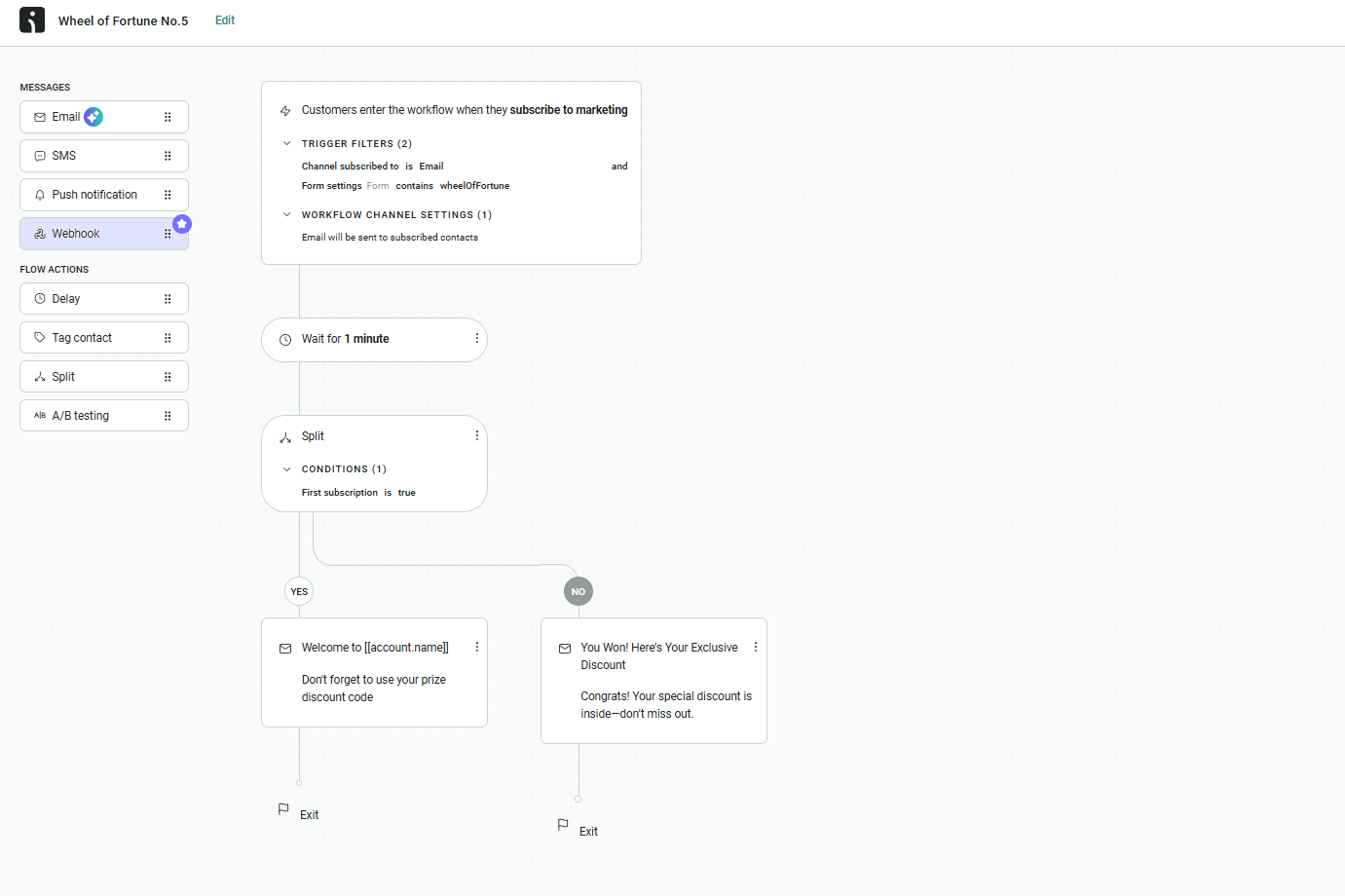 Wheel of Fortune reward automation in the Omnisend builder
In ActiveCampaign, the builder is much closer to a workflow design tool than a traditional email automation editor. The freeform canvas supports inserting new steps anywhere in the workflow, multiple entry triggers, manual contact enrollment, and live validation that flags incomplete conditions before the automation can be activated. Together, these features make it clear that ActiveCampaign’s automations are built to manage customer data and business logic and not just send marketing messages.
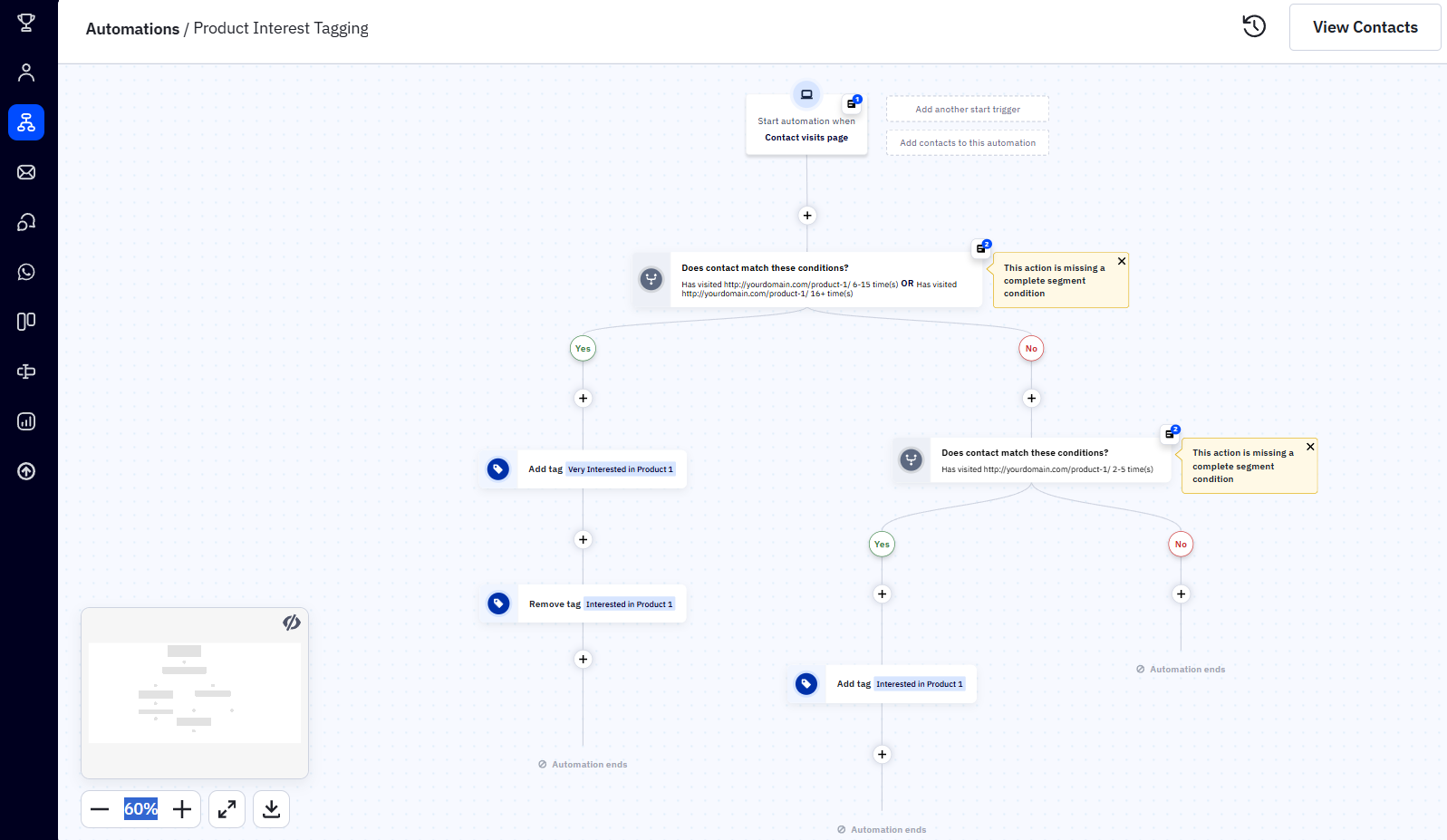 Product interest tagging automation in the ActiveCampaign builder
So, if your automations exist primarily to drive eCommerce sales through timely emails, SMS, and customer journeys, Omnisend is the more practical choice. If your business revolves around customer lifecycle management, lead scoring, CRM enrichment, and sophisticated behavioral logic, ActiveCampaign offers one of the most capable automation builders on the market.
Contact management
Omnisend: 9.2/10 | ⭐ ActiveCampaign: 9.5/10
Marketing automation, segmentation, and tagging are closely connected, so it’s no surprise that both Omnisend and ActiveCampaign offer powerful contact management capabilities.
| Aspect |
Omnisend |
ActiveCampaign |
Winner |
| Segmentation capabilities |
Dynamic, real-time segments with unlimited filters, AND/OR logic, and pre-built templates |
Dynamic, real-time segments with nested AND/OR logic, nearly unlimited conditions, and reusable segment library |
Tie |
| Segmentation criteria |
Contact details, subscription status, tags, campaign engagement, eCommerce behavior, website activity, lifecycle stage, and custom events |
Contact details, tags, lists, unlimited custom fields, campaign engagement, website activity, CRM data, lead scores, automations, referral source, devices, and custom events |
ActiveCampaign |
| Segment update speed |
Real-time updates as customer data changes |
Real-time updates as customer data changes |
Tie |
| Tagging and manual organization |
Manual and automated tags, source tracking, bulk tag management, and tag-based segmentation |
Manual and automated tags combined with lists, unlimited custom fields, lead scoring, and CRM-based organization |
ActiveCampaign |
| Total score |
9.2/10 |
9.5/10 |
ActiveCampaign |
This is a close comparison: Omnisend excels at helping marketers reach the right audience with minimal effort, while ActiveCampaign builds an entire customer management system around contact data. Its deeper CRM integration, lead scoring, and broader set of segmentation criteria make it a stronger platform for businesses that manage long customer lifecycles.
Signup forms and landing pages
⭐ Omnisend: 8.6/10 | ActiveCampaign: 7.2/10
Omnisend and ActiveCampaign form builders reflect the platforms’ different priorities. For Omnisend, forms are a conversion tool that give marketers ways to test, target, and optimize visitor subscriptions. ActiveCampaign treats forms as the starting point of a CRM workflow, focusing more on collecting customer data and passing it into automations than on maximizing signup rates.
If your website is an important source of new subscribers or customers, Omnisend offers a much more robust toolkit. If your forms mainly exist to capture leads that sales or marketing teams will nurture later, ActiveCampaign’s tighter CRM integration may be more valuable.
| Aspect |
Omnisend |
ActiveCampaign |
Winner |
| Types of forms available |
Pop-ups, flyouts, embedded forms, Wheel of Fortune forms, teasers, and multi-step forms |
Embedded forms, pop-ups, floating boxes, floating bars, and offline iPad forms; no gamified or multi-step forms |
Omnisend |
| Form builder |
Drag-and-drop builder with custom fields, GDPR consent, reCAPTCHA, double opt-in, automatic brand styling, and A/B testing for pop-ups and flyouts |
Drag-and-drop builder with custom CSS, HTML editing, custom fields, automatic SMS consent, and removable branding; no A/B testing |
Omnisend |
| Pop-up targeting conditions |
Time on page, scroll depth, exit intent, page visits, URL, country, UTM parameters, audience, device, schedule, and display frequency |
Time delay, scroll depth, exit intent, device targeting, and display frequency controls |
Omnisend |
| Landing page builder |
Hosted landing pages with forms, images, videos, CTA buttons, custom domains, redirects, and scheduling |
Dedicated drag-and-drop landing page builder with reusable templates, site tracking, custom URLs, and forms that can trigger CRM actions |
ActiveCampaign |
| Total score |
8.6/10 |
7.2/10 |
Omnisend |
So, how do they compare in practice? To answer this, we created signup forms with Omnisend and ActiveCampaign. Omnisend’s form builder maximizes conversions. It supports multi-step pop-ups, teasers, gamified forms, countdown timers, audience targeting, frequency capping, auto-tagging, redirects, and one-click A/B testing – all from the same consistent interface used throughout the platform.
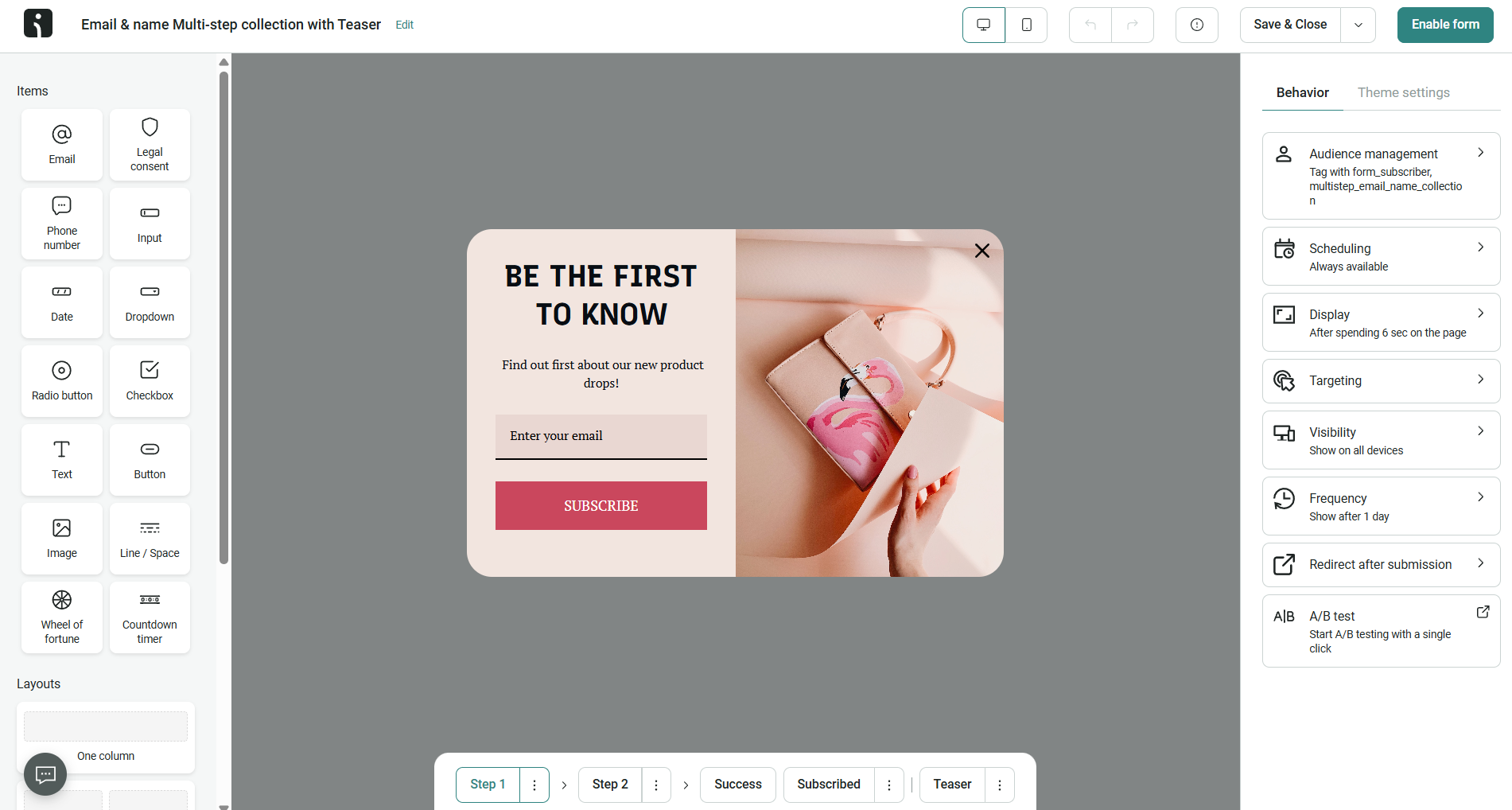 Customizing a signup form in the Omnisend form builder
For ActiveCampaign, forms are the entry point to a CRM system rather than a marketing campaign. Instead of focusing on pop-ups and behavioral targeting, it prioritizes developer control and automation. You can trigger an automation from the form builder itself and style typography globally by element type rather than individual blocks. The interface is closer to configuring a data collection form than designing a conversion-focused pop-up.
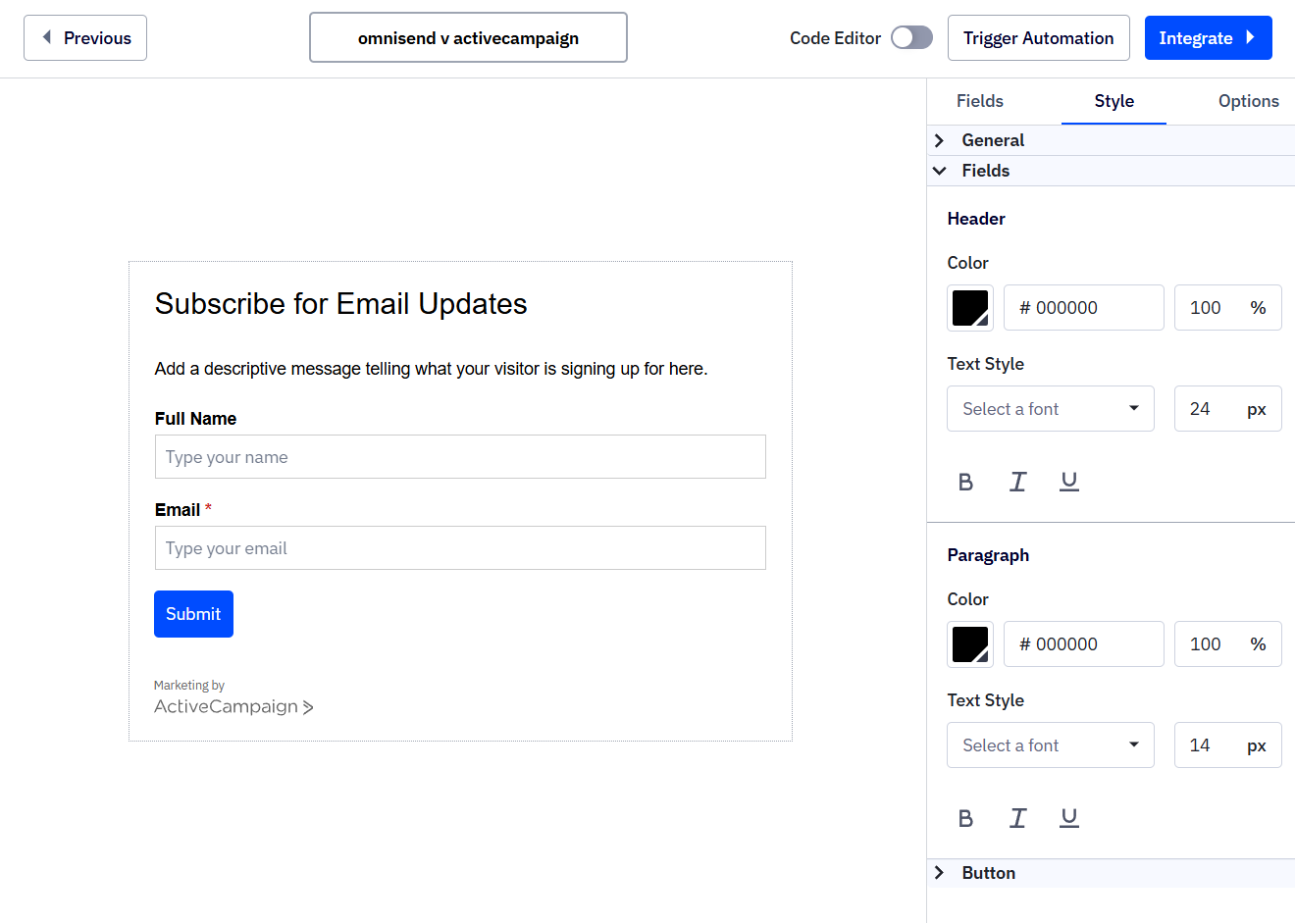 Creating a subscription form in the ActiveCampaign form builder
Overall, these builders solve different problems. Omnisend converts anonymous website visitors into subscribers through targeted, interactive forms, while ActiveCampaign captures leads and moves them into a CRM workflow.
If your priority is growing a mailing list, improving signup rates, and segmenting visitors based on how they subscribe, choose Omnisend. If your forms exist to feed contacts into a sales or CRM pipeline and your team values direct automation triggers and code-level customization, ActiveCampaign is a better option.
Integrations
Omnisend: 8.2/10 | ⭐ ActiveCampaign: 9/10
This category is ambiguous. The thing is, Omnisend focuses on integrating deeply with the tools eCommerce businesses use, while ActiveCampaign focuses on connecting with almost everything. So, ActiveCampaign scores higher overall because it fits into a much broader business ecosystem.
But there is a big exception – Shopify. Here, Omnisend has the stronger integration. It’s available on every plan, captures eCommerce events earlier in the customer journey, and includes features built specifically for online stores, like AI product recommendations and customer lifetime value analytics. So, if Shopify is the center of your business, Omnisend delivers a more complete eCommerce experience.
| Aspect |
Omnisend |
ActiveCampaign |
Winner |
| Integration catalog |
240+ integrations |
1,000+ integrations |
ActiveCampaign |
| eCommerce platforms |
Native integrations with Shopify, WooCommerce, and BigCommerce; real-time sync for customers, products, orders, and carts |
Deep eCommerce integrations with Shopify, WooCommerce, and Magento; BigCommerce and other platforms supported through API or Zapier |
Omnisend |
| CRM systems |
No built-in CRM or native integrations |
Built-in CRM system with sales pipelines and lead management; integrates with external CRM tools |
ActiveCampaign |
| API capabilities |
REST API for contacts, campaigns, and eCommerce events; JavaScript API for real-time on-site and custom events; outbound webhooks triggered from automation workflows |
REST API spanning contacts, CRM objects, automations, campaigns, tags, and custom objects, with account-level and automation-level webhooks |
ActiveCampaign |
| Zapier support |
2 triggers (new and updated contacts) and 17 actions, including campaign management, subscriber creation, template management, and segment deletion |
22 triggers (new and updated custom objects, deals, contacts, and more) and 31 actions, including contact, deal, and campaign management |
ActiveCampaign |
| Total score |
8.2/10 |
9/10 |
ActiveCampaign |
CRM is another part that makes this category as ambiguous as we mentioned. A native CRM system keeps your contacts, automations, emails, and sales data in one place, and ActiveCampaign has it, while Omnisend doesn’t.
That said, if a built-in CRM is important to you, ActiveCampaign isn’t your only option. SendPulse also includes a native CRM system.
ActiveCampaign offers advanced sales forecasting, lead and deal scoring, AI-assisted pipeline management, and sophisticated reporting that larger B2B sales teams will appreciate. SendPulse focuses on accessibility and omnichannel communication. Its CRM tool is available with a free plan; it automatically creates deals from forms, payments, websites, and chatbots and lets you communicate with contacts across email, WhatsApp, Instagram, Facebook Messenger, TikTok, and live chat from a single contact profile.
While it doesn’t match ActiveCampaign’s predictive sales intelligence, it offers far more than most small and medium-sized businesses need.
AI features
Omnisend: 7.2/10 | ⭐ ActiveCampaign: 8.9/10
In this category, we gathered all the AI features offered by both platforms to show how they compare in automating and optimizing your day-to-day work.
| Aspect |
Omnisend |
ActiveCampaign |
Winner |
| Email generation |
AI generates 3 subject lines, preheaders, and email copy for any text block; automatically imports brand colors, fonts, and logos |
AI creates complete email campaigns from a prompt, generates 3 text versions per block, builds follow-up campaigns, and imports brand assets |
ActiveCampaign |
| Automation generation |
Not available |
AI builds automations from natural-language prompts, suggests next workflow steps, and performs AI-powered actions such as summarization, translation, sentiment analysis, and data extraction |
ActiveCampaign |
| Predictive customer analytics |
Customer lifecycle analysis, churn prediction, customer lifetime value, and RFM segmentation for eCommerce stores |
Contact and deal scoring, predictive content selection, proactive AI insights, and natural-language analytics |
Tie |
| Smart segmentation suggestions |
AI builds segments from natural-language prompts and refines them |
AI automatically suggests 3 ready-to-use segments, tracks segment growth, and answers questions about segment performance |
ActiveCampaign |
| Total score |
7.2/10 |
8.9/10 |
ActiveCampaign |
AI is yet another category where ActiveCampaign has a clear advantage. Omnisend focuses on solving common eCommerce marketing tasks with AI, while ActiveCampaign weaves AI into almost every part of the platform, from campaign creation and automation to analytics and workflow recommendations.
For most eCommerce businesses, Omnisend’s AI is practical and sufficient. For teams looking to automate more of their day-to-day work and decision-making, ActiveCampaign offers a more mature AI ecosystem.
Deliverability
⭐ Omnisend: 10/10 | ⭐ ActiveCampaign: 10/10
Both platforms offer excellent deliverability features, so choosing between them shouldn’t come down to inbox placement. Omnisend emphasizes proactive monitoring with built-in reporting and automated safeguards, while ActiveCampaign provides greater flexibility and detailed guidance for managing sender reputation.
| Aspect |
Omnisend |
ActiveCampaign |
Winner |
| Authentication |
Supports SPF, DKIM, and DMARC with guided setup, automatic DNS record generation, and in-app setup alerts |
Supports SPF, DKIM, DMARC, and BIMI with automatic or manual DNS setup |
ActiveCampaign |
| Deliverability monitoring |
Built-in deliverability dashboard with bounce, spam complaint, unsubscribe, and provider-level reports; automatic list-quality warnings and sending suspension if bounce rate exceeds 7% |
Spam check tool and engagement tracking; no dedicated deliverability dashboard or provider-level reporting |
Omnisend |
| List hygiene |
Automatically suppresses hard bounces and unsubscribed contacts; built-in list cleaning tool, hygiene warnings, and account protection based on bounce rates |
Automatically suppresses hard bounces and provides engagement-based segmentation for inactive contacts |
Omnisend |
| Dedicated IP |
Available to senders exceeding 300,000 emails/week, with a 15–30-day warm-up process and eligibility requirements |
Available for users with over 100,000 active contacts; pre-warmed IPs and deliverability guidance |
ActiveCampaign |
| Total score |
10/10 |
10/10 |
Tie |
Even so, no platform can compensate for poor list quality or irrelevant campaigns; your own email practices matter more than the software itself. Here are some of the best practices recommended by SendPulse’s deliverability experts:
- Authenticate your sending domain.
- Separate transactional and marketing emails.
- Keep your sending volume consistent.
- Split large campaigns into smaller batches.
- Segment your audience by relevance.
- Monitor engagement, not just list size.
- Run re-engagement campaigns before removing contacts.
- Maintain good list hygiene by removing hard bounces, validating new email addresses, and never buying or scraping mailing lists.
- Optimize your email design by balancing text and images and avoiding oversized graphics.
- Respect unsubscribes promptly; it’s also required under email marketing laws like CAN-SPAM and GDPR.
Reporting and analytics
Omnisend: 8.2/10 | ⭐ ActiveCampaign: 8.4/10
Reporting and analytics are essential for understanding how well your automations and campaigns perform. Here’s how Omnisend and ActiveCampaign compare in this area:
| Aspect |
Omnisend |
ActiveCampaign |
Winner |
| Report coverage |
Campaign, automation, sales, products, signup forms, deliverability, click map, UTM, and customer lifecycle |
Campaign, automation, eCommerce, contacts, forms, tags, CRM, deals, tasks, sales forecasting, and SMS reports |
ActiveCampaign |
| Custom reports |
Fixed dashboards with custom date ranges and period comparisons |
Custom report builder with reusable dashboards, cross-data analysis, and pre-built reporting templates |
ActiveCampaign |
| Reporting speed |
Live store activity in real time, with campaign and automation reports updating continuously |
Campaign reports update continuously; automation and custom reports refresh every 24 hours |
Omnisend |
| Export capabilities |
CSV and PDF |
CSV, Excel, JSON, TXT, HTML, and Markdown |
ActiveCampaign |
| Total score |
8.2/10 |
8.4/10 |
ActiveCampaign |
This is a close category, and the winner depends largely on what you expect from reporting. Omnisend focuses on giving eCommerce marketers fast, actionable insights into campaign performance, revenue, products, and customer behavior, with real-time store activity adding another layer of visibility. ActiveCampaign takes a broader business intelligence approach, combining marketing, CRM, eCommerce, and sales data while allowing users to build custom reports tailored to their own KPIs.
If your reporting needs revolve around growing an online store, Omnisend is likely to provide everything you need. But if you want to analyze marketing alongside sales and customer management or build reports around your own business questions, then ActiveCampaign would be a better choice.
Customer support
⭐ Omnisend: 8.4/10 | ActiveCampaign: 7.2/10
Whenever you start using new software, you’re likely to run into questions or challenges. To help users overcome them, email marketing platforms typically provide a knowledge base, customer support, or both. Here’s what Omnisend and ActiveCampaign offer when you need assistance.
| Aspect |
Omnisend |
ActiveCampaign |
Winner |
| Channel availability |
24/7 live chat and email support on all plans |
Live chat and email for paid users |
Omnisend |
| Knowledge base |
Help center, glossary, Academy with video tutorials and webinars, release notes, migration guides, and AI-powered help for reporting |
Help center, video tutorials, release notes, migration guides, community forum, webinars, workshops, and AI assistant with contextual guidance |
ActiveCampaign |
| Onboarding assistance |
Guided setup checklist for all users; onboarding, migration assistance, and dedicated account managers on higher plans |
AI-guided setup, live onboarding webinar, in-person workshop, and migration assistance |
Tie |
| Support quality sub-rating on Capterra |
4.6/5 |
4.4/5 |
Omnisend |
| Total score |
8.4/10 |
7.2/10 |
Omnisend |
Both platforms invest in helping customers succeed, but Omnisend does it better, as evidenced by independent ratings from real users on Capterra.
ActiveCampaign focuses on self-service learning through extensive documentation, AI assistance, and structured training, while Omnisend prioritizes direct access to support, making it easier to get help when you actually need it. For most businesses, especially smaller teams without dedicated email marketing specialists, that immediate access is more valuable, which is why Omnisend earns the higher score.

Join businesses growing with SendPulse
From solo creators to global brands, thousands of customers trust SendPulse to run email campaigns, chatbots, automations, and more — all in one place.
Get started for free
Your decision checklist
By now, you’ve seen how Omnisend and ActiveCampaign compare across every major category, from pricing to advanced features. To help you make the final decision, we’ve put together a quick checklist. If one platform matches three or more of your answers, it’s probably the better choice for your business.
| Decision area |
Omnisend
is a better fit if… |
ActiveCampaign
is a better fit if… |
| Business type |
You run an eCommerce store and need purpose-built email, SMS, and push automation based on purchase behavior, cart activity, and product data. |
You run a B2B or hybrid business and need email automation alongside a built-in CRM, deal pipeline, lead scoring, and sales coordination, or an eCommerce business that needs deeper platform flexibility. |
| Budget expectations |
You want generous automation features, including unlimited workflows, with predictable contact-based pricing. |
You don’t mind paying more for advanced automation, AI, CRM capabilities, and optional add-ons. |
| Automation needs |
You need eCommerce-focused multi-channel automation for abandoned carts, browse abandonment, post-purchase campaigns, and cross-sells across email, SMS, and push. |
You need advanced automation with loops, cross-automation triggers, contact and deal scoring, AI-generated workflows, and AI-powered data transformation. |
| Analytics focus |
You need eCommerce reporting, including revenue attribution, product performance, customer lifetime value, RFM analysis, and live store activity. |
You need cross-dimensional custom reports combining campaign, automation, contact, deal, and eCommerce data, and CRM-level reporting alongside standard email metrics. |
| Team setup |
You work in a lean eCommerce marketing team that needs a focused, quick-to-learn platform. |
You work in a marketing or sales team and need a single platform for email automation, CRM, and deal management, with the flexibility to invest time in a more feature-rich platform. |
Keep in mind that choosing an email marketing platform is a long-term commitment. Switching from one platform to another can take time and money, so it’s better to make the right choice from day one. With that in mind, consider not only how your business operates today and what it needs now, but also what it may need tomorrow or in a year.
Final verdict and recommendations
⚖️ Final scores: Omnisend – 8.6/10 | ActiveCampaign – 8.9/10
Would we recommend Omnisend? Absolutely. It’s one of the strongest email marketing platforms for eСommerce businesses, combining an intuitive interface with powerful automation, SMS marketing, and high-converting signup forms.
Would we recommend ActiveCampaign? Even more so. It offers some of the most advanced automation capabilities on the market, a built-in CRM system, an extensive integration library, and AI tools that can even generate complete automation workflows from a simple prompt.
That said, the best platform is always the one that fits your business. If neither Omnisend nor ActiveCampaign feels like the right match, there are plenty of excellent alternatives worth considering:
- Choose SendPulse if you want advanced automation, a built-in CRM, omnichannel chatbots, landing pages, and pop-ups at a more affordable price than Omnisend or ActiveCampaign.
- Choose Kit if you’re a creator or blogger whose primary focus is newsletters and audience building.
- Choose Mailchimp if you’re looking for a mature platform with polished design tools, a bunch of integrations, and a long-established reputation.
Omnisend vs ActiveCampaign FAQs