Brevo and ActiveCampaign are two very popular names in the email marketing industry. Both are capable platforms that combine CRM with the email marketing features you’d expect from a modern vendor. But which one will fit your business better? Let’s find out in our detailed comparison.
How we scored this comparison: This review was created by the SendPulse team. As an email marketing platform ourselves, we work in the same space as the tools we test, which also means we understand the field deeply.
Each platform was evaluated across the key categories using our independent methodology. Pricing (25%), ease of use (20%), and email and automation features (15% each) carry the most weight because they affect daily workflows the most. All scores reflect hands-on testing and analysis as of September 2026.
TL;DR Brevo vs ActiveCampaign at a glance
Quick answer: Brevo is a better choice for most small businesses watching their budget. It has a free plan, charges by emails sent, includes transactional email, and costs less than ActiveCampaign at every list size we priced above 1,000 contacts. ActiveCampaign is a better fit if you need advanced, behavior-based automation and a more powerful CRM. It scores higher overall in our testing (8.9/10 vs 8.5/10).
Here’s a quick look at all the categories we tested and evaluated during this comparison.
| Category |
Brevo |
ActiveCampaign |
Winner |
| Best for |
Multi-channel marketing, large contact lists, and simpler CRM needs |
eCommerce, advanced automation, and CRM-driven marketing |
Depends on the use case |
| Pricing |
8.5/10
Pay by emails sent; better for large lists with lower send frequency |
8/10
Pay by contacts; similar price only for lists of around 1,000 contacts |
Brevo |
| Ease of use |
8.5/10
Faster to learn and easier to navigate |
8.5/10
Steeper learning curve, but more flexibility once mastered |
Tie |
| Email design |
8.4/10
Simple unified builder with solid personalization |
8.8/10
More templates, eCommerce blocks, and predictive content |
ActiveCampaign |
| Automation |
8.8/10
Easier multi-channel workflows, including SMS and WhatsApp |
10/10
Advanced branching, behavioral triggers, and 900+ recipes |
ActiveCampaign |
| Contact management |
9/10
Real-time segmentation with structured contact data |
9.5/10
Flexible tagging and deeper behavioral segmentation |
ActiveCampaign |
| CRM |
8.7/10
Practical CRM for straightforward sales processes |
9.2/10
Deeper pipelines, forecasting, and CRM automation |
ActiveCampaign |
| Forms and pages |
8.5/10
More form types and stronger built-in targeting |
7.2/10
Strong automation connection and website-context previews |
Brevo |
| Integrations |
8.8/10
Smaller ecosystem, but more functionality built in |
9/10
Much broader ecosystem for complex external tech stacks |
ActiveCampaign |
| AI features |
9/10
Strong generation and built-in predictive customer analytics |
9/10
More proactive AI across automation and segmentation |
Tie |
| Deliverability |
10/10
Real-time monitoring and more accessible dedicated IP |
9.8/10
Strong infrastructure, but less built-in visibility |
Brevo |
| Reporting |
9/10
Faster data and stronger custom analytics |
8.4/10
Broader ready-made reports and more export options |
Brevo |
| Customer support |
7.6/10
Fewer support options, but better customer feedback |
7.2/10
Better onboarding and more ways to reach support |
Brevo |
| G2/Capterra rating |
4.5/4.6 |
4.4/4.6 |
Brevo |
| Final score |
8.5/10 |
8.9/10 |
ActiveCampaign |
If that’s not enough, and you want to dig deeper into what these two platforms have in common and where they differ, read on for our detailed Brevo vs ActiveCampaign comparison and evaluation.

Create and send high-performing emails
Use an AI assistant, pre-made templates, advanced segmentation, and feature-rich automation to run campaigns without coding. Send up to 15,000 monthly emails at no cost.
Get started for free
Brevo vs ActiveCampaign pricing and feature differences
For this comparison, we spent several weeks testing both platforms hands-on. We built emails, created automation workflows and signup forms, and explored the interfaces to see how easy the platforms are to use in practice. We also went through their documentation and compared what they say about their capabilities with what there actually is. These were a fascinating few weeks, and below you’ll find the results of our work.
Pricing plans
⭐ Brevo: 8.5/10 | ActiveCampaign: 8/10
Disclaimer: Pricing changes frequently. All prices in this comparison were verified against Brevo’s official pricing and ActiveCampaign’s official pricing as of September 29, 2026. Always confirm current costs on the official pages.
Brevo’s pricing model differs from what we’ve seen with many other email marketing platforms. Instead of charging based on the number of contacts, it bills you for the number of emails you send each month. To compare it with ActiveCampaign’s contact-based pricing, we matched each contact tier with an email volume of ten emails per contact per month. We chose this ratio because it’s the maximum ActiveCampaign allows on its Starter and Plus plans, so each row shows what both platforms cost at the same sending volume.
We’ve also included each platform’s next plan up, since some of the most advanced and interesting features on both platforms are only available in those plans. Finally, we added SendPulse for extra context – to show how much a versatile email marketing platform can offer while still keeping its pricing affordable.
| Contacts (ActiveCampaign, SendPulse) / emails per month (Brevo) |
Brevo, Starter |
Brevo, Standard |
ActiveCampaign, Starter |
ActiveCampaign, Plus |
SendPulse, Standard (unlimited emails) |
| Free plan |
300 emails/day |
14-day free trial |
500 contacts; 15,000 emails/mo |
1,000 contacts
or 10,000 emails |
$15.25 |
$31.50 |
$15 |
$49 |
$14.40 |
10,000 contacts
or 100,000 emails |
$73.75 |
$125.08 |
$149 |
$189 |
$62.40 |
25,000 contacts
or 250,000 emails |
N/A |
$224.08 |
$391 |
$389 |
$127.20 |
50,000 contacts
or 500,000 emails |
N/A |
$386.08 |
N/A |
$609 |
$224.80 |
| Note: All prices reflect annual billing. |
Keep in mind that ten emails per contact is a fairly heavy schedule, roughly two to three campaigns a week. If you send less often, your ActiveCampaign price won’t change, but your Brevo bill will go down. For example, sending four newsletters a month to a 10,000-contact list adds up to 40,000 emails. With Brevo’s Starter plan, that costs $41.42/month (billed annually). ActiveCampaign’s Starter plan costs $149/month (billed annually) for the same 10,000 contacts, more than 3.5 times as much.
For very small lists of around 1,000 contacts, the two platforms cost about the same. Beyond that, Brevo is cheaper at every volume in our table, even when ActiveCampaign users send the maximum their plan allows. If you’re a B2B company with a large contact database that you email rarely or only in selected segments, the gap grows even wider. So if you choose ActiveCampaign, it should be for its automation and CRM depth, not its price.
Transactional email makes the pricing difference between Brevo and ActiveCampaign even more interesting.
Brevo includes transactional sending in every plan, and marketing and transactional messages share one email allowance within the same account. ActiveCampaign handles transactional email through Postmark, a separate service with its own pricing, account, and approval process. Postmark’s free developer plan includes only 100 emails/month, while paid sending starts at $15/month for 10,000 emails.
This makes Brevo considerably more practical for low-volume senders already using it for marketing. Postmark’s approach has its own advantages, though. It keeps transactional messages separate from marketing email and applies stricter approval and compliance checks, which helps protect the delivery of critical messages like password resets and receipts. At very high volumes, its per-email price can also become competitive.
Ease of use and interface
⭐ Brevo: 8.5/10 | ⭐ ActiveCampaign: 8.5/10
The tie is fair, but only because the two platforms are beneficial in different ways. Brevo asks less of you at the beginning, so it’s a better choice if you want to get productive without spending much time learning the platform. ActiveCampaign requires more patience, but that extra effort pays off once you start using its more advanced tools. Choose Brevo for a shorter path to everyday productivity and ActiveCampaign if you’re willing to invest more time upfront for greater flexibility later.
| Aspect |
Brevo |
ActiveCampaign |
Winner |
| First-time experience |
Quick setup; approachable without technical experience |
Strong onboarding, but automations, tags, and lists take time to understand |
Brevo |
| Daily navigation |
Clean interface with core features easy to find |
Feature-rich interface; navigation and reporting can feel less intuitive |
Brevo |
| Learning curve |
Core tasks learned quickly; advanced automation takes longer |
Steeper learning curve |
Brevo |
| Mobile access |
Separate apps for conversations and calling, no unified app for marketers |
Unified iOS/Android app for CRM, reports, WhatsApp, and AI |
ActiveCampaign |
| Workflow efficiency once mastered |
Fast, repeatable workflows with reusable automation templates |
Powerful multi-branch and conditional workflows; greater flexibility once mastered |
ActiveCampaign |
| Total score |
8.5/10 |
8.5/10 |
Tie |
Here’s what your learning curve might look like in practice:
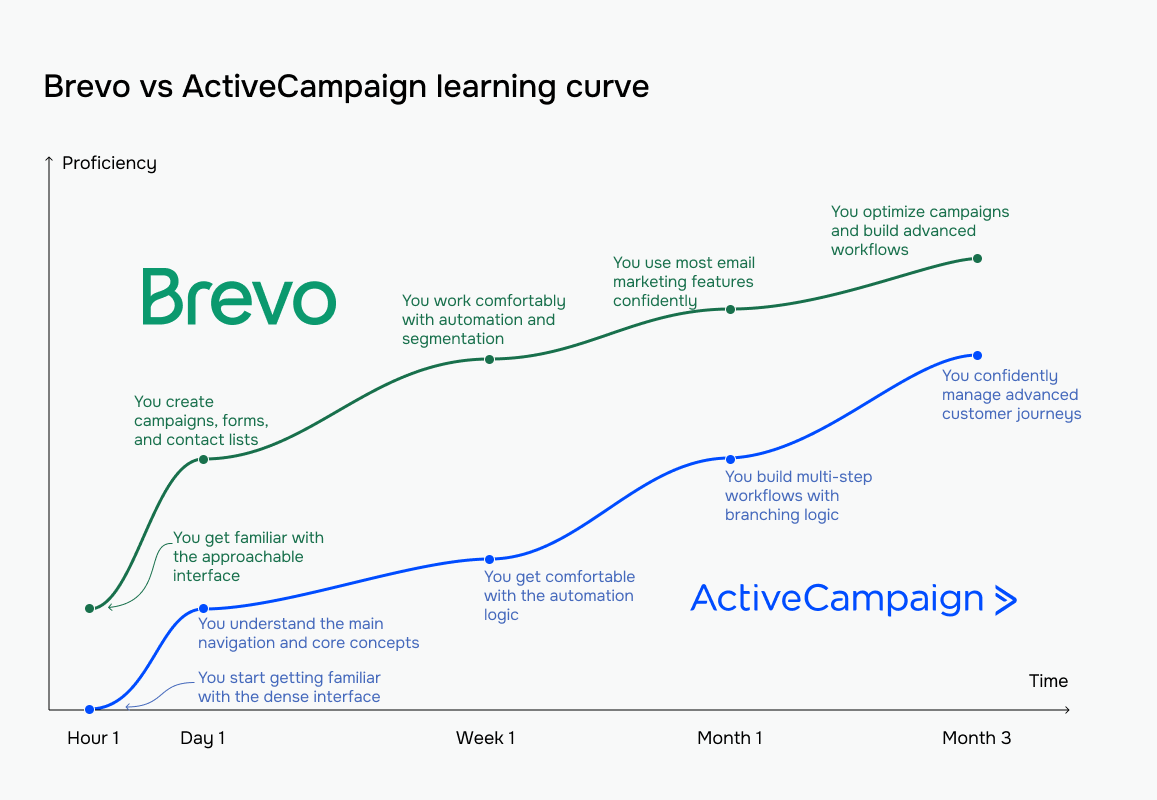 Brevo vs ActiveCampaign learning curve based on our testing experience
Email builder and templates
Brevo: 8.4/10 | ⭐ ActiveCampaign: 8.8/10
ActiveCampaign has the stronger email design toolkit overall. It gives you more room to move beyond a standard campaign, especially if personalization and optimization are important to you. Brevo also has personalization, but its main advantage is simplicity. Its single-editor approach is easier to understand and avoids the awkwardness of having different builders that don’t fully work together.
| Aspect |
Brevo |
ActiveCampaign |
Winner |
| Templates |
48 ready-to-use and 5 basic templates |
125+ templates |
ActiveCampaign |
| Drag-and-drop editor |
One editor with desktop/mobile preview, undo/redo, version history, and optional HTML/CSS mode |
4 creation options: new drag-and-drop, legacy drag-and-drop, HTML, and text-only; templates can’t move between editors |
Brevo |
| Notable content blocks |
Product block for Shopify, Shopware, and PrestaShop |
Product block for up to 4 Shopify products; countdown timer, menu, and predictive content with up to 5 variations |
ActiveCampaign |
| Mobile responsiveness |
Responsive by default; mobile preview with element-width adjustments |
Responsive by default; device-specific visibility and simultaneous desktop/mobile preview |
ActiveCampaign |
| Sending time optimization |
Per-contact best sending time based on engagement |
Predictive Sending based on individual behavior with weekly recalculation; separate account/industry-based sending time recommendations |
ActiveCampaign |
| Total score |
8.4/10 |
8.8/10 |
ActiveCampaign |
And here’s what you will see once you start using the platforms.
Brevo has a clean, content-focused builder. Dynamic content is a regular draggable block so that you can show different content to different segments. There’s also a Product block for pulling store items into emails. The library isn’t huge, but the templates themselves are nice – the Halloween template we tested felt properly designed, with full-width photography, strong typography, and a layout that went well beyond a basic promotional email.
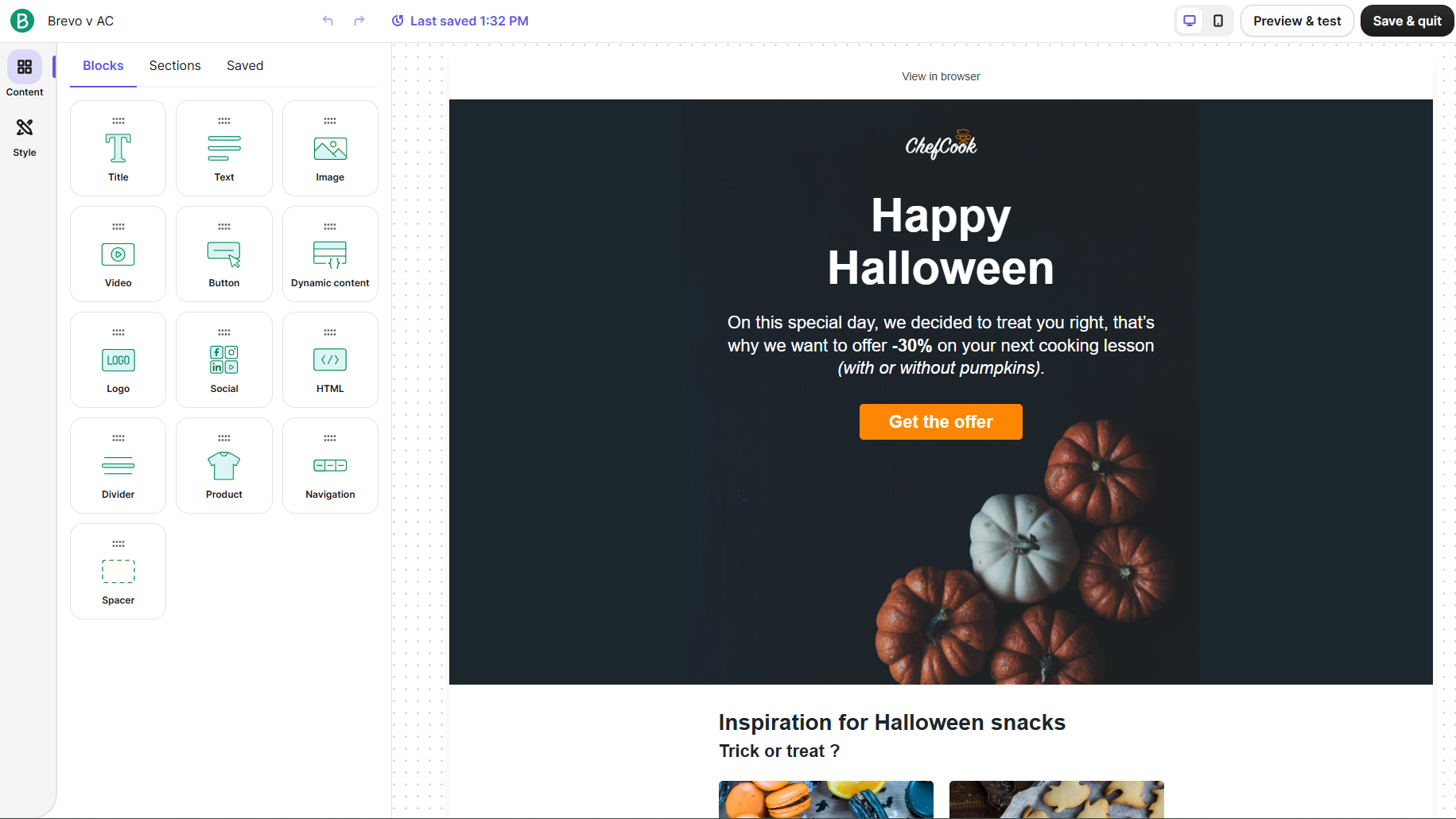 Editing a Halloween promo template in Brevo’s email builder
The standout in ActiveCampaign’s email builder is a built-in countdown timer, which is great for sales, launches, and events, while the RSS block can automatically pull new blog or news content into an email. There are also reusable modules, instantly accessible AI for writing individual blocks, and a contact-level preview that lets you check what a particular recipient will see. Overall, the builder feels especially well suited for eCommerce and emails driven by timing, frequently updated content, and personalization data.
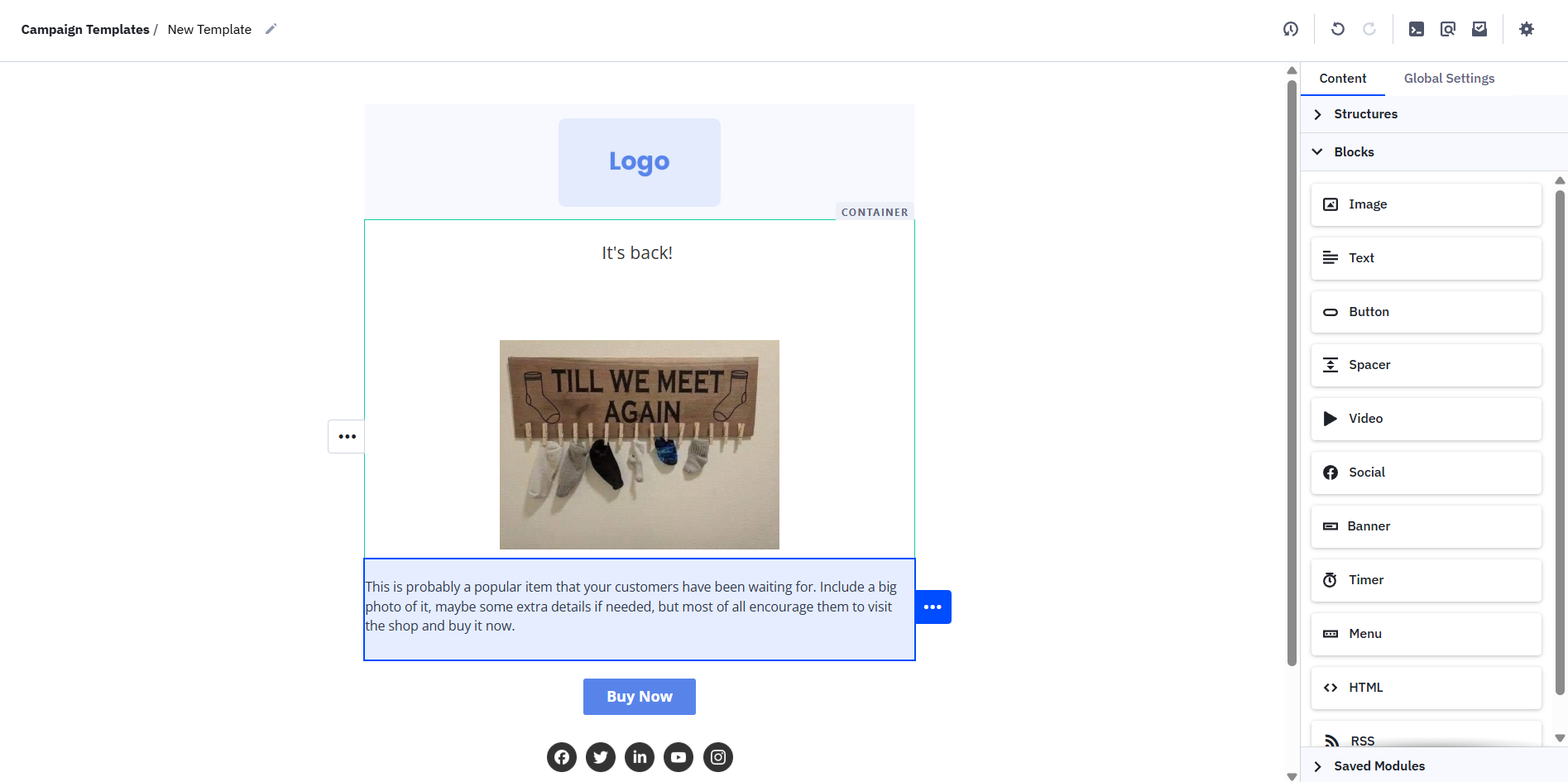 Customizing a product announcement template in ActiveCampaign’s email builder
ActiveCampaign’s email builder gets a higher score in our comparison, but that doesn’t make Brevo a bad choice. Both offer solid builders, good personalization, and attractive templates. However, ActiveCampaign is slightly more eCommerce-focused, with countdown timers for promotions, product catalog blocks that pull store products directly into emails, and abandoned cart blocks that automatically show shoppers the products they left behind. Its predictive content can also choose the message variant each contact is most likely to engage with.
Marketing automation
Brevo: 8.8/10 | ⭐ ActiveCampaign: 10/10
ActiveCampaign is the clear winner for automation and earns its 10/10 because there’s very little room to outgrow it. Its biggest advantage is that its workflows can respond to detailed customer behavior and business events, creating highly specific paths through the customer journey. This makes it suitable for advanced eCommerce, sales, and CRM automation.
Brevo is easier and more accessible, especially for smaller teams, yet still strong and efficient, so it easily earns its 8.8/10.
| Aspect |
Brevo |
ActiveCampaign |
Winner |
| Availability by plan |
Available on all plans, including Free; up to 2,000 contacts in automations on Free and Starter, unlimited on Standard and higher |
Starter supports 5 actions per workflow; advanced triggers and channels unlocked on higher plans or paid add-ons |
Brevo |
| Automation builder |
Visual builder with triggers, rules, and actions |
Visual builder with loops, goals, cross-workflow automation, conditional waits, multiple triggers, and revision history |
ActiveCampaign |
| Triggers available |
Contact, list, form, email, eCommerce, and website triggers; WhatsApp and push on Professional and higher |
Broader behavioral, eCommerce, payment, field-change, scoring, and third-party app triggers; some require higher tiers |
ActiveCampaign |
| Pre-built automations |
14 email templates and 4 SMS templates |
900+ pre-built workflows |
ActiveCampaign |
| Channels supported |
Email, SMS, WhatsApp, and push notifications |
Email, SMS, and WhatsApp |
Brevo |
| Automation complexity |
Simpler, consistent workflow structure |
Deeper branching and more complex workflow logic |
ActiveCampaign |
| Total score |
8.8/10 |
10/10 |
ActiveCampaign |
Now let’s see how these builders look in practice.
For Brevo, we tried the SMS automation builder, which looks exactly like its email automation builder. In the flow we tested, a contact joins a list, waits five minutes, and receives a personalized SMS, with the actual message and personalization token visible directly on the canvas. The builder is easy to scan – triggers, actions, and rules are separated into searchable, color-coded areas, and different node types have their own colors. That makes even multi-channel workflows easy to follow.
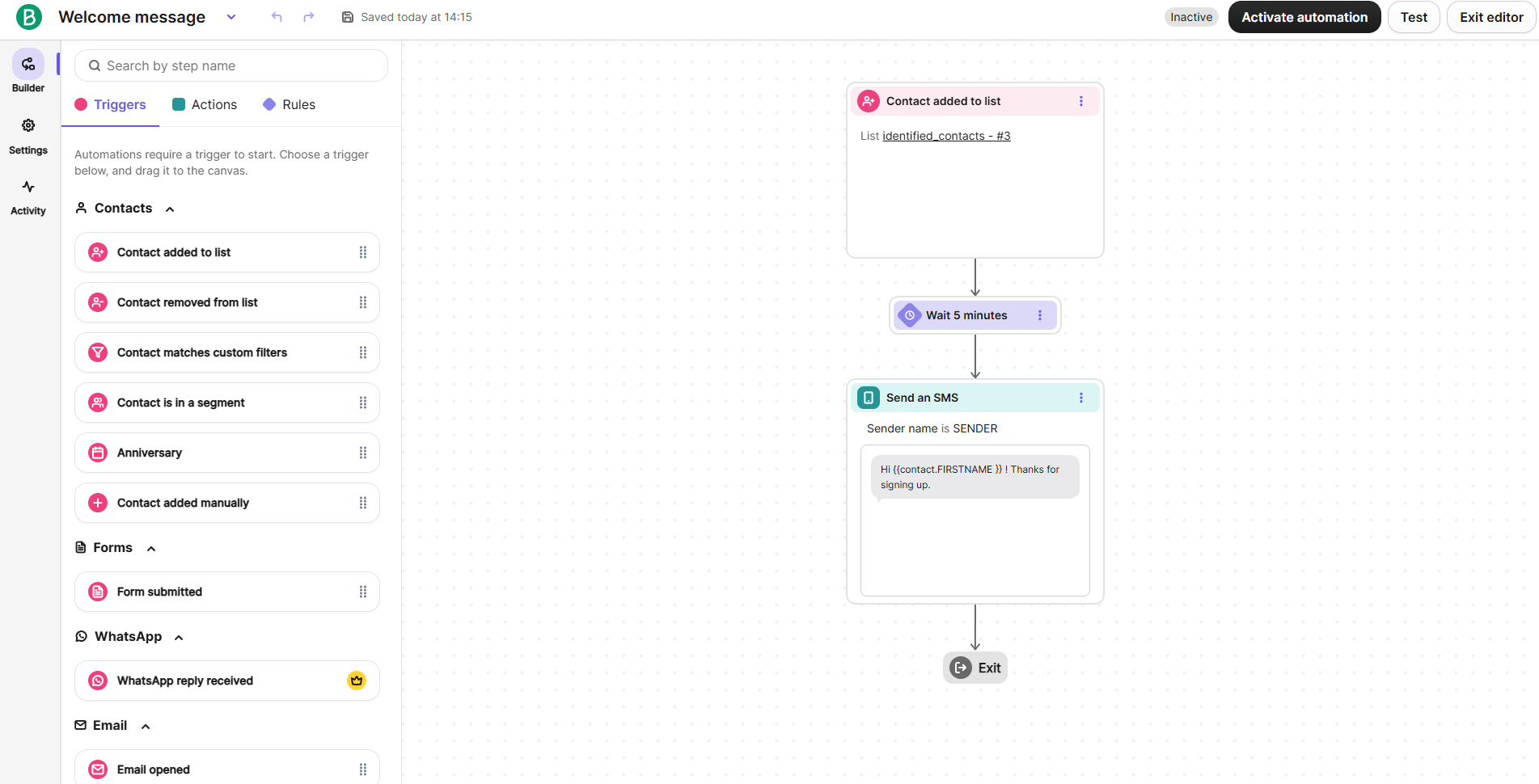 Setting up a welcome SMS flow in Brevo’s automation builder
ActiveCampaign shows its strength when customer behavior gets more specific. The eCommerce flow we tested starts after a purchase, waits a minute, then checks both the product category and product variant before deciding whether to send an upsell email. You can also add multiple entry triggers, while open and click rates appear directly on email nodes. The freeform canvas and minimap are useful once workflows start branching, since you can see a complicated customer journey without being stuck in one long vertical flow.
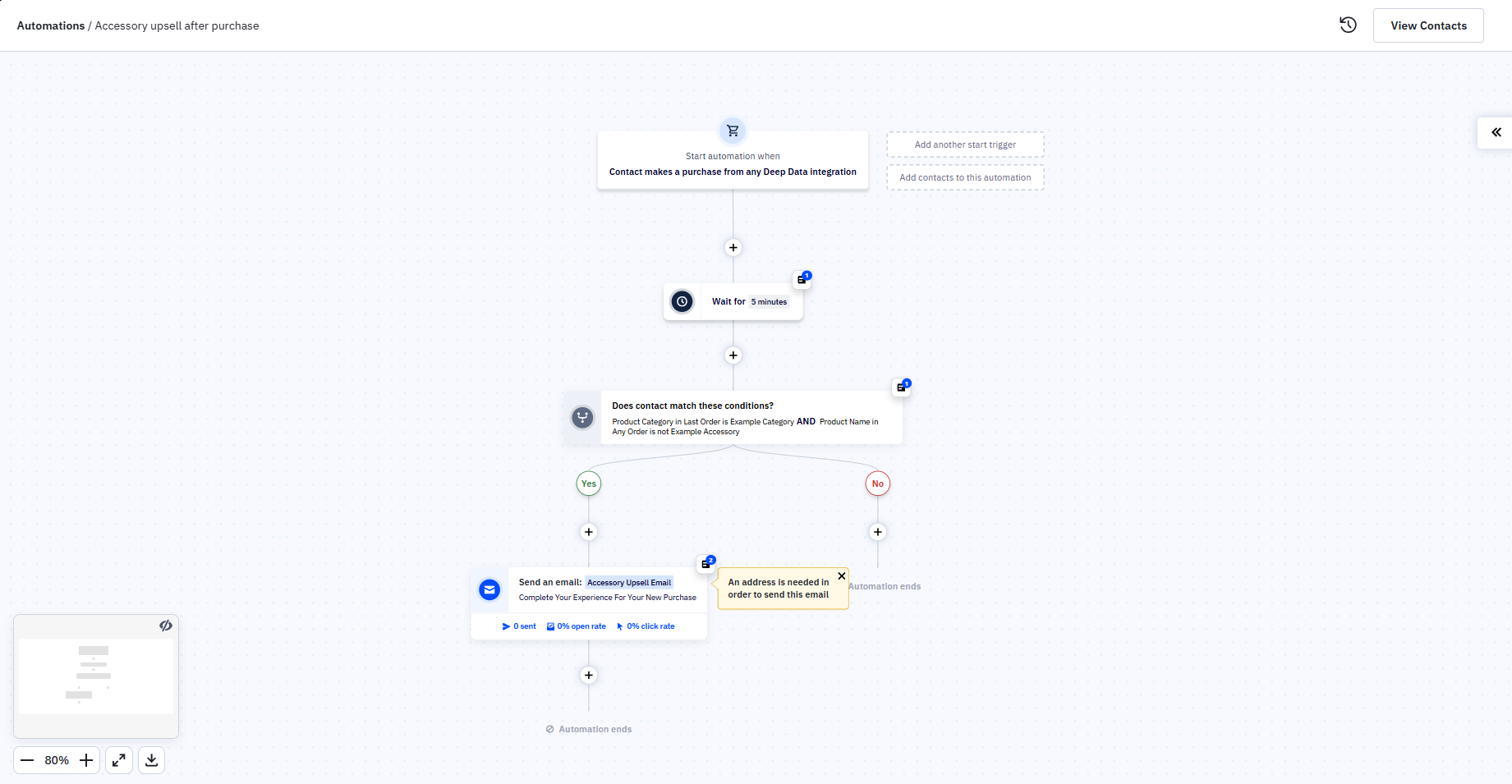 Setting up a post-purchase upsell workflow in ActiveCampaign
The two builders are both good. What we liked most is that both offer AI assistance for creating workflow logic. Brevo has the advantage in multi-channel automation, particularly when SMS or WhatsApp needs to work alongside email without extra complexity. It also offers a cleaner building experience. ActiveCampaign goes deeper when automation depends on detailed customer behavior. Its purchase-driven logic and more flexible canvas make it better suited to eCommerce businesses building targeted upsells and other workflows around exactly what someone bought.
Contact management
Brevo: 9/10 | ⭐ ActiveCampaign: 9.5/10
Tagging and segmentation become more important as your audience grows larger and becomes more diverse. A small business sending the same newsletter to everyone may barely need them. Still, eCommerce stores, SaaS companies, agencies, and businesses with different customer groups rely on them to keep contacts organized and send more relevant campaigns. Here’s how Brevo and ActiveCampaign compare in contact management.
| Aspect |
Brevo |
ActiveCampaign |
Winner |
| Segmentation capabilities |
Real-time segments with up to 100 conditions and AND/OR logic |
Real-time segments with condition groups and no condition limit |
ActiveCampaign |
| Segmentation criteria |
Contact data, engagement, eCommerce, website behavior, custom objects, and CRM deals |
Contact data, tags, engagement, eCommerce, website/events, automations, and time-based activity |
Tie |
| Segment update speed |
Updates automatically in real time |
Criteria update in real time; displayed contact counts may require manual refresh |
Brevo |
| Tagging and manual organization |
No contact-level tags; uses structured contact attributes |
Contact tags work across segmentation, search, and automation |
ActiveCampaign |
| Total score |
9/10 |
9.5/10 |
ActiveCampaign |
Both platforms can handle advanced targeting, but ActiveCampaign gives you more ways to organize contacts. Tags are especially important here since they become part of how contacts move through campaigns and automations.
Brevo is strong if you prefer a more structured, data-driven approach. Still, ActiveCampaign is more flexible for marketers who constantly create, combine, and reuse audiences based on customer behavior, which makes its contact data more useful across the platform.
CRM and sales pipelines
Brevo: 8.7/10 | ⭐ ActiveCampaign: 9.2/10
ActiveCampaign is one of the stronger CRM options among email-first platforms, with sales pipelines closely tied to automation. Brevo added CRM much later and offers a lighter solution for small to medium businesses that want sales and marketing in one system.
| Aspect |
Brevo |
ActiveCampaign |
Winner |
| Pipeline management |
Limited free plan (1 pipeline and 50 open deals); advanced sales tools and multiple pipelines available as an add-on to higher-tier plans |
Unlimited pipelines and stages; automated deal distribution and group-based access; advanced CRM available as an add-on to higher-tier plans |
ActiveCampaign |
| Contact and company records |
Contacts, companies, deals, and tasks; up to 200 custom contact fields; custom objects on higher tiers |
Contacts, accounts, deals, and tasks; custom deal fields and tags; AI can query CRM records in natural language |
ActiveCampaign |
| Sales forecasting |
Stage-based weighted revenue forecast |
AI-based win probability, revenue forecasts, and historical forecast accuracy |
ActiveCampaign |
| CRM automation |
Create/assign deals and trigger workflows from deal stage changes |
Automate deal stages, statuses, scoring, distribution, notes, and pipeline cleanup |
ActiveCampaign |
| Total score |
8.7/10 |
9.2/10 |
ActiveCampaign |
Both platforms go beyond traditional email marketing here, but ActiveCampaign is closer to a full-featured CRM solution, while Brevo covers the essentials for teams that mainly need a simple pipeline next to their marketing toolkit.
Signup forms and landing pages
⭐ Brevo: 8.5/10 | ActiveCampaign: 7.2/10
Brevo is a stronger option for signup form creation overall, but the two builders aren’t aimed at the same needs. Brevo is a more practical lead generation tool as it gives you better control over when and where forms appear. ActiveCampaign is more interesting for businesses where forms feed directly into a larger sales and automation system; it has more strengths for sales-oriented lead capture.
| Aspect |
Brevo |
ActiveCampaign |
Winner |
| Types of forms available |
Embedded/full-page, pop-up, profile update, and unsubscribe forms |
Inline, modal, floating bar, and floating box |
Tie |
| Form builder |
Drag-and-drop editor with contact fields, CAPTCHA, 3 embed options, double opt-in, and submission alerts |
Style controls, live webpage preview, built-in trigger automation, and code editor; pop-ups limited to name, phone, and email |
ActiveCampaign |
| Pop-up targeting conditions |
Exit intent, time delay, page targeting |
Scroll and time delay |
Brevo |
| Landing page builder |
Drag-and-drop editor, custom domains, reCAPTCHA, SEO settings, and custom tracking scripts |
Drag-and-drop editor, custom domains, built-in tracking/analytics, and 60+ templates |
Tie |
| Total score |
8.5/10 |
7.2/10 |
Brevo |
Brevo keeps form building simple, and its strongest points are mobile checking and compliance. Its mobile preview renders the form inside an actual smartphone frame. The builder also has dedicated GDPR, GDPR Declaration, and CAPTCHA blocks. The negative part is a lack of design flexibility – mobile mode is preview-only, so you can’t customize the mobile version separately from desktop.
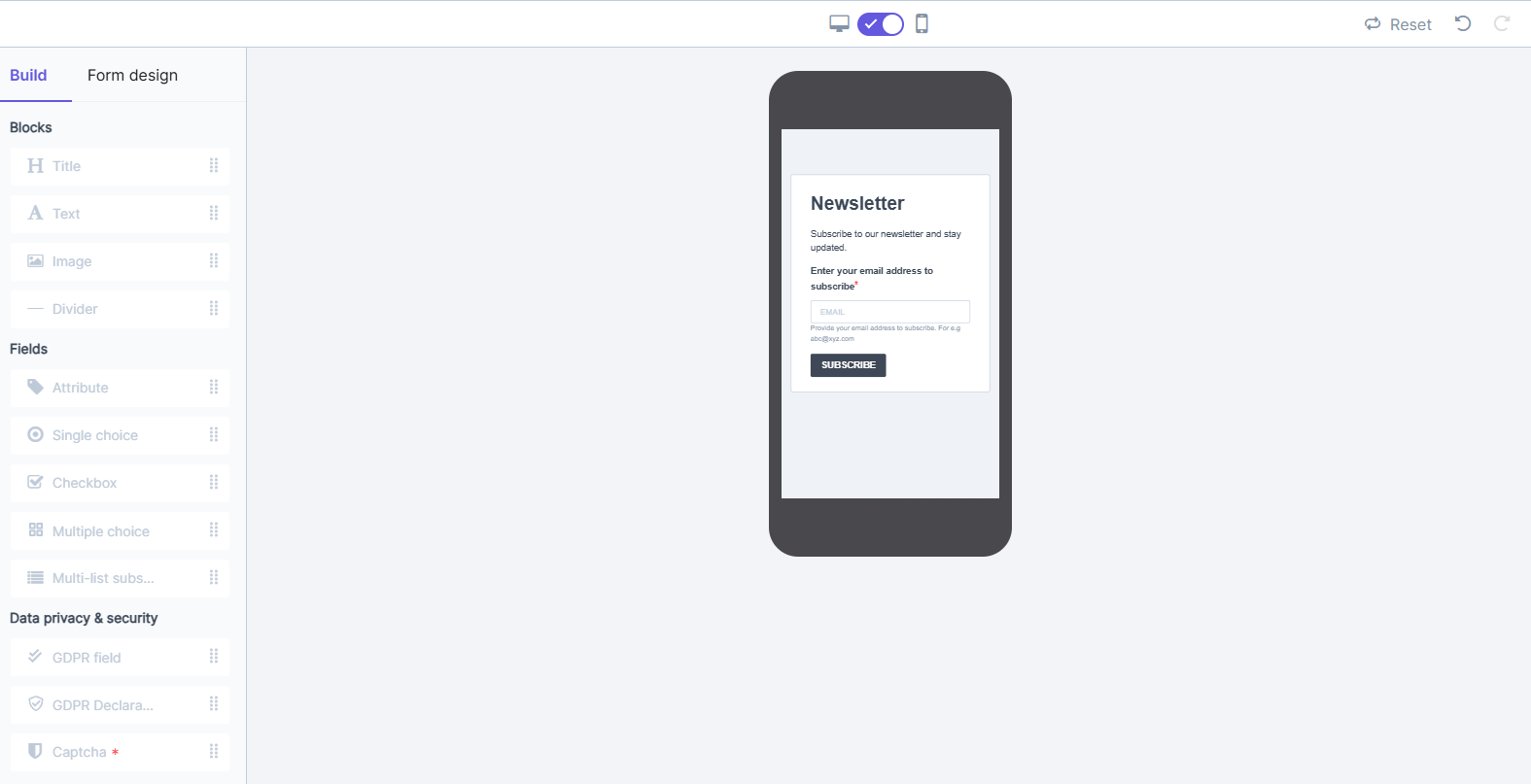 Previewing a newsletter signup form on mobile in Brevo
ActiveCampaign gives you much more control over how a form looks on your website. One of its best features is the ability to preview a pop-up directly over a real webpage. This way, it’s easier to spot whether the pop-up covers important content. There’s also a Trigger Automation option right in the builder, making the connection between collecting a lead and acting on it direct.
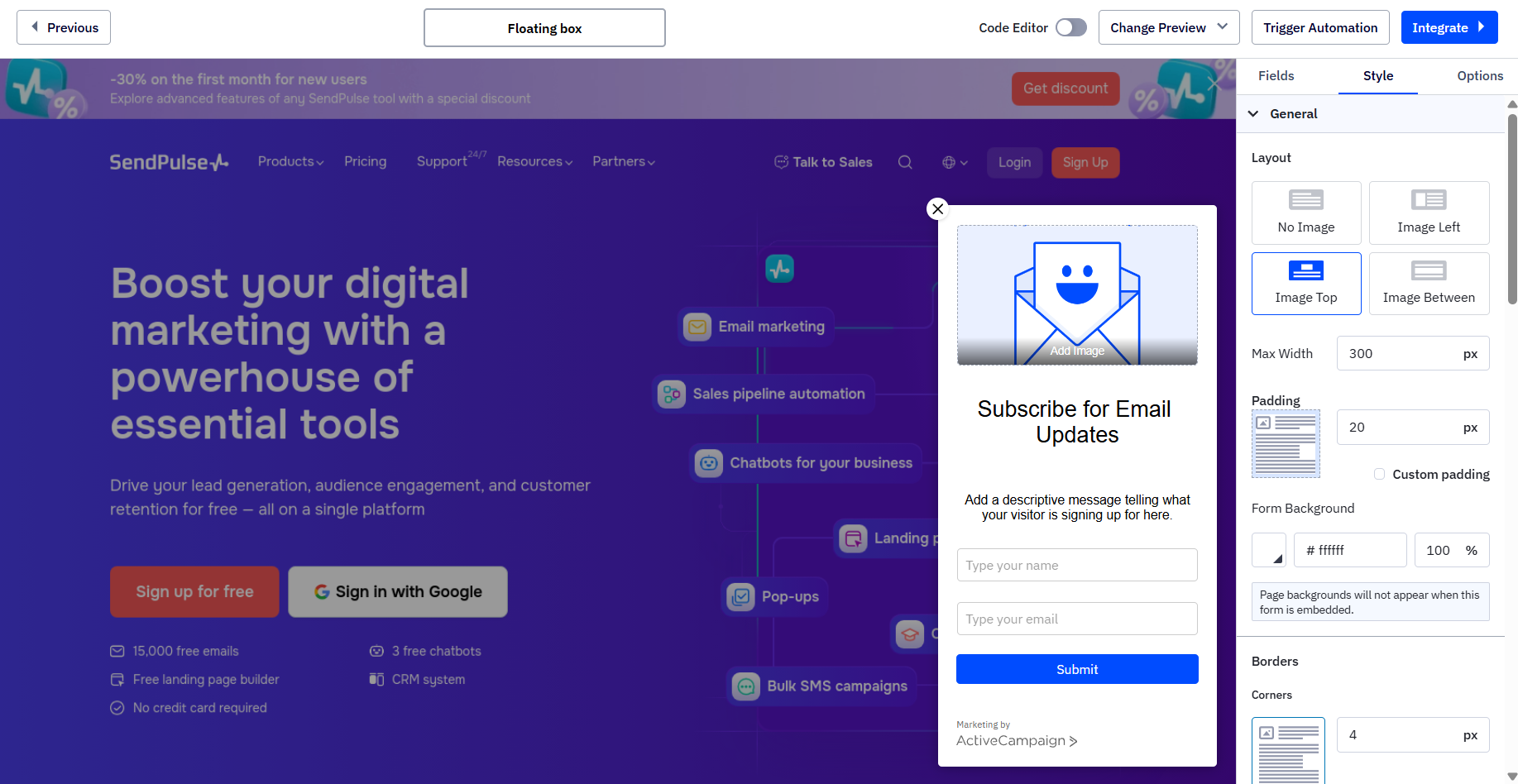 Previewing a custom floating box over a live webpage in ActiveCampaign
Brevo is a winner here because it offers better built-in targeting options for deciding when and where forms appear. You can also easily create mobile-friendly, GDPR-ready forms with it. ActiveCampaign also has some clear advantages. Its builder gives you more control over how forms look in the context of your website and connects lead capture closely with automation.
Integrations
Brevo: 8.8/10 | ⭐ ActiveCampaign: 9/10
Integrations matter when your email platform is only one part of a larger business setup. eCommerce stores, SaaS companies, and businesses with dedicated sales or support teams often need to connect email marketing with their store, CRM, payment system, help desk, analytics tools, or other software. Good integrations keep customer data moving between these systems automatically, so you can target campaigns and trigger automations based on what customers do elsewhere. The more tools your business relies on, the more important a strong integration ecosystem becomes. Here’s what Brevo and ActiveCampaign offer.
| Aspect |
Brevo |
ActiveCampaign |
Winner |
| Integration catalog |
150+ apps |
1,000+ apps |
ActiveCampaign |
| eCommerce platforms |
Shopify, WooCommerce, BigCommerce, Magento/Adobe Commerce, PrestaShop, and more |
Shopify, WooCommerce, BigCommerce, Magento/Adobe Commerce, and Square, all with Deep Data purchase syncing |
ActiveCampaign |
| CRM systems |
Built-in CRM; native Salesforce integration |
Built-in CRM; connectors for external CRMs like Salesforce and Microsoft Dynamics 365 |
Tie |
| API capabilities |
REST and Events APIs; 10 requests/second for contacts and events; webhooks retried if delivery fails |
REST and eCommerce GraphQL APIs; 5 requests/second per account; webhooks are not retried |
Brevo |
| Zapier support |
17 triggers and 16 actions |
22 triggers and 31 actions |
ActiveCampaign |
| Total score |
8.8/10 |
9/10 |
ActiveCampaign |
ActiveCampaign has the edge for integrations, particularly for businesses that already use a fairly complex tech stack. Its ecosystem is better suited to connecting marketing with eCommerce, sales, and other business systems, so data can move between tools and feed directly into campaigns and automation. Brevo is less dependent on external connections, which can be an advantage for businesses looking for a simpler, more self-contained setup.
AI features
⭐ Brevo: 9/10 | ⭐ ActiveCampaign: 9/10
We’ve covered some AI features earlier in this comparison, but if AI-powered optimization matters to you, here’s a side-by-side comparison of Brevo vs ActiveCampaign.
| Aspect |
Brevo |
ActiveCampaign |
Winner |
| Email generation |
Generates complete campaigns from prompts; uses website branding; creates copy, images, and translations |
Generates complete campaigns from prompts and brand kit; creates copy, images, and translations |
Tie |
| Automation generation |
Generates complete workflows from prompts |
Generates workflows from prompts and past campaigns; remembers preferences; AI can analyze and categorize contacts inside running workflows |
ActiveCampaign |
| Predictive customer analytics |
Built-in CLV, churn risk, and predicted purchase metrics |
Built-in deal win probability; CLV and sentiment analysis available through a paid workflow add-on |
Tie |
| Smart segmentation suggestions |
Generates segments from prompts |
Generates segments from prompts and proactively suggests audiences based on behavior and trends |
ActiveCampaign |
| Total score |
9/10 |
9/10 |
Tie |
Both platforms have moved well beyond basic AI writing and can now use AI to create campaigns, build automations, work with customer data, and improve targeting. Where the two are evenly matched – content generation and predictive customer metrics – both deliver comparable depth: full campaign generation with brand awareness, and built-in predictive scoring out of the box. ActiveCampaign pulls ahead specifically where AI extends into ongoing context: it builds automations informed by past campaigns. It remembers stated preferences, and it proactively suggests audience segments based on behavior rather than waiting for a prompt.
We rated both platforms 9/10 because Brevo matches ActiveCampaign step for step on the fundamentals – generation quality and predictive analytics – even though ActiveCampaign’s AI reaches further into the platform’s day-to-day workflows.
Deliverability
⭐ Brevo: 10/10 | ActiveCampaign: 9.8/10
Brevo has a narrow win, 10/10 vs 9.8/10. Its advantage is mainly practical, since it gives you more visibility and control over deliverability. It also makes dedicated sending infrastructure considerably more accessible to businesses that don’t operate at massive scale. ActiveCampaign has a conservative approach, particularly for high-volume senders, but Brevo provides a more complete day-to-day deliverability toolkit for a broader range of businesses.
| Aspect |
Brevo |
ActiveCampaign |
Winner |
| Authentication |
Automated DKIM/DMARC setup for supported DNS providers; BIMI support |
Automated or guided manual DKIM/DMARC/SPF setup; DNS checker |
Tie |
| Deliverability monitoring |
Real-time deliverability score, issue alerts, and domain-level breakdowns |
Spam testing, engagement tracking, and sender reputation guidance through Google Postmaster |
Brevo |
| List hygiene |
Hard bounces blocked immediately; soft bounces retried for 36 hours and blocked after 5 consecutive bounces |
Hard bounces blocked immediately; soft bounces blocked after 3 consecutive campaigns; false-positive bounce protection |
Tie |
| Dedicated IP |
$251/year on higher tiers; no minimum list size; automated or guided warm-up |
$750 one-time payment; requires 100,000+ active, engaged contacts; pre-warmed with gradual scaling recommended |
Brevo |
| Total score |
10/10 |
9.8/10 |
Brevo |
However, email marketing best practices often matter more for deliverability than the platform’s technical stack. Here are some of them:
- list quality – valid, permission-based contacts rather than purchased or outdated lists;
- engagement – how often recipients open, click, reply, or otherwise interact;
- spam complaints – recipients marking your messages as spam;
- sending frequency – consistent sending rather than sudden volume spikes;
- segmentation – sending relevant messages instead of blasting the entire list;
- inactive contacts – regularly suppressing people who consistently don’t engage;
- opt-in quality – clear consent from people who actually expect your emails;
- content quality – relevant content, trustworthy links, and no misleading subject lines.
If you follow them, you should get good deliverability with any modern email marketing platform.
Reporting and analytics
⭐ Brevo: 9/10 | ActiveCampaign: 8.4/10
Reporting tells you what’s actually working and what needs optimization. It helps you see which campaigns bring results, how customers respond, and whether your marketing is making money. This matters even more for eCommerce businesses, larger teams, and anyone running lots of campaigns, automations, or channels, where opens and clicks only tell part of the story.
| Aspect |
Brevo |
ActiveCampaign |
Winner |
| Report coverage |
Email, SMS, transactional, revenue, and customer dashboards; 7 additional dashboards as a paid add-on |
Extensive campaign, automation, CRM/sales, eCommerce, revenue, SMS, and agency reporting |
ActiveCampaign |
| Custom reports |
Built-in BI tool with AI queries and formulas; Google Looker dashboards as a paid add-on |
Custom report builder with 20+ templates; refreshes once daily |
Brevo |
| Reporting speed |
Real-time transactional data down to minutes/seconds; campaign reports generated on demand |
Standard reports appear live; custom reports refresh once daily |
Brevo |
| Export capabilities |
CSV and PDF |
CSV, TXT, Excel, JSON, HTML, and Markdown |
ActiveCampaign |
| Total score |
9/10 |
8.4/10 |
Brevo |
Brevo wins reporting overall, even though ActiveCampaign covers more areas. The thing is, Brevo gives you more freedom to analyze data your own way and, importantly, access fresh data without waiting for the next refresh.
ActiveCampaign is better if you want lots of ready-made reports across marketing and sales without doing much analysis yourself; it also has more flexible export options. However, if your business relies heavily on reporting to make day-to-day decisions, Brevo’s faster data and stronger custom analytics make it a better choice.
Customer support
⭐ Brevo: 7.6/10 | ActiveCampaign: 7.2/10
Customer support matters both when you’re learning a new platform and months or years later when something goes wrong. Good onboarding can save hours of trial and error, while reliable support is what you need most when a campaign won’t send or an automation breaks. Documentation and AI can answer routine questions, but for complicated or urgent problems, reaching a real person who can look into your case makes a big difference.
| Aspect |
Brevo |
ActiveCampaign |
Winner |
| Channel availability |
Tickets on all plans; phone support on higher tiers, Mon–Fri; no live chat |
Live chat 6 days/week; AI-first support with human escalation; 24/7 AI onboarding phone line |
ActiveCampaign |
| Knowledge base |
Smaller but consistently clear and reliable, with useful plan and feature notes |
Broader and more technical, with exact limits and plan requirements, but some articles lag behind product updates |
Brevo |
| Onboarding assistance |
Mainly self-service; hands-on help through paid third-party partners |
Onboarding on all paid plans; AI or 1:1 specialist help; free migration of up to 10 lists, templates, automations, and forms/pages |
ActiveCampaign |
| Total score |
7.6/10 |
7.2/10 |
Brevo |
Brevo wins this category on customer feedback: its support is rated slightly higher on both G2 (8.7/10 vs 8.5/10) and Capterra (4.5/5 vs 4.4/5). ActiveCampaign offers more ways to reach support and more hands-on onboarding, but users rate the help they get a little lower.
What users say about Brevo. Reviewers regularly praise the quality of Brevo’s support, describing replies as detailed and understanding. Response times vary, though: some users had an issue sorted out in a few hours, while others say support can take a couple of days. Access is also limited, since phone support is reserved for the Professional plan and higher.
What users say about ActiveCampaign. Reviewers highlight ActiveCampaign’s responsive support and its 1:1 onboarding. On the downside, some users say it can be hard to get in touch with a human agent.
Key differences between Brevo and ActiveCampaign
Here’s another variation of the too-long-didn’t-read table we had at the beginning. This time, we’ve gathered all the key differences between the platforms so you can immediately spot which ones might be particularly important for your choice.
| Aspect |
Brevo |
ActiveCampaign |
| Pricing model |
Based on emails sent per month |
Based on number of contacts |
| Free plan |
Yes, with automation included |
No, 14-day trial only |
| CRM |
Lighter, part of the marketing suite |
Advanced, core to the platform |
| Automation |
Simpler, available on every plan |
More advanced, with branching logic and 900+ recipes |
| Communication channels |
Email and SMS; WhatsApp and push notifications on higher tiers |
Email; SMS and WhatsApp as add-ons |
| Deliverability score |
Native, real-time score |
No native score |
| Dedicated IP |
$251/year, tier-gated |
$750 one-time, requires 100k+ contacts |
| Live chat support |
Not available |
Available 6 days a week |
| Onboarding |
Self-serve, with paid agency support available |
Free onboarding with every plan |
| Contact tags |
Not available |
Available and deeply integrated |
| Ease of use |
Simpler, with a gentler learning curve |
More complex, with a steeper learning curve |
If this table doesn’t tell you enough, we have a few other ways to help you make the right decision and choose the email marketing platform that best fits your business.

Join businesses growing with SendPulse
From solo creators to global brands, thousands of customers trust SendPulse to run email campaigns, chatbots, automations, and more — all in one place.
Get started for free
Your decision checklist
Here are the key areas that matter most when marketers and business owners choose an email marketing platform. If one platform comes out on top in three or more of them, it’s probably the better choice for your business.
| Decision area |
Brevo
is a better fit if… |
ActiveCampaign
is a better fit if… |
| Business type |
You want multi-channel marketing and basic CRM without a steep learning curve. |
You want deep CRM and automation power and don’t mind investing time to learn it. |
| Budget expectations |
You have a large or growing list but send rarely – Brevo charges by emails sent, not list size, so a big quiet list stays cheap. |
You have a small list of around 1,000 contacts and want advanced automation at a similar entry price. |
| Automation needs |
You want simple automation that’s available even on the free plan. |
You need real branching logic and deep eCommerce/CRM triggers; ActiveCampaign has no free plan, but automation is its core strength. |
| Analytics focus |
You want fast, real-time transactional reporting with a visible deliverability score. |
You want broad reporting across campaigns, automation, sales, and eCommerce, with flexible export formats. |
| Team setup |
Your team is comfortable with self-serve setup, since there’s no built-in onboarding program. |
Your team wants free onboarding and migration help included with your plan. |
If neither Brevo nor ActiveCampaign quite fits your business, these platforms are worth a look:
- SendPulse, if you want AI-assisted email and chatbot marketing in one place. It also offers SMS marketing and a built-in CRM with sales pipelines.
- Kit (ConvertKit), if you mainly send newsletters. Its free plan covers up to 10,000 subscribers, though automations require a paid plan.
- Klaviyo, if you run an online store and want automation, segmentation, and reporting built around your store data.
Final verdict and recommendations
⚖️ Final scores: Brevo – 8.5/10 | ActiveCampaign – 8.9/10
Would we recommend Brevo? Absolutely! Especially if you have a large or growing contact list but don’t email it very often. It’s affordable, capable, and well-liked by its users.
Would we recommend ActiveCampaign? Even more so! However, only if you’re actually going to use its capabilities. Brevo is more universal and can work well for almost any business. At the same time, ActiveCampaign makes the most sense if you run an eCommerce business or need sophisticated automations connected to your CRM. It costs about the same for very small lists but noticeably more as your list grows, so its extra automation and CRM depth are what you pay for.
Whatever you choose, make sure you choose carefully before committing. Onboarding and migration take time and resources, so it’s much easier to pick the right platform from the start.
Brevo vs ActiveCampaign FAQ
Is Brevo cheaper than ActiveCampaign?
Yes, at 10,000 contacts, Brevo Starter costs $73.75/month. It corresponds to ActiveCampaign’s 10,000 contacts, which costs $149/month with ActiveCampaign Starter. Both plans are billed annually.
Does ActiveCampaign include transactional emails?
Not in its marketing plans. Transactional email runs through Postmark, a separate service with its own account and pricing (100 free emails/month; paid plans start at $15/month for 10,000 emails). Brevo includes transactional emails in every plan.
Does Brevo have a CRM?
Yes. Free sales tools include 1 sales pipeline and 50 open deals by default. The Sales Essentials package ($31/month) adds unlimited deals and pipelines as well as sales automation.