One of the first things we realized while testing ActiveCampaign and HubSpot is that they aren’t trying to solve the same problem. Both offer email marketing, automation, AI, and CRM, but ActiveCampaign remains a marketing platform at its core, while HubSpot has grown into an entire business ecosystem.
ActiveCampaign is aimed at businesses that want powerful marketing automation and a capable CRM without paying for tools they’ll never use. HubSpot is built for companies where marketing, sales, and customer support all need to work from the same customer database.
Keeping this difference in mind makes the rest of the comparison easier to understand because it explains many of the decisions each platform makes throughout the product.
How we scored this comparison: This review was created by the SendPulse team. As an email marketing platform ourselves, we work in the same space as the tools we test, which also means we understand the field deeply.
Each platform was evaluated across the key categories using our independent methodology. Pricing (25%), ease of use (20%), and email and automation features (15% each) carry the most weight because they affect daily workflows the most. All scores reflect hands-on testing and analysis as of August 2026.
TL;DR ActiveCampaign vs HubSpot at a glance
Here’s a quick summary of the key differences between ActiveCampaign and HubSpot across every category we compared. If any aspect is particularly important for your business, click on it to jump to the detailed comparison.
| Category |
ActiveCampaign |
HubSpot |
Winner |
| Best for |
Marketing-first businesses needing advanced automation at a reasonable price |
Growing businesses and enterprises that want marketing, sales, and service in one platform |
Depends on the use case |
| Pricing |
8/10
Excellent value for advanced marketing; no free plan |
4/10
Expensive, enterprise-oriented pricing; includes a free plan |
ActiveCampaign |
| Ease of use |
8.5/10
Easier to learn and navigate |
7/10
Powerful but significantly more complex |
ActiveCampaign |
| Email design |
8.8/10
More creative freedom and editing tools |
8.4/10
More consistent, CRM-integrated design system |
ActiveCampaign |
| SMS |
9.2/10
Flexible, multi-country SMS marketing |
7.4/10
Strong CRM integration, limited availability |
ActiveCampaign |
| Automation |
10/10
Best-in-class marketing automation |
9.3/10
Excellent cross-team business automation |
ActiveCampaign |
| Contact management |
9.5/10
Flexible tags, lists, and marketer-friendly segmentation |
9.5/10
CRM-driven, multi-object segmentation |
Tie |
| CRM |
9.2/10
Powerful CRM for marketing and sales |
9.8/10
Full business CRM with forecasting and revenue tools |
HubSpot |
| Forms and pages |
7.2/10
Flexible forms with rich customization |
8.5/10
Advanced lead qualification and landing pages |
HubSpot |
| Integrations |
9/10
1,000+ apps with strong Zapier support |
9.2/10
Larger marketplace with deep CRM and Salesforce integrations |
HubSpot |
| AI features |
8.9/10
AI that speeds up everyday marketing |
9.2/10
AI across marketing, CRM, sales, and analytics |
HubSpot |
| Deliverability |
9.8/10
Excellent deliverability and reputation tools |
10/10
More advanced monitoring and deliverability insights |
HubSpot |
| Reporting |
8.4/10
Strong marketing and eCommerce reporting |
9.2/10
Business-wide analytics and attribution |
HubSpot |
| Customer support |
7.2/10
Good onboarding and self-service resources |
7.4/10
Broader support ecosystem with phone and CSMs |
HubSpot |
| G2/Capterra rating |
4.4/4.6 |
4.4/4.5 |
ActiveCampaign |
| Final score |
8.9/10 |
7.9/10 |
ActiveCampaign |
Looking at the scores, the winner seems obvious, right? But let’s take a closer look to make sure you’re choosing the platform that best fits your business.

Create and send high-performing emails
Use an AI assistant, pre-made templates, advanced segmentation, and feature-rich automation to run campaigns without coding. Start for free with up to 15,000 monthly emails.
Get started for free
ActiveCampaign vs HubSpot pricing and feature differences
How we tested: We signed up for both platforms and spent several weeks testing them. We compared pricing plans, built email campaigns, set up multi-step automations, and sent SMS messages. We created signup forms and landing pages, organized contacts into segments, and checked out template libraries and AI content tools. We also reviewed integration catalogs and deliverability settings and compared reporting dashboards side by side. For customer support, we examined real user feedback on Capterra and G2. All screenshots in this article were captured during our hands-on evaluation.
Let’s start with what matters most to businesses – the cost – and then move on to the features marketers use in their day-to-day work.
Pricing plans
⭐ ActiveCampaign: 8/10 | HubSpot: 4/10
Disclaimer: Pricing changes frequently. All prices in this comparison were verified against ActiveCampaign’s official pricing and HubSpot’s official pricing as of August 4, 2026. Always confirm current costs on the official pages.
ActiveCampaign’s pricing is clear and transparent. While with HubSpot it’s different… We rarely complain about pricing pages, but HubSpot’s deserves a special mention, as you’re expected to calculate your monthly cost yourself using pricing tiers and blended rates. Here’s what that looks like:
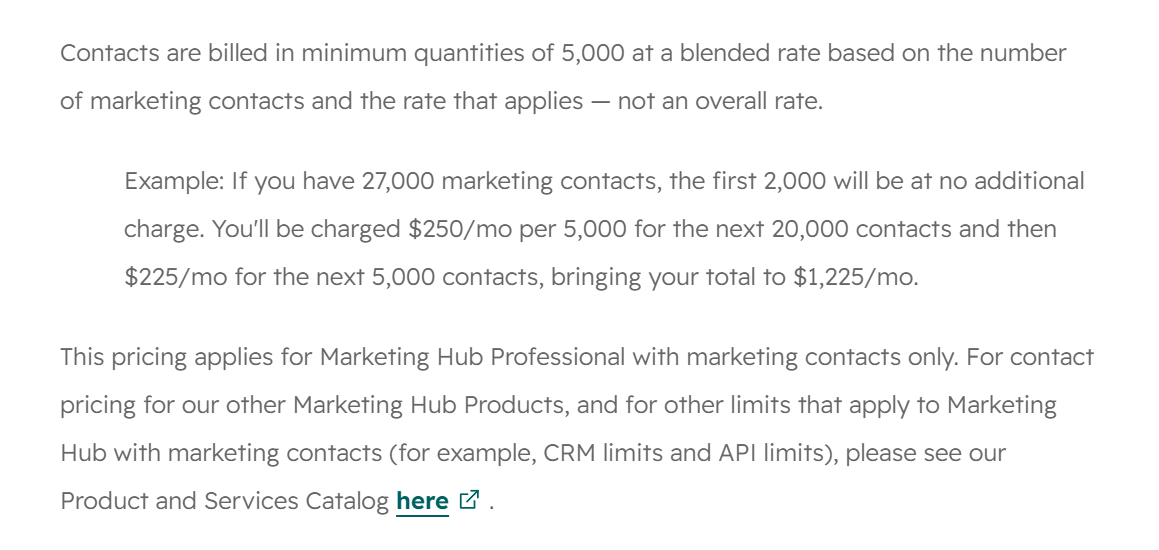 Explanation of marketing credit pricing at HubSpot
For our comparison table, we included several ActiveCampaign and HubSpot plans since higher tiers offer progressively more advanced functionality. At HubSpot, for example, the Starter plan is suitable for basic email marketing, while Professional unlocks most of HubSpot’s advanced capabilities, including the full automation builder with unlimited workflows, advanced branching, AI-generated automations, and dedicated customer support.
In other words, if you’re considering HubSpot for its marketing automation rather than just email campaigns, the Professional plan is the one you’ll most likely end up using. Keep in mind, though, that this jump comes at a price. In addition to the $890/month starting fee (including 2,000 marketing contacts), the Professional plan requires a mandatory one-time onboarding fee of $3,000, and monthly costs increase as your contact database grows.
We also included SendPulse as a pricing benchmark to show that a platform with a built-in CRM, advanced automation, and chatbots doesn’t have to come with an enterprise-level price tag.
| Contacts |
ActiveCampaign, Starter |
ActiveCampaign, Plus |
HubSpot, Starter |
HubSpot, Professional |
SendPulse, Standard |
| Free plan |
14-day free trial |
1,000 contacts; 2,000 emails |
500 contacts; 15,000 emails |
| 1,000 |
$15/mo |
$49/mo |
$11.50/mo |
N/A |
$14.40/mo |
| 10,000 |
$149/mo |
$189/mo |
$449/mo |
$1,584/mo |
$62.40/mo |
| 25,000 |
$391/mo |
$389/mo |
$1,120/mo |
$2,410/mo |
$127.20/mo |
| 50,000 |
N/A |
$609/mo |
$2,240/mo |
$3,616/mo |
$224.80/mo |
Note that this comparison covers HubSpot’s Marketing Hub. If you’re weighing HubSpot as a full suite, its Sales Hub and Service Hub are sold separately and priced per seat rather than by contacts. Both start at $10/seat/month on Starter, rising to $100/seat/month on Professional and $150/seat/month on Enterprise.
If HubSpot’s pricing is simply beyond your reach, you can stop reading here. But if the cost isn’t a deal-breaker, the next question is whether the platform delivers enough value to justify it. Let’s find out.
Ease of use and interface
⭐ ActiveCampaign: 8.5/10 | HubSpot: 7/10
When it comes to usability, there’s one thing you should understand: ActiveCampaign asks you to learn sophisticated marketing automation, while HubSpot asks you to learn an entire business ecosystem. Unless your business genuinely needs multiple teams working from the same system, ActiveCampaign is likely to feel easier to navigate and master over time.
| Aspect |
ActiveCampaign |
HubSpot |
Winner |
| First-time experience |
AI-guided setup builds your first email and automation from prompts; 3-step onboarding checklist |
Personalized onboarding plan, guided tours, recommended Academy lessons, AI assistant available from day one |
Tie |
| Daily navigation |
Two-level left sidebar with persistent AI assistant; optimized for marketing workflows |
Hub-based top navigation with Quick Create and AI assistant; covers marketing, sales, service, CMS, and more |
ActiveCampaign |
| Learning curve |
AI onboarding, contextual help, 90-minute webinar, and 2-day workshop reduce complexity |
Steeper due to broader platform; personalized lessons and AI guidance help new users |
ActiveCampaign |
| Mobile access |
An app supports contacts, deals, tasks, email metrics, and resend campaigns |
An app helps manage CRM records, campaigns, reports, sequences, business cards, QR codes, AI reports, and call recordings |
HubSpot |
| Workflow efficiency once mastered |
Fast campaign creation and automation |
Centralized work across the business |
Tie |
| Total score |
8.5/10 |
7/10 |
ActiveCampaign |
ActiveCampaign is easier to learn for its intended purpose. Although it has a steep learning curve, almost everything revolves around marketing automation, email campaigns, and a CRM system. The AI assistant also does a remarkable job of reducing complexity by building campaigns and automations from simple prompts. Once you understand the core concepts, the interface becomes quite focused.
HubSpot is beautifully designed, but it has one unavoidable disadvantage – it’s simply a much larger product. Marketing, CRM, sales, CMS, Data, Development… all of these modules are available from the same interface. That’s incredibly powerful, but it also means users inevitably spend more time navigating and discovering where everything lives.
Here’s how we would put the difference in learning curve into a graph:
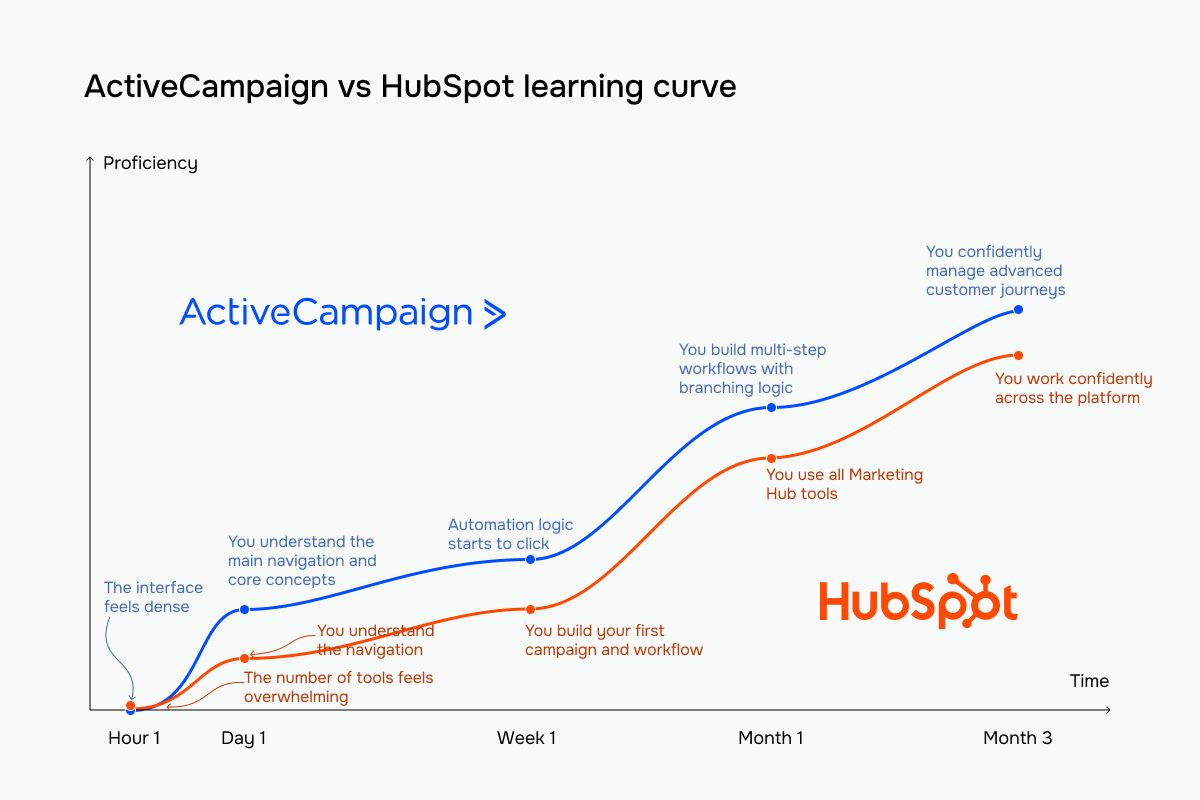 ActiveCampaign vs HubSpot learning curve based on our testing experience
Email builder and templates
⭐ ActiveCampaign: 8.8/10 | HubSpot: 8.4/10
We now come to the core function of any email marketing platform – the email builder. And we can immediately say that ActiveCampaign and HubSpot represent two different philosophies. ActiveCampaign gives you as many creative tools as possible and encourages experimentation. HubSpot assumes your company already has established brand guidelines and, instead of giving you dozens of blocks and layouts, focuses on consistency and integration with the rest of the HubSpot platform.
| Aspect |
ActiveCampaign |
HubSpot |
Winner |
| Templates |
125+ templates |
50+ templates |
ActiveCampaign |
| Drag-and-drop editor |
Hierarchical editor with structures, containers, and blocks |
Module-based editor with reusable sections and desktop/mobile section settings |
ActiveCampaign |
| Notable content blocks |
Countdown timer, banners, menus, video |
Products, cart, payments |
Tie |
| Mobile responsiveness |
Responsive by default; configurable stacking order, mobile spacing, and per-element visibility controls |
Responsive by default; separate desktop/mobile settings per section, configurable stacking, and per-module visibility controls |
HubSpot |
| Sending time optimization |
Offers predictive per-contact delivery, account-based recommendations, and industry benchmarks |
Best sending time is based on engagement, supports recipient time zones, and smooths delivery timing |
Tie |
| Total score |
8.8/10 |
8.4/10 |
ActiveCampaign |
Now, let’s check how the interfaces look in real life. ActiveCampaign offers one of the most advanced email editors we’ve tested. It combines a familiar word processor-style toolbar with precise design controls. You can customize responsive spacing for desktop and mobile separately, insert personalization tags directly while editing, and use AI to generate or improve content for individual blocks.
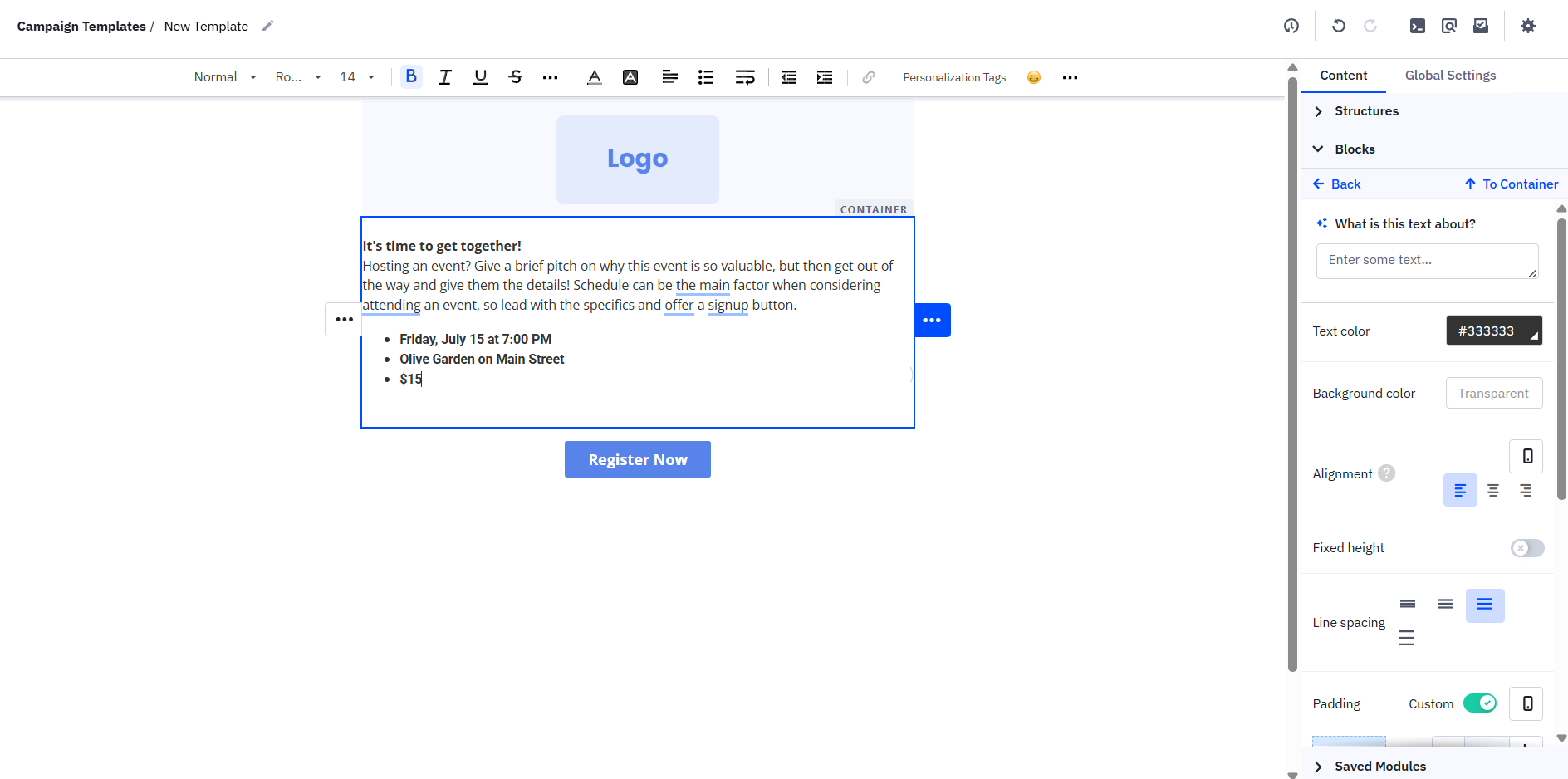 Testing ActiveCampaign’s email builder
HubSpot puts the email canvas at the center of the experience and minimizes interface clutter. The builder includes a searchable module library, reusable developer-built custom modules, and unique eCommerce blocks. It also displays the email’s file size while you build, helping you stay within recommended deliverability limits. Instead of dozens of content blocks, HubSpot focuses on a smaller, highly polished module library that’s tightly integrated with the rest of the CRM platform.
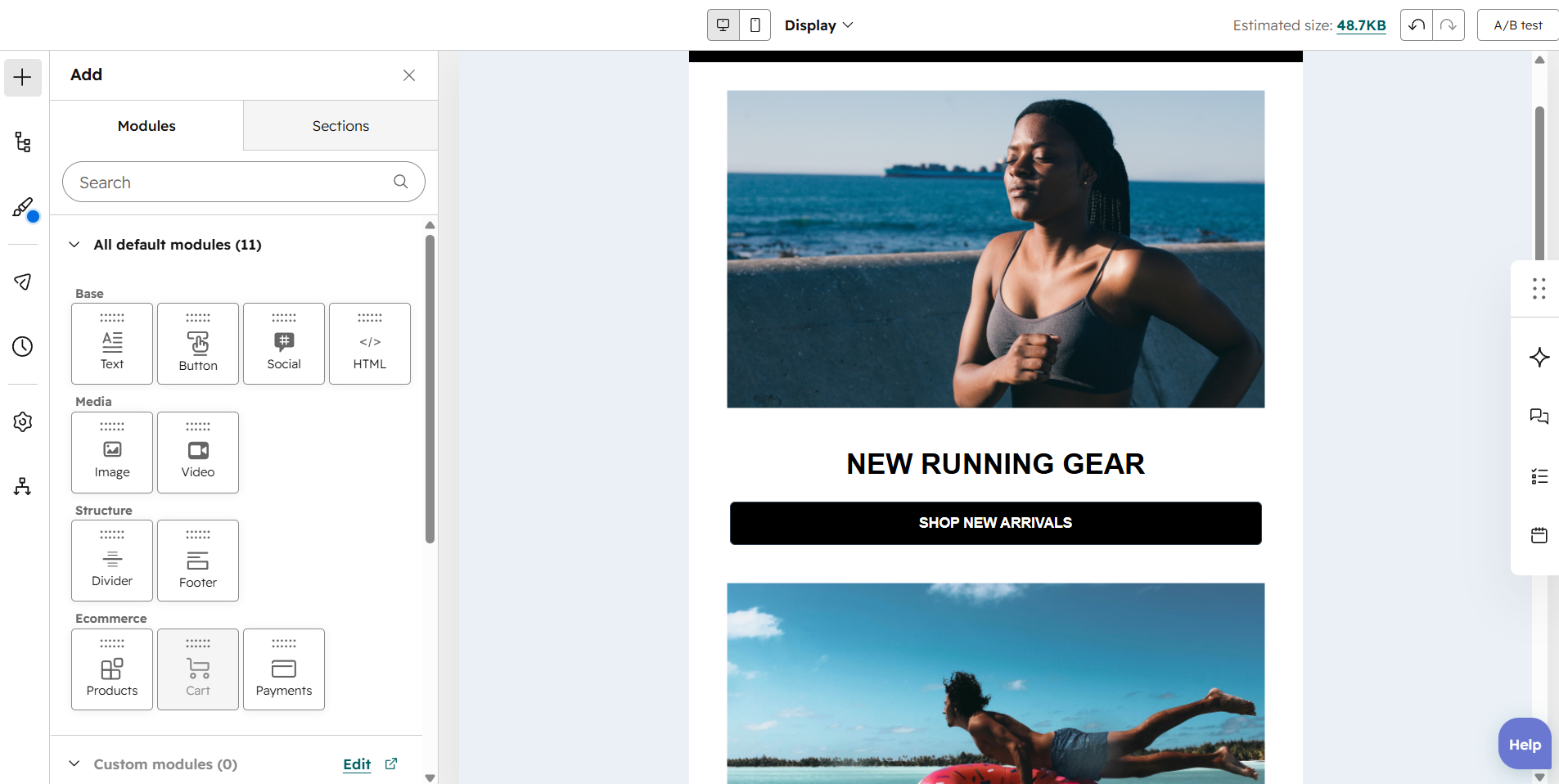 Hands-on look at HubSpot’s email builder
Our takeaway? ActiveCampaign is built for marketers who spend their day creating and refining email campaigns. Its Google Docs–style editing, responsive design controls, and deeply integrated AI make it one of the strongest builders for content-heavy marketing teams.
For HubSpot, it seems that emails are not of that big of importance. Instead of maximizing editing features, it integrates email into a larger CRM ecosystem through searchable modules, developer-built components, native payment blocks, and even live email size monitoring.
So, overall, ActiveCampaign is the stronger standalone email builder, while HubSpot is the better choice if email is only one part of a broader sales and customer management process.
SMS capabilities
⭐ ActiveCampaign: 9.2/10 | HubSpot: 7.4/10
If SMS is one of your key channels of communication with your clients, ActiveCampaign and HubSpot can help you out, even though on different levels. Here’s what they offer:
| Aspect |
ActiveCampaign |
HubSpot |
Winner |
| Plans that include SMS |
Available as a paid add-on for all paid plans |
Available as an add-on for highest tier paid plans |
ActiveCampaign |
| Supported countries |
US, Canada, UK, Australia, and other supported markets |
US and Canada |
ActiveCampaign |
| Pricing model |
Credit-based pricing varies by destination country; credits purchased separately |
SMS is a premium add-on layered on top of an already enterprise-priced plan, making it one of the most expensive SMS implementations |
ActiveCampaign |
| Compliance tools |
Quiet hours, A2P 10DLC, UK KYC, SHAFT compliance, manual review before first send |
Automatic quiet hours, A2P 10DLC, automated START/STOP keywords, short-code registration |
Tie |
| SMS-specific automation and keywords |
SMS in automations, broadcast campaigns, keyword-based opt-in, automated STOP clause, replies trigger automations |
SMS in workflows, broadcast campaigns, automated START/STOP keyword handling, opt-in confirmation for short codes |
Tie |
| Two-way messaging SMS |
Native SMS inbox with AI conversation summaries and reply suggestions for US, UK, and AU |
Native inbox for SMS replies for US only |
ActiveCampaign |
| Total score |
9.2/10 |
7.4/10 |
ActiveCampaign |
ActiveCampaign is the stronger SMS platform because it offers greater flexibility. Moreover, instead of limiting SMS to higher-tier customers or a single market, it makes the feature available to a wider range of businesses and integrates it into marketing automation.
HubSpot’s SMS capabilities are well-designed and tightly connected to its CRM, so they’re a good fit for companies already invested in the HubSpot platform. However, their narrow geographic availability and higher entry point make SMS an optional extension and not a core marketing channel.
Marketing automation
⭐ ActiveCampaign: 10/10 | HubSpot: 9.3/10
We wouldn’t choose between these two platforms based on automation features alone because both are excellent. Instead, we’d look at what you’re actually trying to automate. If it’s marketing, email nurturing, and customer journeys, ActiveCampaign gets you there faster. If it’s processes that involve marketing, sales, support, and CRM working together, HubSpot’s automation becomes more valuable.
| Aspect |
ActiveCampaign |
HubSpot |
Winner |
| Availability by plan |
Full automation on Plus+; Starter supports 5 actions per workflow |
Basic workflows on Free/Starter; full automation with unlimited actions on Professional+ |
ActiveCampaign |
| Automation builder |
Visual builder with loops, goals, cross-workflow automation, conditional waits, multiple triggers, and revision history |
Visual builder with goals, cross-workflow automation, pause dates, and AI-assisted workflow editing |
ActiveCampaign |
| Triggers available |
Website, email, CRM, SMS, tags, dates, custom events, and app triggers |
CRM, email, forms, ads, meetings, schedules, webhooks, and manual triggers |
Tie |
| Pre-built automations |
900+ pre-built automations |
50+ workflow templates |
ActiveCampaign |
| Channels supported |
Email, SMS, WhatsApp |
Email, SMS |
ActiveCampaign |
| AI features |
AI builds complete workflows |
AI builds complete workflows |
Tie |
| Automation complexity |
Supports loops, goals, multiple triggers, scoring, cross-workflow automation, and revision history |
Supports advanced enrollment logic, goals, suppression lists, pause dates, and cross-workflow automation |
Tie |
| Total score |
10/10 |
9.3/10 |
ActiveCampaign |
Even though in many respects, their marketing automation looks alike, the platforms’ automation builders are quite different. ActiveCampaign’s builder focuses on helping marketers build workflows as fast as possible. Its biggest advantage is AI: instead of generating individual emails, it can scaffold an entire automation, complete with a logical sequence, subject lines, and preview text that you can refine afterward. The builder also displays email performance metrics directly on each workflow step, so it’s easy to identify weak points without opening separate reports. Combined with built-in validation that flags configuration issues before activation, it creates an efficient environment for building and optimizing automations.
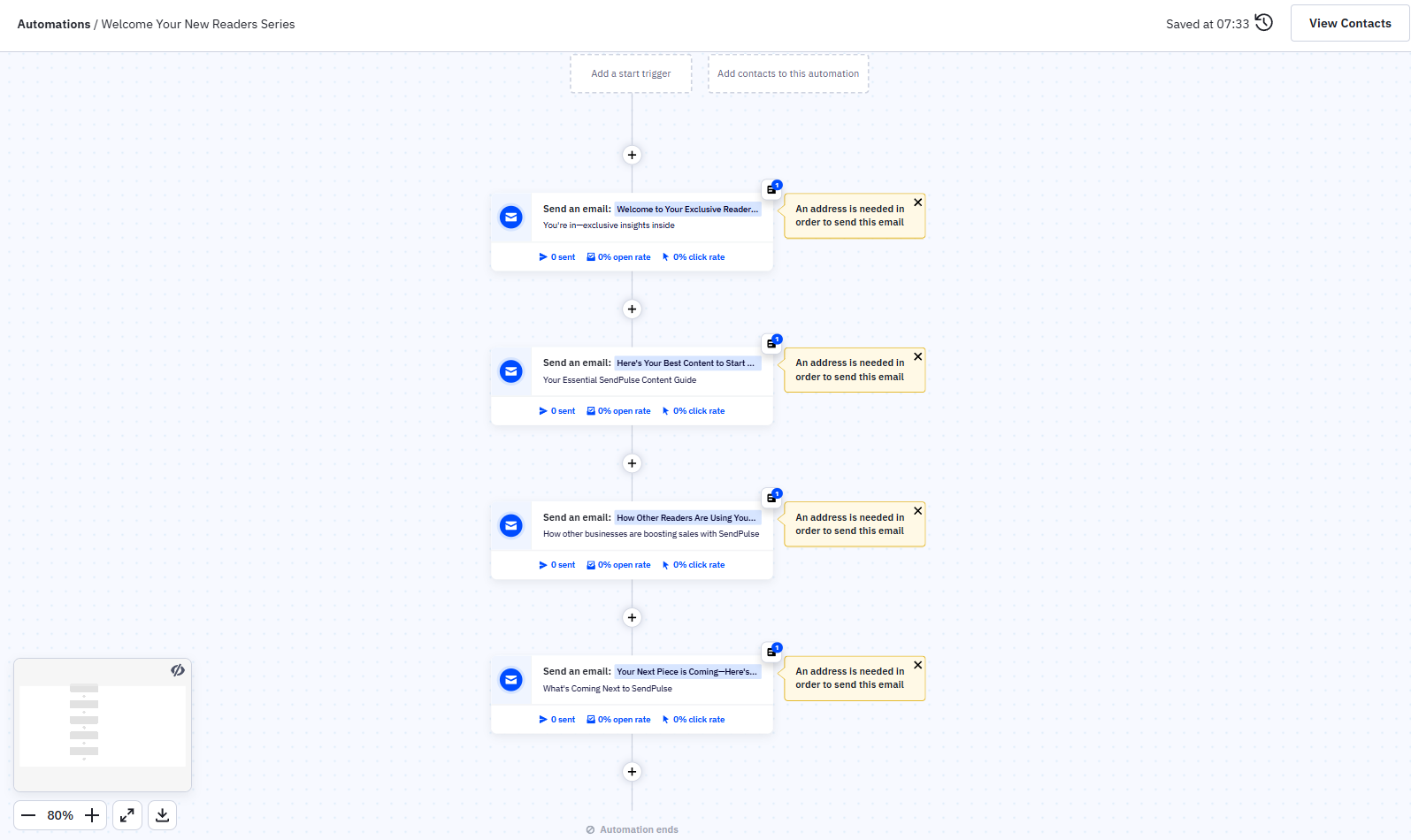 Automation sequence built by ActiveCampaign AI
HubSpot prioritizes control over speed. The builder offers one of the most advanced trigger configuration systems we’ve tested, allowing multiple trigger groups, OR logic between enrollment conditions, and separate filtering before contacts even enter a workflow. Dedicated testing tools, performance history, and re-enrollment controls reduce the risk of configuration mistakes. Instead of simplifying the creation of automations, HubSpot gives experienced teams extensive control over how workflows behave.
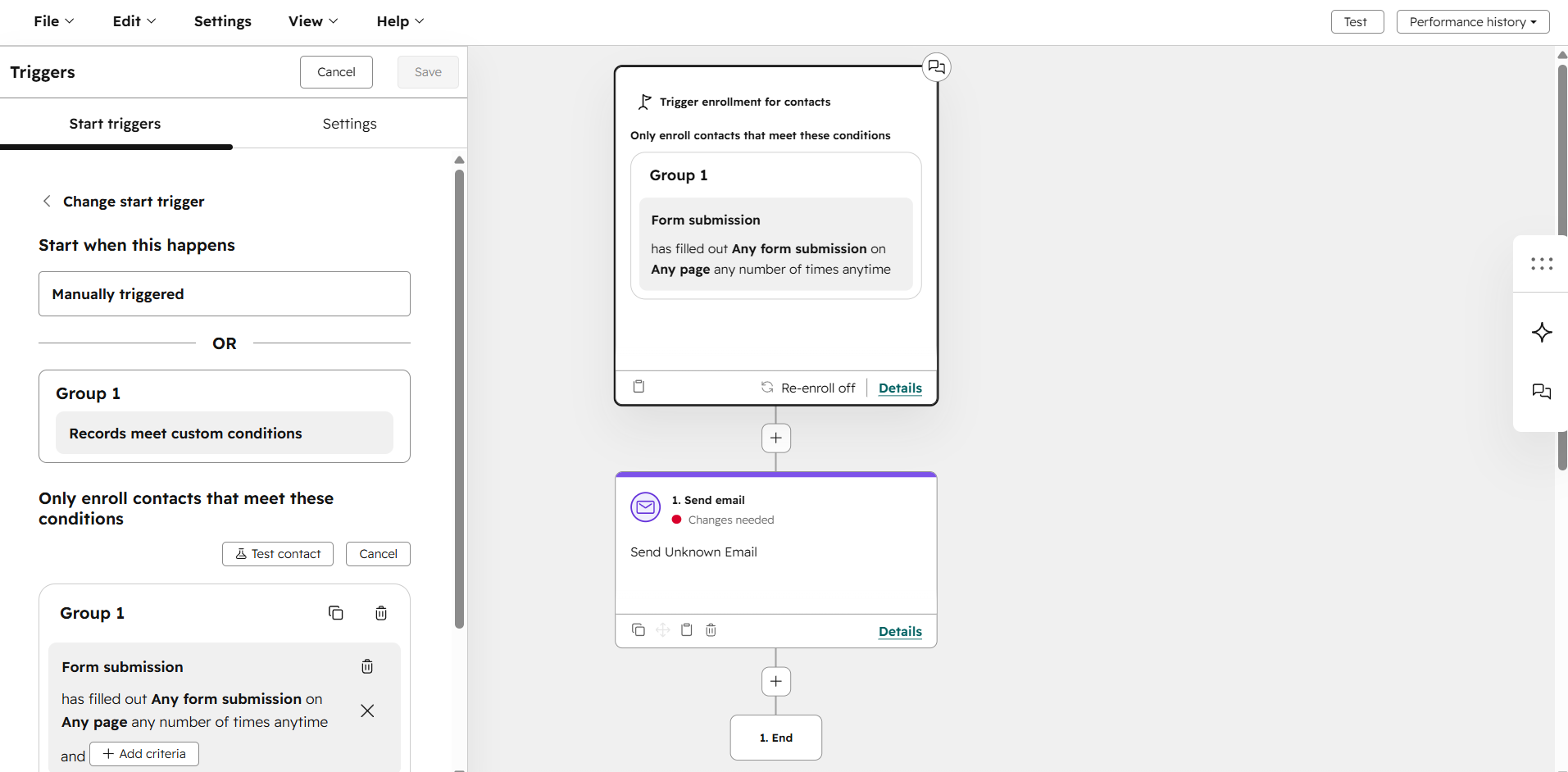 Product interest tagging automation in HubSpot’s builder
Our conclusion: ActiveCampaign is designed to help you launch automations using AI to generate complete workflows and surface performance metrics directly inside the builder for faster optimization. HubSpot, on the other hand, emphasizes operational reliability. Its sophisticated trigger logic, formal testing and review process, and extensive workflow controls make it one of the strongest builders for companies where automations involve complex CRM processes.
Overall, ActiveCampaign is the stronger automation builder because it combines advanced functionality with a faster workflow. HubSpot offers deeper operational controls, but many businesses won’t need that level of complexity. For most marketing teams, ActiveCampaign strikes the better balance between power, usability, and speed.
Contact management
⭐ ActiveCampaign: 9.5/10 | ⭐ HubSpot: 9.5/10
Both ActiveCampaign and HubSpot make it easy to build highly targeted audiences, so most businesses won’t feel limited by either one. ActiveCampaign sticks to the familiar combination of tags, lists, and custom fields, and HubSpot takes a CRM-first approach, where contacts, companies, deals, tickets, and other business objects are all connected and can be segmented together.
| Aspect |
ActiveCampaign |
HubSpot |
Winner |
| Segmentation capabilities |
Dynamic contact segments with nested AND/OR logic; reusable segments and one-time filters |
Active and static segments with up to 250 filters, exclusions, and segmentation across contacts, companies, deals, tickets, orders, carts, and custom objects |
HubSpot |
| Segmentation criteria |
Contact properties, tags, lists, email engagement, website activity, CRM data, scores, automation activity, and dates |
Contact, company, deal, ticket, and custom object properties, email engagement, website activity, forms, and workflows |
Tie |
| Segment update speed |
Real-time updates as contact data changes |
Active segments update automatically; static segments update manually |
ActiveCampaign |
| AI features for segmentation |
AI suggests 3 ready-to-use segments based on account data and customer behavior |
AI generates segment filters and descriptions |
Tie |
| Tagging and manual organization |
Flexible tags, lists, and unlimited custom fields work together; tags can trigger automations and update scores |
Organizes data through properties and multi-object relationships instead of tags; automatic deduplication and record merging included |
ActiveCampaign |
| Total score |
9.5/10 |
9.5/10 |
Tie |
If your marketing revolves around email campaigns and customer journeys, ActiveCampaign’s approach will probably feel more natural. But if segmentation needs to span sales, support, and CRM data and not just contacts, HubSpot offers capabilities that most email marketing platforms just don’t have.
CRM
ActiveCampaign: 9.2/10 | ⭐ HubSpot: 9.8/10
Before we get to the comparison, there’s an important thing to mention – there’s a dramatic difference in pricing. ActiveCampaign offers advanced CRM automation at a fraction of HubSpot’s cost, making it a better value for marketing and sales teams. HubSpot is significantly more expensive because you’re paying for more than a CRM system, as you buy an entire business platform that combines marketing, sales, customer service, content, and payments under one roof.
| Aspect |
ActiveCampaign |
HubSpot |
Winner |
| Pipeline management |
Unlimited pipelines and stages, Kanban view, drag-and-drop deals, AI win probability, custom fields, tasks, and notes |
Unlimited pipelines with Board, List, and Forecast views, required stage fields, stage analytics, and drag-and-drop |
Tie |
| Contact and company records |
Contact timeline with emails, automations, tasks, deals, scores, and unlimited custom fields |
Unified contact and company records with automatic company matching, activity timeline, hierarchy, and lifecycle stages |
HubSpot |
| Sales forecasting |
Pipeline values and win probability tracking |
Dedicated forecasting with team views, quotas, weighted forecasts, and AI revenue predictions |
HubSpot |
| CRM automation |
CRM workflows for deals, tasks, ownership, scoring, and AI-generated automations |
CRM workflows for contacts, companies, deals, tickets, lead routing, sequences, audiences, and AI prospecting |
HubSpot |
| Total score |
9.2/10 |
9.8/10 |
HubSpot |
ActiveCampaign gives marketers and sales teams a powerful CRM tool that naturally complements its automation platform. HubSpot aims to be the system your entire business runs on, extending well beyond sales into forecasting, payments, customer service, and revenue management.
If marketing is your main priority, ActiveCampaign will give you everything you need. If you’re looking for a platform to connect multiple departments around the same customer data, HubSpot earns the win.
Signup forms and landing pages
ActiveCampaign: 7.2/10 | ⭐ HubSpot: 8.5/10
Neither platform struggles with lead capture. ActiveCampaign gives you the tools to build attractive signup forms and connect them to your marketing automations. HubSpot is less focused on the form itself and more on the experience around it, showing different forms to different visitors and continuously improving conversion through testing and personalization.
If your goal is to grow a mailing list, ActiveCampaign will do the job well. But if forms are an important part of your lead-generation strategy and you want to qualify prospects before they ever speak with sales, HubSpot offers a more sophisticated toolkit.
| Aspect |
ActiveCampaign |
HubSpot |
Winner |
| Form types |
Embedded and pop-up forms, floating box, floating bar |
Embedded forms, sticky banners, pop-ups, slide-ins |
Tie |
| Form builder |
Drag-and-drop editor with custom fields, double opt-in, and SMS consent support |
Visual editor with CRM fields, progressive profiling, smart forms, hosted forms, GDPR tools, and double opt-in |
HubSpot |
| Pop-up targeting conditions |
Exit intent, scroll depth, and basic display conditions |
Exit intent, scroll depth, URL, visitor segments, login status, device, language, and country |
HubSpot |
| Landing page builder |
Drag-and-drop pages with forms, custom domains, 60+ templates, and site tracking |
Drag-and-drop pages with A/B testing, adaptive AI testing, smart content, SEO settings, and custom domains |
HubSpot |
| Total score |
7.2/10 |
8.5/10 |
HubSpot |
Here’s how signup form building looks in practice. ActiveCampaign’s form builder includes one of the richest field libraries we’ve seen. Beyond standard contact fields, you can also add CAPTCHA protection, let subscribers choose which lists to join, and manage their subscription preferences directly from the form. A built-in automation shortcut also lets you connect any form to a workflow, making it easy to move contacts from signup to automated nurturing.
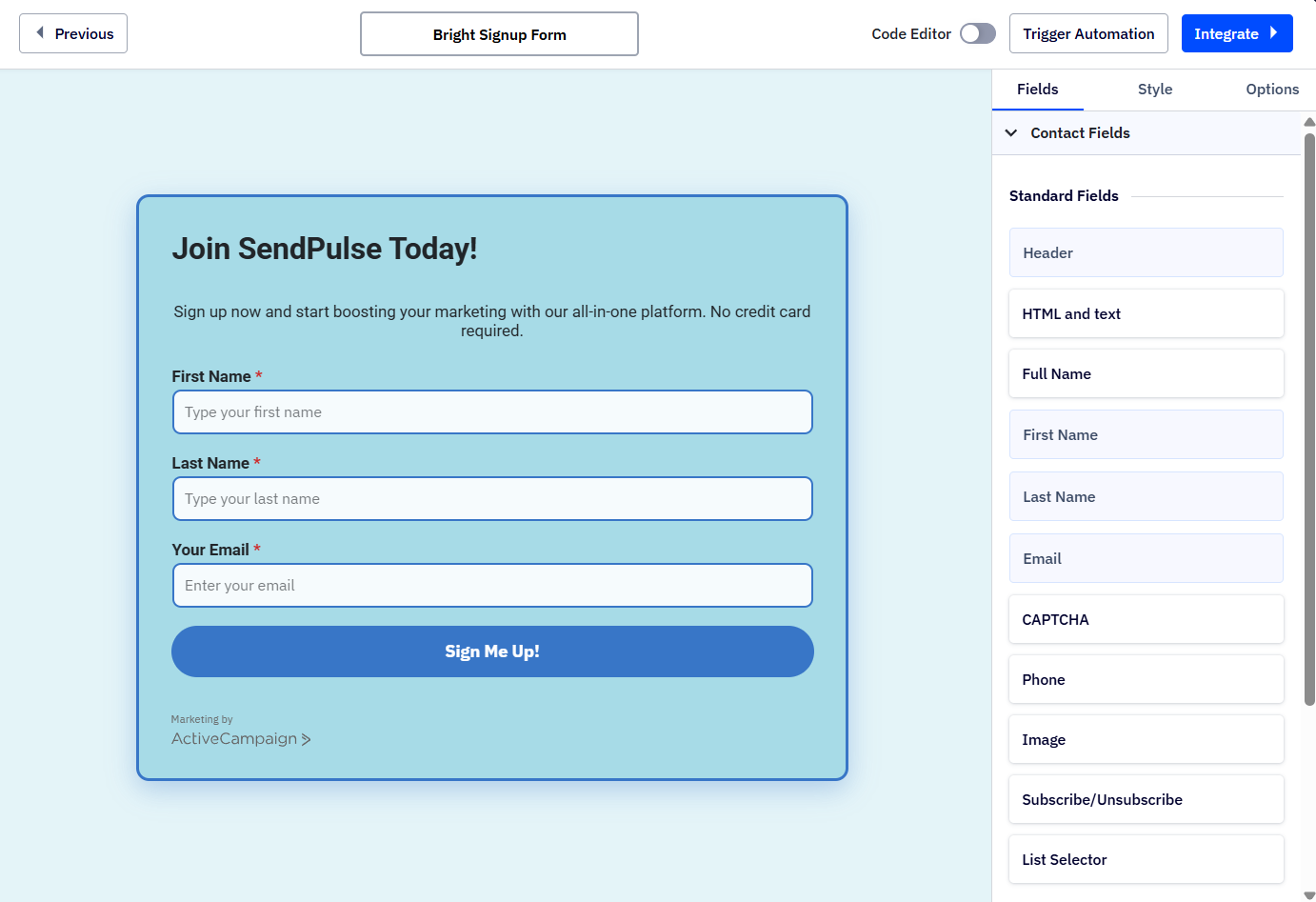 Customized signup form created by ActiveCampaign AI
HubSpot treats forms as CRM data-collection tools. Its native multi-step builder uses a searchable hierarchical tree to organize complex forms and includes built-in progress bars and customizable navigation between steps. Instead of focusing primarily on email subscriptions, HubSpot captures detailed business information, including company name, job title, and company size, syncing every field directly with CRM records. This makes it particularly well suited for lead qualification and B2B sales processes.
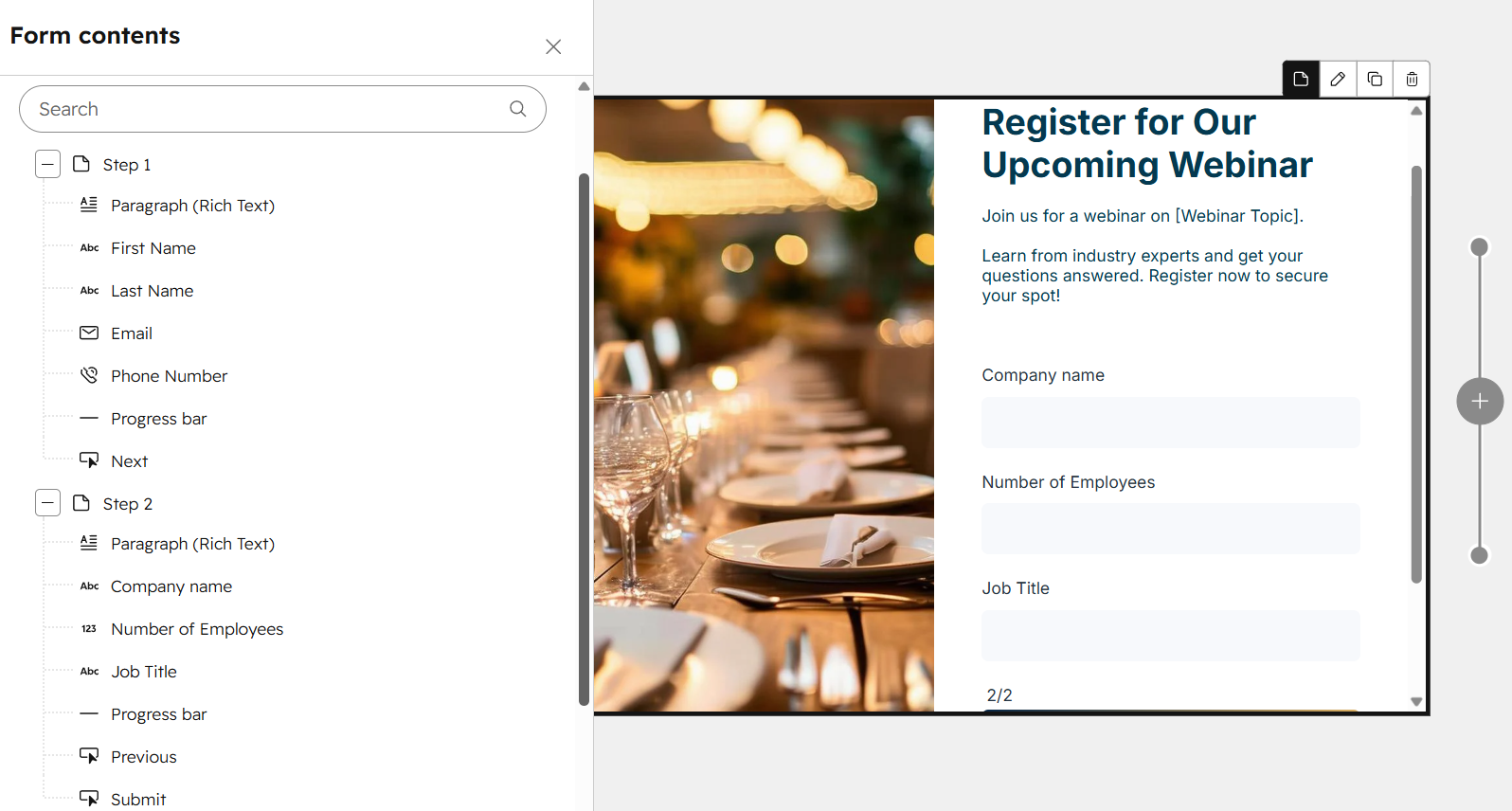 Creating a subscription form in HubSpot’s builder
Both builders integrate with automation, but while ActiveCampaign focuses on growing and segmenting mailing lists through a wider selection of fields and flexible subscription management, HubSpot focuses on enriching CRM records, offering one of the strongest multi-step qualification experiences we’ve tested.
Overall, ActiveCampaign is a nice all-around form builder for most email marketers, while HubSpot is a better choice when forms are primarily used to qualify business leads and feed detailed information into a CRM system.
Integrations
ActiveCampaign: 9/10 | ⭐ HubSpot: 9.2/10
Integrations are where HubSpot’s ambitions pay off. ActiveCampaign connects to almost every tool a marketing team is likely to touch. Still, HubSpot goes a step further, wiring marketing, sales, service, and reporting tools into one system.
| Aspect |
ActiveCampaign |
HubSpot |
Winner |
| Integration catalog |
1,000+ apps, combining native integrations with connections through Zapier and the open API |
2,000+ native apps and roughly 1,400 connected via Zapier |
HubSpot |
| eCommerce platforms |
Deep native integrations with Shopify, WooCommerce, and Magento; BigCommerce and other stores connect through the API or Zapier |
Native Shopify sync with multi-store support and updates every few minutes; WooCommerce, NetSuite, and more from the marketplace |
Tie |
| CRM systems |
Built-in CRM with sales pipelines and lead management; connectors for external CRMs |
CRM at the core of the platform; deep two-way Salesforce sync with property mapping and sandbox testing |
HubSpot |
| API capabilities |
REST API covering contacts, CRM objects, automations, campaigns, tags, and custom objects, with webhooks at both the account and automation level |
REST API covering the CRM, eCommerce, workflows, and custom objects |
Tie |
| Zapier support |
22 triggers and 31 actions spanning contacts, deals, custom objects, and campaigns |
12 triggers and 15 actions across contacts, companies, deals, tickets, and social posts |
ActiveCampaign |
| Total score |
9/10 |
9.2/10 |
HubSpot |
ActiveCampaign almost never leaves a marketing team stuck. Since it has over 1,000 apps, offers some of the most comprehensive Zapier support we’ve seen, and provides webhooks that can be triggered from inside an automation, it integrates smoothly with eCommerce platforms, marketing tools, and occasional custom systems. Its built-in CRM means you don’t need a separate integration just to manage pipelines and leads, and the API is broad enough to cover most bespoke setups.
HubSpot’s advantage is scale and cohesion. Its App Marketplace is one of the largest in the industry, and because every connected app reports into the same CRM system, integrations feel like part of the platform. The two-way Salesforce sync is a genuine differentiator for larger sales organizations, and native eCommerce connections keep customer data flowing without middleware.
So HubSpot earns the edge here, thanks to the sheer size of its marketplace and the depth of its CRM and Salesforce integrations. That said, ActiveCampaign’s stronger Zapier support and automation-level webhooks make it the more flexible choice for teams that automate across a lot of smaller, specialized tools.
AI features
ActiveCampaign: 8.9/10 | ⭐ HubSpot: 9.2/10
In this part, we’ve simply brought all the AI features together so you can see at a glance which platform makes better use of it in everyday marketing.
| Aspect |
ActiveCampaign |
HubSpot |
Winner |
| Email generation |
Generates complete emails, rewrites copy, imports brand assets, creates follow-up campaigns, and uses previous campaigns as AI context |
Generates complete emails, converts HTML into editable templates, summarizes campaign performance, and imports brand assets |
Tie |
| Automation generation |
Builds complete workflows, suggests next steps, and transforms data |
Builds workflows, triggers, individual actions, and custom code |
Tie |
| Predictive customer analytics |
Predictive content, contact and deal scoring, AI insights, and natural-language analytics |
Predictive lead scoring, AI revenue forecasting, contact prioritization, and workflow-ready predictions |
HubSpot |
| Smart segmentation suggestions |
Suggests 3 ready-to-use segments and monitors segment performance over time |
Builds segment filters and generates segment descriptions |
Tie |
| Total score |
8.9/10 |
9.2/10 |
HubSpot |
ActiveCampaign uses AI to help you work faster. Every AI feature it offers is designed to help you launch campaigns more efficiently. HubSpot applies AI not just for marketing but across the CRM as well, predicting which leads are most likely to convert, forecasting future revenue, and generating workflow logic. In other words, its AI supports business decisions just as much as campaign creation.
Deliverability
ActiveCampaign: 9.8/10 |⭐ HubSpot: 10/10
Both ActiveCampaign and HubSpot follow modern authentication standards, provide dedicated IPs for high-volume senders, and offer the tools needed to maintain good sender reputation. If you follow email marketing best practices, you can achieve excellent deliverability with either platform.
| Aspect |
ActiveCampaign |
HubSpot |
Winner |
| Authentication |
SPF, DKIM, DMARC, and BIMI support with guided or manual setup; automatic DNS record generation |
SPF, DKIM, DMARC, and BIMI support with guided setup, authentication status monitoring, and support for up to 2,000 sending domains |
HubSpot |
| Deliverability monitoring |
Spam check tool, engagement management, and Gmail/Postmaster guidance |
Email health dashboard, recipient-level delivery status, graymail suppression, AI performance insights, and double opt-in |
HubSpot |
| List hygiene |
Automatic bounce suppression, engagement-based cleanup, email validation recommendations, and inactivity guidelines |
Automatic bounce suppression, graymail suppression, double opt-in, shared global bounce protection, and manual recovery for false bounces |
HubSpot |
| Dedicated IP |
Pre-warmed dedicated IPs with deliverability team guidance and reputation support |
Dedicated IP add-on with automated 40-day warm-up and support for multiple domains |
HubSpot |
| Total score |
9.8/10 |
10/10 |
HubSpot |
HubSpot gets a slight edge because it gives you more visibility into deliverability. Instead of simply helping you send emails, it also helps you understand why emails perform the way they do through sender health monitoring and AI-powered insights. Those are practical tools that make ongoing reputation protection easier.
Reporting and analytics
ActiveCampaign: 8.4/10 | ⭐ HubSpot: 9.2/10
Good reporting should tell you more than who opened an email; it should help you understand what happened next and whether your marketing contributed to real business results. Here’s how ActiveCampaign and HubSpot approach that task.
| Aspect |
ActiveCampaign |
HubSpot |
Winner |
| Report coverage |
Campaigns, automations, eCommerce, forms, contacts, SMS, deals, sales, forecasting, and custom reports |
Marketing, CRM, sales, website, social, ads, workflows, revenue, forecasting, customer journeys, attribution, and custom reports |
HubSpot |
| Custom reports |
Custom reports with cross-data analysis, reusable dashboards, scheduled email delivery, and funnel reporting |
Single-object and multi-source report builders, attribution reports, dashboards, recurring reports, and up to 12 dimensions/measures per report |
HubSpot |
| Reporting speed |
Campaign reports update in near-real-time; automation overview reports refresh every 24 hours; custom reports refresh once daily |
Campaign and CRM reports update in near-real-time; custom reports auto-refresh every 2 hours |
HubSpot |
| Export capabilities |
CSV, Excel, JSON, TXT, HTML, and Markdown |
CSV, XLS/XLSX, and PDF |
ActiveCampaign |
| Total score |
8.4/10 |
9.2/10 |
HubSpot |
ActiveCampaign offers everything most marketing teams expect. Campaign, automation, eCommerce, sales, and SMS reports are all there, and the custom report builder is perfectly capable for day-to-day analysis.
HubSpot goes beyond marketing analytics, bringing together CRM, sales, website traffic, ads, social media, customer journeys, revenue, forecasting, and attribution into a single reporting system. That’s a completely different level of visibility, especially for businesses where multiple teams contribute to revenue.
Customer support
ActiveCampaign: 7.2/10 | ⭐ HubSpot: 7.4/10
Starting with a large platform like HubSpot or ActiveCampaign inevitably comes with questions. Here’s how both platforms answer them, supporting users through human assistance, AI guidance, and self-service resources.
| Aspect |
ActiveCampaign |
HubSpot |
Winner |
| Channel availability |
Live chat, email, and self-service resources |
Chat, email, phone, call-back support |
HubSpot |
| Knowledge base |
Extensive, clear, and concise help center |
Extensive help center |
ActiveCampaign |
| Onboarding assistance |
AI-guided setup, onboarding webinar, workshops, migration guides, deliverability consultation, and in-app AI assistant |
Personalized onboarding plan, AI assistant, migration and onboarding services, Customer Success Manager on higher plans |
HubSpot |
| Support quality sub-rating on Capterra |
4.4/5 |
4.4/5 |
Tie |
| Total score |
7.2/10 |
7.4/10 |
HubSpot |
Neither platform is particularly outstanding when it comes to customer support, as reflected in their identical 4.4/5 support rating on Capterra. Apart from that, they differ in what they prioritize. ActiveCampaign focuses on helping marketers become productive through AI guidance and self-service resources, while HubSpot builds a broader support ecosystem with phone support, Customer Success Managers, and learning resources.
Reviews surface each platform’s rougher edges, too. ActiveCampaign reviewers on G2 note that segmentation and reporting get harder to navigate as campaigns grow, and some call its pricing steep for small businesses, especially since attribution, predictive content, and predictive sending require the highest-tier plan. HubSpot users, meanwhile, note a real learning curve and limited customization without workarounds, and point out that data tools like deduplication sit behind a separate hub while attribution and reporting still leave room for improvement.
What changed in 2025–2026 for ActiveCampaign and HubSpot?
Both platforms saw major updates over the past year. Here’s what they focused on.
ActiveCampaign lowered the barrier to entry by cutting its starting price from $29 to $15/month and replacing separate Marketing and Sales products with a single platform that includes CRM. Throughout 2025–2026, it also expanded Active Intelligence, introducing AI-powered email and automation generation, proactive insights, and smarter audience analysis. WhatsApp was also added as a standalone marketing channel.
HubSpot invested heavily in AI. It launched the Breeze ecosystem with AI agents, a marketplace, and AI-assisted workflow creation, and introduced Answer Engine Optimization to help brands appear in AI search results. It also renamed Operations Hub to Data Hub and replaced its legacy pop-up forms with the newer CTAs tool.
In short, ActiveCampaign focused on making its platform more affordable and easier to automate with AI, while HubSpot expanded into a broader AI-powered business platform with new products and capabilities beyond email marketing.
We included this section because today’s updates often reveal tomorrow’s priorities. Understanding where each platform is heading can help you choose one that will continue to support your business as it grows.

Join businesses growing with SendPulse
From solo creators to global brands, thousands of customers trust SendPulse to run email campaigns, chatbots, automations, and more — all in one place.
Get started for free
Your decision checklist
Now you have all the information to choose the platform that best fits your business and email marketing needs. To make the final decision a little easier, here’s a quick checklist: if three or more points match one platform, that’s probably the right choice for you.
| Decision area |
ActiveCampaign
is a better fit if… |
HubSpot
is a better fit if… |
| Business type |
You run a marketing-first business that needs advanced email automation, deep CRM capabilities, and multi-channel campaigns. |
You run a business that needs marketing, sales, service, and content management in one unified platform, or a company already using HubSpot’s CRM that wants to expand into marketing automation. |
| Budget expectations |
You want enterprise-grade automation and CRM depth at a mid-market price point. |
You’re comfortable with high pricing in exchange for an all-in-one platform, and you’re willing to invest in onboarding. |
| Automation needs |
You need the most advanced marketing automation logic available without the complexity of a full enterprise platform. |
You need automation that connects marketing, sales, and service in one system, enrolling contacts based on deal stage changes, sequence completions, or revenue events, not just email behavior. |
| Analytics focus |
You need flexible custom reports combining campaign, automation, contact, and deal data. |
You need attribution reporting, predictive lead scoring, AI-powered sales forecasting, and revenue analytics across invoices, quotes, and subscriptions. |
| Team setup |
You work in a dedicated marketing or sales team that needs deep automation and CRM without the broader overhead of a full business suite. |
You work across marketing, sales, and service teams and need a single shared platform that keeps a contact’s entire journey, from first email to closed deal to support ticket, in one system. |
Before we finish, here’s one final reminder: choosing an email marketing platform is a long-term decision, especially if you’re investing as much as you would in HubSpot. Make your choice based not only on what your business needs today, but also on where you want it to be tomorrow.
Final verdict and recommendations
⚖️ Final scores: ActiveCampaign – 8.9/10 | HubSpot – 7.9/10
HubSpot is an exceptional platform. However, it’s not an exceptional value if you’re primarily looking for an email marketing platform. Much of what makes HubSpot so powerful – CRM, Service Hub, payments, forecasting, and operations tools – is also what makes it expensive, and many email marketers don’t need those capabilities. That is why we gave it a lower score. It doesn’t make HubSpot a bad platform; it simply isn’t the best choice if your main goal is email marketing.
ActiveCampaign, on the other hand, is impressive with very few compromises. It’s affordable, easy to justify, and exceptionally good at what it was built for – automation and email marketing.
But what if neither HubSpot nor ActiveCampaign feels like the perfect fit for your business? In that case, consider these alternatives:
- SendPulse – if you want an all-in-one platform with built-in CRM and chatbots at a much lower price.
- Omnisend – if you run an eCommerce business and want email marketing, automations, and SMS built around online sales.
- Kit – if you’re a creator or newsletter-focused business looking for a simple platform with a generous free plan.
Ultimately, there isn’t a single platform that’s perfect for everyone. The right choice depends on your business, your budget, and the way you work. Hopefully, this comparison has made that decision a little easier.
ActiveCampaign vs HubSpot FAQ
Do HubSpot and ActiveCampaign have a free plan?
HubSpot has a permanent free plan that includes CRM features, limited contacts, and capped monthly emails; ActiveCampaign doesn’t have a free plan, but you can test the platform for 14 days.