If it feels like your customers’ inboxes are a battlefield that you’re mostly losing, you are probably right. The average person is subscribed to dozens of email lists and bombarded with push notifications, pop-ups, and ads wherever they scroll. However, most consumers do have one thing in common: if their phone buzzes with a text, they look.
It’s no coincidence that global ad spend on SMS marketing keeps climbing. It is one of the few channels where customers actually want to hear from you. In fact, 87% say they welcome scheduling notifications from businesses. Moreover, 74% of people read every text they get, according to the same source.
Whether you are a local business sending appointment reminders, a B2B company running high-value alerts, or an eCommerce brand automating abandoned cart flows, this guide will provide you with modern and reliable SMS marketing tools you didn’t know you’ve been missing. We’ll break down diverse use cases, SMS pricing structure, compliance, scalability, and other key aspects of successful SMS marketing in 2026.
Disclaimer: This guide is published by SendPulse. Although we cover our own product alongside competitors, we aim to present each tool fairly.
Please note that all features, pricing, and positioning below are accurate as of September 4, 2026.
If you already know your use case, this quick overview will get you to the right platform in under a minute.
| Platform |
Best for |
Starting price |
Free trial/tier |
Standout features |
Compliance support |
| SendPulse |
Multi-channel marketing |
$0.024/SMS |
Free test SMS |
CRM, email, AI chatbots |
Standard registration support |
| Twilio |
Developers / API-first teams |
$0.0083/message |
Free trial |
Programmable Messaging API, Conversations API |
Guide and Fast Track package |
| Klaviyo |
eCommerce combining email and SMS |
$20/mo email + ~$0.01/SMS |
Free plan |
Unified customer profiles, deep segmentation |
Handled within platform |
| Attentive |
Enterprise eCommerce |
Quote-based |
Free trial on demand |
AI send-time optimization, concierge services |
Built-in, enterprise-managed |
| Postscript |
Shopify sellers |
$49/mo + $0.009/SMS |
30-day free trial |
65+ Shopify triggers & templates, compliance tools |
Standard registration support |
| SimpleTexting |
Small businesses |
$29/mo |
14-day free trial |
Shared inbox, AI-assisted replies |
Compliance-friendly tools built in |
| EZ Texting |
Small businesses |
$25/mo |
14-day free trial |
AI-assisted campaign creation, unlimited contacts |
Standard registration support |
| Omnisend |
eCommerce brands |
$59/mo + $0.007–$0.009/SMS |
Free plan (SMS on Pro) |
TCPA-friendly forms, frequency caps, lifecycle segmentation |
Built-in, compliant by default |
| SlickText |
Small businesses |
$29/mo (500 credits) |
14-day free trial |
Rollover credits, API access |
Guide and white-glove service |
| Textmagic |
Low-volume, no-contract senders |
$0.049/text |
30-day free trial |
Polling/voting, email-to-SMS gateway, BYOC |
Standard registration support |
| Textedly |
Businesses wanting AI voice + SMS |
$29/mo |
14-day trial + free plan (50 msgs) |
24/7 AI voice & SMS agents, text-to-pay, business reviews |
Standard registration support |
| Textla |
Small businesses wanting hands-on support |
$25/mo |
14-day free trial |
Shared inbox, US-based support, real-time insights |
Standard registration support |
If two or three names above overlap with your use case, it’s worth diving into our detailed breakdown below before committing.
An SMS marketing platform is software that lets you build subscriber lists, capture consent, segment audiences, send, automate, and track text message campaigns at scale. It’s also referred to as text message marketing tools or SMS campaign software.
In simpler terms, this is the very engine behind every “Your order is on the way 🚚” update you’ve received. SMS marketing platforms are responsible for who gets a message, when, why, and whether the business is legally allowed to send it at all.
To avoid confusion, it helps to know what an SMS marketing platform isn’t. The category gets thrown together with a few adjacent tools:
- A raw SMS gateway or API (like Twilio’s core API) sends messages when your code tells it to. It does not include list management, consent tracking, audience segmentation, or campaign UI.
- A personal texting app operating as P2P messaging, meaning it is one-to-one, unthrottled, with no compliance features or documented consent. This makes it unsuitable for business messaging.
- An SMS marketing suite often bundles SMS alongside other communication channels. It offers personalization, list management, and conditional automation. These tools use application-to-person messaging, are registered and rate-limited by carriers, and require documented consent.
Only the latter option gives you the flexibility and marketing features you need to run compliant campaigns at scale. The API requires you to build those features yourself, and the personal texting app does not offer them at all.

Start growing with SendPulse
Join thousands of businesses using SendPulse to make marketing, automation, and sales easier. Explore the tools built for growth.
Get started for free
Why brands use SMS marketing in 2026
If you have any doubt left about whether SMS deserves a place in your marketing stack, here are the reasons other businesses keep coming back to it:
- Direct line of communication. Customers are conditioned to treat texts as personal and immediate — this is where messages from friends and family land. This is exactly why SMS click-through rates can run five times higher than email, often read within minutes of arrival.
- Built-in urgency. A text reads as time-sensitive in a way email and social posts don’t. That makes SMS the natural communication channel for anything with an expiration date on it, be it flash sales, last-call inventory, or appointment reminders.
- Low cost relative to results. Similar to WhatsApp campaign pricing, SMS carries a per-message cost, but that cost buys predictable engagement that very few other messaging channels can offer.
- Reliable, predictable delivery. Unlike email, SMS doesn’t get filtered into a promotions tab or flagged as spam by an algorithm you don’t control. As long as your opt-ins are properly captured and your sender ID is registered and compliant, your message reaches the inbox.
- Near-universal accessibility. SMS doesn’t require a smartphone, an app download, or even a data connection. Any phone that can receive a text can receive your message. This is one of the few channels that reaches customers regardless of device, income bracket, age, or tech savviness.
- Plays well with other channels. SMS can be paired with email and other communication channels. For example, an abandoned cart flow that starts with an email and follows up with a text gets more chances to convert than either channel running solo.
In short, SMS is far from becoming obsolete. If anything, its relevance only increases as other communication channels get noisier and more populated with ads.
SMS marketing compliance and regulations
Chances are, you’ve noticed you don’t receive as many spam SMS anymore, and those that do get through tend to be marked as potential spam automatically. The reason for this is strict carrier network filters and legal rules governing who can text whom, when, and with what consent. Here’s what you need to know before you get started with SMS marketing tools.
TCPA and consent (US)
The Telephone Consumer Protection Act (TCPA) is the federal law that governs SMS marketing in the US. Its baseline requirement is simple: you need prior express written consent before sending a single marketing text. The consent must be a clear and documented agreement, not a sneaky pre-checked box or a number pulled from a purchase form.
Transactional text messages, like order or appointment alerts, only require the lighter “prior express consent” standard, which can even be verbal. But the moment your texts start promoting something, written consent is the rule.
Opt-outs work the same way in reverse. Consumers must be able to withdraw consent, and once they do, you have to stop all future marketing texts, but keep careful records of how and when that opt-out came in.
Since April 2025, businesses must honor opt-outs through any reasonable channel, including email, phone calls, or chatbots, under the FCC’s consent-revocation rules. Under the TCPA, you also must process them within ten business days, with only one brief confirmation text permitted afterward.
Quiet hours are a thing, too. You are only allowed to send marketing texts between 8 AM and 9 PM in the recipient’s local time zone, and several states narrow that time window even further.
A2P 10DLC registration explained
A2P 10DLC (Application-to-Person messaging on a 10-Digit Long Code) is a registration system that governs businesses’ texting sent from standard, local-looking phone numbers in the US.
Before it existed, there was no technical distinction between a person texting a friend and a company blasting 50,000 promotional messages from the same type of number. As a result, there was no reliable way to filter the ads without harming private conversations.
A2P 10DLC effectively created the much-needed separation between the two. With it, each commercial sender gets a registered identity that carriers can actually verify, trust-score, and throttle appropriately.
Registration happens in two layers:
- Brand registration verifies your business identity, including your legal business name, EIN, and other identifying details. Typically processed in a few minutes to a few business days.
- Campaign registration approves your specific use case, namely what you’re texting about, how you collected consent, and sample message content. Can take up to ten business days.
This typically isn’t included in your SMS marketing platform’s plan, so expect a separate, albeit moderate, carrier-imposed fee on top. Some of the SMS platforms offer onboarding and A2P guides, while others ensure a fully white-glove, care-free registration or even Fast Track packages.
Why it affects deliverability. Since February 2025, carriers block 100% of unregistered A2P traffic. Moreover, your registered campaign data directly affects your carrier trust score, which determines how aggressively your messages get filtered. Content violations can result in real penalties.
CTIA guidelines and carrier requirements
The Cellular Telecommunications Industry Association (CTIA) is a US trade association, and its industry guidelines are meant to keep the SMS ecosystem healthy for everyone. CTIA guidelines are recommendations, not federal laws, but it helps to think of them as an important industry benchmark.
The practical basics are straightforward:
- Get clear opt-in consent. People should actively agree to receive marketing texts from your business. Don’t assume consent based on an existing customer relationship. Keep records showing when and how someone opted in.
- Introduce yourself. Make the sender obvious, especially in the first message. A recipient shouldn’t have to guess which company is texting them.
- Make it clear what people signed up for. Set expectations around the type of messages they’ll receive, like promotions, appointment reminders, order updates, etc.
- Give them an easy way to stop messages. Standard commands such as STOP should work, and unsubscribe requests should be honored promptly.
The rule of thumb is simple: if a message would feel surprising, misleading, or annoying to the person receiving it, carriers may see it that way too.
Carriers and providers restrict illegal, deceptive, abusive, or unwanted content, especially when it comes to areas such as gambling, tobacco, firearms, hate, sexually explicit content, and certain alcohol or sweepstakes promotions.
GDPR and other international SMS rules
- The EU/EEA (GDPR). GDPR applies to any business texting people in the EU or EEA, regardless of where your business is based. A phone number is personal data, so for sending SMS promotions, you need a lawful basis, which is almost always freely given, specific, informed, unambiguous consent – not a pre-ticked box. Non-compliance is expensive, with fines running up to 4% of global annual turnover or €20 million, whichever is higher.
- The UK (PECR/UK GDPR). The Data (Use and Access) Act 2025 raised the maximum penalty from £500,000 to £17.5 million or 4% of global turnover, and critically, the burden of proof sits with the sender. In other words, without a documented consent trail, your consent wouldn’t hold ground in an audit.
Beyond Europe, requirements vary sharply. For example, Canada’s CASL holds company directors personally liable, while Australia mandates SMS Sender ID registration since July 2026, with several other markets having their own GDPR-influenced rules.
For international senders, managing each country separately is not feasible. Instead, build to the strictest common standard, which means explicit, documented, specific opt-in for every contact. Then, let your platform automate consent logging and opt-out handling.
SMS marketing pricing
SMS platforms don’t all charge the same way. Two approaches are the most common, though you’ll also see variations.
Pay-as-you-go charges a set rate for every message you actually send, so your cost scales directly with volume. There’s no monthly plan or fixed bundle to buy. The exact rate depends on the destination country, message length, and sending route.
The advantage is precision and flexibility, since you pay only for what you send. The trade-off is predictability: a surprise spike in sending means a surprise on the invoice.
Buy-credits (prepaid bundle) flips the model. You purchase a block of message credits as part of a monthly or annual plan, and each SMS draws down that balance, with one credit usually equal to one SMS segment (MMS costs more).
Unused credits roll over rather than expiring at the end of the billing period, which softens the sting of a slower month. Here’s the catch: the advertised credit price typically doesn’t include carrier pass-through fees, which are billed separately on top.
Beyond these two, some platforms charge by contact list size (subscriber-based pricing), while others use a hybrid of a monthly fee plus per-message rates. It’s worth confirming which model a platform uses before you compare headline prices.
Hidden costs to budget for
The number on an SMS marketing tool’s pricing page rarely tells the full story. Here’s what you’ll typically see in the final bill:
- A2P 10DLC registration fees — one-time brand vetting (~$46+) plus a per-campaign vetting fee (~$15-17), independent of your platform subscription.
- Monthly campaign fees — a recurring charge (often ~$10/month per campaign) billed through The Campaign Registry on top of registration.
- Carrier pass-through fees — a small per-message surcharge (roughly $0.003-$0.005) that carriers charge regardless of which platform you use.
- DCA/aggregator fees — some providers route through a third-party Direct Connect Aggregator that tacks on its own fee (typically $0-$20 per campaign).
- Short-code lease costs — if you opt for a dedicated short code instead of 10DLC, expect $500-$1,000/month in leasing fees, plus its own separate registration process.
- MMS surcharges — picture messages cost more than plain text, typically three times more than a standard SMS.
- International rates — sending outside the US/Canada often comes with higher per-message rates, and may require country-specific sender ID registration.
- Overage and resubmission fees — going over your plan’s message allotment or getting a 10DLC campaign rejected and resubmitted can each trigger extra charges.
- Duplicate/unsubscribed contact fees — on subscriber-based pricing, some platforms bill for every contact stored, including duplicates across lists or numbers that already opted out.
Two platforms that look identically priced can leave you with very different real-world costs once all the surcharges are factored in, so it’s always worth asking for the total cost per message.
How to estimate your SMS budget
The real-life math is more approachable than the pricing pages make it look. This simple formula will give you a more down-to-earth monthly estimate:
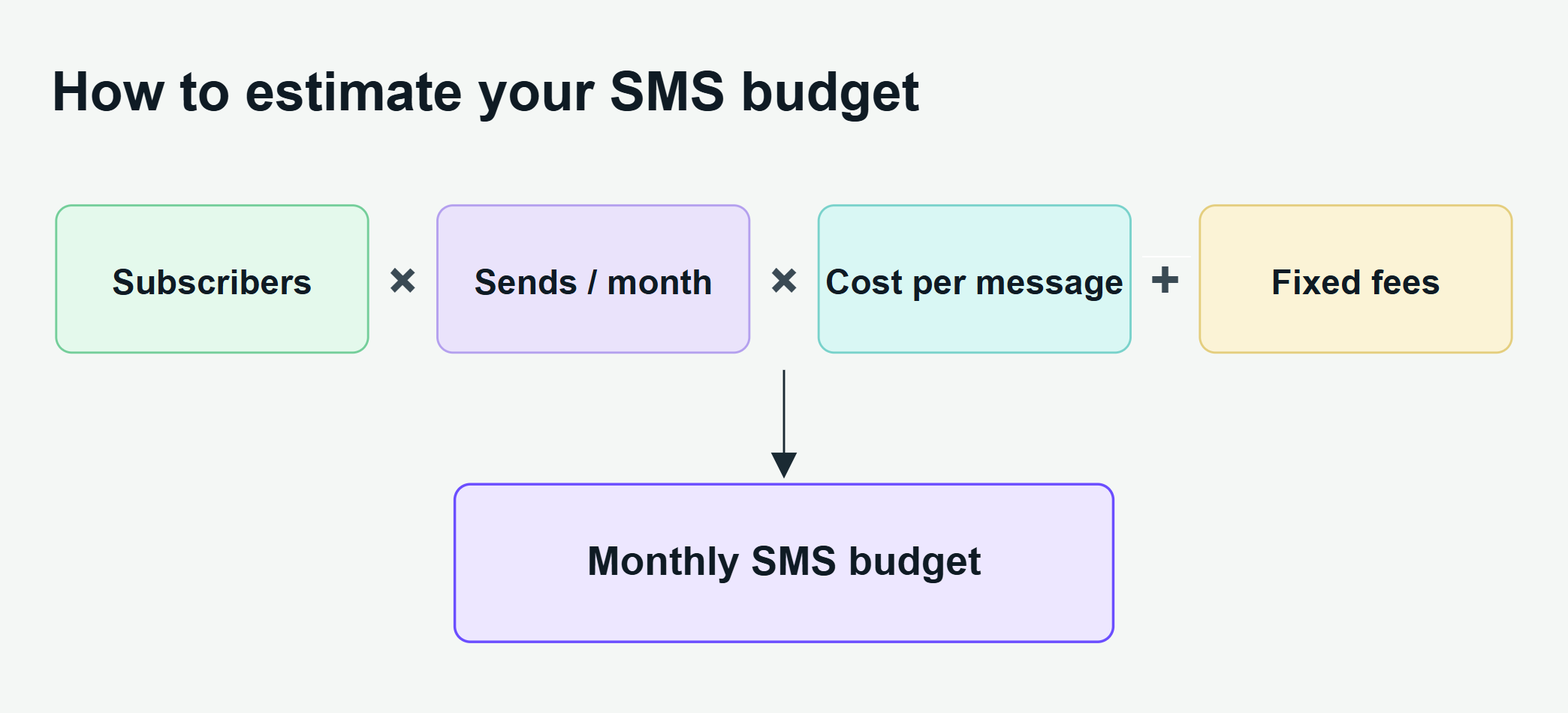 SMS budget estimation formula
This is what a base calculation may look like:
    2,000 subscribers × 4 sends/month × $0.02/message = $160
    + $10/month 10DLC campaign fee
    + $29/month platform base plan
    ────────────────────────────────
    ≈ $199/month, or roughly $0.10 per subscriber per month.
Here’s a more detailed breakdown:
- Subscribers — your active, opted-in list size, not your total contact database.
- Sends per month — how many campaigns/messages you’ll actually send to each subscriber, not your platform’s max allowance. Realistically, plan for around four to six sends per month per subscriber.
- Cost per message — your platform’s rate plus carrier pass-through fees (the total number from the last section).
- Fixed fees — the flat monthly costs that don’t scale with volume, like the 10DLC campaign fee, your platform subscription base, or any short-code lease.
While the formula above won’t predict your exact invoice as carrier fees and list sizes change, it will provide you with a more realistic range than simply comparing headline prices.
As a conscious marketer, you want SMS marketing software that actually ensures sustainable, personalized, and compliant campaigns at scale, not just fast ones. Here’s what we’ll be evaluating each platform against:
- Core campaign features. At minimum, a platform needs solid contact management, list segmentation, and automation/drip flows that are triggered by real customer actions. Other nice-to-haves include two-way SMS, MMS support, templates, personalization via merge tags, scheduling, and built-in link shortening with click tracking.
- Deliverability and sender reputation. How reliably your messages land depends heavily on throughput limits and number type — long code, toll-free, and short code each come with different sending speeds, costs, and carrier trust levels. If you compare two SMS platforms by sending identical campaigns, you’ll likely see different delivery outcomes based on their registration quality and sending reputation.
- Integrations. In 2026, SMS rarely works in isolation, so check how well a platform connects to your existing CRM and eCommerce stack like Shopify, WooCommerce, Zapier, and email tools. Preferably, you should be able to build seamless cross-channel automations, with SMS being part of a bigger puzzle.
- Analytics and reporting. SMS itself is hard to track — there’s no equivalent to an email open pixel, so “engagement” and CTR on a text is usually measured through the short link inside it. That makes built-in link shortening and click tracking a backbone of your SMS analytics. Your platform’s console should also supply you with A/B testing support and clear insights into your delivery rates and failure reasons.
- Built-in compliance tools. Ideally, the platform should handle opt-in and STOP-based opt-out processing automatically, log consent in a traceable way, and actively support A2P 10DLC brand and campaign registration.
- Pricing model and scalability. One key decision you’ll need to make early on is whether pay-as-you-go or a monthly credit plan fits your sending pattern better. Then, check whether there’s a trial package or free tier available and calculate the real per-message cost with carrier fees and how it changes with volume growth.
We’ve selected the platforms below based on the criteria above. Some of these tools are SMB-first while others boast serious enterprise and multichannel features, so you’ll find a good fit no matter where you are in your SMS marketing journey.
SendPulse
G2: 4.6 ⭐ | Capterra: 4.6 ⭐
SendPulse is an AI-driven marketing platform for email, chatbots, and SMS, tied together by a built-in CRM system. Its bulk SMS covers both transactional and promotional sends, with a visual campaign builder that handles carrier connections and routing for you.
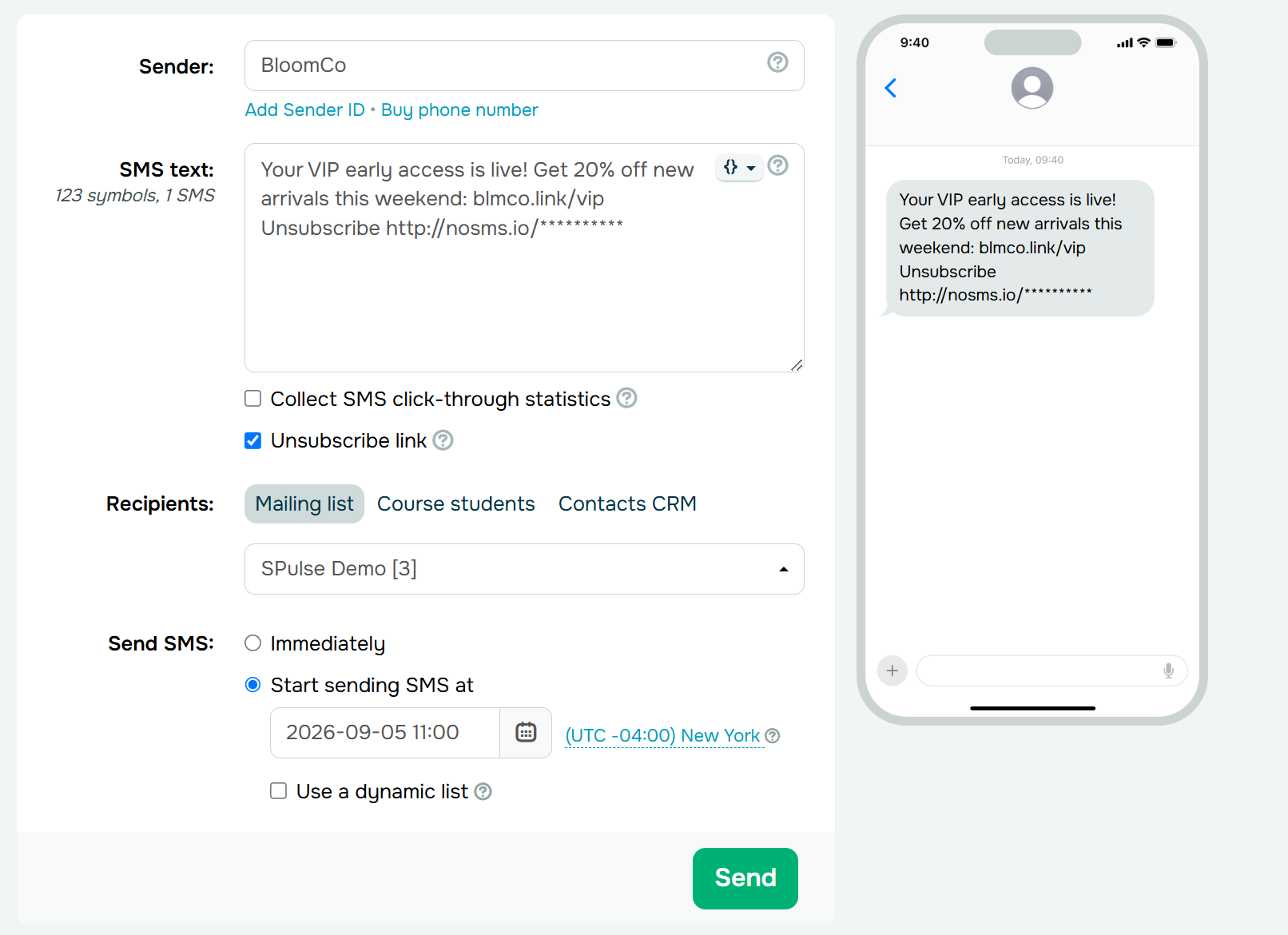 Building and scheduling a bulk SMS campaign in SendPulse
SendPulse’s feature list includes:
- native CRM with detailed customer profiles;
- AI-powered SMS chatbots for two-way conversations and feedback collection;
- automations across SMS, email, WhatsApp, and other communication channels;
- 200+ countries and 1,000+ operators covered;
- lead capture forms and pop-ups;
- bulk campaign scheduling;
- reusable SMS templates;
- event- and action-based triggers;
- list segmentation by age, interests, gender, and more;
- personalization with numbers, names, dates, and other data;
- bulk SMS API or SMPP gateway;
- integrations with Zapier, Pipedrive, and other eCommerce, email, and AI tools;
- detailed sender registration guides;
- 24/7 multilingual support via chat.
Limitations. SendPulse doesn’t offer white-glove A2P 10DLC registration (only self-serve guides), and its SMS analytics aren’t as deep on revenue attribution and click tracking as SMS-first tools. New users also mention a learning curve.
Pricing. SendPulse offers 10 free trial SMS messages. There’s no paid plan; you only pay for SMS you actually send, with a clear pricing structure by country, including estimated setup fees and registration times. US rate: $0.024/SMS. Check SendPulse’s official pricing page for details.

Power up your business with smart tools
From solo creators to global brands, thousands of customers trust SendPulse to run email campaigns, chatbots, automations, and more — all in one place.
Get started for free
Twilio
G2: 4.1 ⭐ | Capterra: 4.4 ⭐
Twilio is a developer-first SMS API built for sending marketing, verification, and authentication texts at scale. Rather than a visual campaign builder, it offers a code-based Programmable Messaging API. Relying on just a few lines of code, you can send, receive, and route campaigns across carriers globally.
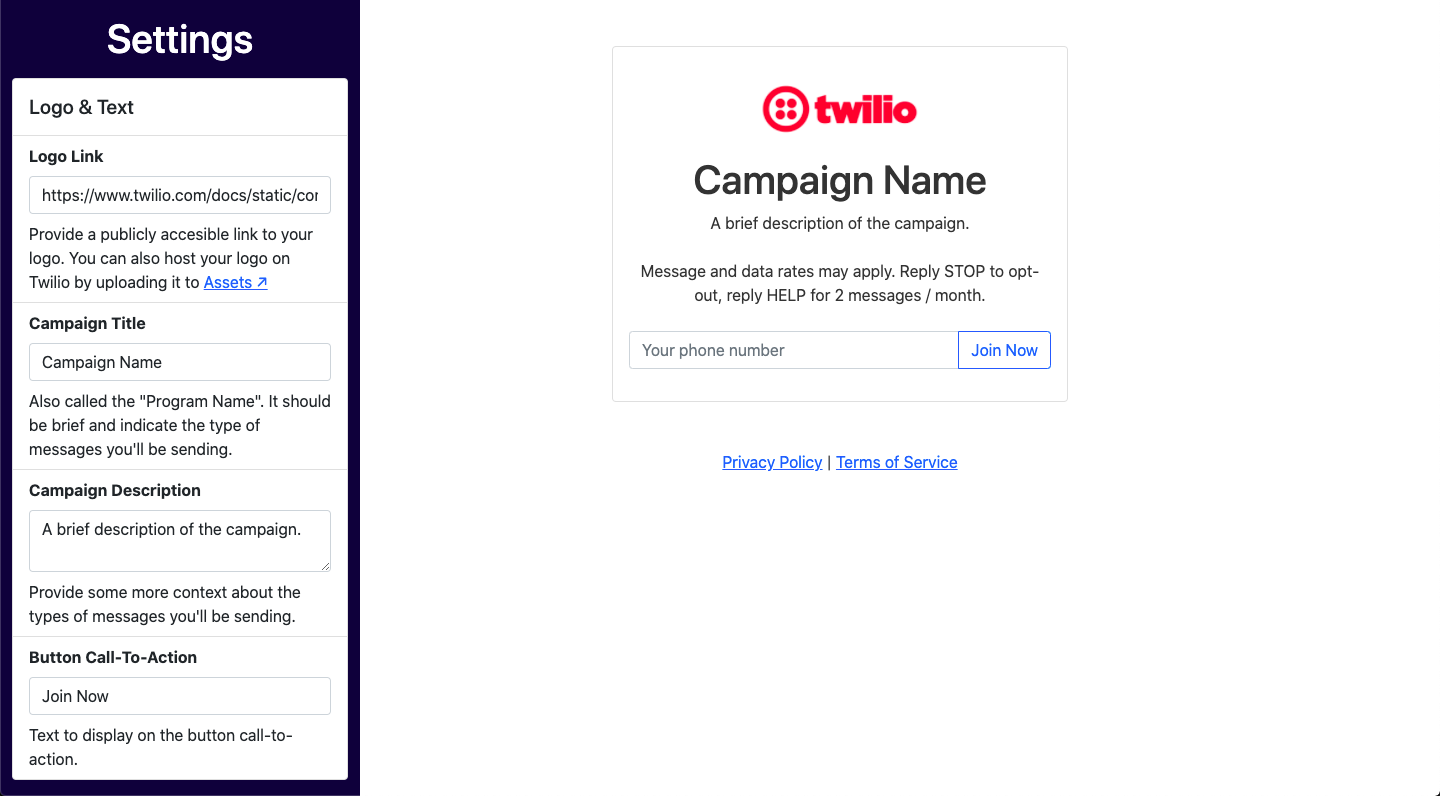 Creating an SMS subscriber opt-in form in Twilio with consent disclosures; source: Twilio
Here are Twilio’s strengths at a glance:
- 180+ countries, localized senders, and built-in compliance tools;
- all-in-one coverage for SMS, MMS, RCS, voice, email, and WhatsApp;
- authentication solution for 2FA, OTP, passkeys, and more;
- two-way, cross-channel messaging support;
- SMS opt-in form builder;
- reusable message templates;
- dynamic variables for personalization;
- A2P 10DLC registration guidance and white-glove expert services;
- toll-free and short code number support;
- campaign scheduling and native link shortening with click tracking;
- high-throughput routing and claimed low-filter-rate link delivery;
- in-depth analytics and real-time dashboards;
- rich docs and limitless integration opportunities through API access.
Limitations. Twilio has no conventional campaign builder, list segmentation UI, or marketing automation flows, so you build the entire marketing layer yourself or introduce a third-party tool into the mix. Reviewers also report slow, stall-prone A2P 10DLC setup and customer support that’s unresponsive without a paid plan.
Pricing. The platform offers a free trial and pay-as-you-go, country-specific rates. US rate: $0.0083/SMS (before carrier fees). Check Twilio’s official pricing page for details.
Klaviyo
G2: 4.6 ⭐ | Capterra: 4.6 ⭐
Klaviyo is an eCommerce-focused marketing automation solution with SMS being a native communication channel alongside email and social media platforms. The software’s key selling points are unifying customer data in the native B2C CRM system and employing agentic AI to optimize every interaction.
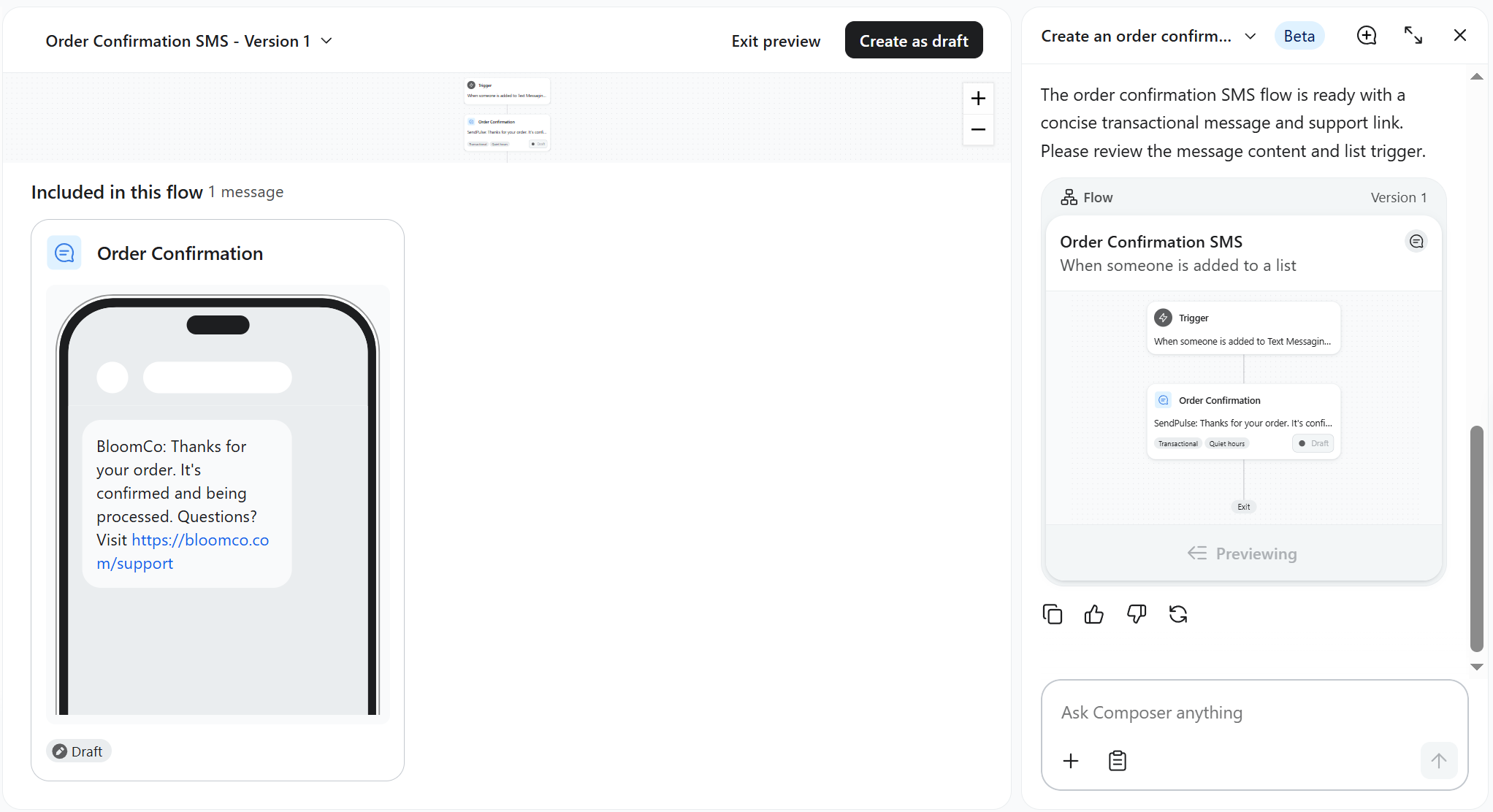 Building an SMS order-confirmation flow with Klaviyo’s AI assistant
Let’s go through Klaviyo’s feature list:
- unified customer profiles shared across SMS and email;
- toll-free, short codes, and 20+ countries supported;
- consent management and compliance toolkit;
- built-in consent safeguards and features like Quiet Hours;
- AI chatbots for two-way SMS exchanges;
- automated SMS A/B testing;
- smart campaign scheduling;
- pre-built cross-channel automation flows;
- AI-driven audience segmentation with real-time updates;
- SMS personalization powered by rich lifetime customer profiles;
- 70+ customizable opt-in form templates;
- multi-channel attribution and insights;
- deep native integrations with platforms like Shopify and 350+ others.
Limitations. Klaviyo’s SMS strength mostly makes sense for eCommerce businesses with an established online store. Service providers and local businesses may struggle to justify the costs while underutilizing the platform’s potential. Reviewers also note that pricing climbs quickly as your contact list grows and that the advanced automations take time to learn.
Pricing. Klaviyo bills SMS separately as an add-on to the marketing suite and prices it per message through a visual calculator. Rates depend on the number type and volume, and they drop as you send more, with carrier fees bundled into the rate. US rate: from $0.009/SMS (carrier fees included). Check Klaviyo’s official pricing page for details.
Attentive
G2: 4.5 ⭐ | Capterra: 4.8 ⭐
Attentive is an AI-powered SMS and email platform built specifically for retail and eCommerce. Its main purpose is to engage customers with highly targeted, revenue-driving campaigns rather than broad blasts.
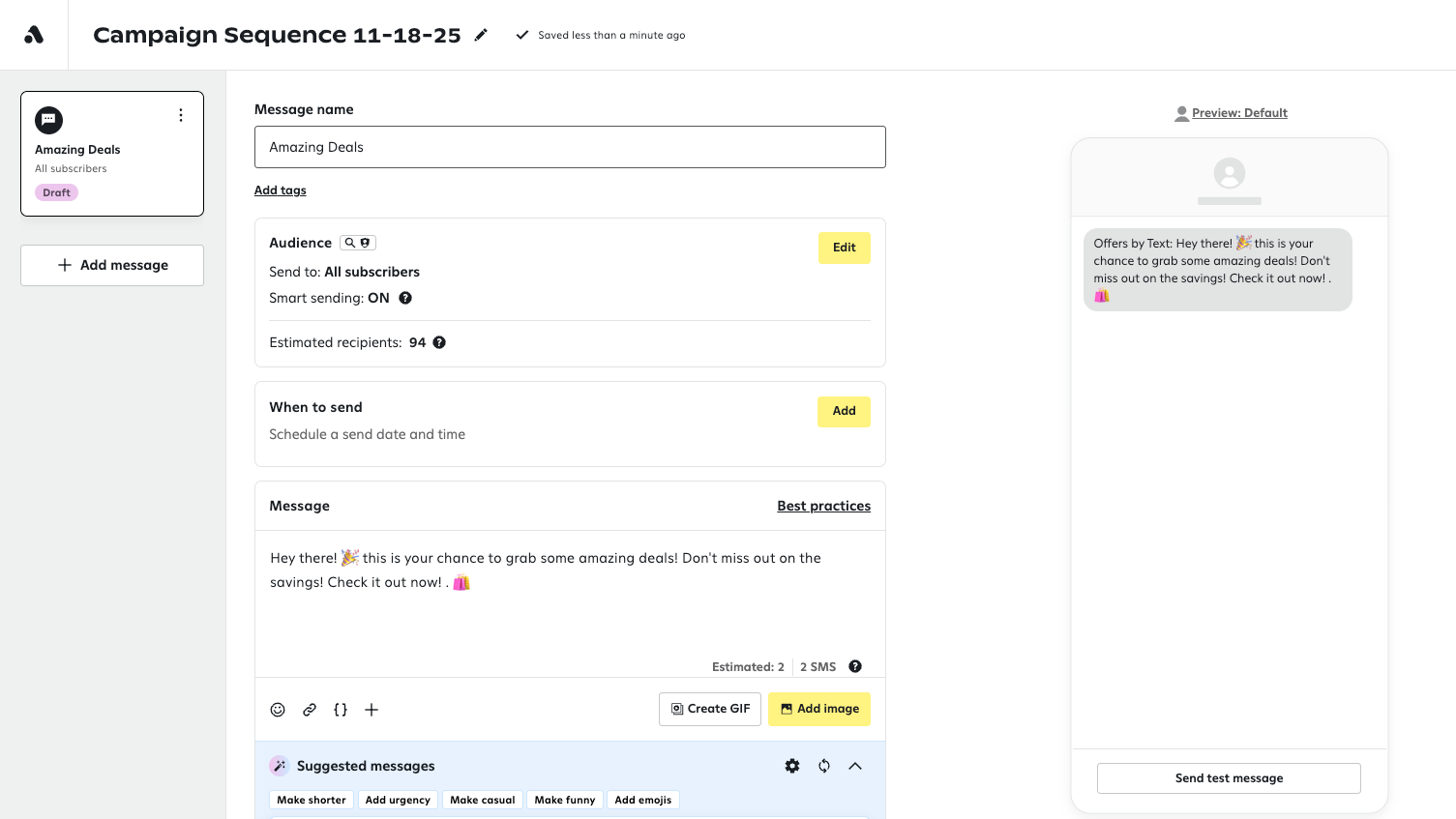 Composing an SMS campaign in Attentive; source: Attentive
The platform’s features include:
- AI-powered targeting and sending time optimization;
- intelligent, conditional sign-ups for quality list building;
- two-way conversational AI agent for SMS;
- rich subscriber profiles with historical and real-time data;
- built-in audit assistant, compliance checks and tools, and double opt-ins;
- AI-driven content insights and personalization;
- negative sentiment recognition and reassigned number support;
- intelligent AI SMS campaign scheduling;
- concierge-level implementation support;
- revenue and performance reporting;
- 100+ flexible integrations.
Limitations. Attentive is intended for brands with serious transaction volume and strict compliance requirements — it wouldn’t work as a lightweight tool for local businesses, service providers, or B2B senders. Reviewers point out that Attentive’s default attribution can overstate SMS-driven revenue and that advanced AI features sit behind higher pricing tiers, so cost and complexity climb at scale.
Pricing. Attentive uses custom, usage-based pricing, with AI tools available as add-ons; you request a quote and can start a free trial via their pricing page. US rate: custom (quote-based). Check Attentive’s official pricing page for details.
Postscript
G2: 4.8 ⭐ | Capterra: N/A
Postscript is an SMS-first marketing platform built specifically for Shopify sellers. Originally, it was purpose-built around SMS and a single eCommerce platform, though its team recently announced they’re expanding into email.
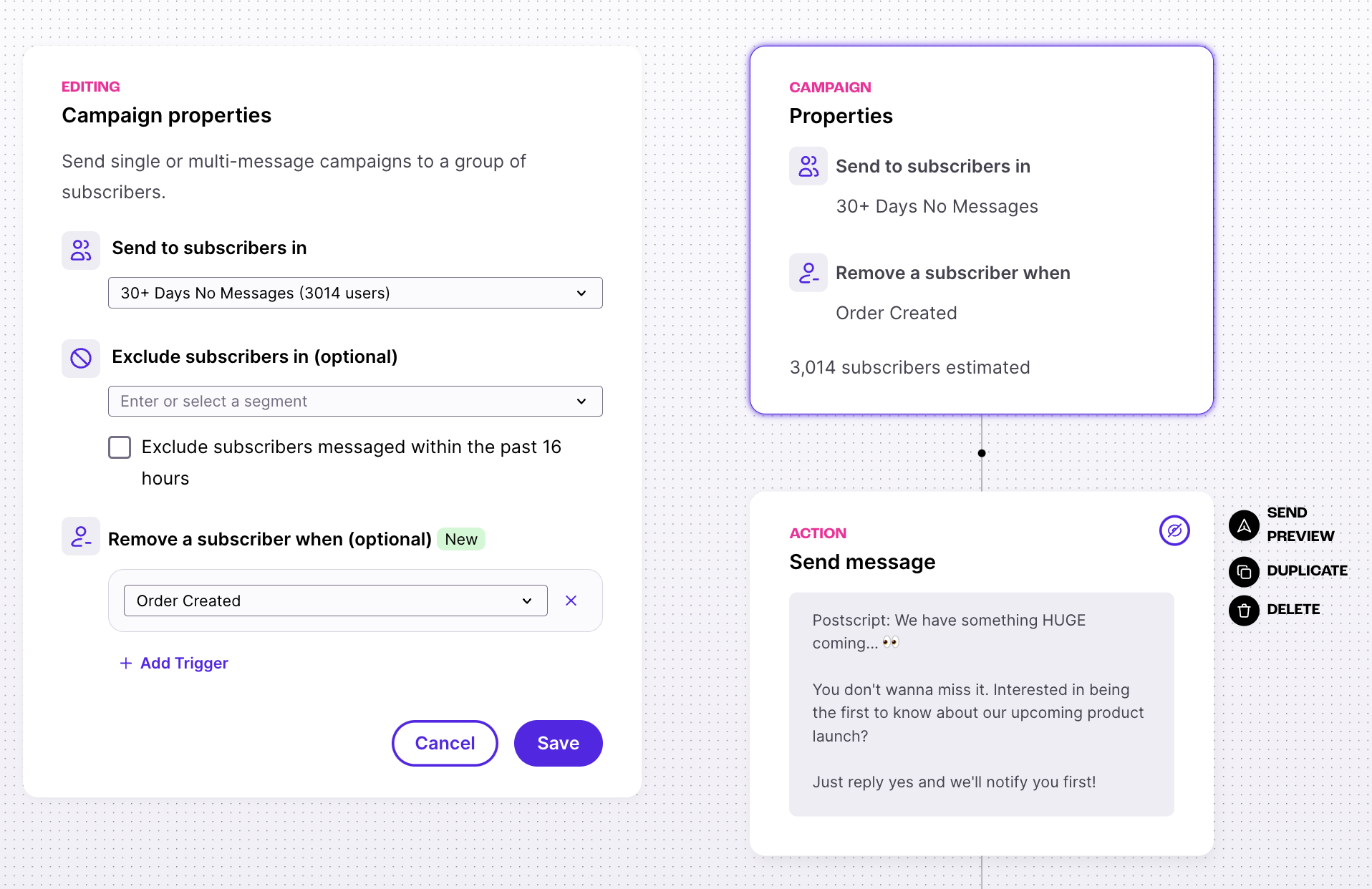 Building a targeted SMS campaign in Postscript, with subscriber segmentation and exit rules; source: Postscript
Postscript’s toolkit includes:
- personalized SMS and MMS campaigns with 45+ segmentation filters;
- 65+ Shopify-specific automation triggers and templates;
- high-converting opt-ins for desktop and mobile;
- text scheduler for timed sends;
- reliable consent records and access to vetted TCPA litigators;
- Quiet Hours and other compliance features;
- dashboard with a high-level overview of SMS performance;
- conversational AI agents for SMS and beyond;
- visual flow builder for nuanced two-way messaging;
- trackable text-to-join keywords and unique QR codes;
- global UTM parameters for campaigns and automations;
- coupons and short link subdomains;
- revenue attribution reporting;
- compatibility with checkout pages.
Limitations. Postscript’s biggest constraint is its ecosystem. With no native WooCommerce support, merchants outside Shopify are effectively locked out of its core value proposition. Pricing can also be a concern for budget-conscious users since Postscript charges both per message and a flat monthly fee. The costs can add up fast, especially when MMS is involved.
Pricing. Postscript offers a 30-day free trial and a Starter plan with a $49 minimum monthly spend at $0.009 per message; paid plans start at $100/month with per-message rates around $0.008. Carrier fees are billed separately on top. US rate: from $0.008/SMS (before carrier fees). Check Postscript’s official pricing page for details.
SimpleTexting
G2: 4.7 ⭐ | Capterra: 4.7 ⭐
SimpleTexting is a straightforward, small-business-friendly SMS marketing platform geared specifically toward senders targeting users in the US and Canada.
Here are the key features:
- mass SMS and MMS, templates, and two-way conversations;
- contact list management tools;
- audience segmentation and data collection;
- opt-in forms and text-for-info keywords;
- local, toll-free, and short code numbers;
- drip campaigns and free reply messages;
- scheduled SMS and autoresponders for timed and triggered sends;
- AI-assisted replies to help manage one-on-one FAQs;
- compliance-friendly tools;
- multi-number support and collaboration features;
- link tracking and shortening;
- connections to 1,000+ apps;
- API access for custom integrations.
Limitations. SimpleTexting is an SMS/MMS-only solution focused on the US and Canada, so it’s a poor fit if you need other communication channels or global reach. Reviewers are mostly happy, but some mention that pricing on extra messages could be lower and that a few important integrations are missing.
Pricing. SimpleTexting uses credit-based plans (1 credit = 1 SMS) starting at $29/month for 500 credits on a toll-free number, with extra credits at 5.5¢ each; number, registration, and carrier fees apply on top. US rate: from $0.055/SMS (before carrier fees). Check SimpleTexting’s official pricing page for details.
EZ Texting
G2: 4.5 ⭐ | Capterra: 4.5 ⭐
EZ Texting is a streamlined bulk SMS platform for effortless, safe, and scalable messaging. It’s suitable for appointment reminders, promotional campaigns, transactional SMS, and everything in between.
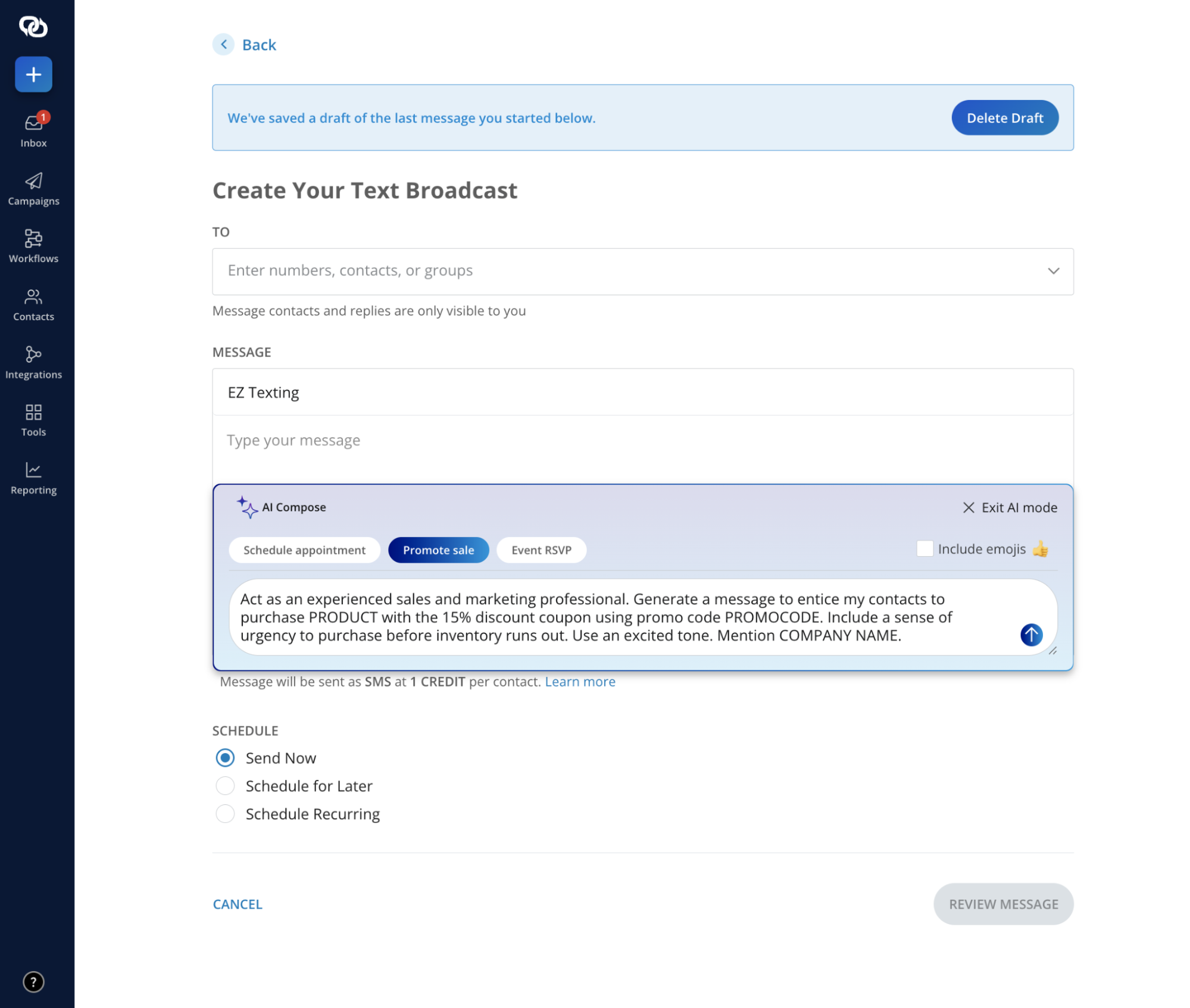 Drafting a promotional SMS with EZ Texting’s AI Compose; source: Capterra
Let’s go through EZ Texting’s crucial features:
- automation templates and a drag-and-drop builder;
- AI campaign composer;
- image library and editor for MMS;
- SMS campaign scheduler and visual planner;
- text-to-give and text-to-pay support;
- native opt-in tools;
- landline, toll-free, and short code number support;
- AI-powered SMS replies;
- support for six languages;
- A2P registration, real-time deliverability monitoring, and safeguards;
- reproducible opt-in records and one-tap STOP links;
- dedicated mobile app;
- app integrations via Zapier;
- advanced reports.
Limitations. The EZ Texting mobile app lacks efficient inbox navigation and management, which can be an issue for active senders. Reviewers also note the 160-character SMS limit is misleading because it counts the account’s phone number, and that texting sits outside your CRM as an extra step.
Pricing. EZ Texting uses a rollover credit system with unlimited contacts on paid plans. Monthly plans start at $25/month for 500 credits plus carrier fees. Higher tiers have zero carrier fees. US rate: from $0.05/SMS (credit-based; before carrier fees). Check EZ Texting’s official pricing page for details.
Omnisend
G2: 4.6 ⭐ | Capterra: 4.7 ⭐
Omnisend is an eCommerce-focused marketing automation platform with SMS and MMS intended to complement email and web push campaigns. With it, you can expect a no-code setup and strategic AI assistance at every step.
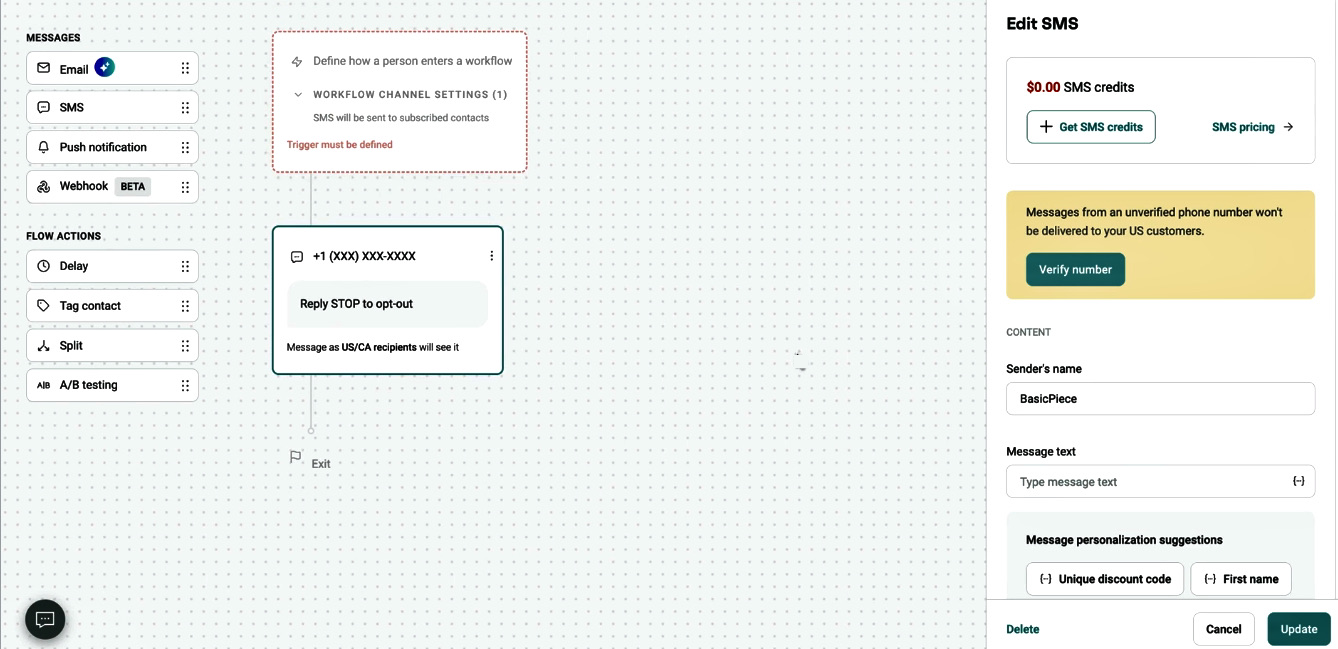 Adding an SMS step to a multi-channel automation in Omnisend; source: Omnisend
Here’s a quick overview of the platform’s key selling points:
- visual campaign editor;
- built-in frequency capping and quiet hours;
- two-way exchange support;
- short link click-through and sales tracking;
- SMS automation templates;
- dynamic, AI-powered lifecycle stage segmentation;
- SMS blocks that drop directly into cross-platform automations;
- A/B testing for automations;
- tag- and event-based triggers;
- double opt-ins and TCPA compliance support;
- carrier-optimized deliverability and high throughput;
- channel-specific reports;
- five-day free migrations;
- API and webhooks access.
Limitations. Being an email-first platform, Omnisend only includes SMS in its highest tier, making it an out-of-reach option for smaller businesses with tight budgets. Reviewers also note that reporting could be deeper without exporting and that form and template customization is limited.
Pricing. The software offers SMS as a premium add-on for the Pro plan, which starts at $59/month, with 30% off the first 3 months when you prepay. The price per SMS depends on the sending volume and destination country. US rate: from $0.009/SMS. Check Omnisend’s official pricing page for details.
SlickText
G2: 4.8 ⭐ | Capterra: 4.8 ⭐
SlickText is an intuitive text marketing software with a wide array of automation and list-building features and a minimal learning curve.
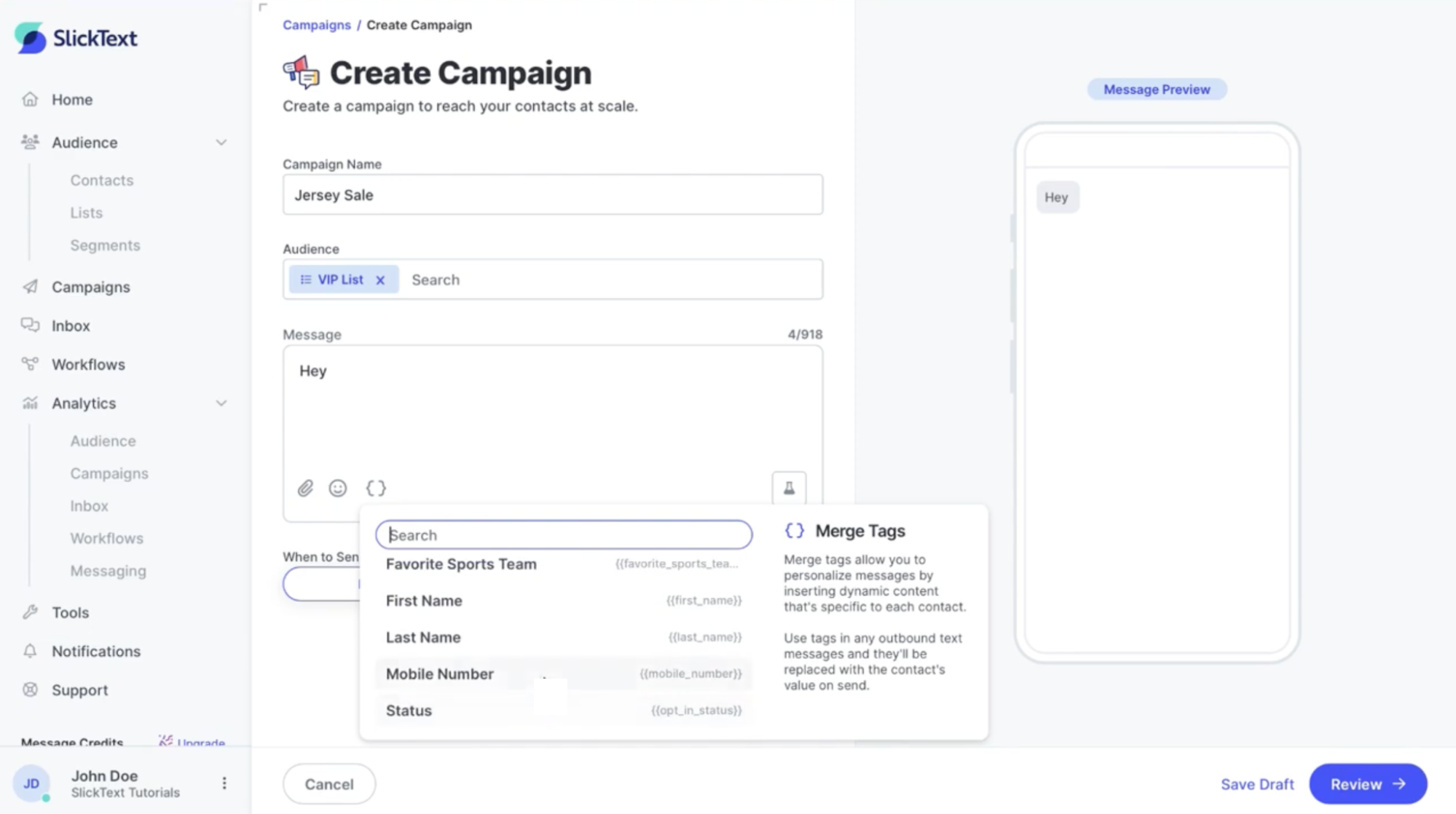 Creating an SMS campaign in SlickText; source: SlickText
Its complete feature list includes:
- bulk SMS and MMS with AI campaign drafting;
- drag-and-drop workflow builder;
- A/B testing and drip campaigns;
- personalized SMS and customer contact profiles;
- segmentation with custom fields;
- flexible campaign scheduling;
- conversational data collection;
- keyword-based opt-ins, tap-to-join links, pop-ups, and web forms;
- tags and statuses for smooth inbox management;
- notes, assignments, and other collaboration features;
- white-glove A2P 10DLC registration;
- consent management, age verification, and double opt-ins;
- AI-powered opt-out processing;
- actionable analytics dashboards;
- integrations with popular apps and via Zapier.
Limitations. SlickText currently only supports messaging in the US and Canada, which is a poor fit for brands with global audiences. Some reviewers want more built-in automation instead of routing contacts through Zapier. It’s also not the cheapest option, and a few reviewers say big group sends can add up fast.
Pricing. There’s a free 14-day trial, and credit-based plans start at $29/month for 500 credits (1 credit = 1 SMS). Credits roll over, and carrier fees aren’t included. US rate: ~$0.058/SMS on the entry plan (credit-based; before carrier fees). Check SlickText’s official pricing page for details.
Textmagic
G2: 4.4 ⭐ | Capterra: 4.6 ⭐
Textmagic is an uncomplicated, pay-as-you-go platform that brings SMS, email, and a shared team inbox together, with AI reply suggestions built in.
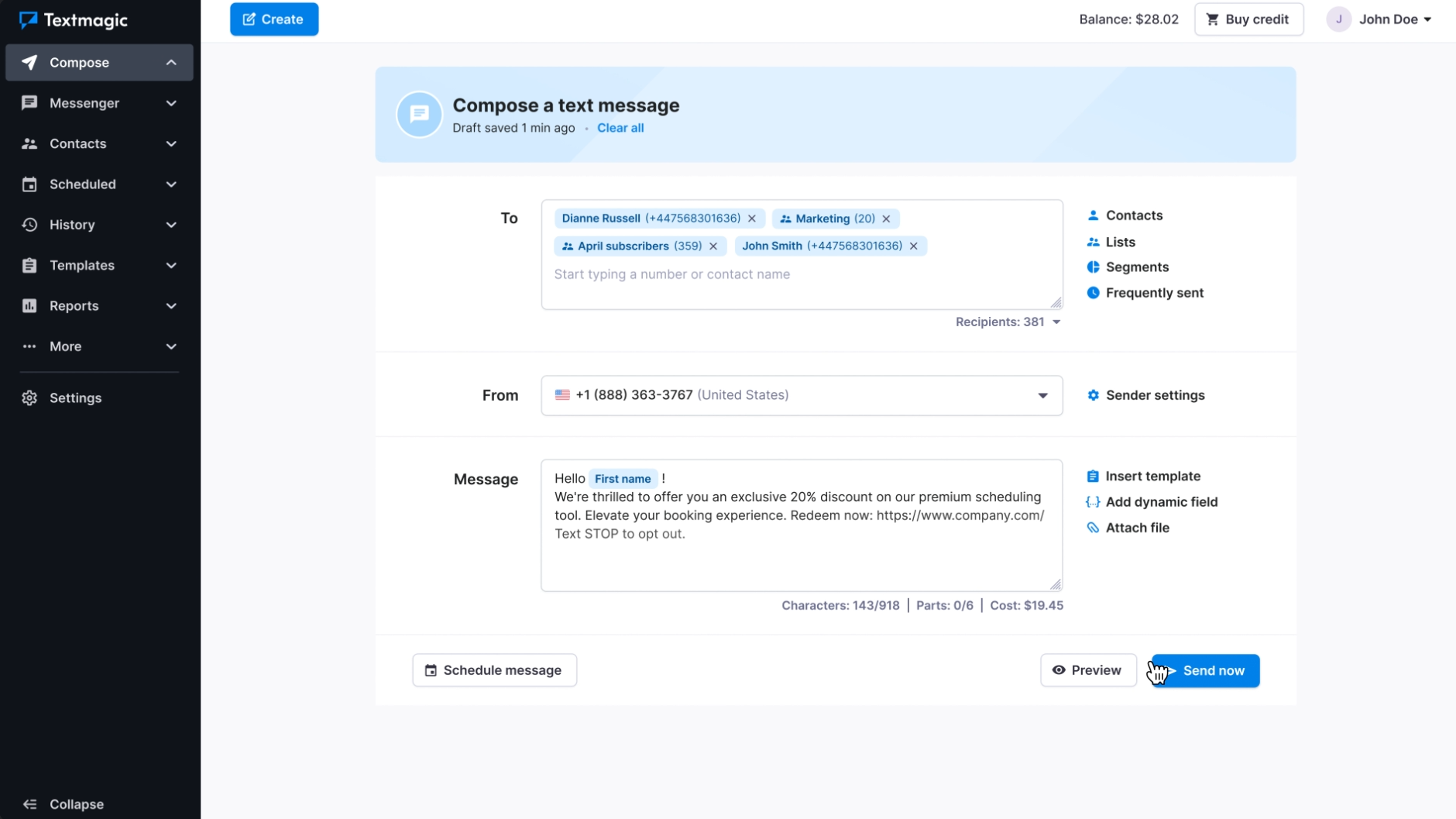 Composing a bulk SMS campaign in Textmagic, with segments, dynamic fields, and a live cost estimate; source: Textmagic
Here’s what Textmagic has to offer:
- bulk two-way SMS and MMS;
- embeddable opt-in forms;
- drag-and-drop automation flow builder;
- email-to-SMS support;
- toll-free and bring-your-own-number;
- scheduled and recurring campaigns;
- dynamic fields for granular segmentation;
- SOC2, GDPR, and 10DLC compliance;
- opt-out management;
- AI-powered SMS replies and knowledge base;
- native CRM and live chat;
- task and deal management for productive collaboration;
- SMS API gateway;
- reporting and analytics;
- integrations with Shopify, WooCommerce, Zapier, and other tools.
Limitations. With Textmagic virtual numbers, you cannot send SMS campaigns internationally. For that, you’ll need to connect your preferred Communication Platform as a Service (CPaaS) provider, and its pay-per-text model means large blasts add up. Some reviewers wish mass texts could be sent in a group format rather than paying to send many individual messages.
Pricing. The platform allows you to buy universal credits and use them both for email and SMS. The per-message rates depend on the type of number you use and the destination country. On top of that come registration and number rental fees. US rate: $0.049/SMS. Check Textmagic’s official pricing page for details.
Textedly
G2: 4.6 ⭐ | Capterra: 4.5 ⭐
Textedly is AI-first SMS campaign software with powerful capabilities for conducting human-like conversations and even collecting payments at scale via SMS.
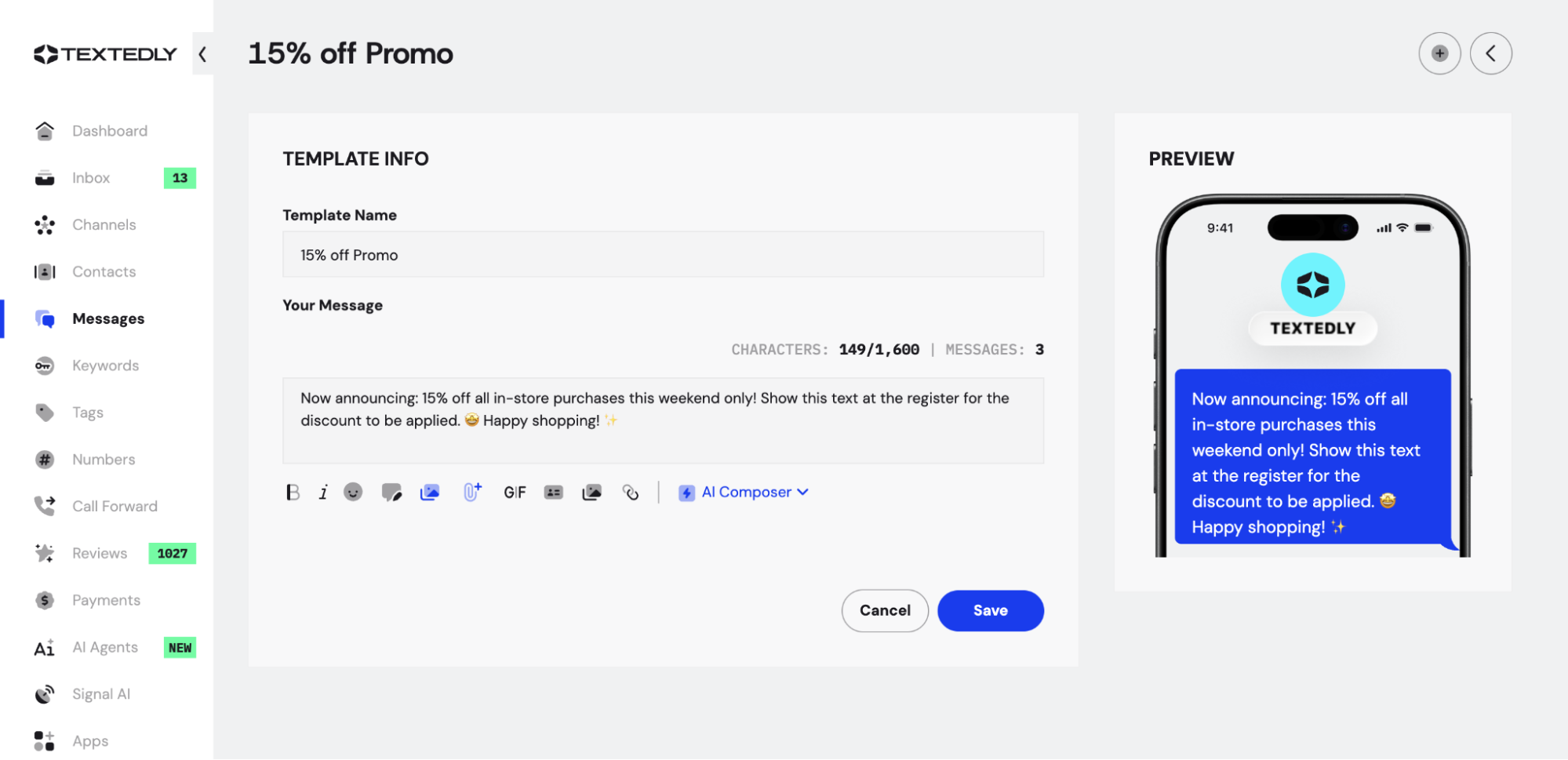 Editing an SMS campaign template in Textedly; source: Textedly
Textedly’s feature list spans every aspect of text marketing and beyond:
- one-on-one and broadcast SMS and MMS messaging;
- AI SMS campaign creation and rich font formatting;
- automated drip campaigns;
- free incoming messages;
- secure SMS payment links;
- mobile contact card support (via .vcf files);
- short links and link tracking (launching soon);
- custom compliant SMS signup forms;
- AI contact enrichment and smart fields for personalization;
- customer feedback collection;
- AI voice agents for inbound calls;
- email marketing automation (launching soon);
- iOS and Android apps;
- built-in reporting;
- API and SMS gateway (launching soon).
Limitations. Textedly can’t send to international numbers, and reviewers describe the initial number-registration setup as confusing without a tutorial. Because every plan includes the full AI/omnichannel toolkit, smaller senders also pay for voice agents and automation they may never use, with costs rising as you move to higher tiers.
Pricing. Textedly comes with a 14-day free trial and a free plan with 50 messages. Paid plans are credit-based and start at $29/month, and annual billing adds 20% more credits. Each account includes a free toll-free phone number and a free 10DLC phone number. US rate: from $0.45/SMS on the entry plan. Check Textedly’s official pricing page for details.
Textla
G2: 5.0 ⭐ | Capterra: 5.0 ⭐
Textla is a budget-friendly, instant-setup bulk SMS platform for businesses in need of uncomplicated, reliable outreach and contact management.
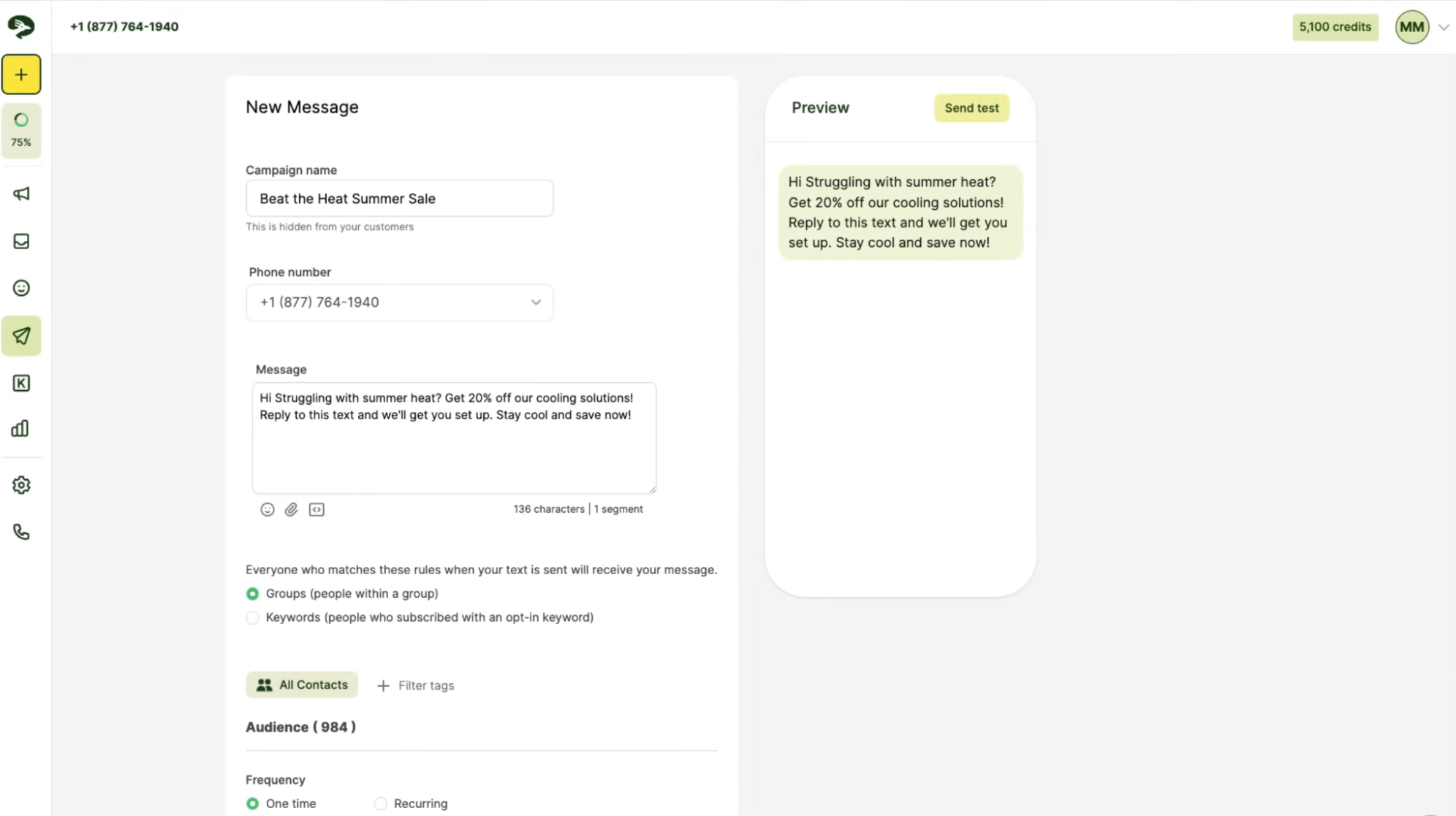 Editing an SMS campaign in Textla’s editor; source: Textla
Its feature list contains:
- mass and direct SMS and MMS campaigns;
- shared team inbox;
- groups and tags for easier contact navigation;
- audience segmentation and filters;
- campaign scheduling and personalization;
- keyword-based opt-ins;
- auto list clean for removing “dead” numbers;
- real-time deliverability insights;
- dedicated mobile app (coming soon);
- integrations with tools like HubSpot, Zapier, Slack, etc.
Limitations. Textla currently only supports toll-free US numbers, although there are plans to add local US numbers soon. Short codes are available upon request. Some reviewers note that number verification takes a few steps and that contacts can’t be grouped after upload.
Pricing. Textla offers a 14-day free trial with 100 credits, then paid plans starting at $25/month, with unlimited daily sends and no hidden fees. Annual plans are 20% cheaper. US rate: $0.01/SMS (carrier fees included). Check Textla’s official pricing page for details.
In the sea of SMS marketing tools, there’s something for everyone, no matter if you’re a seasoned developer or just getting started. Here are our best picks.
Best SMS platform for small businesses
SimpleTexting is our top pick for small businesses, while SendPulse suits small teams that want a free, low-commitment way to start and grow beyond texting.
| Rank |
Platform |
Why it fits |
| Winner |
SimpleTexting |
Easy two-way texting, a clean shared inbox, and transparent monthly credit plans with a short learning curve |
| Runner-up |
SendPulse |
A user-friendly visual builder, built-in CRM, and free lead capture forms for list growth |
Best SMS platform for eCommerce and Shopify
Postscript is our top pick for Shopify-focused SMS marketing, while Klaviyo is better suited to eCommerce brands that want to coordinate SMS and email using detailed customer data.
| Rank |
Platform |
Why it fits |
| Winner |
Postscript |
Shopify-native SMS automation for store events, including abandoned carts, post-purchase follow-ups, and back-in-stock notifications |
| Runner-up |
Klaviyo |
SMS and email automation driven by detailed eCommerce customer and purchase data |
Best SMS platform for enterprises
Attentive is our top pick for high-volume eCommerce businesses, while Twilio is better suited to enterprises that need global reach, transactional messaging, and more control over their SMS infrastructure.
| Rank |
Platform |
Why it fits |
| Winner |
Attentive |
AI-powered sending time optimization, list-growth tools, and concierge-level onboarding support |
| Runner-up |
Twilio |
Global messaging infrastructure, enterprise security, and SLA-backed reliability |
Best SMS platform for developers
Twilio is our top pick for developers who need flexible SMS infrastructure at scale, while Textmagic offers a more accessible API for integrating messaging into existing applications.
| Rank |
Platform |
Why it fits |
| Winner |
Twilio |
Global coverage, mature documentation, and proven reliability at scale |
| Runner-up |
Textmagic |
An SMS gateway API with ready-to-use scripts for Java, Ruby, PHP, Python, and Perl |
Best SMS platform for tight budgets
Textla is our top pick for budget-conscious senders thanks to the lowest advertised SMS rate in our roundup, while EZ Texting offers useful cost-saving features for lower-volume campaigns.
| Rank |
Platform |
Why it fits |
| Winner |
Textla |
Around $0.01 per SMS, a simple shared inbox, and responsive US-based support |
| Runner-up |
EZ Texting |
Rollover credits and unlimited contacts on paid plans |
Best SMS platform for multi-channel marketing
SendPulse is our top pick for multi-channel marketing, while Omnisend is better suited to eCommerce brands focused on coordinating email, SMS, and push campaigns.
| Rank |
Platform |
Why it fits |
| Winner |
SendPulse |
SMS alongside emails, chatbots, and native CRM, with pay-per-message pricing |
| Runner-up |
Omnisend |
Email, SMS, and push with lifecycle automation for eCommerce brands |
How to launch your first SMS marketing campaign
Once you’ve chosen a platform, launching an SMS campaign comes down to six steps:
- Get a sending number. Pick a 10DLC long code for local sending, a toll-free number for higher volume, or a short code for large-scale campaigns. Your choice affects throughput, cost, and carrier trust.
- Register your number. US carriers block unregistered traffic, so you have to register before you send SMS campaigns. A 10DLC long code needs brand and campaign registration. Toll-free numbers and short codes use their own verification instead. Approval takes from a few minutes for 10DLC to several weeks for a short code.
- Collect and log opt-in consent. Gather explicit opt-ins through a signup form, a text-to-join keyword, or a checkout checkbox, and keep a timestamped record of each. It’s both a legal requirement and the foundation of a healthy subscriber list.
- Segment your list. Group subscribers by behavior, location, or interest so every message is relevant. Targeted messages earn higher engagement and fewer opt-outs.
- Write and schedule the message. Keep it short, name your brand, include one clear CTA and a STOP opt-out, and send within quiet hours (8 AM–9 PM local). Personalize with merge fields where it’s relevant.
- Measure and refine. After each send, track delivery rate, link clicks, and opt-outs, then adjust your timing, copy, and segments. Small tweaks compound over time.
For consent and 10DLC specifics, see the compliance section above.
Summing up
As you can see, some of the best SMS marketing platforms cover very diverse needs. Looking for strong agentic AI and seamless conversions via text? Textedly could be your best bet. Need stellar deliverability and compliance for sensitive messaging? Look no further than SlickText with its built-in safeguards and premium carrier relationships.
But what if you want SMS working hand in hand with the rest of your marketing? Consider SendPulse with its built-in CRM system that powers automation across emails, chatbots, and SMS. Create your free account today to get started!
SMS marketing platforms FAQ
Which SMS provider is best?
There’s no single best SMS provider. SendPulse and SimpleTexting are strong for small businesses, while Twilio is better suited to developers, integrations, and large-scale transactional or global messaging.
Is SMS marketing legal?
Yes, but only when you follow the rules regarding consent, privacy, and commercial messaging in the respective countries where your audience is based. This includes regulations like TCPA in the US and GDPR in Europe.
Which SMS provider is free?
There is no truly free, unlimited SMS marketing provider because carriers always charge for message delivery. However, some services like SendPulse or Textedly offer free starter SMS.
What is the cheapest SMS service?
The cheapest option depends on message volume, destination country, and whether you need a full marketing platform or just an SMS API. Pay-as-you-go services tend to be cheapest for occasional sending, while subscription platforms may give you more attractive rates at higher volumes.