Both Klaviyo and HubSpot have a reputation for being expensive and difficult to learn, and judging by user reviews, that’s largely true. But after testing them ourselves, we found that those drawbacks aren’t really comparable.
How we scored this comparison: This review was created by the SendPulse team. As an email marketing platform ourselves, we work in the same space as the tools we test, which also means we understand the field deeply.
Each platform was evaluated across the key categories using our independent methodology. Pricing (25%), ease of use (20%), and email and automation features (15% each) carry the most weight because they affect daily workflows the most. All scores reflect hands-on testing and analysis as of August 2026.
TL;DR Klaviyo vs HubSpot comparison at a glance
Before we get to the full comparison, here’s a quick overview to help you understand both platforms in less than a minute. The category names are clickable, so you can jump straight to the sections that matter most when choosing an email marketing platform.
| Category |
Klaviyo |
HubSpot |
Winner |
| Best for |
eCommerce brands |
B2B and CRM-driven companies |
Depends on the use case |
| Pricing |
7/10
Predictable for growing stores |
4/10
Expensive enterprise platform |
Klaviyo |
| Ease of use |
7.5/10
Focused but eCommerce-specific |
7/10
Powerful but complex |
Klaviyo |
| Email design |
9.2/10
Advanced eCommerce email builder |
8.4/10
CRM-focused email builder |
Klaviyo |
| Automation |
9.4/10
Marketing and customer journey automation |
9.3/10
CRM and business process automation |
Klaviyo |
| SMS |
9.2/10
Full-featured global SMS marketing |
7.4/10
Basic North American SMS |
Klaviyo |
| Contact management |
9.5/10
Customer profiles and predictive segmentation |
9.5/10
Multi-object CRM segmentation |
Tie |
| CRM |
8/10
Customer marketing CRM |
9.8/10
Full sales and marketing CRM |
HubSpot |
| Forms and pages |
8.8/10
Conversion-focused forms |
8.5/10
CRM-driven lead capture |
Klaviyo |
| AI features |
9.2/10
Marketing and eCommerce AI |
9.2/10
Cross-platform business AI |
Tie |
| Integrations |
8.7/10
Strong eCommerce-focused integration ecosystem |
9.2/10
Massive, business-wide integration ecosystem |
HubSpot |
| Deliverability |
10/10
Excellent sender reputation tools |
10/10
Excellent monitoring and diagnostics |
Tie |
| Reporting |
9/10
Marketing and eCommerce analytics |
9.2/10
Business and CRM analytics |
HubSpot |
| Customer support |
7.3/10
Strong self-service resources |
7.4/10
More structured onboarding and support |
HubSpot |
| G2/Capterra rating |
4.6/4.6 |
4.4/4.5 |
Klaviyo |
| Final score |
8.6/10 |
7.9/10 |
Klaviyo |
Looks like we have a clear winner in this comparison! But Klaviyo won’t be the right choice for every business, just as HubSpot won’t lose for every use case. Read on to understand how they differ in detail and which platform is the better choice for your particular business needs.

Create and send high-performing emails
Use an AI assistant, pre-made templates, advanced segmentation, and feature-rich automation to run campaigns without coding. Start for free with up to 15,000 monthly emails.
Get started for free
Klaviyo vs HubSpot pricing and feature differences
How we tested: We signed up for both platforms and spent several weeks testing them. We compared pricing plans, built email campaigns, set up multi-step automations, and sent SMS messages. We created signup forms and landing pages and checked out template libraries and AI content tools. We also reviewed integrations and deliverability settings and compared how each platform handles customer data, from segmentation to full customer data platform capabilities. For customer support, we examined real user feedback on Capterra. All screenshots in this article were captured during our hands-on evaluation.
We begin with the factors that matter most when choosing an email marketing platform: pricing first, then the core features, and finally the areas that may influence your decision but are less likely to determine it. We’ll start by comparing pricing across different plans and then look at whether each platform is actually worth the money.
Pricing plans
⭐ Klaviyo: 7/10 | HubSpot: 4/10
Disclaimer: Pricing changes frequently. All prices in this comparison were verified against Klaviyo’s official pricing and HubSpot’s official pricing as of September 1, 2026. Always confirm current costs on the official pages.
Just to be clear, we’ve awarded a perfect 10/10 for pricing to several email marketing platforms we’ve tested. Klaviyo and HubSpot simply aren’t among them. Both are expensive compared to most competitors, and HubSpot becomes particularly costly once you start adding its different Hubs and advanced features.
Below, we’ve compared pricing across multiple plans because many of the features that make these platforms stand out are only available on higher-tier plans. We’ve also included SendPulse’s Standard plan to show that you don’t have to spend this much to get a powerful email marketing platform.
| Contacts |
Klaviyo, Marketing |
Klaviyo, Data + Analytics |
HubSpot, Starter |
HubSpot, Professional |
SendPulse, Standard |
| Free plan |
250 contacts; 500 emails |
1,000 CRM contacts; 2,000 emails |
500 contacts; 15,000 emails |
| 1,000 |
$30 |
$130 |
$11.50 |
N/A |
$18 |
| 10,000 |
$150 |
$250 |
$449 |
$1,584 |
$78 |
| 25,000 |
$400 |
$500 |
$1,120 |
$2,410 |
$159 |
| 50,000 |
$720 |
$936 |
$2,240 |
$3,616 |
$281 |
| Note: All prices reflect monthly billing. |
We also turned these numbers into a chart, in case you find it easier to compare prices visually.
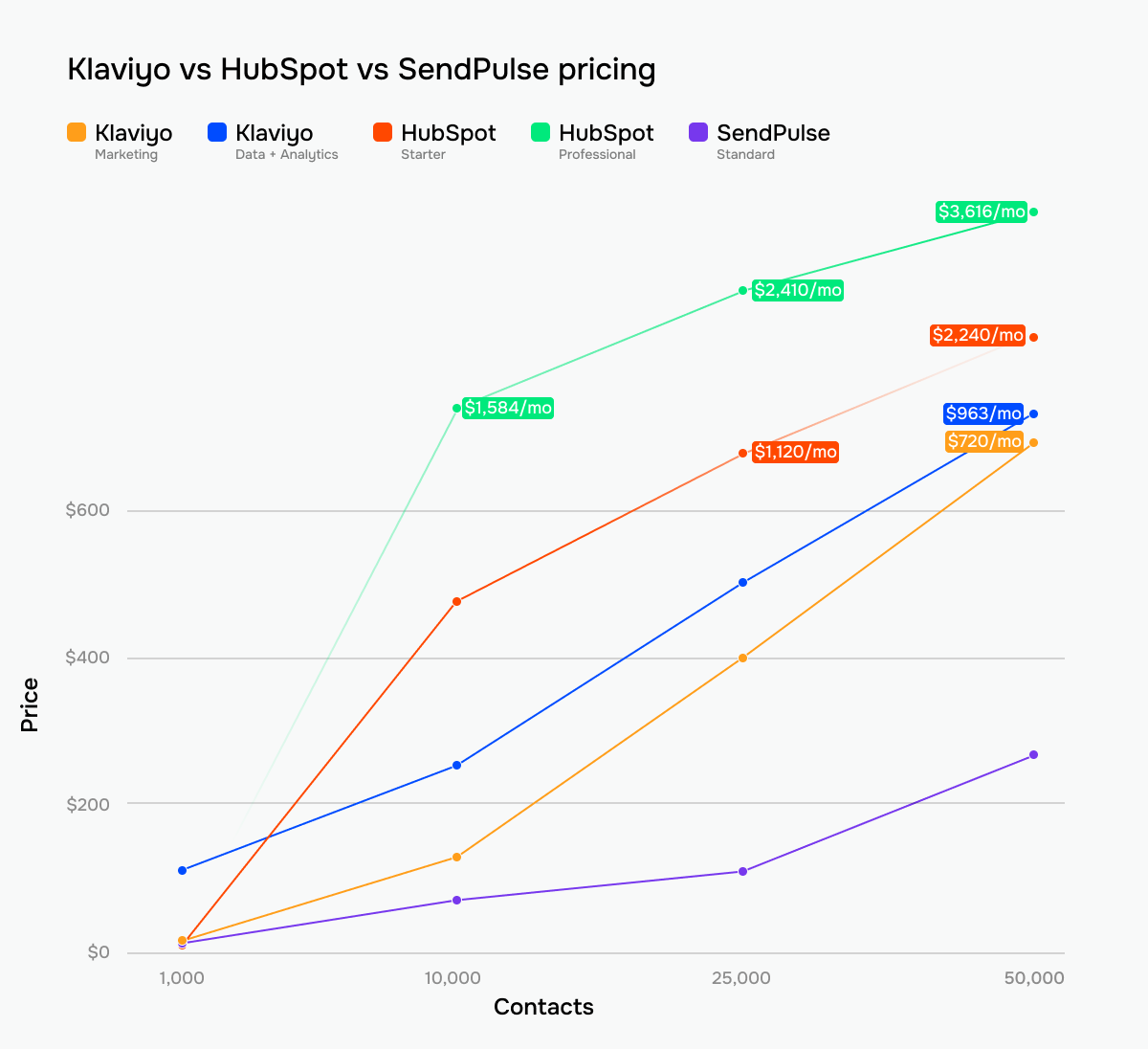 Klaviyo, HubSpot, and SendPulse pricing we compared across contact tiers
If both Klaviyo and HubSpot are beyond your budget, you can stop here. But we have to warn you – they really do offer unique features for the price they charge. Keep reading, because they might even offer capabilities you didn’t know you needed.
Ease of use and interface
⭐ Klaviyo: 7.5/10 | HubSpot: 7/10
As mentioned earlier, neither platform is particularly simple or intuitive. Both Klaviyo and HubSpot are large platforms with many features that aren’t always easy to navigate. Here’s what you can expect during your first days of using them.
| Aspect |
Klaviyo |
HubSpot |
Winner |
| First-time experience |
eCommerce-focused onboarding with store-aware setup; feels intuitive for online stores but less relevant for other businesses |
AI-guided onboarding and personalized tasks; broad platform with many hubs takes time to navigate |
Klaviyo |
| Daily navigation |
Clean eCommerce workspace with campaigns, flows, audience, and analytics always easy to find |
Hub-based navigation – powerful but more complex |
Klaviyo |
| Learning curve |
Steep; eCommerce data model, predictive analytics, and B2C CRM require time to master |
Even steeper; combines marketing, CRM, sales, service, and content |
Klaviyo |
| Mobile access |
No mobile app |
iOS and Android apps for marketing and CRM management |
HubSpot |
| Workflow efficiency once mastered |
Fast eCommerce workflow with reusable content, flows, segments, and campaigns in one focused workspace |
End-to-end business workflows across marketing, CRM, sales, reporting, and pipelines from one platform |
Tie |
| Total score |
7.5/10 |
7/10 |
Klaviyo |
The biggest takeaway from our testing is that both platforms assume you’ll invest time learning them, and both reward that investment. The difference is that Klaviyo specializes in eCommerce, while HubSpot spreads its complexity across marketing, CRM, sales, and customer service.
Here’s how your learning curve might look:
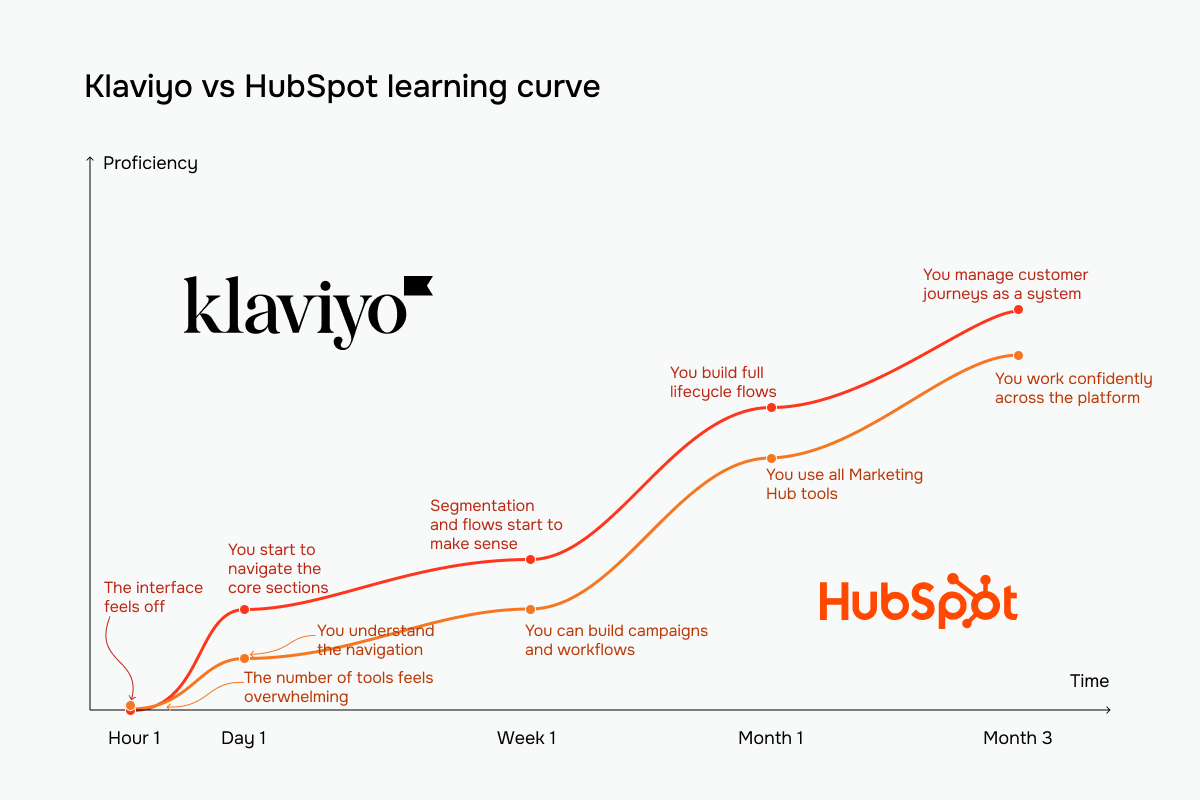 Klaviyo vs HubSpot learning curve based on our testing experience
Email builder and templates
⭐ Klaviyo: 9.2/10 | HubSpot: 8.4/10
If we looked only at the email builder, Klaviyo would be the clear winner. It gives you more creative freedom, stronger eCommerce personalization, and more tools to optimize campaigns that generate revenue. HubSpot gives up some of that flexibility in exchange for a builder that works hand in hand with its CRM.
| Aspect |
Klaviyo |
HubSpot |
Winner |
| Templates |
370+ templates |
50+ templates |
Klaviyo |
| Drag-and-drop editor |
Section-based editor with global styles, reusable synced sections, brand styles, and hybrid HTML + drag-and-drop editing |
Module-based editor with reusable sections, desktop/mobile styling, searchable modules, and live email size indicator |
Klaviyo |
| Notable content blocks |
Countdown timer, product block, coupon, video, table |
Payments, cart, product recommendations |
Tie |
| Mobile responsiveness |
Separate desktop/mobile layouts, per-block mobile settings, optimization controls, desktop and mobile preview |
Responsive templates, separate desktop/mobile settings, per-module visibility controls |
Tie |
| Sending time optimization |
Smart sending time for the whole campaign and personalized sending time that optimizes delivery per recipient with AI |
AI sending time optimization and recipient time zone delivery |
Klaviyo |
| Total score |
9.2/10 |
8.4/10 |
Klaviyo |
Now it’s time to see how both platforms perform in real use.
Klaviyo has one of the most advanced email builders we tested, especially for eCommerce. Beyond the usual drag-and-drop editing, it gives you unusually detailed control over layout with separate text area, block padding, and dedicated display settings for individual elements. Personalization goes beyond merge tags; the Insert menu supports dynamic content, conditional blocks, and product-driven content.
Combined with blocks like coupons, review quotes, and product recommendations, the builder is clearly designed for brands whose emails revolve around catalogs, purchase history, and customer behavior.
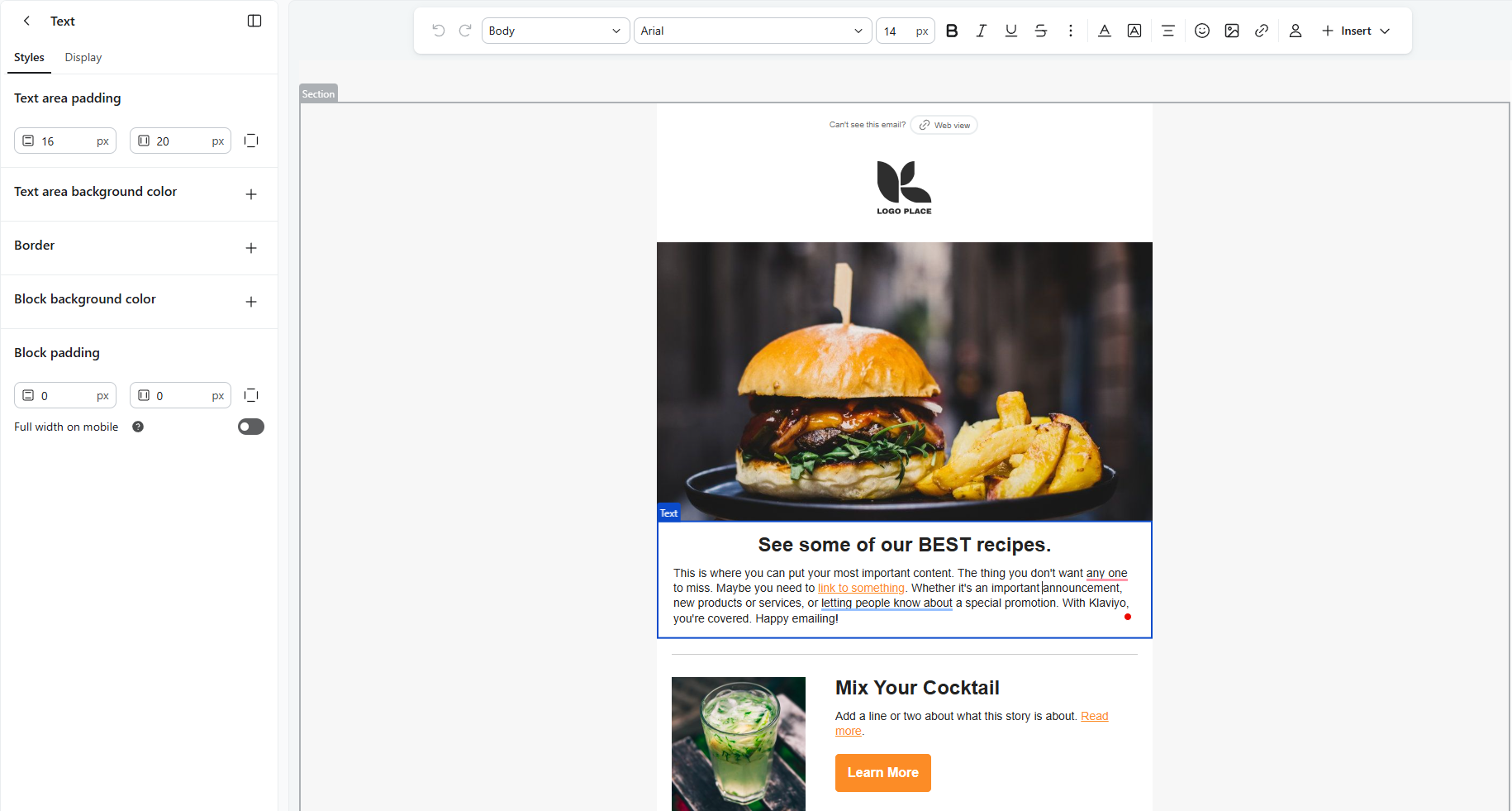 Styling a recipe newsletter block by block in Klaviyo’s editor
HubSpot puts CRM data at the center of the email editing experience. Instead of showing placeholders, the builder renders personalization with real contact information directly in the preview, so you immediately see what a recipient will get. It also includes CRM-specific tools, like sender personalization and suppression management.
While the design controls aren’t as deep as Klaviyo’s, the builder is tightly connected to the rest of HubSpot, making it easy to create emails that fit naturally into larger marketing, sales, and customer success workflows.
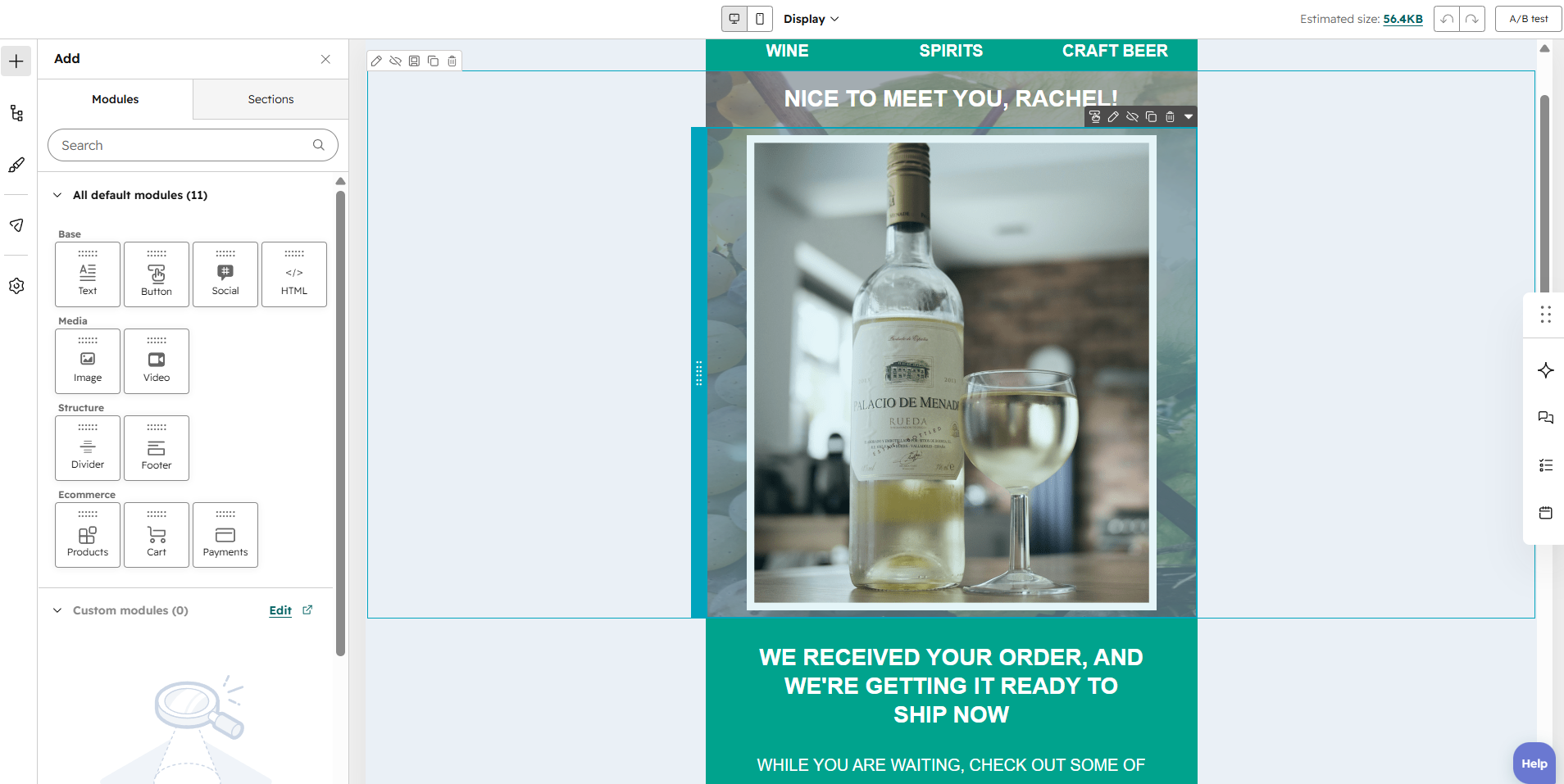 Dragging products and content modules into an order email in HubSpot
Our takeaway? Klaviyo is built around products, customer behavior, and dynamic eCommerce content, so most of its advanced features help you personalize emails using shopping data. HubSpot assumes every email is part of an ongoing customer relationship, so it focuses on CRM data, real contact previews, sender personalization, and tools that support sales and customer communication.
SMS capabilities
⭐ Klaviyo: 9.2/10 | HubSpot: 7.4/10
In case SMS marketing is a priority for your business, we’ve taken a close look at how both Klaviyo and HubSpot handle it. Here’s what you can expect from each platform and which types of businesses they’re best suited for.
| Aspect |
Klaviyo |
HubSpot |
Winner |
| Plans that include SMS |
Paid add-on available on all plans |
Paid add-on for Professional and Enterprise plans only |
Klaviyo |
| Supported countries |
US, Canada, UK, Australia, New Zealand, and most EU countries |
US and Canada |
Klaviyo |
| Pricing model |
Credit-based pricing shared across SMS, MMS, WhatsApp, and RCS |
Segment-based pricing with monthly message allowances; additional segments purchased separately |
Klaviyo |
| SMS-specific automation and keywords |
Keyword-triggered conversations, surveys, quizzes, buying guides, product recommendations, profile updates, and conversational branching |
SMS actions in workflows, opt-in/opt-out keywords, broadcast analytics, and confirmation messages |
Klaviyo |
| Two-way messaging SMS |
Full two-way SMS with helpdesk, ticket routing, AI customer agent, and 24-hour reply attribution |
Two-way messaging through conversations inbox |
Klaviyo |
| Total score |
9.2/10 |
7.4/10 |
Klaviyo |
The gap between these platforms is larger than the scores suggest. Klaviyo has clearly invested in making SMS a first-class marketing channel, with conversational automations, international support, and features built specifically for eCommerce.
HubSpot’s SMS capabilities fit naturally into its CRM ecosystem, but they don’t have the same depth. Businesses that rely on SMS for customer acquisition and retention will get far more value from Klaviyo, while HubSpot is better suited to teams that just want to add SMS to an existing CRM-driven marketing strategy.
Marketing automation
⭐ Klaviyo: 9.4/10 | HubSpot: 9.3/10
The scores for marketing automation are almost identical because both platforms excel at what they were built to do. Klaviyo creates sophisticated customer journeys that drive eCommerce revenue, while HubSpot focuses on automating the entire customer lifecycle, from lead generation to sales and beyond.
| Aspect |
Klaviyo |
HubSpot |
Winner |
| Availability by plan |
Available on all plans, all trigger types included |
Free/Starter tiers allow basic workflows; higher tiers allow unlimited workflows with all trigger types |
Klaviyo |
| Automation builder |
Visual builder with conditional and trigger splits, flow debugging, profile filters, per-message filters, and A/B testing |
Visual builder with minimap, if/then branches, cross-workflow enrollment, suppression lists, pause dates, undo/redo, and AI assistance |
Tie |
| Triggers available |
List, segment, events, date properties, price drops, low inventory, and SMS keywords |
CRM events, forms, emails, ads, meetings, schedules, webhooks, manual triggers, and up to 250 enrollment filters |
HubSpot |
| Pre-built automations |
500+ templates (and the numbers are growing) |
50+ templates |
Klaviyo |
| Channels supported |
Email, SMS, push notifications, WhatsApp, and RCS |
Email and SMS |
Klaviyo |
| Automation complexity |
Entry and step-level filters, trigger splits, conditional branches, per-message filters, A/B testing, configurable re-entry |
Advanced branching, cross-workflow enrollment, goals, suppression lists, pause dates, re-enrollment, and custom workflow code |
Tie |
| Total score |
9.4/10 |
9.3/10 |
Klaviyo |
Klaviyo’s automation builder is one of the cleanest we’ve tested. Despite supporting complex customer journeys, the interface stays minimal, with just a handful of actions covering messaging, data updates, delays, and branching. The freeform canvas makes multi-branch automations easy to follow, while inline controls let you change email status, insert new steps, or review timing without opening individual nodes.
The standout feature, however, is Audit flow. Instead of simply flagging configuration errors, Klaviyo’s AI reviews the entire automation and suggests improvements to timing, structure, and logic. It’s the first platform in our comparison series to offer an AI assistant for the workflow as a whole rather than individual automation steps. Combined with native support for email, SMS, and WhatsApp, the builder feels purpose-built for eCommerce teams managing sophisticated customer journeys.
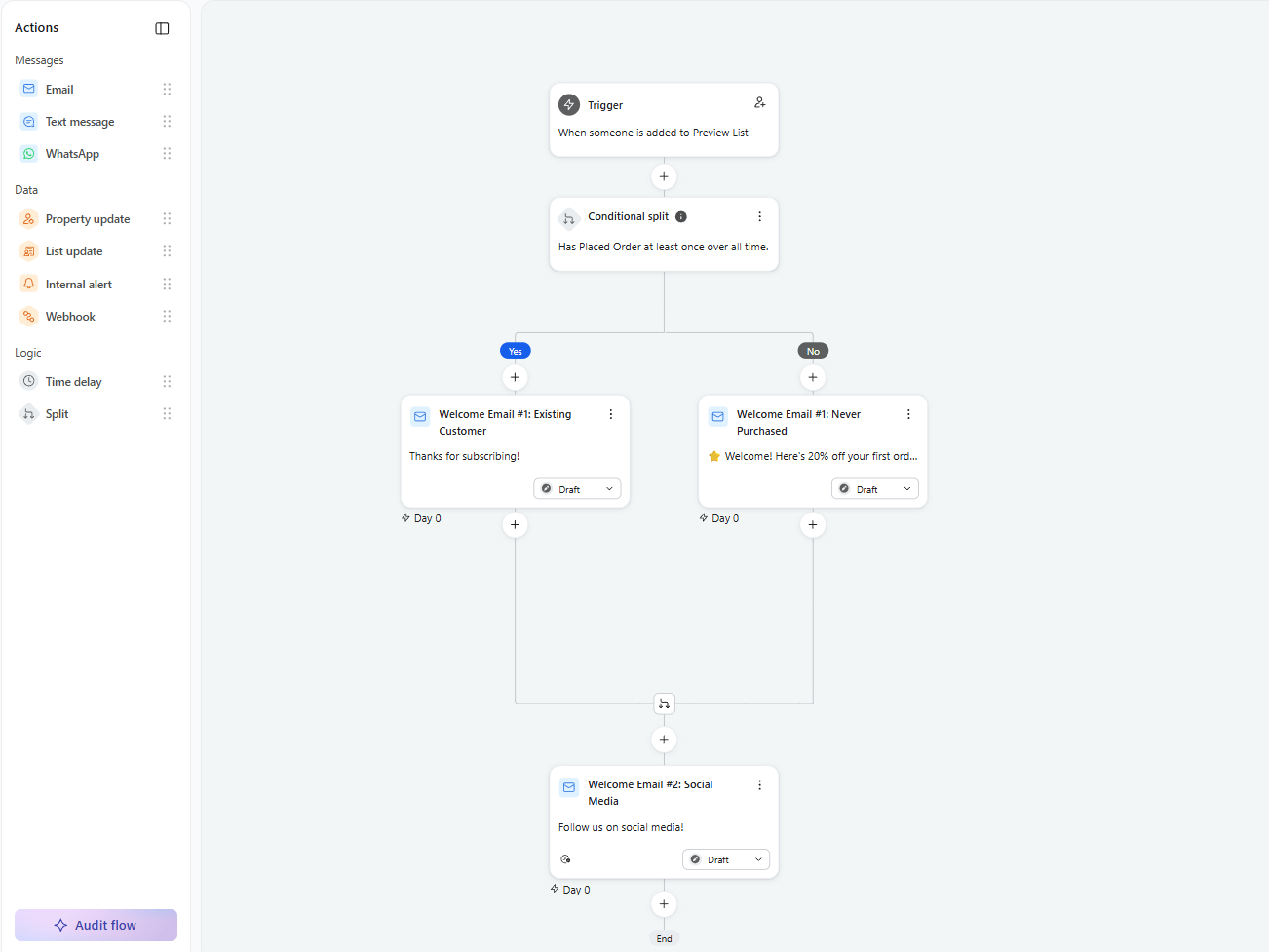 Splitting new subscribers into existing customers and first-time buyers in Klaviyo’s flow builder
HubSpot approaches automation from a CRM perspective. Workflows aren’t just sequences of emails; they’re connected to customer records, lifecycle stages, business goals, and sales processes. You can trigger automations when contacts reach a specific CRM stage, send emails to associated contacts instead of the enrolled record, manually enroll contacts into existing workflows, and measure whether contacts achieve the workflow’s goal.
The builder also includes several operational tools that become valuable as automations grow more complex. Keyboard shortcuts, workflow cleanup, performance history, and built-in goal tracking make it professional business software.
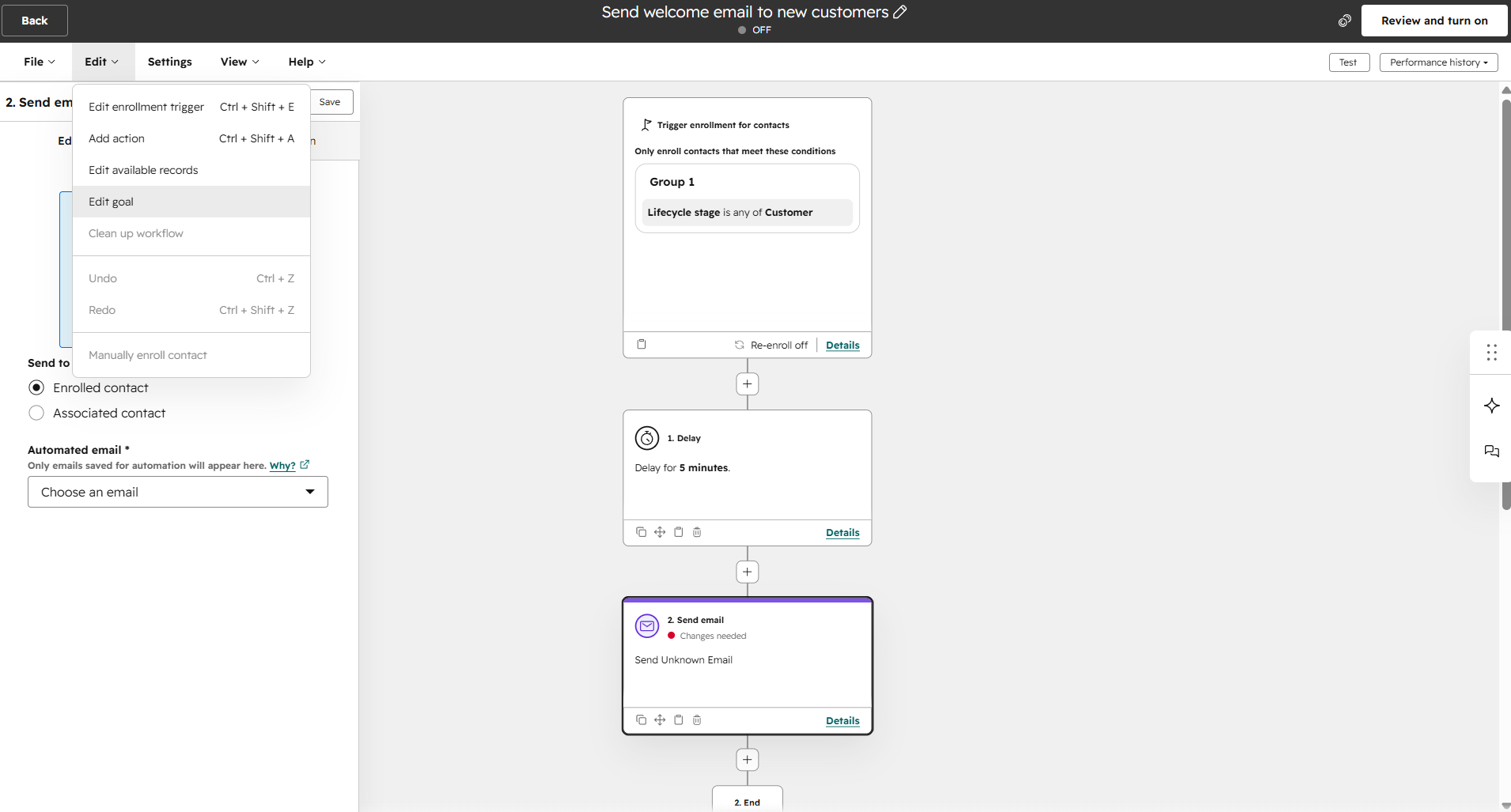 Configuring enrollment for new customers in HubSpot’s workflow builder
These builders are optimized for different kinds of work. If your automations revolve around customers, products, and purchases, Klaviyo is the stronger choice. If they focus on leads, sales pipelines, and customer relationships, HubSpot is a better option.
Contact management
⭐ Klaviyo: 9.5/10 | ⭐ HubSpot: 9.5/10
When it comes to contact management, Klaviyo focuses on customer behavior, purchases, and predictive insights, making segmentation a powerful tool for driving eCommerce revenue. HubSpot expands segmentation beyond contacts to the entire CRM system, making it much better suited to businesses where marketing, sales, and customer management all rely on the same data.
| Aspect |
Klaviyo |
HubSpot |
Winner |
| Segmentation capabilities |
Dynamic segments with AND/OR logic, up to 100 conditions, optional static snapshots, custom objects, and segments usable in campaigns, automations, and conditional splits |
Active and static segments with nested AND/OR logic, up to 250 filters including 60 CRM object filters, segment exclusions, and segmentation across contacts, companies, deals, tickets, carts, and orders |
HubSpot |
| Segmentation criteria |
Contact properties, customer behavior, eCommerce activity, location, and predictive analytics |
CRM properties, email engagement, website activity, forms, ads, workflows, custom objects, and predictive lead scoring |
Tie |
| Segment update speed |
Near real-time updates; manual refresh up to 15 minutes; monitored segments up to 1 hour |
Active segments update automatically; complex updates may take up to 1 hour |
Tie |
| Tagging and manual organization |
Unified customer profile, custom properties, lists, and reusable tags for profiles and marketing assets |
Unified contact records, custom properties, automatic deduplication, and segment-based organization |
Klaviyo |
| Total score |
9.5/10 |
9.5/10 |
Tie |
One thing that often surprises new HubSpot users is the lack of contact tags. Unlike most email marketing platforms, HubSpot deliberately doesn’t support freeform tags for contacts. Instead, it encourages businesses to organize data using custom properties, lists, segments, and lifecycle stages.
According to HubSpot, this leads to cleaner, more structured customer data because information like industry, source, or customer type is stored in dedicated fields instead of being mixed together as tags. It’s a CRM-first approach that works well once your data model is in place, but it can feel restrictive for teams used to quickly tagging contacts on the fly.
Klaviyo approaches customer data from the opposite side. Instead of a CRM-first model, it’s built on a native customer data platform (CDP): the Klaviyo Data Platform unifies web, email, SMS, and purchase data into one real-time customer profile, which is what powers its predictive segmentation (lifetime value, churn risk, and predicted next order). HubSpot reaches similar depth from the other direction, unifying that same data through its Smart CRM. That’s why the two tie here: Klaviyo leads on out-of-the-box B2C customer data, while HubSpot leads on unifying it across the business.
CRM
Klaviyo: 8/10 | ⭐ HubSpot: 9.8/10
We couldn’t leave CRM out of this comparison, since it’s a crucial part of HubSpot. What’s more, Klaviyo now also has enough CRM capabilities to make the comparison meaningful. While HubSpot still offers one of the most comprehensive CRMs on the market, Klaviyo has become a legitimate alternative for some businesses.
| Aspect |
Klaviyo |
HubSpot |
Winner |
| Pricing |
CRM features included on all plans |
Free CRM; advanced marketing automation requires Professional plan |
Tie |
| Pipeline management |
No sales pipeline; customer lifecycle based on eCommerce events and purchases |
Unlimited pipelines and stages, Kanban, list and forecast views, deal aging, required stage fields |
HubSpot |
| Contact and company records |
Unified customer profiles with purchase history, website activity, email/SMS engagement, unlimited custom properties, and predictive eCommerce analytics |
Contact and company records with activity history, lifecycle stages, automatic company matching, parent-child hierarchies, and deduplication |
HubSpot |
| Sales forecasting |
eCommerce revenue and customer lifetime value reporting; no pipeline forecasting |
AI-powered sales forecasting, weighted revenue forecasts, quota tracking, and team performance views |
HubSpot |
| CRM automation |
Customer journeys triggered by eCommerce and engagement events; AI campaign creation and customer service automation |
CRM workflows for contacts, companies, deals, tickets, lead assignment, sales sequences, ad audiences, and AI sales assistants |
HubSpot |
| Total score |
8/10 |
9.8/10 |
HubSpot |
HubSpot’s CRM is much more than a customer database, as it connects contacts, companies, deals, tickets, and custom objects into a single system, giving marketing, sales, and support teams a shared view of every customer relationship. That’s why it can handle pipelines, deal management, forecasting, account ownership, and cross-team reporting. Klaviyo’s CRM is excellent for managing customer profiles and eCommerce interactions, but HubSpot is built to manage the entire customer lifecycle across multiple business teams.
Signup forms and landing pages
⭐ Klaviyo: 8.8/10 | HubSpot: 8.5/10
Both Klaviyo and HubSpot offer excellent forms. Klaviyo puts more effort into helping you increase signup rates, while HubSpot is more focused on improving the quality of the leads you collect. If growing your audience is the priority, Klaviyo has the edge, but if every submission feeds a sales process, HubSpot’s approach will pay off more.
| Aspect |
Klaviyo |
HubSpot |
Winner |
| Types of forms available |
Pop-ups, flyouts, banners, embedded forms, full-page forms, hosted subscribe pages |
Embedded and hosted forms, pop-ups, sticky bars, and slide-ins |
Tie |
| Form builder |
Drag-and-drop builder with multiple field types, GDPR block, reCAPTCHA, double opt-in, A/B testing, bot filtering, and display priority controls |
Drag-and-drop builder with CRM fields, progressive profiling, smart forms, GDPR support, double opt-in, and brand-specific forms |
Klaviyo |
| Pop-up targeting conditions |
Exit intent, time delay, scroll depth, pages viewed, custom triggers, URL, visitor segments, device targeting, frequency caps, and display priority |
Exit intent, scroll depth, time delay, button click, URL, visitor segments, login status, device, language, location, scheduling, and advanced AND/OR targeting |
Tie |
| Landing page builder |
Landing pages with custom domains, SEO settings, UTM tracking, analytics, and multi-step forms |
Drag-and-drop landing pages with A/B and adaptive testing, personalized content, SEO settings, and custom domains |
HubSpot |
| Total score |
8.8/10 |
8.5/10 |
Klaviyo |
Let’s see how their form builders compare.
Klaviyo’s builder is designed for conversion-focused eCommerce campaigns. It offers a visual editing experience with simultaneous desktop and mobile previews. Design customization is also one of its strengths, with flexible typography, individual padding controls, and block-level visibility settings that let you show or hide elements for desktop or mobile independently.
The platform also includes features rarely found in form builders, such as a native spin-to-win pop-up and multi-step forms with customizable intermediate steps. Rather than simply collecting email addresses, Klaviyo encourages merchants to build engaging signup experiences that maximize conversions and fit naturally into online stores.
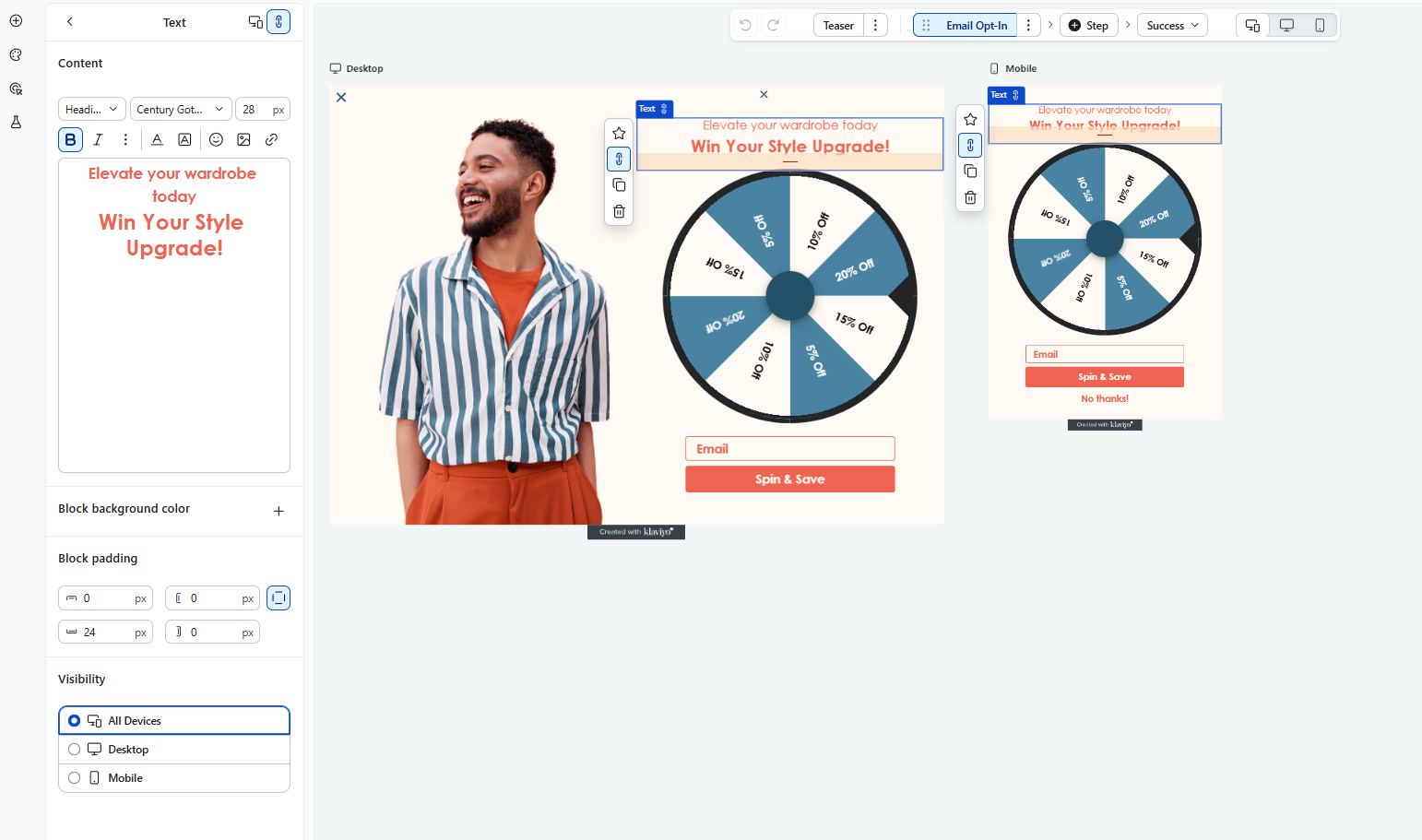 Styling our spin-to-win pop-up across desktop and mobile in Klaviyo’s form builder
HubSpot is more data-oriented and, instead of emphasizing visual customization, it focuses on collecting better information. Every field is connected to CRM properties, so it’s easy to map submissions directly into customer records, while field-level logic allows you to tailor forms based on user responses.
One of HubSpot’s standout features is AI form shortening, which automatically hides fields the platform already knows about a visitor. Combined with progressive profiling, connected CRM properties, email domain blocking, and advanced field options, the builder is clearly designed to improve data quality rather than make forms more visually engaging.
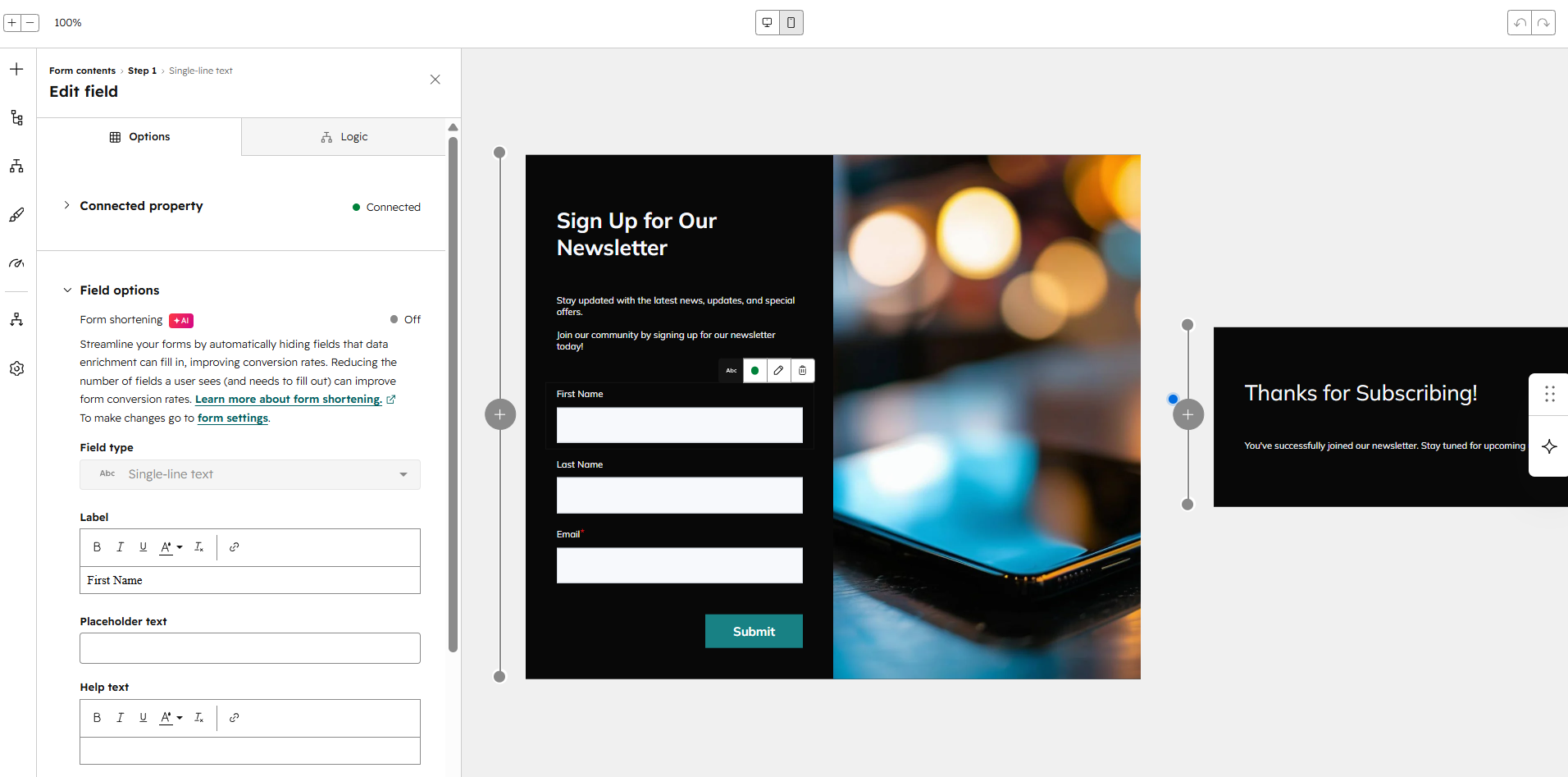 Wiring our newsletter form fields to CRM properties in HubSpot’s form builder
These builders reflect the priorities of their platforms. Klaviyo treats forms as a conversion tool, while for HubSpot, they are an extension of the CRM system. Choose Klaviyo if your goal is growing an email list through promotional pop-ups, and opt for HubSpot if forms are your way to qualify leads and enrich CRM data.
AI features
⭐ Klaviyo: 9.2/10 | ⭐ HubSpot: 9.2/10
We’ve gathered AI features in one place in case AI is one of the main factors influencing your choice of an email marketing platform.
| Aspect |
Klaviyo |
HubSpot |
Winner |
| Email generation |
AI creates complete email and SMS campaigns; continuously learns from campaign performance |
AI generates complete emails from prompts, imports HTML into editable templates, and provides post-send performance recommendations |
Tie |
| Automation generation |
AI builds workflows from natural language, audits existing automations, and suggests structural improvements |
AI builds workflows, edits individual steps, and generates custom workflow code on higher plans |
Tie |
| Predictive customer analytics |
Customer lifetime value, churn risk, purchase predictions, order forecasts, demographics, and next purchase date |
Predictive lead scoring, contact priority, and AI revenue forecasting |
Klaviyo |
| Smart segmentation suggestions |
AI creates segments from natural language and audits existing segments for logic, duplicates, and deliverability issues |
AI creates segment filters from natural language and generates segment descriptions |
Tie |
| Total score |
9.2/10 |
9.2/10 |
Tie |
Both platforms have moved well beyond using AI just to write emails. Klaviyo uses it to help you build campaigns and optimize automations, while HubSpot extends AI across the entire customer journey, from marketing and segmentation to CRM and sales. If email marketing is your main focus, both platforms offer excellent AI capabilities. The advantage shifts toward HubSpot only if you plan to use AI across your wider business operations.
Integrations
Klaviyo: 8.7/10 | ⭐ HubSpot: 9.2/10
HubSpot is clearly stronger in integrations. Beyond its much larger app marketplace, it exchanges data far more deeply with the tools it connects to. Klaviyo still has a strong integration library for eCommerce and marketing, but it gets more limited once you need to connect multiple stores, CRM data, or a broader range of business objects.
| Aspect |
Klaviyo |
HubSpot |
Winner |
| Integration catalog |
350+ apps across eCommerce, loyalty, reviews, subscriptions, attribution, ads, and more |
2,000+ apps across data, marketing, communication, eCommerce, etc. |
HubSpot |
| eCommerce platforms |
Shopify, Magento 1 and 2, BigCommerce, WooCommerce, OpenCart, PrestaShop, Spree, Shift4Shop, Volusion, Square Online, Salesforce Commerce Cloud |
Shopify, BigCommerce, WooCommerce, Magento, Square |
Klaviyo |
| CRM systems |
Native Salesforce integration with object and multi-object data sync into customer profiles; limited native reverse sync |
Native bidirectional Salesforce sync for contacts, companies, deals, and activities, with field and pipeline mapping |
HubSpot |
| API capabilities |
REST API plus high-volume event and profile ingestion, tuned for eCommerce data |
REST API spanning the full CRM object model, with webhooks and extensive endpoints |
HubSpot |
| Zapier support |
3 triggers and 7 actions across profiles, lists/segments, and events |
27 triggers and 60+ actions across 9 object types |
HubSpot |
| Total score |
8.7/10 |
9.2/10 |
HubSpot |
Since Klaviyo is known as a top eCommerce email platform, we looked at how its Shopify integration compares with HubSpot’s. Both sync Shopify data in real time, but they use it differently: Klaviyo turns orders, abandoned checkouts, and product views into marketing events for segments and automations, while HubSpot writes that data to contact records and can auto-create deals from purchases.
So even though HubSpot wins on integrations overall, Klaviyo is the stronger fit for eCommerce brands focused on retention through email and SMS.
Deliverability
⭐ Klaviyo: 10/10 | ⭐ HubSpot: 10/10
Klaviyo and HubSpot both give most businesses everything they need for excellent deliverability, which is why they tie here. They just get there a little differently: Klaviyo leans toward proactive monitoring and list hygiene, while HubSpot offers more sending infrastructure, like dedicated IPs with automated warm-up.
| Aspect |
Klaviyo |
HubSpot |
Winner |
| Authentication |
Automatic SPF and DKIM; external DMARC setup; BIMI supported |
Guided SPF, DKIM, DMARC, MX, and BIMI setup; supports up to 2,000 sending domains |
Tie |
| Deliverability monitoring |
Deliverability dashboard, bounce analytics, engagement-based suppression, internal blocklist monitoring, suspicious profile detection |
Email health dashboard, recipient-level delivery status, AI performance insights |
Klaviyo |
| List hygiene |
Automatic hard bounce suppression; suppresses after 7 consecutive soft bounces; removes suppressed contacts from all lists |
Automatic hard bounce suppression, global bounce protection, 7 bounce categories, graymail suppression |
Tie |
| Dedicated IP |
Available for qualifying high-volume senders of 1M+ emails/month; warm-up process available |
Dedicated IP add-on with 40-day automated warm-up and separate IPs for multiple brands |
HubSpot |
| Total score |
10/10 |
10/10 |
Tie |
Want to maximize your inbox placement? Here are some recommendations from SendPulse’s deliverability experts:
- Segment by email engagement, not product activity.
- Send large campaigns to engaged subscribers first, then inactive ones gradually.
- Make re-engagement campaigns opt-in to stay, not opt-out.
- Keep sending volumes consistent and predictable.
- Treat list hygiene as your primary defense against spam traps, not just email authentication.
Those are the things that have the biggest impact on long-term deliverability.
Reporting and analytics
Klaviyo: 9/10 | ⭐ HubSpot: 9.2/10
Good reporting helps you understand what works, optimize future campaigns, and make better marketing decisions. Fortunately, reporting is another area where both platforms perform exceptionally well.
| Aspect |
Klaviyo |
HubSpot |
Winner |
| Report coverage |
Dashboards for email, SMS, flows, deliverability, signup forms, and business performance |
Dashboards for marketing, sales, CRM, website, revenue, attribution, and customer service analytics |
HubSpot |
| Custom reports |
Custom report builder with up to 20 filters, campaign and flow analysis, and profile attributes; requires a paid analytics add-on |
Multi-source custom reports, funnel reports, custom objects, and scheduled reports; available on Professional and Enterprise tiers |
Tie |
| Reporting speed |
Segments update near real time, but reports require manual refresh; scheduled reports may run up to 2 hours early |
CRM data updates in 2–5 minutes; marketing metrics about every 40 minutes; custom reports refresh every 2 hours and can be refreshed manually every 15 minutes |
HubSpot |
| Export capabilities |
CSV |
CSV and Excel |
HubSpot |
| Total score |
9/10 |
9.2/10 |
HubSpot |
Klaviyo helps you understand what drives eCommerce revenue. HubSpot looks beyond marketing, connecting reports with CRM data, sales activity, customer journeys, and revenue attribution. If your reports are mainly used by the marketing team, Klaviyo offers a more focused experience, while HubSpot provides a much broader view of the business.
Customer support
Klaviyo: 7.3/10 | ⭐ HubSpot: 7.4/10
When you start using a new platform, you’ll probably need some assistance from time to time. In many cases, an AI assistant will be enough, but sometimes you’ll need help from a real person. Here’s everything Klaviyo and HubSpot offer to make onboarding and everyday use as easy and pain-free as possible.
| Aspect |
Klaviyo |
HubSpot |
Winner |
| Channel availability |
24/7 email support on paid plans; live chat for paid users after AI chatbot; free plan includes 60 days of email support; no phone support |
No support on free plan; chat and email for cheapest tier; phone, callback, and multilingual support on higher tiers |
Klaviyo |
| Knowledge base |
Smaller and focused; clear, consistent articles that make answers easy to find |
Much larger and covers more tools; some older articles may conflict with newer information, so details can require double-checking |
Klaviyo |
| Onboarding assistance |
Self-service migration tools and guides; dedicated onboarding and Customer Success Manager on highest plans |
Mandatory paid onboarding on Professional and Enterprise tiers; advanced onboarding and migration services available |
Tie |
| Support quality sub-rating on Capterra |
4.3/5 |
4.4/5 |
HubSpot |
| Total score |
7.3/10 |
7.4/10 |
HubSpot |
Neither platform stands out in this category. Klaviyo puts more emphasis on helping users learn independently through frequent live training sessions and self-service resources, while HubSpot invests more in structured onboarding and hands-on assistance, especially for larger companies that use the platform across multiple teams.
Real users’ reviews on Klaviyo and HubSpot
One theme comes up again and again in reviews of both platforms: pricing. Even users who are otherwise very happy with the product often mention that costs grew much faster than they expected as their business expanded. Here are some examples for Klaviyo:
Users say the same about HubSpot Marketing Hub:
Beyond that, however, the feedback starts to diverge in a way that closely matches what we found during our own testing. Klaviyo users are generally willing to pay the premium because of its deep eCommerce capabilities, particularly its segmentation, Shopify integration, and automation.
HubSpot users, meanwhile, justify the higher cost because they’re getting much more than an email marketing platform — they’re investing in an all-in-one system that runs more of their business.
The only thing worth keeping in mind is that HubSpot has a much larger customer base, which naturally brings a wider range of experiences, including some serious complaints. That doesn’t automatically make it any better or worse than Klaviyo’s, but it’s a reason to read the reviews themselves rather than judge either platform on its star average alone.

Join businesses growing with SendPulse
From solo creators to global brands, thousands of customers trust SendPulse to run email campaigns, chatbots, automations, and more — all in one place.
Get started for free
Your decision checklist
Now that you know everything about Klaviyo and HubSpot, you’re ready to make your final choice. Here’s a quick checklist to help you decide.
| Decision area |
Klaviyo
is a better fit if… |
HubSpot
is a better fit if… |
| Business type |
You’re an eCommerce brand. |
You’re B2B or need CRM across the whole business. |
| Budget expectations |
You want predictable, contact-based email pricing. |
You’re fine paying more for an all-in-one platform. |
| Automation needs |
You want deep, revenue-driven email/SMS flows. |
You need automation spanning marketing, sales, and service. |
| Analytics focus |
You care about eCommerce revenue and customer-value metrics. |
You need reporting that ties marketing to sales outcomes. |
| Team setup |
A small marketing team runs everything itself. |
Multiple teams (marketing, sales, support) share one system. |
If three or more of your answers point to the same platform, that’s probably the right choice for your business.
Final verdict and recommendations
⚖️ Final scores: Klaviyo – 8.6/10 | HubSpot – 7.9/10
Would we recommend Klaviyo? Absolutely, but only if you’re running an eCommerce business and want to maximize revenue with data-driven email marketing.
Would we recommend HubSpot? Yes, but only if you plan to take advantage of its broader ecosystem of Hubs and business tools. If you’re only looking for an email marketing platform, it’s simply too expensive.
What if neither platform fully corresponds to your needs? Here are a few alternatives that might be a better fit:
- Choose SendPulse if you want an AI-driven marketing platform with a built-in CRM system at a much lower cost than HubSpot.
- Consider Omnisend if you’re an eCommerce business, but Klaviyo is beyond your budget.
- Take a look at ActiveCampaign if automation is your top priority and you want to build your email marketing around customer data.
Overall, choose your vendor as you would a strategic partner, looking not only at your needs today but also anticipating what you’ll need tomorrow.
Klaviyo vs HubSpot FAQ
What's the main difference between Klaviyo and HubSpot?
The main difference is what each platform focuses on. Klaviyo is designed for B2C and eCommerce marketing and is built on a customer data platform. HubSpot, on the other hand, is an all-in-one CRM that covers marketing, sales, and service. Klaviyo is best for eCommerce email and SMS that drive revenue, while HubSpot is better if you want a single system for your entire business.
Is Klaviyo or HubSpot better for B2B?
HubSpot is a better choice for B2B. It is built to manage deals, sales pipelines, lifecycle stages, and sales sequences, which helps with the longer, more complex sales cycles common in B2B. Klaviyo is mainly for B2C and eCommerce. While it now has a B2C CRM, it does not offer sales pipeline or deal management, so B2B teams may find it limiting beyond email and SMS.
Can Klaviyo be used for B2B?
Klaviyo can handle B2B email and SMS, but it is not a true B2B platform. It works best for eCommerce and direct-to-consumer brands, including those with a wholesale side, where customers are shoppers instead of sales opportunities. If you need to manage deals, quotes, or a sales team, you should use Klaviyo with a dedicated CRM or choose HubSpot.
Is HubSpot good for eCommerce and B2C?
HubSpot can help you run B2C and eCommerce marketing, but it works best for businesses that see every contact as part of a sales or service relationship. For catalog-driven and behavior-based marketing, such as abandoned carts, product recommendations, and post-purchase flows, Klaviyo is usually the better option.
Is Klaviyo a CDP, and does HubSpot have one?
Yes, Klaviyo has a built-in customer data platform called the Klaviyo Data Platform, and it offers an Advanced CDP for enterprise users. This platform brings together web, email, SMS, and purchase data into a single real-time profile. HubSpot does not offer a separate CDP. Instead, its Smart CRM acts as the unified customer record. Teams that need more data consolidation can add data-sync tools or use a third-party CDP.
Can you integrate Klaviyo with HubSpot?
Yes, you can connect the two platforms using integration tools so that contact and engagement data flows between them. A common setup is to use HubSpot as the CRM for sales and Klaviyo for eCommerce email and SMS marketing, keeping both systems in sync.
Which is cheaper, Klaviyo or HubSpot?
Klaviyo is usually less expensive than HubSpot for the same number of contacts, and the difference grows as you add more contacts because HubSpot’s Professional plan gets much more expensive.