Email marketing is often associated with B2C brands, flash sales, and personalized product recommendations. But in B2B, email can do much more than announce updates or send a monthly newsletter. Used strategically, it helps companies educate prospects and move leads through the sales pipeline.
The difference is that B2B email marketing can’t simply borrow B2C tactics. Business purchases involve longer decision cycles, multiple stakeholders, and a stronger need for trust before any commitment is made. That’s why effective B2B email marketing depends on segmentation, automation, and lifecycle-based messaging.
In this blog post, we’ll explain how B2B email marketing works, how it differs from B2C, and what strategies can help you turn email into a revenue-driving channel. We’ll also share real B2B email marketing examples to show how companies use email across different stages of the buyer journey.
TL;DR B2B email marketing at a glance
In B2B, email marketing campaigns are no longer treated as isolated sends. They work as a connected system that helps prospects move from awareness to purchase, and customers move from onboarding to expansion.
Segmentation, B2B email automation, and behavioral triggers make interactions through email relevant and timely. At the same time, success is measured by pipeline influence, product adoption, and revenue rather than open rates alone. The table below summarizes the core campaign types that make up a B2B email strategy.
| Campaign type |
Best for |
Funnel stage |
Typical CTA |
Primary KPI |
| Welcome and onboarding |
Introducing new leads or users to your brand |
Awareness and activation |
Get started |
Activation rate |
| Lead nurture drip |
Educating prospects and building trust over time |
Consideration |
Read the guide |
MQLs and CTR |
| Webinar invite |
Driving registrations for upcoming events |
Consideration |
Register now |
Registration rate |
| Product update |
Promoting new features and product improvements |
Retention |
Explore the update |
Feature adoption rate |
| Case study email |
Demonstrating real-world results and social proof |
Consideration and conversion |
Read the case study |
Demo requests |
| Re-engagement |
Reconnecting with inactive or lapsed contacts |
Retention |
Return to your account |
Re-engagement rate |
| ABM outreach |
Engaging high-value target accounts with personalized messaging |
Conversion |
Book a meeting |
Meetings booked |
What is B2B email marketing, and why does it still matter
B2B email marketing uses email to support business purchases and customer relationships throughout the entire buyer journey.
Unlike mass promotional sends, it focuses on delivering relevant content based on a recipient’s role, needs, and stage in the decision-making process. B2B email serves as a communication channel for nurturing leads, enabling sales conversations, and driving retention, making it one of the few marketing tools that can influence both pipeline growth and long-term revenue.
B2B email in the modern growth stack
Modern B2B growth rarely depends on a single marketing channel. Prospects may discover your brand through search or social media, but email is often what keeps the conversation going.
In inbound marketing, it helps nurture leads after they download a resource or subscribe to a newsletter. In account-based marketing, it delivers personalized messages to key stakeholders within target accounts.
For product-led growth companies, email guides users toward activation and adoption, while sales teams use it to support follow-ups and stay top of mind during long buying cycles.
This role has become even more important as B2B buyers increasingly prefer self-directed research. By the time they speak with sales, they have often compared vendors, read reviews, and evaluated potential solutions. Email helps marketers stay present throughout this process by delivering educational content, customer stories, and timely reminders that move prospects closer to a decision.
That ability to deliver relevant information at the right moment is one reason email remains a cornerstone of B2B marketing. According to the 2026 B2B Content and Marketing Trends Report, 89% of organizations personalize their content, and email is the channel where personalization is used most often, ahead of websites, social media, and webinars.
For marketers, this means email is a way to adapt the conversation to different audiences, buying stages, and decision-making needs without requiring a sales call.
How email is used depends heavily on the business model. A SaaS company might use an automated onboarding sequence to encourage trial users to complete key actions, such as inviting teammates or creating their first project.
Meanwhile, a consulting firm may focus on thought leadership emails that share industry insights, reports, and expert commentary to build trust over months before a prospect is ready to engage. In both cases, email supports growth, but the strategy, content, and goals are entirely different.

Create and send high-performing emails
Use an AI assistant, pre-made templates, advanced segmentation, and feature-rich automation to run campaigns without coding. Start for free with up to 15,000 monthly emails.
Get started for free
B2B email ROI and engagement in 2026
Email remains one of the highest-performing channels in B2B marketing. According to Litmus, businesses commonly earn $10-36 for every $1 spent on email marketing.
The UK’s Data & Marketing Association reports an even higher return: its Marketer Email Tracker 2026, based on 250 marketers, puts email ROI at £40.96 (around $55) for every £1 spent. The same report shows email maturing well beyond acquisition, with sharp rises in post-purchase (+24 percentage points) and customer service (+22 percentage points) usage.
Those gains past the point of sale reflect email’s real advantage: it’s one of the few marketing channels that can support the entire B2B buyer journey, from lead generation to customer retention. And despite the growing focus on AI and emerging technologies, marketers are not moving away from owned channels. According to the 2026 B2B Content and Marketing Trends Report, 32% of B2B marketers plan to increase investment in owned media, including email, making it the third most common investment priority after AI-powered marketing tools (45%) and events (33%).
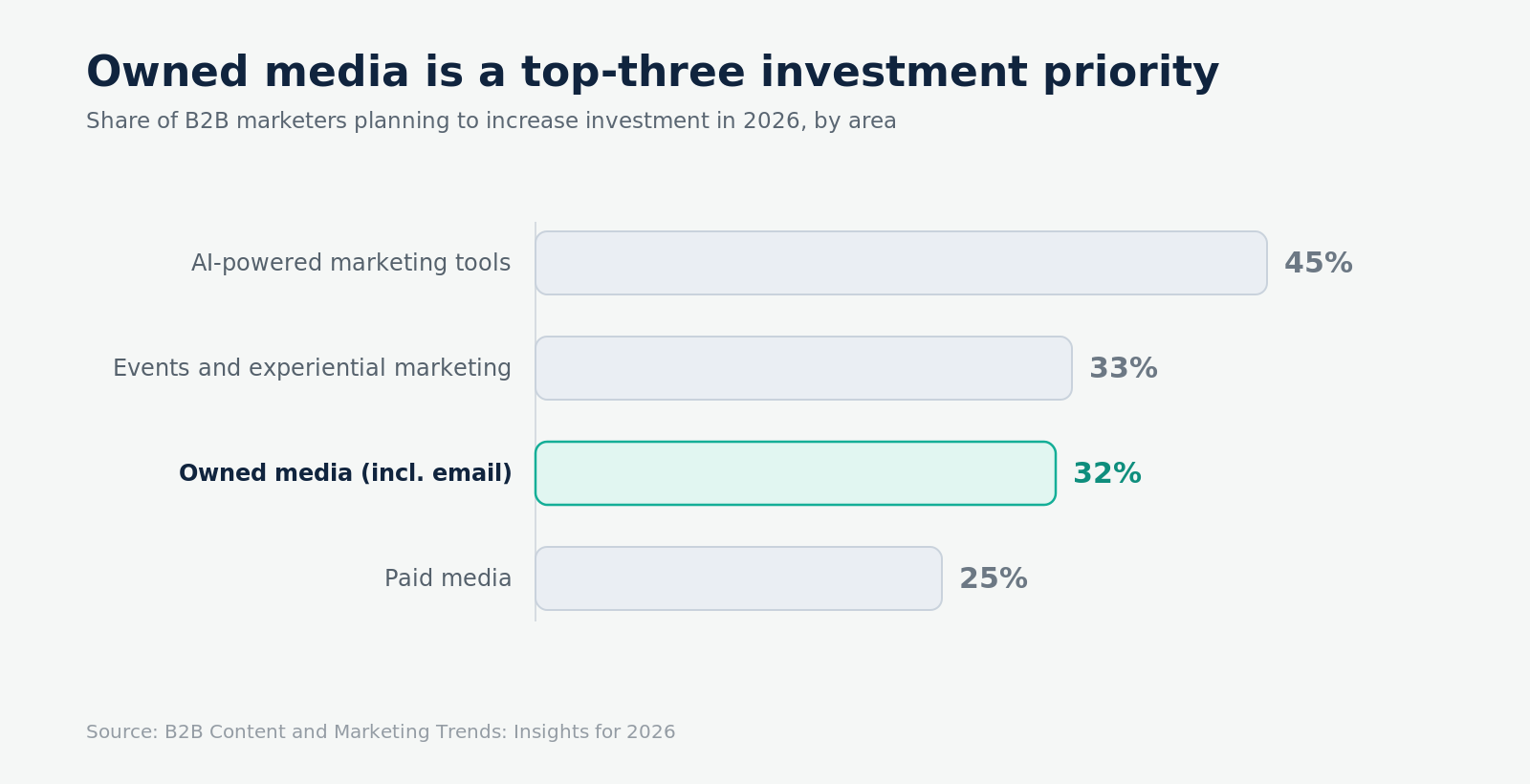 Owned media, including email, is a top-three investment priority for B2B marketers in 2026
This reflects a simple reality: rented attention is becoming more expensive, while owned audiences remain a long-term competitive advantage.
How B2B and B2C email marketing differ
The biggest difference between B2B and B2C email marketing is the buying process behind it. B2C emails typically target a single person, making a relatively quick decision.
B2B emails, on the other hand, often support longer buying journeys involving multiple stakeholders, larger budgets, and more research. As a result, B2B marketers must focus less on immediate conversions and more on educating prospects and helping buyers reach a decision.
| Factor |
B2B email marketing |
B2C email marketing |
| Buying cycle length |
Typically spans weeks or months |
Typically spans minutes, days, or weeks |
| Decision makers involved |
Multiple stakeholders participate in the decision |
A single buyer makes the decision |
| Primary email goal |
Generate pipeline, nurture leads, and support revenue growth |
Drive purchases, repeat sales, and customer retention |
| Content style |
Educational, consultative, and proof-driven |
Promotional, emotional, and product-focused |
| CTA type |
Book a demo, register for a webinar, download a guide |
Shop now, claim a discount, buy now |
| Key metric |
Pipeline influence, opportunities created, and revenue impact |
Conversions, orders, and revenue generated |
| Personalization approach |
Based on role, industry, company, and buying stage |
Based on preferences, purchase history, and behavior |
| Typical sending frequency |
Lower volume with a stronger focus on relevance |
Higher volume with more frequent promotional messaging |
A challenge unique to B2B is the buying committee. A single purchase may involve a department head, a budget owner, and an IT specialist. Each person evaluates the same solution from a different perspective. A CFO wants to understand ROI, and an IT specialist is focused on security and implementation requirements.
This changes how effective email campaigns are built. Instead of sending one generic newsletter to every contact, marketers need role-based segmentation and tailored content tracks. The same case study or webinar invitation can be positioned differently depending on who receives it and where they are in the buying process.
That said, the line between B2B and B2C isn’t always clear-cut. Some self-serve SaaS products and lower-cost tools have buying journeys that resemble B2C purchases, with shorter decision cycles and fewer stakeholders. That’s why it’s often more useful to think of B2B and B2C as two ends of a spectrum.
How to build a B2B email marketing strategy that drives pipeline
The companies that generate pipeline through email start by understanding who they want to reach, what information buyers need at each stage, and how email can help move opportunities forward. The following steps will help you turn email into a predictable driver of pipeline growth.
Set goals around pipeline stages
One of the most common mistakes in B2B email marketing is measuring activity instead of business impact. An email with a high open rate may look successful, but it doesn’t necessarily generate leads or revenue.
To create a strategy that drives the pipeline, every campaign should support a specific stage of the buyer journey and be measured against the outcome you want to influence.
| Goal |
Email type |
Primary KPI |
| Generate awareness |
Newsletters and educational content |
New subscribers and marketing-qualified leads (MQLs) |
| Build consideration |
Lead nurturing emails and webinar invitations |
Click-through rate (CTR) and webinar registrations |
| Create buying intent |
Case studies and product comparison emails |
Demo requests |
| Drive conversion |
Trial onboarding emails and sales follow-ups |
Trials started and opportunities created |
| Increase adoption |
Onboarding sequences and product education emails |
Activation rate and feature adoption |
| Improve retention |
Renewal reminders, upsell campaigns, and re-engagement emails |
Renewals and expansion revenue |
This approach also helps align marketing with sales and customer success. Instead of reporting that a campaign achieved a 35% open rate, you can show that it generated webinar registrations, influenced demo bookings, or contributed to renewal revenue. Those are the metrics that connect email performance to business growth.
Define your ICP and map the buying committee
Before you write a single email, you need to know who you’re writing to. In B2B, that means defining your ideal customer profile and understanding the people involved in the purchase.
Start with firmographic criteria such as industry, company size, location, and revenue. Then go deeper into the factors that influence buying decisions: job role, business challenges, use case, and buying stage. The more precisely you define your audience, the easier it becomes to create emails that feel relevant instead of generic.
The same account can contain multiple audiences. In a typical B2B purchase, the people evaluating your solution often care about very different outcomes, which is why role-based messaging tends to outperform one-size-fits-all campaigns.
| Role |
Main concern |
Email content that resonates |
| Champion (Operations Manager) |
Improving team productivity and operational efficiency |
Workflow tips, use cases, best practices, and product demos |
| Decision-maker (COO or VP Operations) |
ROI, business outcomes, and strategic impact |
Case studies, ROI calculators, customer success stories, and business results |
| Blocker (IT Manager) |
Security, integrations, compliance, and implementation risk |
Technical documentation, integration guides, security certifications, and compliance resources |
| End user (Team Lead) |
Ease of adoption and day-to-day usability |
Product tutorials, onboarding resources, feature highlights, and practical how-to content |
Notice that all four contacts work for the same company but care about completely different things. If you send them the same newsletter, at least some of them will find it irrelevant.
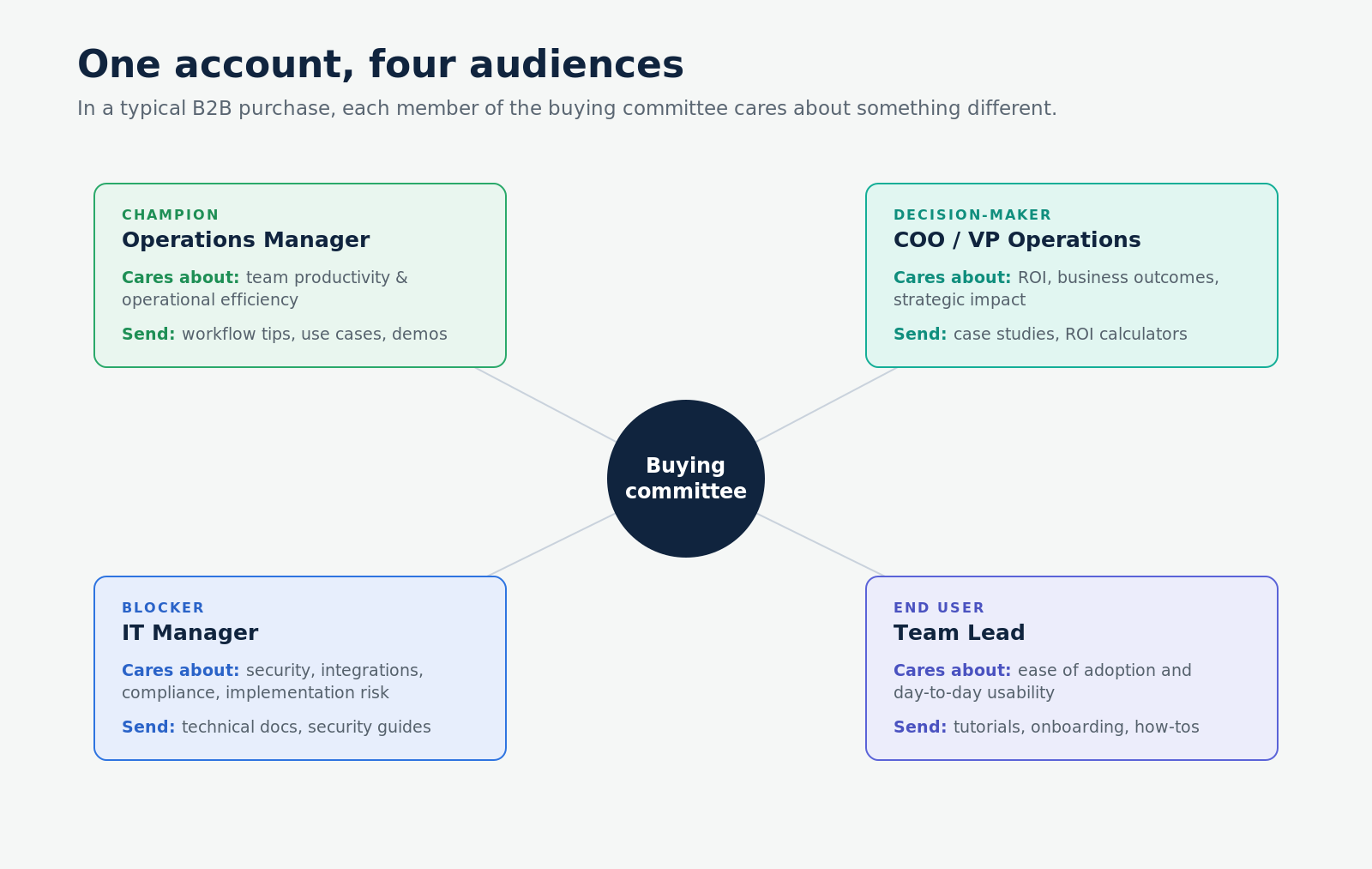 Each member of the buying committee weighs the same solution differently
That’s why modern B2B email marketing relies on role-based messaging rather than list-wide averages. A security-focused email may help remove objections from IT, while a customer success story may be exactly what the executive sponsor needs to move the deal forward.
The goal is to address the concerns of the people who influence the buying decision.
Build your list through first-party channels
A strong email strategy starts with a strong list. In B2B marketing, the goal is to attract people who are likely to become customers.
The most effective ways to grow a B2B mailing list include:
- Lead magnets. Offer practical resources that solve a specific problem, such as templates, checklists, or industry benchmarks. The narrower the topic, the easier it is to understand a subscriber’s interests and segment them later.
- Gated reports and research. Original data, market reports, and trend analyses tend to attract decision-makers actively researching solutions. These contacts are often further along in the buying process than typical blog readers.
- Webinar registrations. Webinars help you capture leads while revealing what topics matter most to them. Follow-up emails can be personalized based on the event they attended and the questions they asked.
- Demo requests. These are among the highest-intent contacts in your database. Instead of adding them to a generic newsletter, create dedicated email tracks that support evaluation and purchase decisions.
- Product signups. Free trials and freemium accounts generate valuable behavioral data. Use it to personalize onboarding emails based on the actions users take or fail to take inside the product.
- Newsletter subscriptions. A newsletter can attract prospects long before they’re ready to buy. Focus on delivering useful insights, not product promotions, to stay relevant throughout the research phase.
- Partner co-marketing campaigns. Joint webinars, research projects, and content collaborations can introduce your brand to highly relevant audiences. Just make sure subscribers explicitly consent to receiving emails from both partners.
As you build your list, keep permission-based email marketing separate from cold outreach. Someone who downloads a report or signs up for a webinar has agreed to hear from you, while a cold prospect has not.
Mixing these audiences in the same sending platform or domain can hurt deliverability and make it harder to measure performance accurately.
For example, a demo request form can do more than collect contact information. In the first step, prospects provide their business email address. The second step gathers details that help qualify and segment the lead, such as company size, industry, or role.
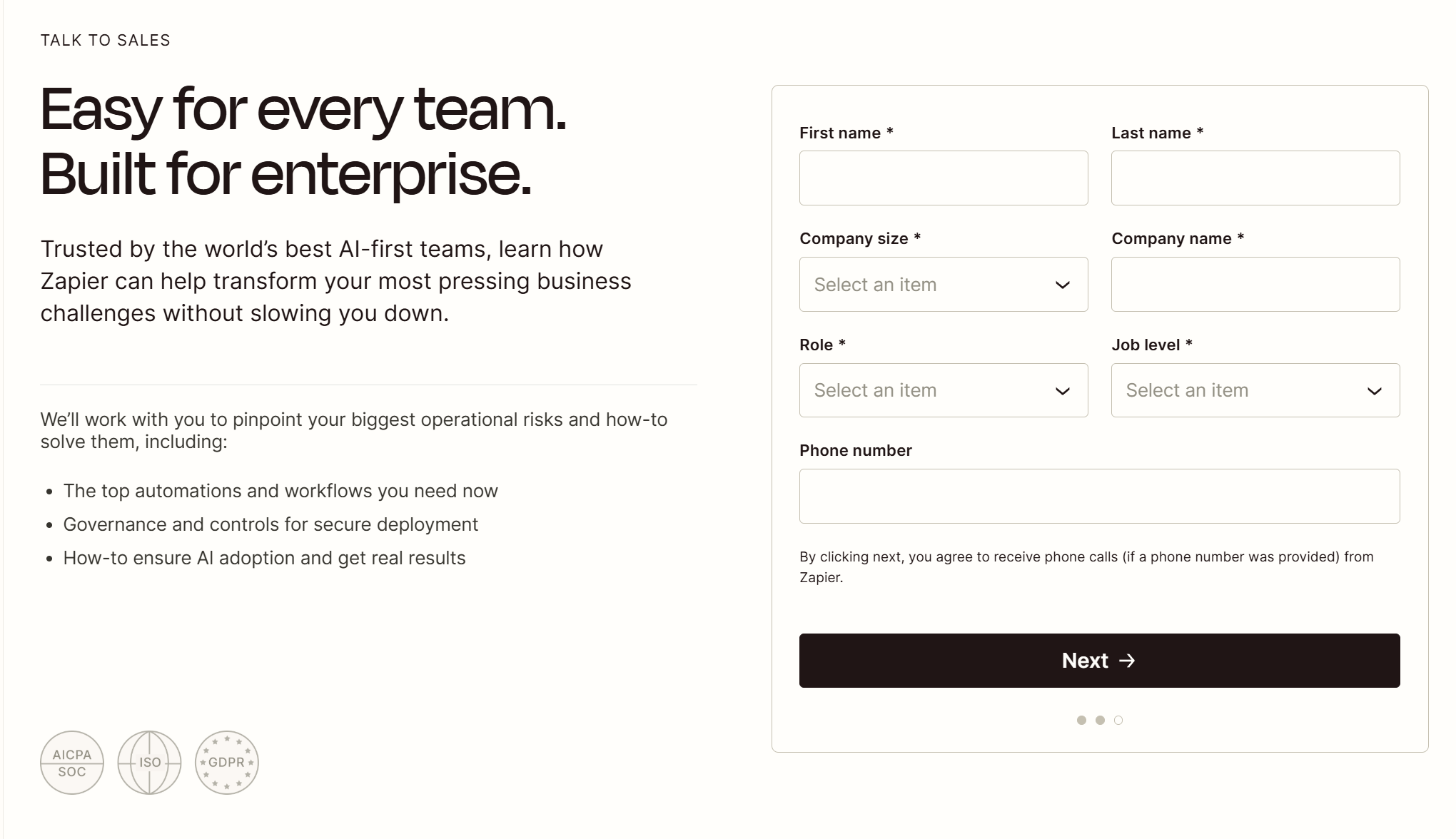 Zapier’s multi-step demo request form gathers emails and qualifying details
In the final step, prospects select the topic they want to discuss or describe their request if none of the predefined options fit. This approach helps sales teams prepare for the conversation while giving marketers valuable data for future segmentation and personalization.
It’s also worth considering double opt-in, especially for B2B audiences. While it adds an extra step to the subscription process, it helps verify email addresses, improves data quality, reduces spam complaints, and provides proof of consent.
In practice, a smaller list of engaged subscribers is usually far more valuable than a larger list filled with inactive or unqualified contacts.
Segment before you automate
Automation is often presented as the solution to better email marketing. In reality, it only amplifies the strategy already in place. If your audience isn’t segmented, automation simply sends irrelevant emails faster and at a larger scale.
Before building workflows, divide your audience into meaningful segments. A good starting point is:
- role or job function;
- funnel stage;
- account tier;
- product interest;
- engagement level;
- geography or language.
These attributes help you understand who your contacts are and what information they need next.
Consider two contacts in the same database. One is a new subscriber who just downloaded a compliance guide. The other is an existing customer on a free plan who recently visited your pricing page. Sending both contacts the same nurture sequence would ignore their intent and relationship with your brand.
The first contact may need educational content that builds trust and expertise, while the second may be ready for product comparisons or a conversation with sales.
Map the lifecycle and build a smart cadence
Many marketers think about email campaigns as separate activities: a welcome series here, a webinar invite there, and a re-engagement campaign somewhere down the road. Buyers don’t experience them that way. From their perspective, every email is part of a single relationship with your company.
That’s why it’s helpful to think of email marketing as a connected lifecycle that guides prospects and customers from their first interaction to long-term retention.
A typical B2B email lifecycle includes:
- welcome emails;
- nurture campaigns;
- event and webinar invitations;
- sales-assist emails;
- onboarding sequences;
- customer education;
- renewal campaigns;
- re-engagement flows.
Each stage should naturally prepare contacts for the next one, creating a continuous experience instead of isolated touchpoints.
| Period |
Stage |
Trigger |
Email type |
Suggested frequency |
| Days 1–30 |
Welcome and nurture |
Newsletter subscription, content download, or account signup |
Welcome emails and educational content |
1–2 emails per week |
| Days 31–60 |
Consideration |
Content engagement or webinar registration |
Case studies, webinar invitations, and product comparisons |
1 email per week |
| Days 61–90 |
Conversion and onboarding |
Demo request, trial signup, or purchase |
Sales follow-ups, onboarding sequences, and activation emails |
Trigger-based and as needed |
| Ongoing |
Education and retention |
Product usage, milestones, or feature adoption |
Tutorials, best practices, and product updates |
1–4 emails per month |
| Ongoing |
Renewal and re-engagement |
Contract renewal dates or subscriber inactivity |
Renewal reminders and win-back campaigns |
Trigger-based |
An important thing to remember is that cadence should be driven by behavior instead of a publishing calendar. A contact who visits your pricing page or requests a demo is sending a stronger signal than someone who simply receives your monthly newsletter.
Triggered emails based on actions, interests, and product behavior are typically more relevant and timely than scheduled campaigns because they respond to what buyers are doing right now, not what marketers planned weeks ago.

Turn conversations into conversions
Build targeted automation flows with emails, chatbots, SMS, and more — powered by CRM data and real user behavior.
Get started for free
B2B email marketing examples worth borrowing
Understanding the theory behind B2B email marketing is important, but seeing how successful companies put it into practice is even more valuable. Rather than grouping examples by format, we’ll organize them by lifecycle stage because the same type of email can serve very different goals depending on when it’s sent.
Below, you’ll find real-world examples of awareness, consideration, conversion, and retention emails.
Awareness emails
Awareness emails are one of the earliest touches prospects have with your brand. Their job is not to generate a demo request immediately but to earn attention and establish credibility.
RGE Studio’s welcome email demonstrates how to make a strong first impression without overwhelming new users. It opens by welcoming subscribers to a community of “1M+ email marketers, designers, and teams” and reinforces this with recognizable customer logos, including Netflix and UNICEF. For someone who has just signed up and is still deciding whether they made the right call, the immediate social proof builds trust before introducing any features.
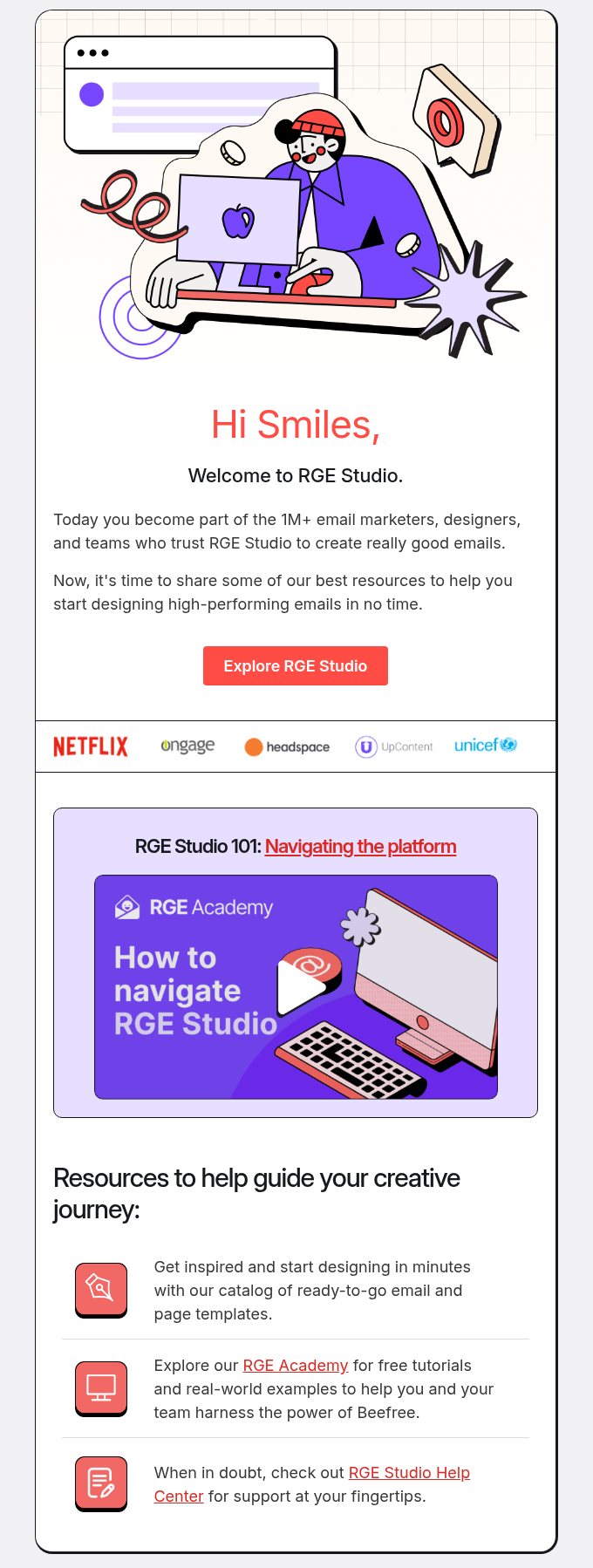 RGE Studio welcomes new users with strong social proof and shows them where to begin; source: Really Good Emails
Instead of pitching, the primary CTA, “Explore RGE Studio,” gives users one clear place to start. A short, scannable list of resources (ready-to-go templates, the RGE Academy for tutorials, and a Help Center) guides users on their next steps. This approach addresses new users’ need for direction by setting expectations and making the first step clear.
While many welcome emails focus on introducing a brand, HubSpot uses its welcome email to start the onboarding process immediately.
The subject line, “Welcome to your HubSpot journey,” signals that the recipient is beginning a new process instead of simply joining a mailing list. It sets expectations for what’s coming next.
The email is structured around activation. Instead of overwhelming new users with every available feature, it highlights key resources and next steps that help them get value from the platform faster. This approach keeps recipients focused on a single goal: taking action inside the product.
The CTA works because it aligns with the user’s intent at the moment of signup. Someone who has just created an account needs guidance, rather than another sales pitch. By helping users achieve an early win, HubSpot increases the likelihood of long-term engagement and product adoption.
Consideration emails
At the consideration stage, prospects already know who you are. The goal now is to help them evaluate whether your solution is worth their time, budget, and attention. This is where lead nurture emails, case studies, and webinar campaigns become effective because they answer questions, address objections, and build confidence before a sales conversation happens.
Adobe’s Summit promotion email demonstrates how educational events can support consideration-stage buyers.
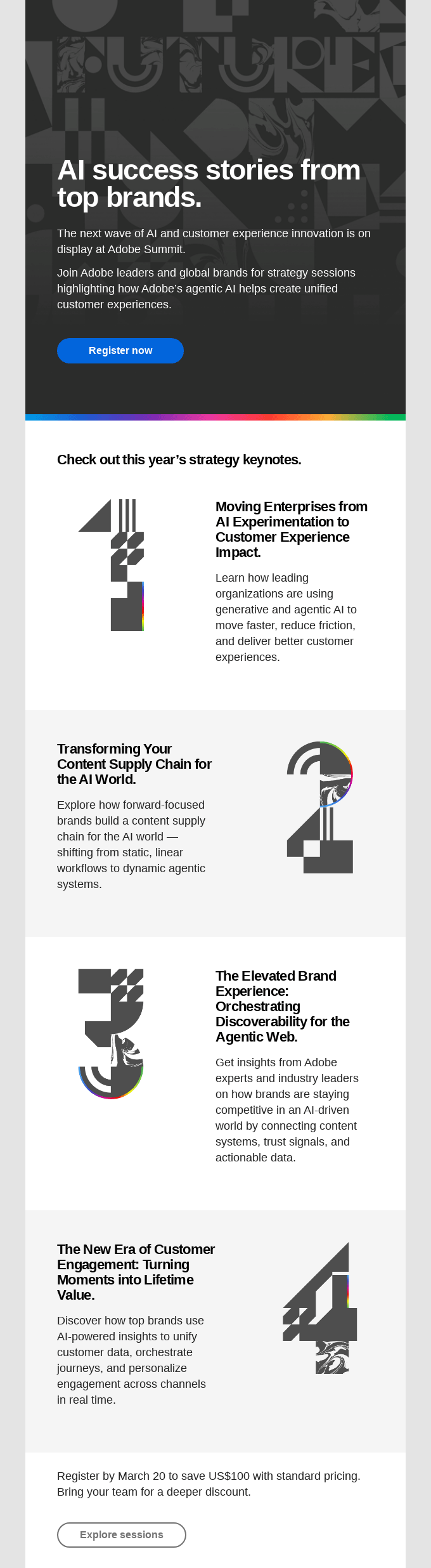 Adobe sells its Summit on the problems each session will help solve; source: Really Good Emails
Rather than focusing on event logistics, the email highlights specific strategy sessions covering AI adoption, customer experience, personalization, and content operations.
Each session is framed around a business challenge that marketing leaders are actively trying to solve, helping prospects see the value before they’re asked to register.
The CTA evolves naturally from the content. Readers first learn what they can gain from attending, then receive an invitation to explore sessions or register. This approach works because the email sells expertise, not event access.
An event email from BeeFree promotes its Unspam email marketing conference, but it does much more than announce the speaker lineup. The email is designed to help prospects evaluate whether attending is worth the investment of time and budget.
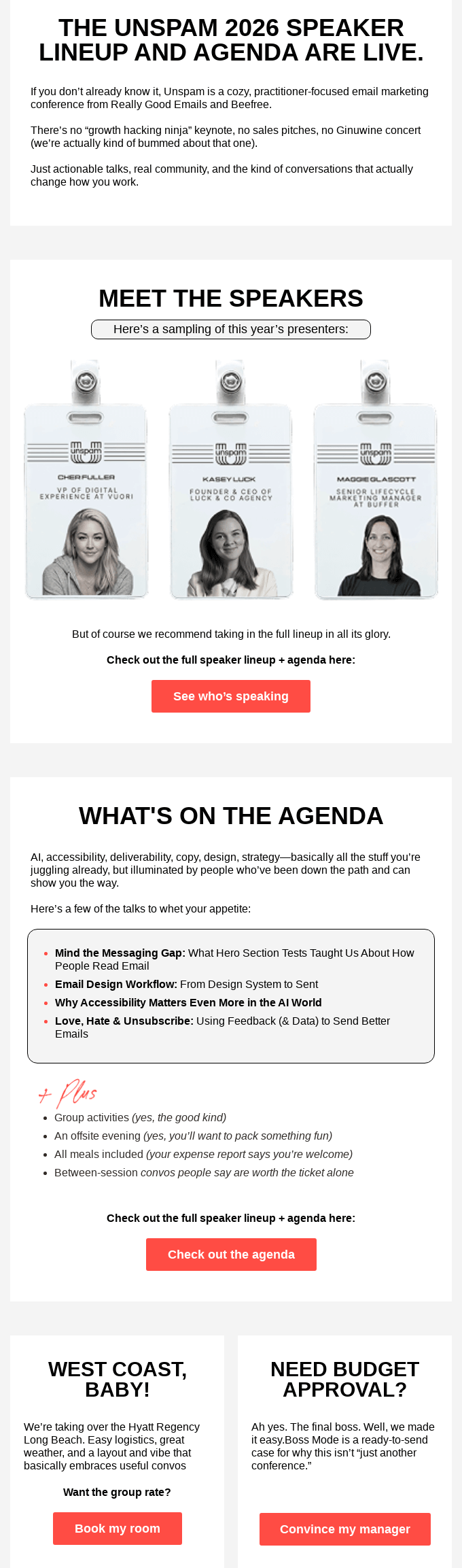 BeeFree helps prospects decide whether the conference earns their time and budget; source: Really Good Emails
The headline communicates the main update — the agenda and speakers are now available. From there, BeeFree builds credibility by showcasing industry experts and previewing specific sessions covering AI, deliverability, accessibility, strategy, and email design. The email gives readers a concrete preview of what they will learn.
Beyond promoting the agenda, the email addresses practical concerns that often delay registration. One section helps attendees arrange accommodation, while another provides resources for gaining manager approval. This acknowledges the reality of B2B purchasing, where professional development budgets often require internal buy-in.
The CTAs support different stages of consideration. Readers can explore speakers, review the agenda, book accommodation, or access materials designed to justify attendance. Instead of pushing a single conversion path, the email helps prospects gather the information they need to make a confident decision.
Conversion emails
At the conversion stage, prospects need help reaching value. An effective activation email highlights the next best action and guides users toward meaningful product milestones. Importantly, these emails should be triggered by behavior, not by arbitrary dates in the trial period.
An email from Claude targets users who have already completed the basics and are ready to explore more advanced capabilities.
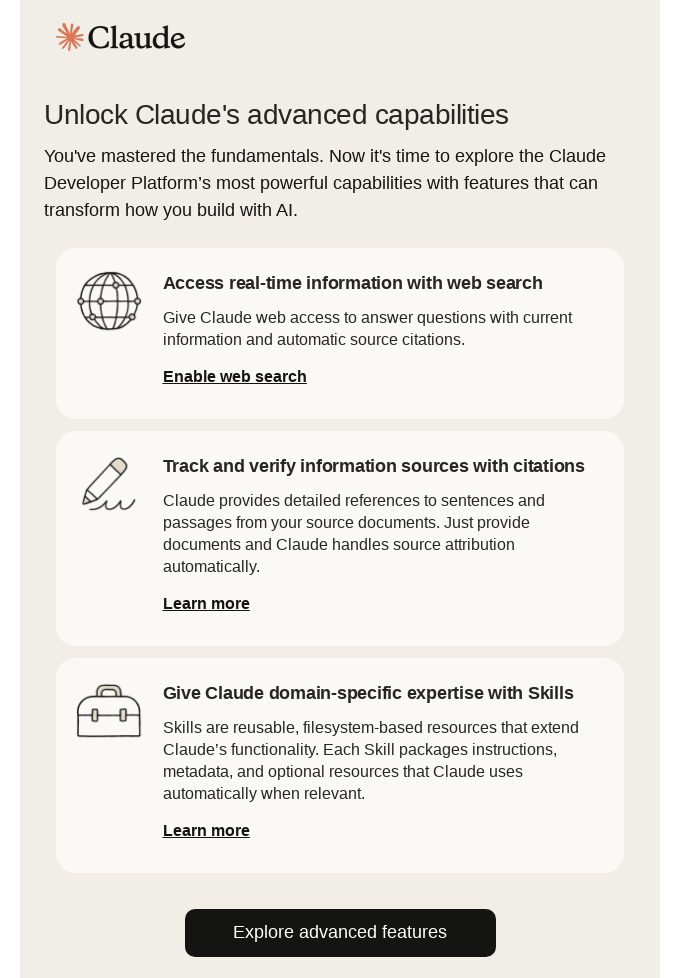 Claude introduces its advanced features to users who are ready for them; source: Really Good Emails
It introduces three specific features: web search, citations, and Skills. Each feature is presented with a clear explanation of what it does and why it matters, making it easier for users to understand its practical value.
The email succeeds because it focuses on activation. Instead of asking users to upgrade or book a demo, it encourages them to adopt features that make the product more useful.
The CTA “Explore advanced features” feels like a natural next step because the email has already demonstrated the value behind it.
An email from Gorgias is triggered by a missing setup step. The subject line, “Connect your first support channel,” immediately communicates what the user needs to do next.
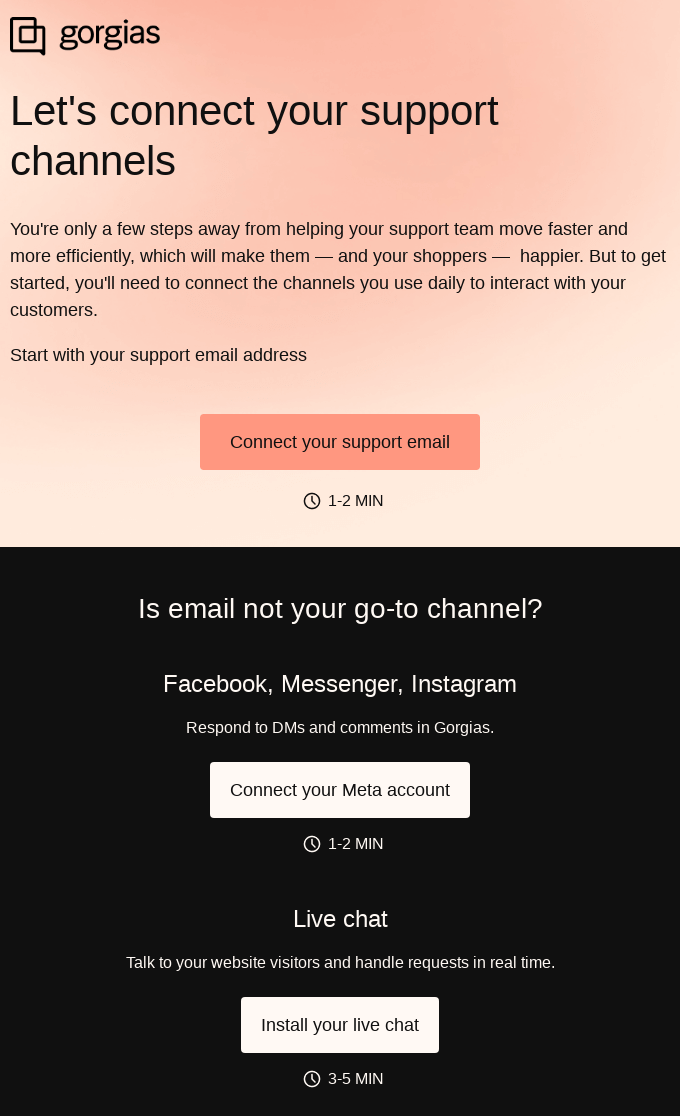 Gorgias nudges users to finish the one setup step they skipped; source: Really Good Emails
Instead of introducing every feature in the platform, the email focuses on connecting a support channel. The email works because it reduces friction. Gorgias explains why the action matters, highlights the estimated setup time, and provides separate CTAs for different communication channels, including email, social media, and live chat.
Most importantly, the email is tied to user behavior. It doesn’t matter whether the user signed up one hour ago or one week ago. The email remains relevant until the setup step is completed.
Retention emails
At the retention stage, email shifts from generating interest to maintaining momentum. The goal is to help customers continue finding value, renew their subscriptions, and return before they become inactive.
This email from Squarespace is a classic renewal and conversion campaign.
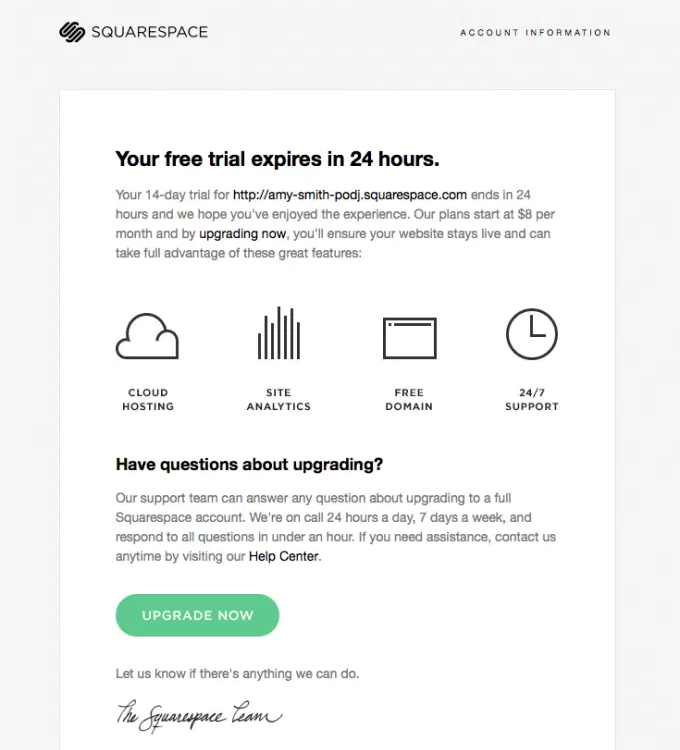 Squarespace’s trial-ending reminder reassures as much as it prompts action; source: Really Good Emails
The message opens with a clear reminder that the free trial expires in 24 hours, creating urgency without relying on aggressive sales tactics. Instead of focusing on pricing, Squarespace reinforces the value users will receive after upgrading by highlighting benefits such as hosting, analytics, domain registration, and support.
Another smart element is the support-focused messaging. The email anticipates hesitation and reassures prospects that help is available if they have questions about upgrading. This shifts the conversation from “buy now” to “let us help you make the right decision.”
An email from Loom is triggered when users approach their content limit.
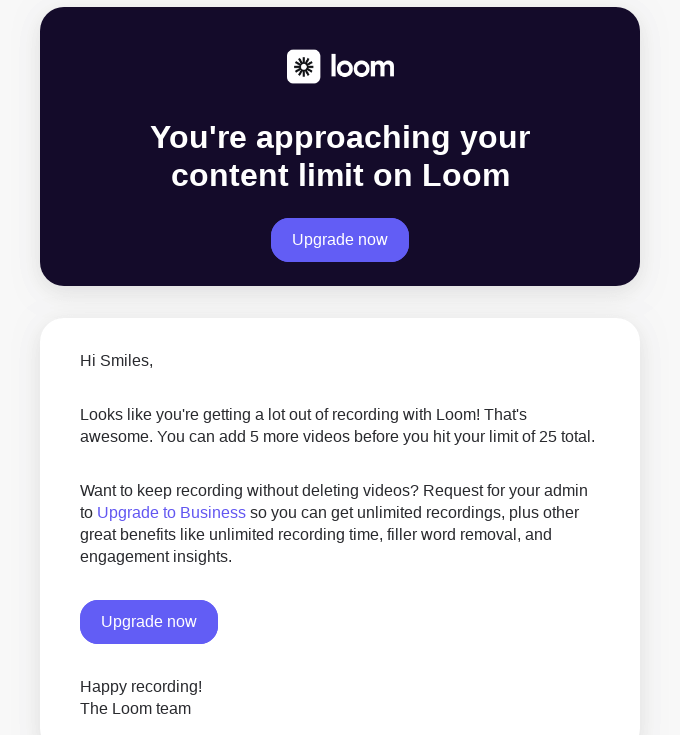 Loom times its upgrade offer for the moment a user is about to bump the ceiling; source: Really Good Emails
Instead of promoting an upgrade to everyone, Loom waits until customers are actively using the product and nearing a restriction that could interrupt their workflow.
The message is effective because it frames the upgrade as a solution rather than a sales offer. Loom starts by acknowledging the user’s success as they’ve created enough recordings to nearly reach their limit.
It then explains what happens next and introduces premium benefits that directly address the customer’s current needs, such as unlimited recordings and additional functionality.
This is a strong example of behavior-based retention marketing. The email arrives at the exact moment when the upgrade becomes relevant, making the offer feel helpful.
How to write B2B emails people actually read
B2B buyers don’t read emails the way marketers hope they do. Most scan subject lines between meetings, skim messages on mobile devices, and decide within seconds whether an email deserves their attention.
Let’s look at B2B email marketing best practices for writing messages that earn attention and move buyers closer to a decision.
B2B email subject line frameworks
B2B buyers rarely open emails because the subject line sounds clever. They open them because the subject line promises something useful. In crowded inboxes, clarity is often more effective than creativity. And that matters even more now that AI assistants in Apple Mail and Gmail often summarize a message before the recipient opens it, surfacing your value up front.
A good B2B subject line helps recipients quickly understand what’s inside and why it matters to them. The following frameworks can help you create subject lines that earn attention without relying on clickbait.
| Framework |
Example subject line |
| Utility |
How to reduce onboarding time by 40% |
| Social proof |
How X reduced customer churn by 18% |
| Curiosity gap |
The onboarding mistake most SaaS teams overlook |
| Question-led |
Is your sales team losing leads after the demo? |
| Data-led |
2026 benchmark report: What top-performing teams do differently |
| Urgency (use sparingly) |
Last chance to register for tomorrow’s webinar |
| Personalized |
Sarah, your Q2 pipeline report is ready |
| Problem–solution |
Struggling with webinar attendance? Here’s what worked for our customers |
No framework guarantees results, which is why testing remains essential. However, the best-performing B2B subject lines usually communicate value immediately instead of trying to trick recipients into opening the email.
Let’s look at a few effective B2B email subject line examples from real-world campaigns:
| Brand |
Example subject line |
Primary framework |
| Fitbit |
Don’t miss a step—move now |
Urgency / Action-oriented |
| Section |
One week left to register: Free AI ROI strategy sessions |
Urgency + Value |
| Salesforce |
Registration is open. Save $400 before prices rise. |
Offer + Urgency |
| Apollo.io |
5 steps to find and engage high-potential accounts |
Educational / List-based |
| MasterClass |
Save 30% and gain AI credibility that sets you apart |
Offer + Benefit |
| Typeform |
Did you know you could do this with Typeform? |
Curiosity gap |
Copy structure and CTA design
Many B2B emails fail because they try to achieve too many goals at once. If an email promotes a webinar, announces a feature update, and asks readers to book a demo, most recipients will do nothing. A more effective approach is to focus on a single objective and make the next step obvious.
To improve readability, keep paragraphs short, use descriptive headings where appropriate, and leave enough white space for readers to scan the message quickly. Since many B2B buyers check email on their phones between meetings, every email should be designed with mobile users in mind.
Your CTA should also match the recipient’s stage in the buying journey. At the top of the funnel, educational CTAs such as “Read the guide” or “Download the report” work best.
In the consideration stage, you can encourage prospects to “Watch the case study”, “Join the webinar”, or “See how it works.”
When buyers are evaluating vendors, stronger conversion-focused CTAs such as “Book a demo” or “Start a free trial” become more relevant.
Personalization beyond first name
Personalization in B2B email marketing goes far beyond inserting a recipient’s first name into the subject line. What matters is whether the email reflects the recipient’s role, priorities, and recent interactions with your brand.
A CFO evaluating your solution may care about ROI and efficiency gains, while an IT specialist is more interested in security, integrations, and implementation requirements. Sending both contacts the same message means at least one of them will find it irrelevant.
The most effective personalization combines several types of data. Start with firmographic information such as industry and company size. Then add role, buying stage, content interests, and product behavior.
For example, if a marketing team member downloads your SEO guide, the next email should continue the conversation with SEO-related insights, case studies, or tools. Similarly, a prospect who attends a webinar about customer retention should receive follow-up content on retention strategies rather than acquisition tactics.
Behavioral signals can be even more powerful. A free-plan user who visits your pricing page shows a different intent than a subscriber who only reads blog content.
One may be ready for an upgrade conversation, while the other still needs educational resources. The goal of personalization is to make every email feel like a logical next step based on what the recipient already told you through their profile and actions.
Accessibility and dark mode
An increasing number of B2B recipients use assistive technology or dark mode to read emails, and inaccessible designs reduce engagement. The Web Content Accessibility Guidelines set the baseline:
- keep a contrast ratio of at least 4.5:1 for body text and 3:1 for large text;
- add descriptive alt text to every meaningful image to ensure your message is accessible when images are blocked or read aloud;
- use HTML text instead of text embedded into images;
- give each email a logical heading order.
Accessibility is also becoming a regulatory expectation: the EU’s European Accessibility Act, in force since June 28, 2025, strengthened requirements for consumer-facing digital services. That’s a clear signal that brands should hold their emails to the same standard.
Dark mode needs special attention. Apple Mail, Outlook, and Gmail each display dark mode differently. Some change only the background, while others invert all colors. A design that appears polished in light mode may lose its logo or become unreadable in dark mode. Designing for both modes protects your brand and ensures accessibility for your audience:
- avoid using pure black or pure white;
- ensure logos and dark icons have a contrasting background or outline to remain visible;
- maintain contrast above WCAG thresholds in both modes;
- preview every campaign in dark mode across major email clients before sending.
Join 3M+ businesses growing with SendPulse
From solo creators to global brands, millions trust SendPulse to run email campaigns, chatbots, automations, and more — all in one place. Get started for free now!
Get started for free
B2B email deliverability and compliance in 2026
Deliverability used to feel like a technical background issue. In 2026, it directly affects whether your B2B email strategy can work at all. Gmail, Yahoo, Microsoft, Apple Mail Privacy Protection, stricter authentication standards, and corporate security filters have changed the rules.
Marketers can no longer rely on volume, inflated opens, or weak list hygiene. The inbox now rewards senders that prove they are legitimate, respect consent, and maintain engaged audiences.
This matters especially in B2B, where one missed email can mean a lost demo request or a sales follow-up buried in spam. A strong B2B email strategy now needs two layers: the message people want to read and the technical foundation that helps it reach them. Now we’ll explain what changed, which metrics to trust, and how to keep your list healthy without damaging the pipeline.
What Gmail, Yahoo, and Microsoft require from bulk senders
For years, email authentication was something many marketers left to IT teams. Today, it’s a marketing responsibility because it directly affects whether your campaigns reach the inbox.
Since 2024, Gmail and Yahoo require senders of more than 5,000 messages per day to authenticate their domains with SPF, DKIM, and DMARC, keep their spam-complaint rate below 0.3%, and support a one-click unsubscribe option for marketing and subscribed messages. Microsoft has introduced similar requirements for Outlook.com, Hotmail, and Live.com high-volume senders in 2025, so email that fails authentication is now rejected outright with a “550 5.7.515” error. Messages that don’t meet these standards are more likely to be filtered, flagged as spam, or blocked altogether.
The good news is that these requirements aren’t new marketing tactics. They’re simply the new baseline for responsible email sending. If you’re using a professional email service provider, much of the heavy lifting is already built into the platform. Your job is to make sure everything is configured correctly.
At a minimum, check four things:
- DNS authentication records. Verify that SPF, DKIM, and DMARC are configured for your sending domain.
- Authentication status. Make sure your email platform confirms that authentication is active and passing validation checks.
- Unsubscribe functionality. Ensure recipients can opt out easily and that one-click unsubscribe is enabled where supported.
- Spam rate. Monitor your Gmail spam complaint rate in Google Postmaster Tools and keep it below 0.1%. Avoid reaching a spam rate of 0.3% or higher. Yahoo exposes a similar metric through its Complaint Feedback Loop.
Mailbox-provider requirements are only half of compliance. Email is also governed by regional laws like CAN-SPAM in the US, GDPR in the EU, CASL in Canada, and more, each with its own consent and unsubscribe rules. Check our full guide to email marketing laws for the requirements and penalties by region.
Why open rates are no longer reliable
For years, open rates were one of the most important email marketing metrics. Today, they’re useful but far from definitive. The biggest reason is Apple’s Mail Privacy Protection, which automatically preloads tracking pixels used to measure opens.
As a result, some emails appear to be opened even when recipients never read them. MPP also obscures location data, making geo-based open tracking less reliable. In practice, this means open rates can no longer tell the full story of how recipients engage with your emails, and you need to focus on metrics that reflect meaningful actions.
How to keep your list clean and compliant
A healthy mailing list is one of the strongest predictors of long-term deliverability. Your goal is to maintain an audience that wants to hear from you. Start with double opt-in to verify subscriptions and reduce invalid or mistyped email addresses.
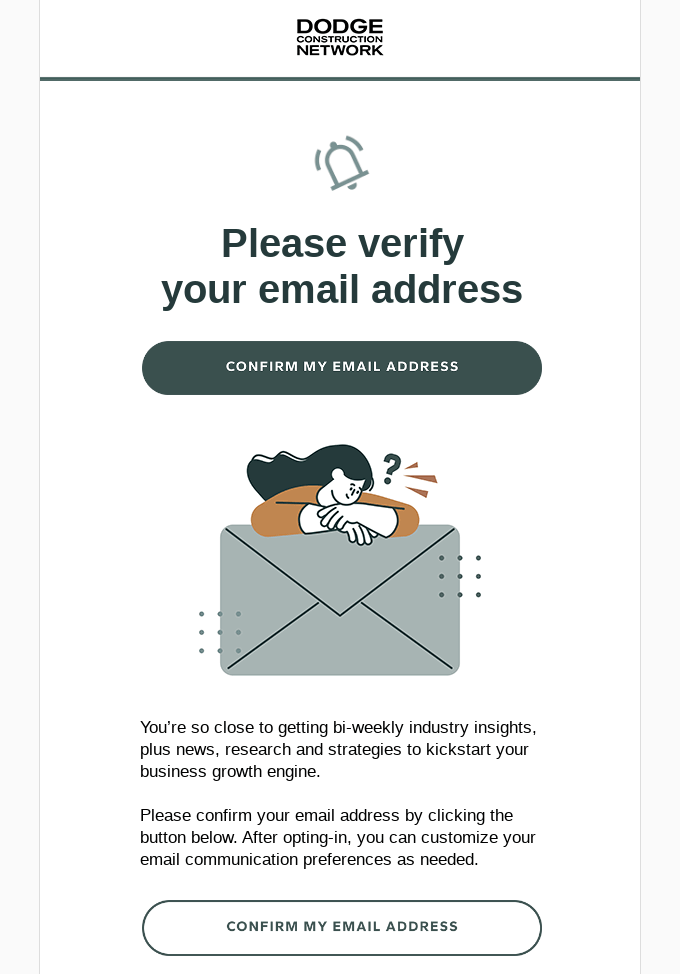 Dodge Construction Network confirms every new subscriber with a double opt-in; source: Really Good Emails
Monitor hard and soft bounces regularly, and remove addresses that consistently fail to receive emails. Use suppression lists to prevent unsubscribed contacts, bounced email addresses, and other ineligible recipients from re-entering your campaigns.
It’s equally important to have a plan for inactive subscribers. Rather than continuing to send emails indefinitely, create a policy that defines when a contact should be considered inactive.
Before removing them, run a re-engagement campaign asking whether they still want to hear from you. This gives subscribers a chance to stay while helping you identify contacts who no longer engage with your content.
B2B marketers should also be careful when interpreting engagement data. Corporate email gateways and security tools often scan incoming emails and click links automatically to detect threats.
These non-human interactions can inflate click metrics and make campaigns appear more successful than they actually are. If you notice all links being clicked within a second of delivery or identical click patterns across multiple contacts, the activity may be generated by security software rather than real recipients.
Looking beyond raw click counts and analyzing engagement patterns, and following our B2B email marketing tips can help you make more accurate decisions.
AI in B2B email marketing
According to the McKinsey 2025 report, marketing and sales teams report the highest revenue gains from AI adoption, with 67% seeing increased revenue over the past year.
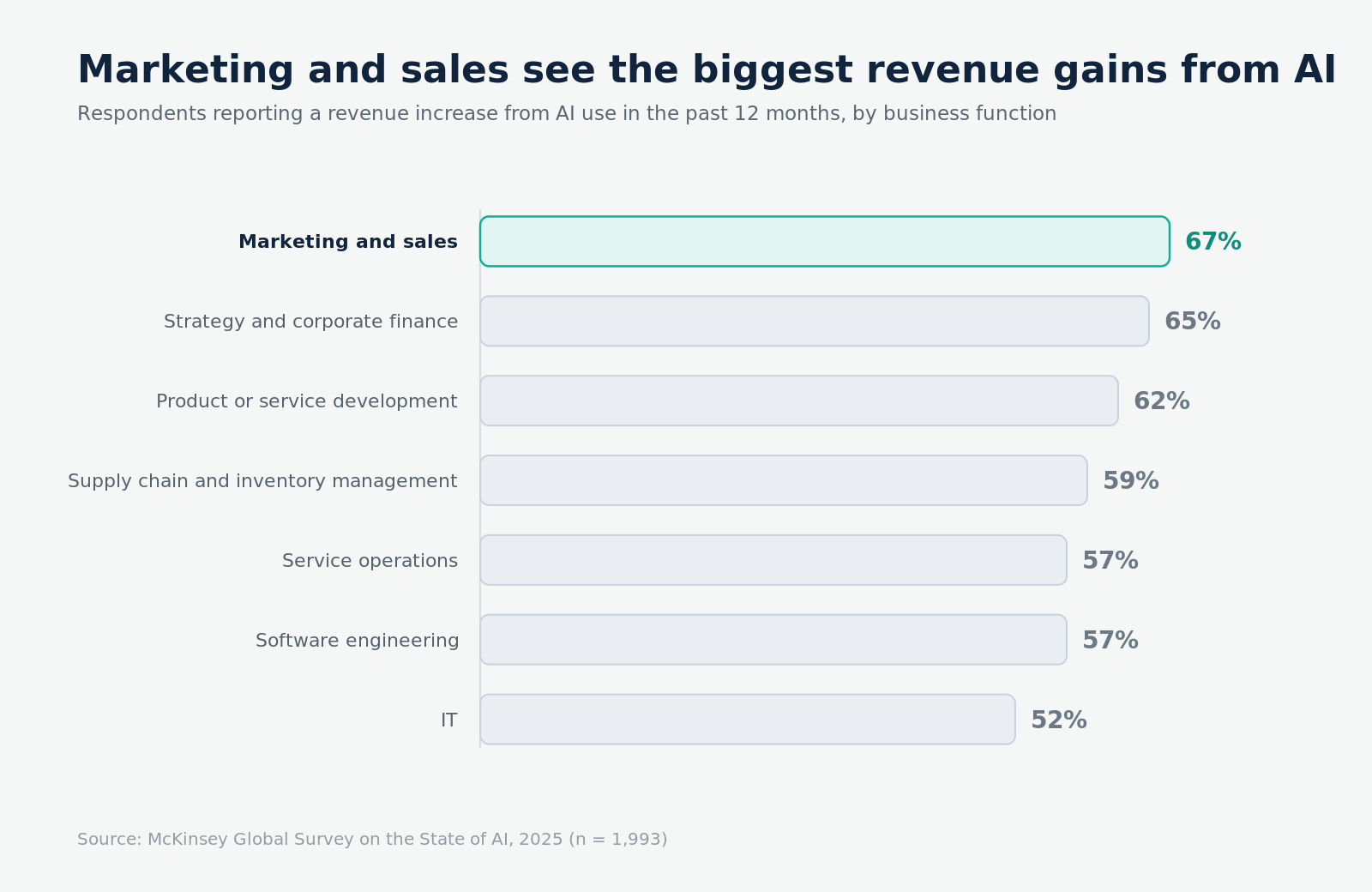 Marketing and sales report the biggest revenue gains from AI of any business function
Those gains, though, rarely come from letting AI run campaigns on autopilot. Some marketers expect it to replace strategy, copywriting, and campaign planning; in practice, AI pays off when it accelerates work that already has a clear objective — moving faster while a marketer still decides where to go.
Where AI saves time
AI delivers the most value when it removes repetitive work from the email creation process. For example, it can generate multiple subject line variations for A/B testing in seconds. That way, it helps marketers explore different angles without starting from scratch each time. AI can also produce first-draft email copy, giving teams something to refine instead of facing a blank page.
Another practical use case is content repurposing. A single webinar or blog post can be transformed into a nurture series, newsletter, follow-up email, or customer update. AI can also adjust tone for different audiences, translate content into multiple languages, and suggest audience segments based on customer attributes and behavior.
Workflow planning is another area where AI can save time. Instead of manually mapping every step, marketers can use AI to generate automation ideas, identify potential triggers, and outline nurture flows. For instance, SendPulse includes built-in AI tools that help create automation flows based on a simple prompt.
The common theme across all of these tasks is speed. AI is excellent at producing options, drafts, and starting points. It helps marketers spend less time creating assets and more time improving strategy, messaging, and customer experience.
Where human review still matters
AI can draft an email in seconds, but it doesn’t understand your customers or the risks of getting important details wrong. That’s why many parts of B2B email marketing still require human review. Brand voice is one example. AI can mimic a tone, but only people can decide whether a message sounds consistent with the company’s positioning and values.
Human oversight is also essential for legal and compliance claims, pricing information, product capabilities, and any statement that needs to be factually accurate.
An AI-generated mistake in a blog summary is one thing; an incorrect claim in a sales email can damage trust or create legal issues. The same applies to customer stories and case studies, where accuracy and context matter as much as the results themselves.
Executive-level communication deserves particular attention. Messages aimed at decision-makers often require a deeper understanding of business priorities, industry dynamics, and organizational goals than AI can reliably provide.
AI creates drafts, variations, and ideas. Humans review, challenge, refine, and approve them. In other words, AI helps eliminate blank-page paralysis, but editorial judgment remains a human responsibility.
It’s easy to get distracted by email dashboards filled with opens, clicks, and engagement trends. While these metrics can help diagnose performance, they don’t necessarily tell you whether email is contributing to business growth. A campaign with a high open rate may generate little pipeline, while a niche webinar invitation with modest engagement could influence a major deal.
The following metrics and frameworks will help you evaluate email performance in the context of pipeline growth, customer retention, and revenue impact.
Track metrics by funnel stage
Not every email should be judged by the same metric. A newsletter designed to attract new prospects and an onboarding sequence designed to activate customers serve different purposes, so they should be measured differently.
A frequent trap is judging every campaign on opens and clicks alone. Instead, define success based on the role each email plays in moving prospects and customers through the funnel.
| Funnel stage |
What to measure |
What good looks like |
What to do if it’s low |
| Awareness |
New subscribers, content CTR, and resource downloads |
Steady audience growth and consistent content engagement |
Improve lead magnets, test B2B email subject lines, and refine audience targeting |
| Consideration |
Webinar registrations, case study clicks, and demo intent signals |
Prospects actively engaging with content and evaluating solutions |
Strengthen educational content, add social proof, and improve segmentation |
| Conversion |
Meetings booked, trials started, opportunities created, and deals influenced |
Email contributing directly to pipeline creation and revenue opportunities |
Review CTAs, reduce conversion friction, and align campaigns with sales outreach |
| Retention |
Feature adoption, renewal rate, expansion revenue, and customer engagement |
Customers continuing to use, renew, and expand their relationship with your brand |
Improve onboarding, expand product education, and launch re-engagement campaigns |
The further prospects move through the funnel, the closer your metrics should be to revenue. While engagement metrics can help identify optimization opportunities, they are rarely the end goal.
Prioritize your A/B tests
A/B testing can improve email performance, but only if you focus on the variables most likely to influence results. Many marketers spend time testing button colors or minor design tweaks while overlooking factors that have a much bigger impact on engagement and conversions.
A practical testing priority looks like this:
- Subject line — determines whether recipients open your email at all.
- Sender name and address — shapes trust before the subject line is even read.
- CTA — covers wording, placement, and the value proposition behind the action you want readers to take.
- Send time — especially important for global audiences and behavior-based campaigns.
- Content angle — for example, a product-focused message versus a customer success story or educational approach.
- Audience segment — the same campaign sent to different roles, industries, or engagement levels.
To get reliable results, test only one variable at a time. If you change the subject line, CTA, and audience simultaneously, you won’t know what caused the outcome. It’s also worth running tests across multiple sends before concluding.
One campaign can be affected by timing, seasonality, or audience composition. As a rule of thumb, look for consistent patterns over two or three campaigns rather than reacting to a single result.
Most importantly, evaluate tests using metrics tied to business outcomes. Open rates can provide directional feedback, but clicks, conversions, and meetings booked are usually better indicators of whether a change actually improved performance.
Connect email to CRM and revenue attribution
If you only measure opens and clicks, you’re evaluating email as a communication channel. If you connect your email to your CRM system, you can evaluate it as a revenue channel. This makes it possible to understand not just who engaged with a campaign, but how that engagement influenced opportunities, customers, and revenue.
Start by tracking pipeline sourced by email — opportunities created directly from email-driven actions such as demo requests, trial signups, or webinar registrations.
Then look at the pipeline influenced by email, which measures deals where email played a supporting role somewhere in the buying journey. This is often more important in B2B, where prospects may interact with multiple campaigns before speaking with sales.
Email can also affect deal velocity, or the speed at which opportunities move through the pipeline. For example, targeted case studies or follow-up sequences may help prospects overcome objections and progress to the next stage faster. Even if an email doesn’t create a deal directly, shortening the sales cycle can have a significant impact on revenue.
How to do B2B email marketing with SendPulse
A successful B2B email setup starts with building the infrastructure that turns subscribers into qualified opportunities and customers. In SendPulse, this process typically begins with capturing leads, organizing them into segments, and creating automated workflows that respond to buyer behavior.
Once the foundation is in place, you can use AI tools, testing features, and analytics to improve performance continuously.
The following steps show how to do B2B email marketing well with SendPulse.
Capture and qualify leads
The quality of your email marketing depends heavily on the quality of your data. That’s why lead capture should gather the information you’ll need for segmentation and personalization later.
In SendPulse, you can create pop-ups and landing pages to collect leads from your website. You can build them from scratch using the drag-and-drop builders or choose a template from the library and customize its design to match your brand and goals.
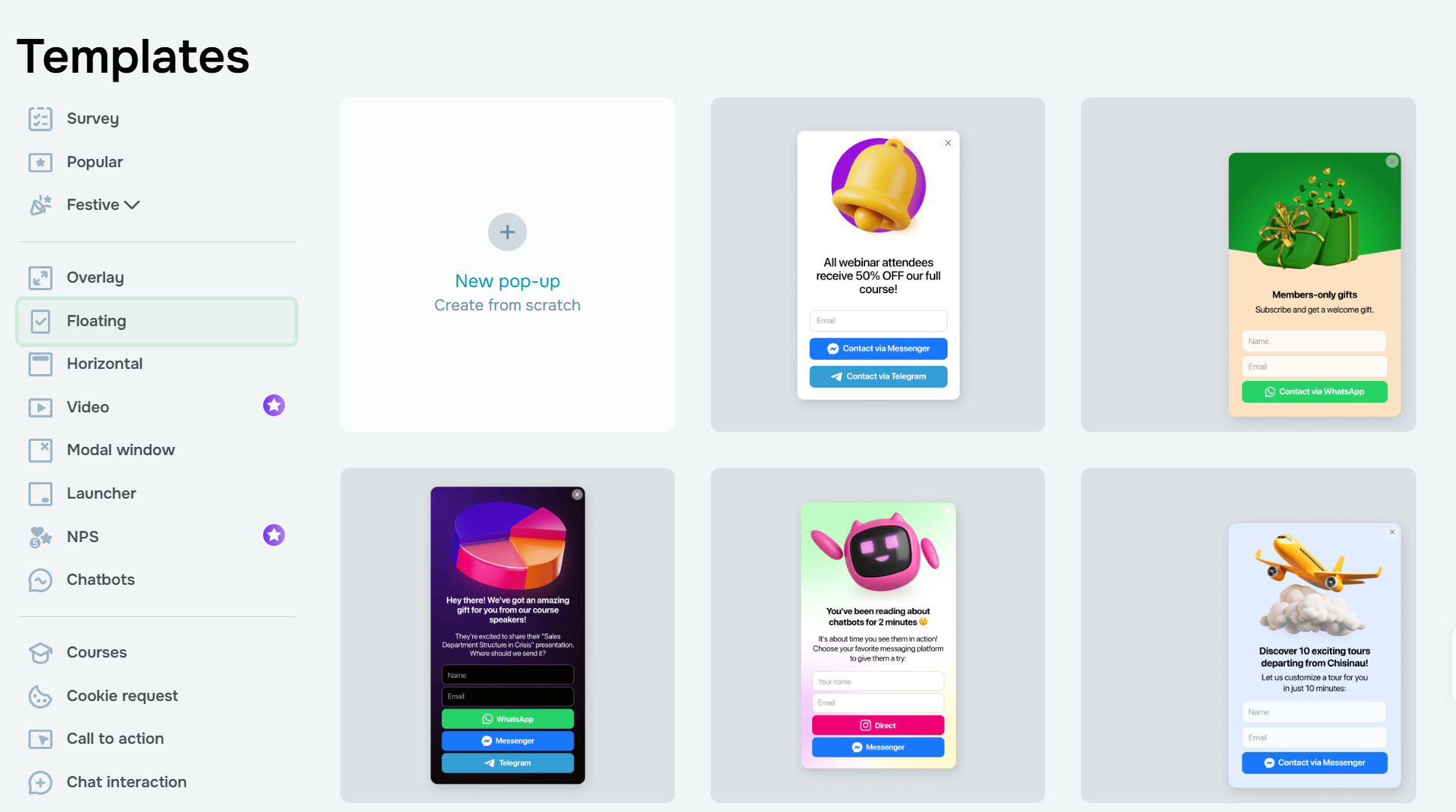 Choose a ready-made pop-up template and customize it
You can also use AI to speed up the process. Simply describe the type of form you want to create, and AI will generate a pop-up draft that you can further customize.
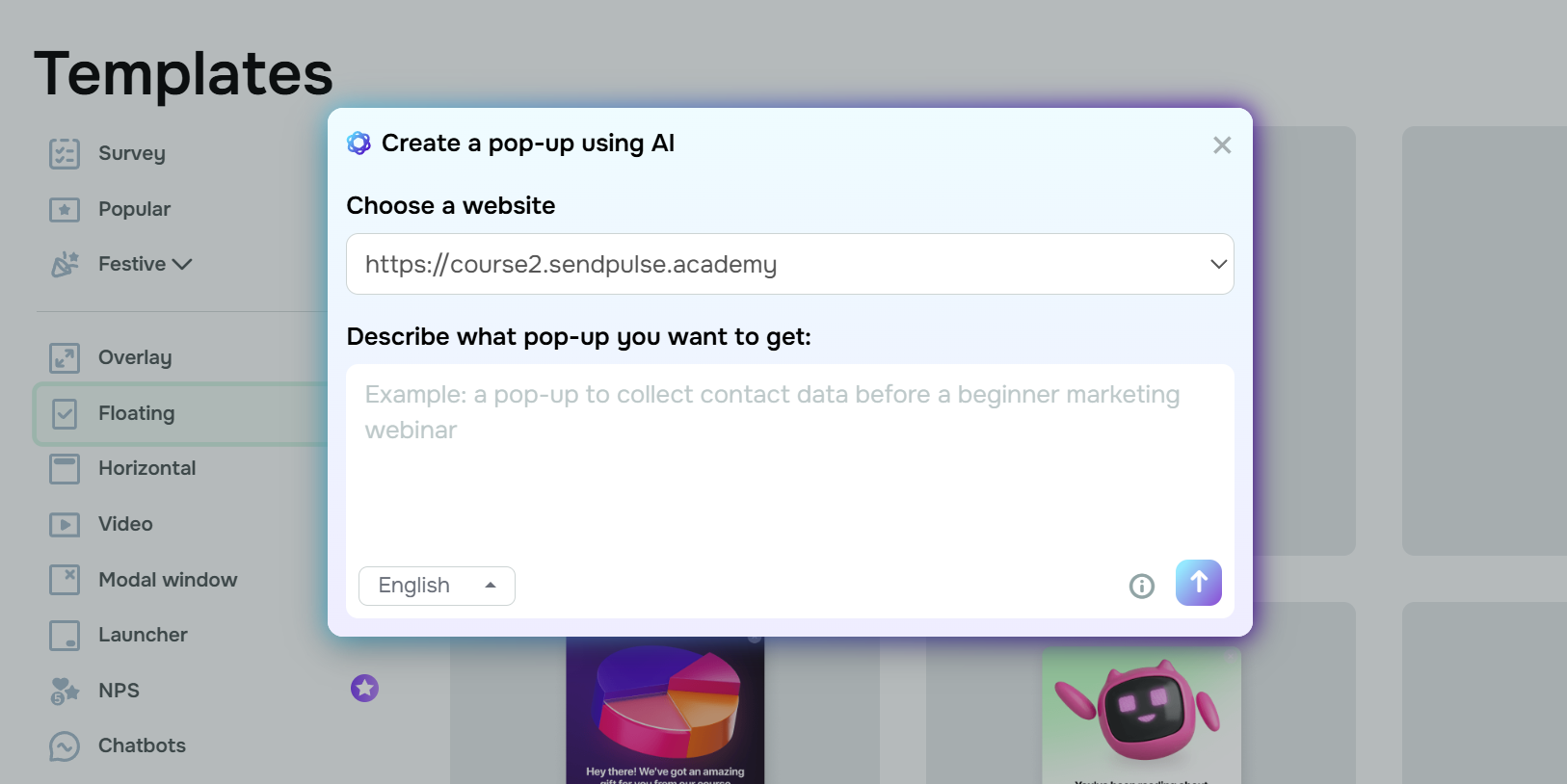 SendPulse’s AI builds a pop-up from a short description
When designing a form, consider adding custom fields such as job role, company size, industry, or area of interest. These details can help you build more relevant segments and automate personalized follow-ups from day one.
For example, a prospect interested in customer retention may need a different nurture sequence than someone researching lead generation.
It’s also a good idea to enable double opt-in. After submitting a form, subscribers receive a confirmation email and are added to your list only after verifying their email address. While this adds an extra step, it helps keep your database clean, improves deliverability, and provides a record of consent.
Build segments and custom data fields
Capturing data is only the first step. To make your emails relevant, you need a way to organize that data and turn it into actionable segments.
In SendPulse, you can create custom variables that store any information relevant to your sales process. Create custom variables by opening the “Mailing lists” section, selecting a list, and clicking “Create variable.” Choose the variable type based on the data you want to store: String for text values such as job roles or company names, Number for numeric data, and Date for information such as registration dates or event dates.
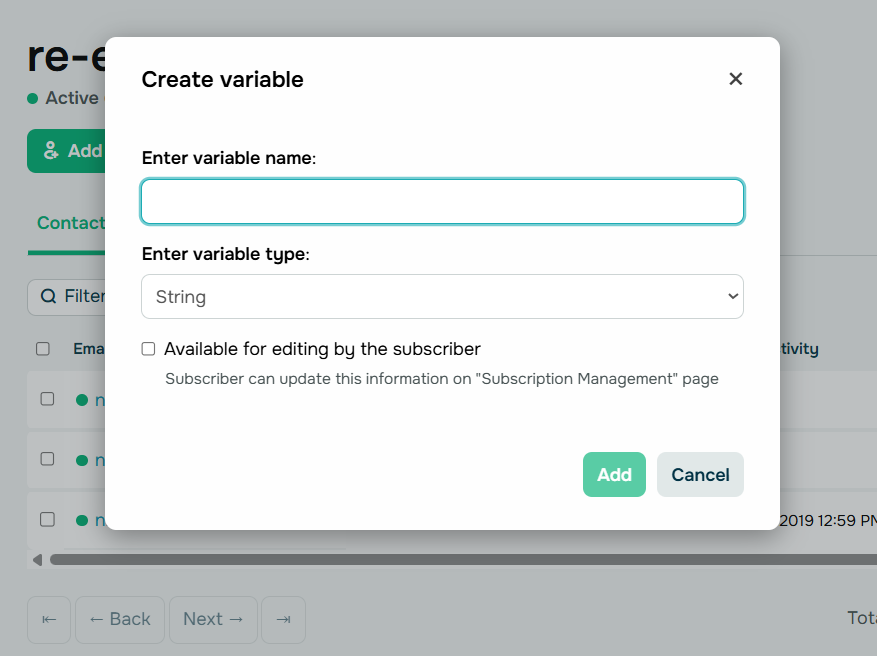 Adding a new custom variable to a mailing list
For example, you might create separate variables for:
- role – Marketing Manager, COO, IT Manager;
- industry – SaaS, eCommerce, healthcare;
- lifecycle stage – Lead, MQL, opportunity, customer;
- product interest – Email marketing, CRM, chatbots, pop-ups.
Once these variables are in place, you can build dynamic segments that update automatically. Instead of manually moving subscribers between lists, SendPulse can group contacts based on their profile information and behavior.
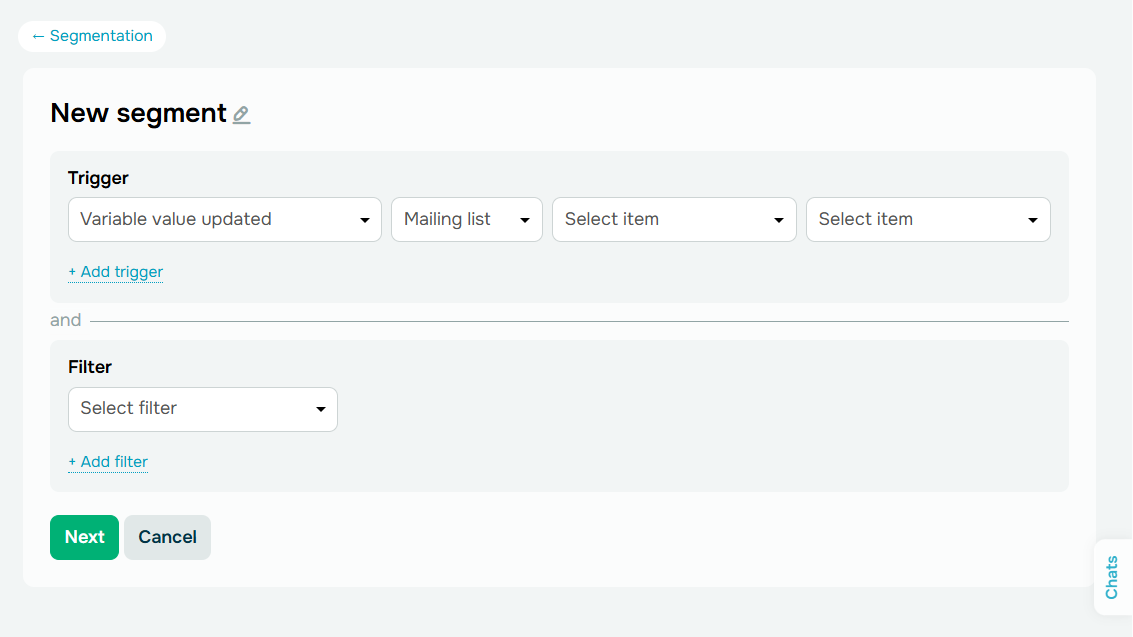 Building a segment that stays up to date on its own
To give you an idea, you could create a segment for marketing managers from SaaS companies who downloaded a lead generation guide or customers interested in CRM features who haven’t logged in during the last 30 days.
This approach becomes especially powerful as your database grows. Rather than managing dozens of static lists, you maintain a single source of truth while allowing segments to evolve automatically. As a result, the right people receive the right emails without requiring constant manual updates.
SendPulse dynamic segmentation functions across multiple tools at once. Contacts can enter a segment based on actions from emails, chatbots, CRM, or courses, with real-time updates as their data changes. It also unifies fields from different sources into a single variable, so data stays consistent regardless of how it was originally collected. In practice, segments act as live, multi-channel entry points that can immediately trigger automation flows when a contact qualifies.

Tetiana Moroz
Automation Product Manager at SendPulse
Set up core lifecycle automations
Once your audience is segmented, you can start building B2B email automation workflows that guide contacts through the customer lifecycle. In SendPulse, you can create workflows using event triggers, conditions, delays, and filters, allowing each contact to follow a path based on their actions and attributes.
You can build flows from scratch using the visual builder and its elements, conditions, and settings, or start with a pre-built template and adapt it to your scenario.
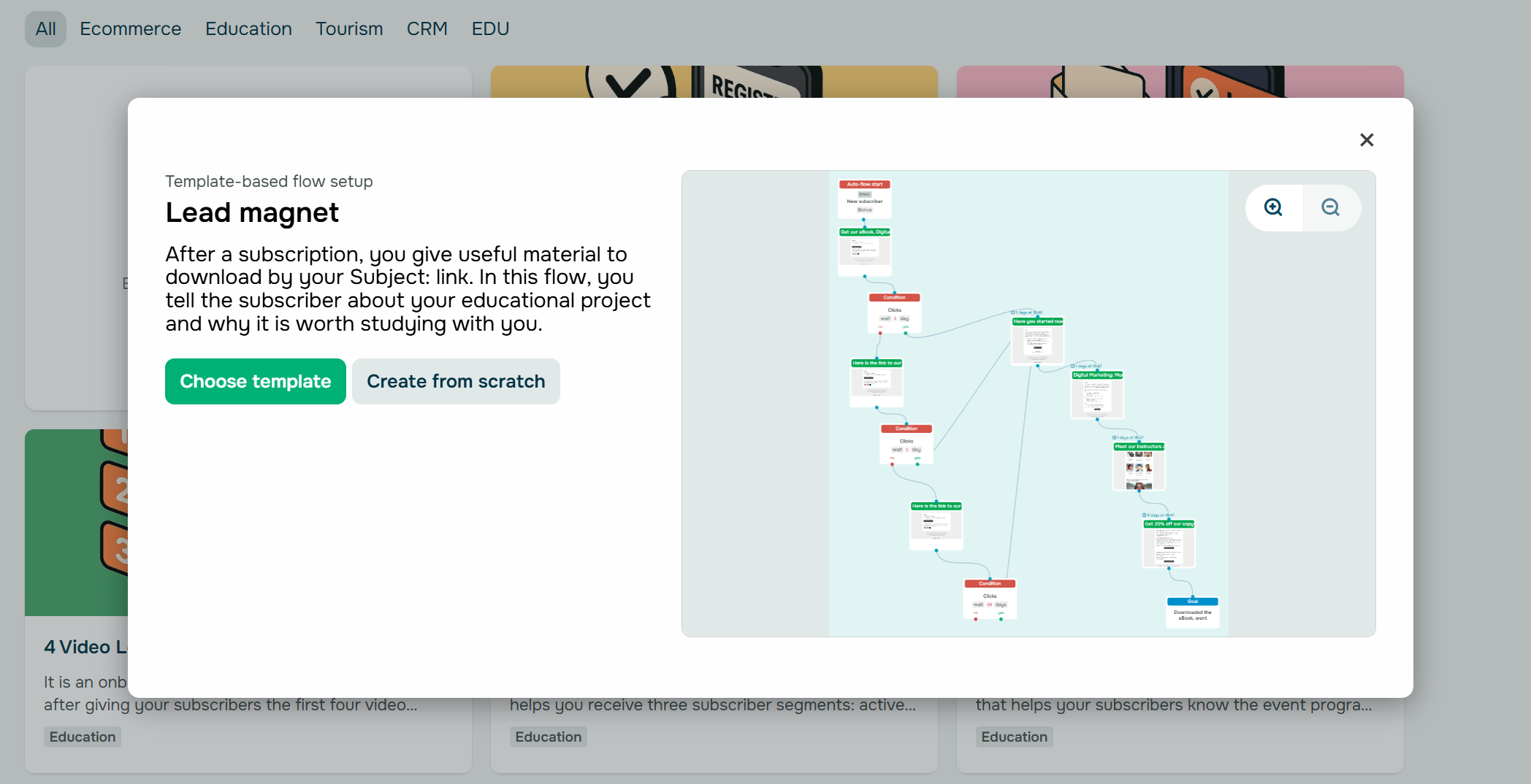 Example of a flow template in the SendPulse account
To speed up the process even further, you can use the AI assistant. Describe the workflow logic you need, and it will generate the structure for you. Then, all that’s left is to review the flow and configure any additional settings.
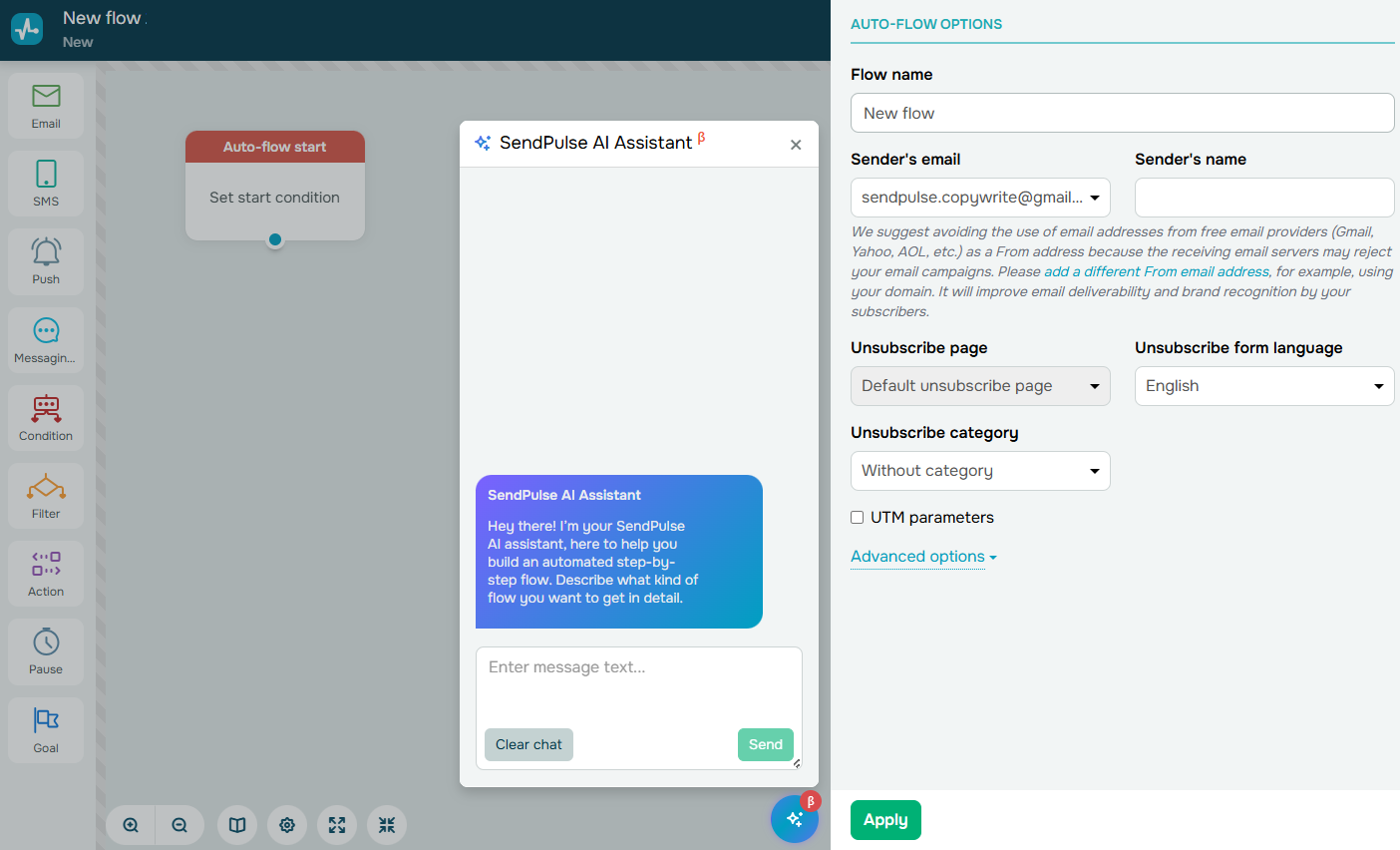 Creating a flow using AI in the SendPulse builder
Say, a workflow might begin when a contact downloads a report. The automation sends the resource immediately, waits three days, checks whether the contact opened the email, and then branches into different follow-up paths. Engaged subscribers may receive a case study or webinar invitation, while less engaged contacts receive additional educational content.
Test, optimize, and report
To improve results over time, you need a process for testing, analyzing, and refining your emails based on real data. Start with A/B testing.
In SendPulse, you can compare different B2B email subject lines, sender names, and email content to identify what drives higher engagement.
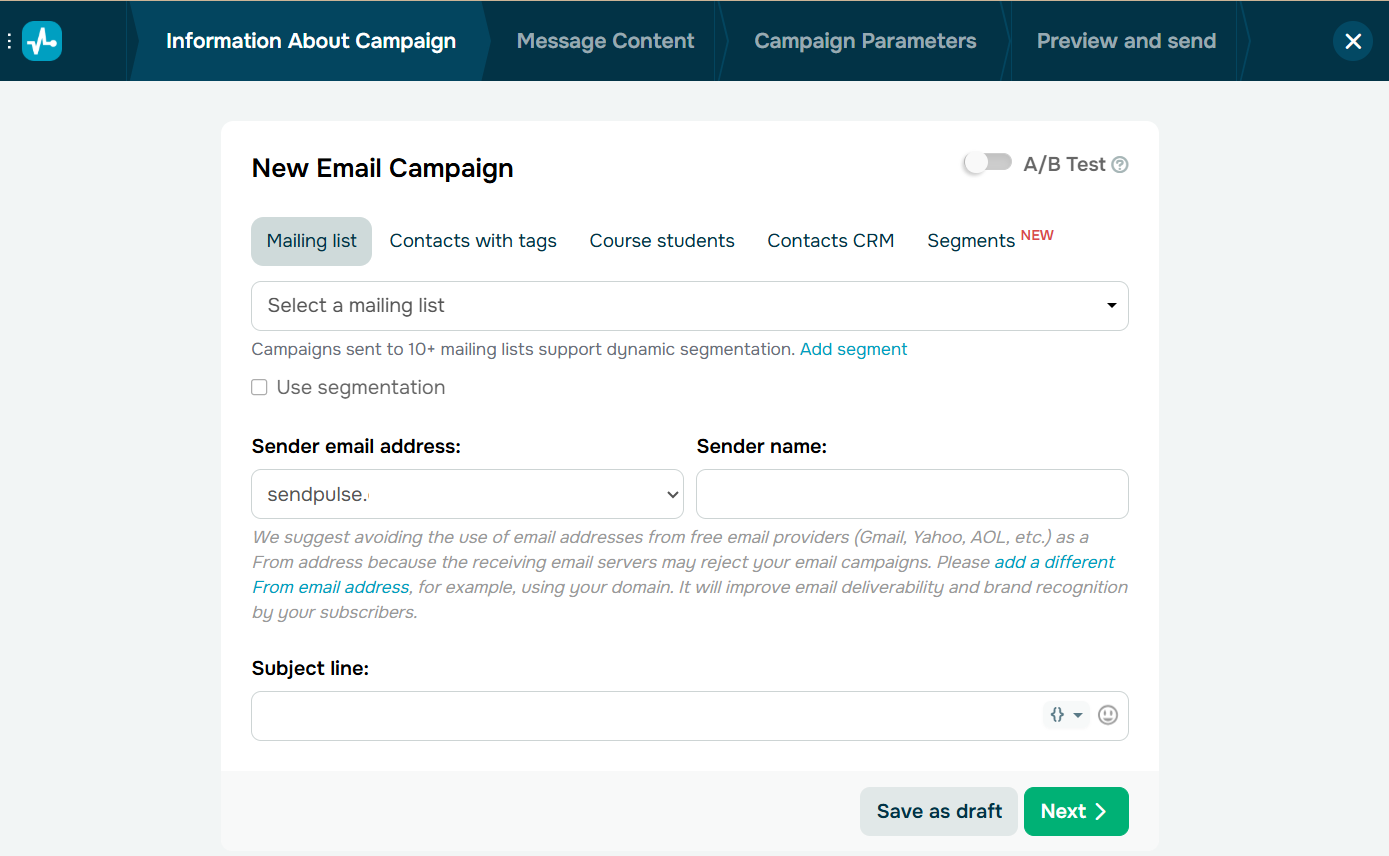 Email A/B testing in the SendPulse account
To create an A/B test, open the “Email” section and enable the “A/B Test” toggle when creating a campaign. Then choose what you want to test and define the percentage of recipients who will receive each variation.
After the test period ends, SendPulse automatically identifies the winning version based on your selected metric and sends it to the remaining subscribers. This allows you to optimize campaigns using real audience behavior.
To analyze campaign performance, open the “Analytics” tab in SendPulse. There, you can track key metrics such as opens, clicks, unsubscribes, spam complaints, and delivery rates, as well as review click maps to see which links attracted the most attention.
The platform also provides audience insights, including subscriber locations, devices, and email clients.
You can export reports or use the data to identify optimization opportunities and measure the business impact of your email campaigns over time.
Turn email into a revenue channel
B2B email marketing has evolved far beyond newsletters and promotional campaigns. In 2026, the most effective marketing is built around the customer lifecycle, using segmentation, automation, and behavioral data to move prospects through the pipeline and strengthen customer relationships after the sale.
Success is no longer measured by how many emails you send or how many people open them, but by the opportunities, revenue, and retention they help generate.
You don’t need a complex tech stack to put these ideas into practice. Small improvements at each stage compound into significant pipeline growth over time. Before you scale, make sure you avoid these common B2B email mistakes:
- Don’t send the same email to every contact. Segment your audience by role, intent, and lifecycle stage.
- Don’t rely on open rates alone. Measure clicks, conversions, pipeline impact, and revenue instead.
- Don’t write like a product brochure. Focus on customer challenges, insights, and outcomes.
- Don’t automate before defining your strategy. Start with segmentation, lifecycle mapping, and campaign goals.
- Don’t wait for deliverability problems to appear. Authenticate your emails and monitor list health, bounce rates, and spam complaints continuously.
- Don’t stop testing. Regularly experiment with subject lines, CTAs, content, and audience segments.
If you’re ready to get more strategic with B2B emails, try SendPulse. You can create subscription forms, segment your audience, launch automated flows, and start turning email into a measurable revenue channel.
B2B email marketing FAQs
What is B2B email marketing?
B2B email marketing is the practice of using email to attract, nurture, convert, and retain business customers. Unlike B2C campaigns, which often focus on immediate purchases, B2B email marketing supports longer buying journeys involving multiple stakeholders and decision-making stages.
How to build a B2B mailing list?
Effective B2B mailing lists are built through permission-based channels such as subscription forms, lead magnets, gated reports, webinars, product signups, and newsletter subscriptions. Focus on attracting contacts who are genuinely interested in your solution rather than maximizing list size. Collecting additional information, such as role, company size, or product interest, can also help you segment and personalize future campaigns.
How to improve B2B email campaign deliverability?
Start by authenticating your sending domain with SPF, DKIM, and DMARC records. Use double opt-in to improve list quality, remove invalid addresses, monitor bounce rates, and run re-engagement campaigns before inactive contacts stop engaging completely. Good deliverability is the result of ongoing list hygiene, strong sender reputation, and relevant content that recipients actually want to receive.
How to write a B2B sales email?
A strong B2B sales email focuses on the recipient’s challenges. Keep the message concise, personalize it based on the prospect’s role or situation, and communicate a clear value proposition. Instead of asking for a major commitment immediately, use a simple next step such as booking a short call, viewing a case study, or requesting a demo.