Email is considered to be the most effective marketing channel with its return on investment (ROI) of $39.40 per email. Read on to find out how to calculate yours, learn different goals and measurements of the return on email marketing investments, and check several ROI calculators.
What is email marketing ROI
Return on investment, or ROI in email marketing is a performance measure used to evaluate the effectiveness of an investment. Basically, marketers determine what they gained from the investment on email marketing strategy and how much they spent on it.
The basic return on marketing investment formula is as follows:
(Gained – Spent) / Spent = ROI%
Here, we deal with two values — gained and spent — so it’s important to understand what lays behind both of them:
- Gained value shows how much you’ve earned throughout the accounting period. You need to define the exact sources the sales come from. In the case of email marketing, you can use integration with Google Analytics to track how many purchases have been made from a single email. The data can be then collected either for the whole campaign or across a year.
- Spent value demonstrates the amount invested in an email campaign. It includes spends on email service provider, salaries of email marketers, designers, copywriters and other members engaged in bringing your email marketing strategy to life.
Note: You should understand that email marketing needs time to build momentum. So consider at least one year when calculating your email marketing ROI.
Email marketing ROI and how to calculate it
Before you start implementing an email marketing strategy, you need to set measurable goals you want to achieve from your email marketing campaigns. The next step is to develop KPIs that will help you track the progress of your goals along the way.

Ready to automate your email marketing?
Create automated email flows that will be triggered by certain user actions: page visits and purchases, search queries, individual milestones, and so on. Use Automation 360 to reinforce your email flows with web push notifications and SMS.
Get started for free
There are different email marketing ROI goals and measurements. Let’s consider three of them.
Sales and conversions as a part of email marketing ROI
Lead nurturing is like building a long-term relationship: timing and gradualism are everything. Email is an integral part of your gradual moving the leads through a sales funnel up to making a purchase.
To see how email affects your lead nurturing strategy, e.g. sales and conversions, measure engagement, lead acceleration and track impact on revenue:
- Engagement shows how actively customers interact with your emails. To determine whether or not your email engaged customers or deepened relationships, track opens, clicks, unsubscribers, conversions, and click-to-open rate.
- Lead acceleration is a measure that demonstrates how long it took to move users from one stage of the buying cycle to another on their way from a cold lead to a customer. To understand whether or not your email affects lead acceleration, compare how fast a nurtured and non-nurtured lead move along the buying cycle.
- Impact on revenue shows the role of emails in shaping up your company revenue over time across multiple steps of the customer journey — touch points. Such touch points can be your website, email, Facebook page and so on. Assign a value to each of these points in your CRM or email automation system and collect only successful touches — those that led to the action.
Website traffic as a part of email marketing ROI
Bringing traffic back to a website is another email marketing goal. To expand your business and improve awareness, you need to get visitors to your website so that they can get familiar with what you offer. Though there are SEO, social media and search advertisements to help you drive traffic to your website, email marketing can also contribute significantly.
To check how your email campaigns motivate subscribers to visit your website, monitor the following metrics:
- Click-through rate (CTR) — to find out how many customers click on the links in your email. To do that, divide the number of unique clicks by the number of delivered emails and multiply the result by 100%.
- Сlick-to-open rate (CTOR) — to see how many of those who opened your email actually clicked on the links. Divide the number of unique clicks by the number of unique opens and multiply it by 100%.
Both CTR and CTOR help you understand how compelling the content and call-to-action buttons of your emails are. The bigger these metrics are, the more website traffic you get, and the higher your website is ranked in search engines, as a result.
You can go even further and track how many purchases your email subscribers make compared to other website visitors by offering a separate link for your email recipients. However, this doesn’t exclude those who are subscribed to your emails but purchased by simply typing your website or a company name in a search bar.
Brand awareness as a part of email marketing ROI
Brand awareness influences users’ decisions when they hesitate between two different companies. People would rather choose the brand they’ve already heard about than the one which sounds unfamiliar. Email has its share in increasing brand awareness as it helps you reach wider audience, constantly interact with people guiding them through other marketing resources — social media, website, PR publications in different online media, and so on.
There is no single sure way to measure how email increases brand awareness, but you can notice some trends in the following areas:
- Website traffic. Or rather direct website traffic that comes when a person types your website URL directly in their browsers. To determine how your email marketing affects this process, check how many of these visitors are on your mailing list.
- Link building. Check where your external links come from and analyze how many of them can come from the recipients of your email marketing campaigns.
Email marketing ROI calculators
To make the process of measuring basic email marketing ROI easier and faster, use online calculators.
Sleeknote offers an email marketing ROI calculator to answer one simple question: “Are you doing email marketing right?” Choose one of eight currencies and provide the required data:
- send volume;
- cost of campaign;
- open rate;
- click-through rate;
- conversion rate;
- average value of a conversion.
And get the detailed results:
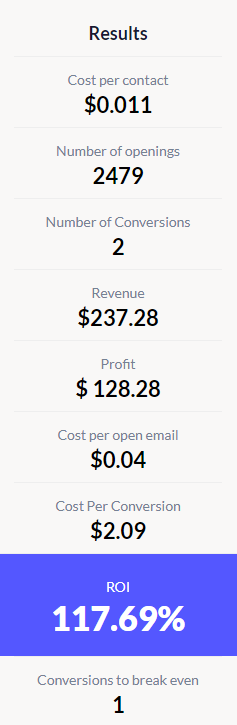 The results of measuring ROI with Sleeknote calculator
It’s a separate website for measuring email marketing ROI. To calculate ROI, you can choose the exact period of time and currency. Then, you need to enter the following data:
- send volume;
- open rate;
- click rate;
- conversion rate;
- net conversion value;
- total costs.
As a result, you get a summary which includes expected conversion, total profit, total revenue, number of conversions needed to break even, and the ROI percentage. There’s also an opportunity to compare your statistics to other companies in your industry by leaving your email.
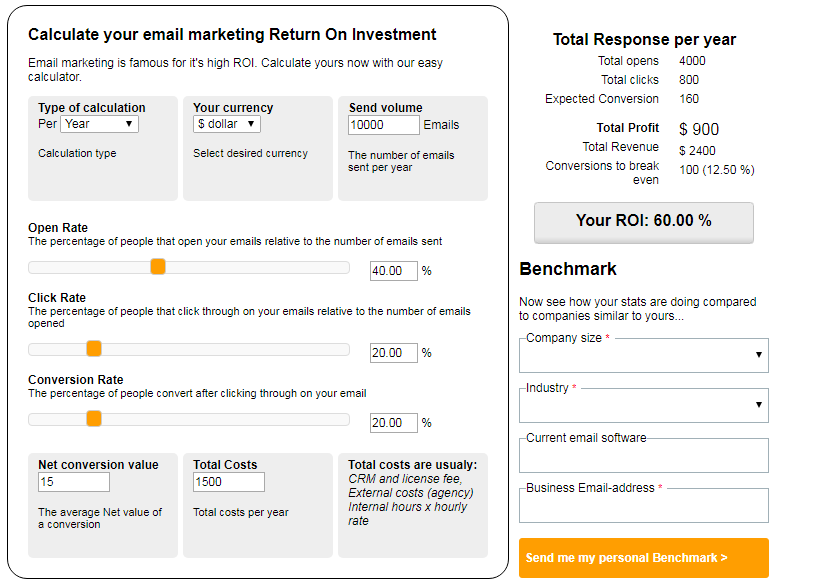 ROI calculator on Email Marketing ROI website
SendGrid doesn’t offer you an exact calculation of your email marketing ROI, rather an opportunity to experiment finding out how a 1% improvement to deliverability can raise the return on investment. The tool uses the following values:
- industry;
- monthly send volume;
- current inbox placement rate;
- unique opens;
- unique clicks;
- total monthly revenue from email.
Once you’re done, you can see how the 1% improved deliverability could influence your opens, clicks and ROI. Strong motivation backed up by real numbers.
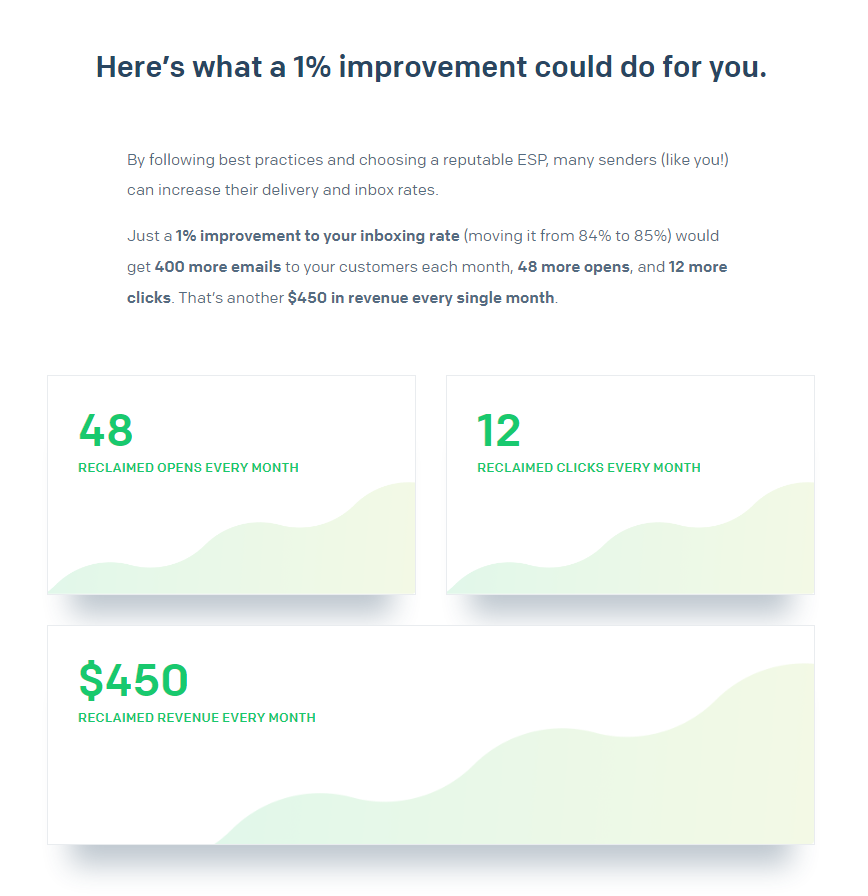 ROI calculator results from SendGrid
How to improve your email marketing ROI
Knowing your ROI number is one thing — doing something about it is another. Here are the most effective ways to push that number higher.
- Segment your audience. Sending the same email to everyone on your list is one of the fastest ways to hurt engagement. Group your subscribers by behavior, purchase history, demographics, or where they are in the customer journey, and tailor your content accordingly. Relevant emails get opened; generic ones get ignored.
- Personalize your campaigns. Go beyond using a subscriber’s first name. Look at past purchases, browsing behavior, and individual preferences to make each email feel like it was written for that specific person. The more relevant your message, the more likely it is to convert.
- Optimize for mobile. More and more people check their inbox on their phones, so if your emails don’t look great on a small screen, you’re leaving conversions on the table. Make sure your layout, images, and CTA buttons all work seamlessly on any device.
- Write subject lines that earn the open. Everything else in your email is irrelevant if no one opens it. Keep your subject lines specific, benefit-driven, and free of anything that looks like spam. Test different approaches and pay attention to what resonates with your audience.
- Automate where it makes sense. Welcome sequences, abandoned cart reminders, re-engagement flows — these are campaigns you can set up once and let run. Automation keeps your audience engaged without requiring constant manual effort, and triggered emails tend to perform significantly better than one-size-fits-all broadcasts.
- Use clear, actionable CTAs. Every email should have one primary action you want the reader to take. Make that CTA visible, specific, and easy to click. “Shop the sale” outperforms “click here” every time.
- Clean your mailing list regularly. Inactive subscribers drag down your open rates and, by extension, your ROI. Remove addresses that haven’t engaged in several months and focus your efforts on people who actually want to hear from you.
- Run A/B tests. Don’t guess what works — test it. Try different subject lines, send times, layouts, or CTAs and let the data tell you which version performs better. Small improvements compound into meaningful gains over time.
- Focus on content quality over send frequency. Bombarding your list with emails does more harm than good. Prioritize sending fewer, better emails that genuinely deliver value — helpful tips, exclusive offers, or content your audience actually looks forward to receiving.
- Add social proof. Customer reviews, testimonials, usage numbers, and case studies all help build trust and reduce hesitation. If someone is on the fence about clicking through or making a purchase, social proof can tip the balance.
Improving your email marketing ROI isn’t about one big fix — it’s about getting a lot of small things right consistently. Segment thoughtfully, personalize where it matters, keep your list clean, and always give your subscribers a reason to open the next email. Do that, and your ROI will take care of itself.
In a nutshell
Email marketing ROI is one of the most significant email metrics that demonstrates the effectiveness of marketing efforts. To count basic ROI, divide the difference between the investment and profit by the amount of investments.
You can also measure other types of email marketing ROI:
- sales and conversions based on engagement, lead acceleration, and impact on revenue;
- website traffic by taking into account click-through and click-to-open rates;
- brand awareness by looking at direct website traffic and external links back to your website.
Use SendPulse to reinforce your email marketing strategy and see your ROI growing!