If it feels like the golden era of influencer marketing is over, that’s because it is — at least the way we knew it. The good old days of 2018, when a single low-effort social media post could skyrocket a brand to fame, are gone. Consumers today are more skeptical — and can sense inauthenticity from a mile away.
In fact, 26% of surveyed consumers do not trust typical influencer marketing at all. Another 11% say they don’t trust any ads. These harsh numbers mean that marketers have to up their influencer game, shifting from polished, static perfection to raw, performance-driven storytelling.
Nowhere is this shift more evident than on TikTok, where community, trends, and commerce move at an unprecedented speed and intersect in real time. So, how can you as a marketer keep up — and win back consumer trust? Let’s explore what makes a successful TikTok influencer marketing strategy today and how to perfect your message at every step.
What does TikTok influencer marketing look like nowadays?
As of 2025, TikTok has amassed over 955 million users, most of which are Gen Z, Gen Alpha, and millennials — some of the most trend-hungry demographics. The ability to reach that massive audience with the help of authentic, short-form videos was made possible by the platform’s unique algorithm.

Join 3M+ businesses growing with SendPulse
From solo creators to global brands, millions trust SendPulse to run email campaigns, chatbots, automations, and more — all in one place. Get started for free now!
Get started for free
Other platforms allow businesses to showcase products — TikTok helps embed them into narratives, challenges, memes, and micro trends. Influencers in particular serve as cultural translators, turning commercial brand messages into organic, entertaining, and emotionally resonant content made for humans by humans.
Moreover, TikTok’s For You Page makes influencer content discoverable by anyone, based on their interests and engagement. This means influencers with smaller followings can still deliver massive reach and high ROI, which is good news for businesses with tight budget constraints.
TikTok creators build niche communities around interests and activities like #studywithme, #morningshed, #weddingtok, #runfitcheck, #corporategirlies, etc. Brands can tap into these trends and subcultures to deliver hyper-targeted messages through influencers who embody that very lifestyle.
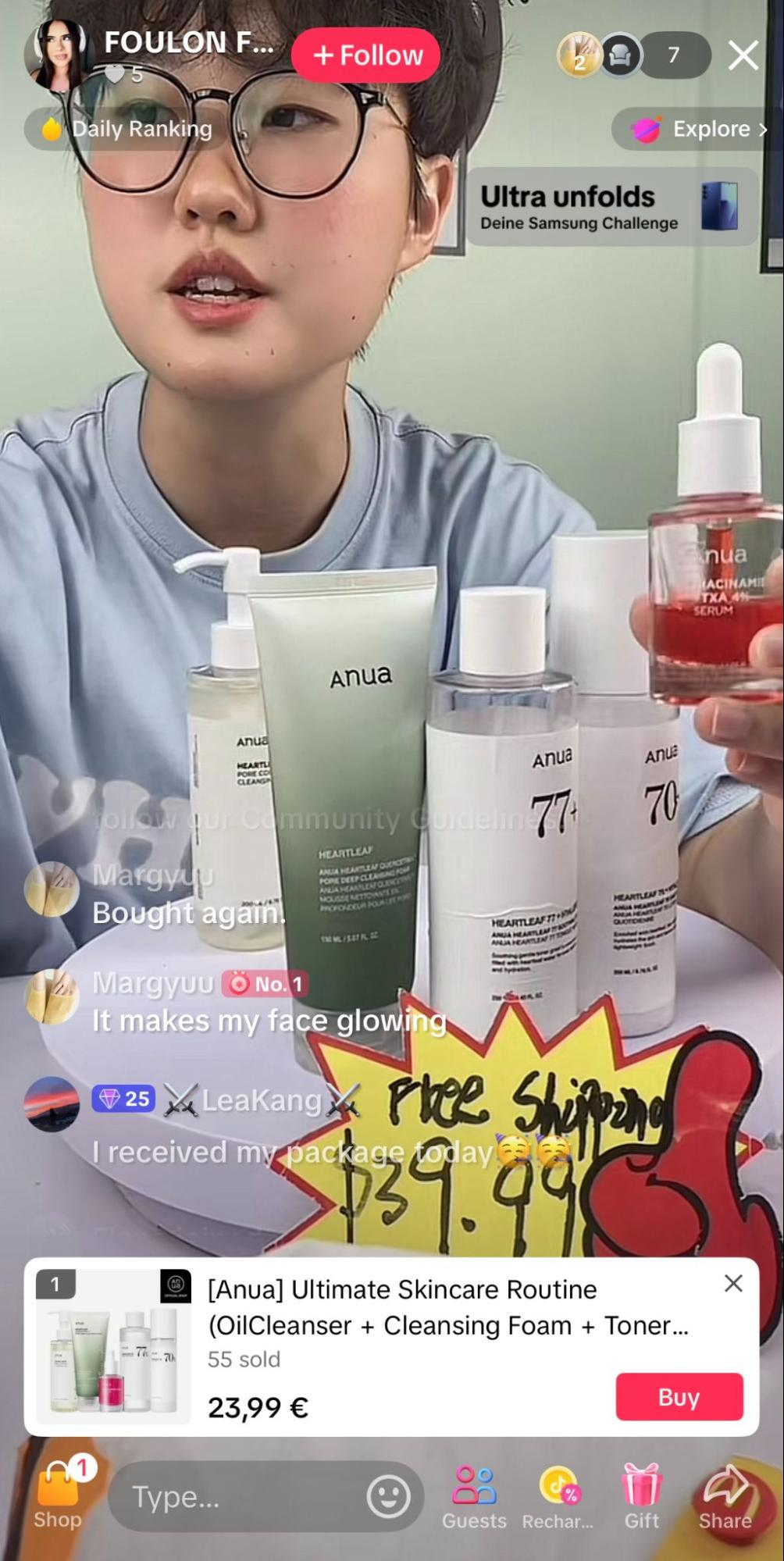 A Live Shopping event on TikTok
Another big appeal of the platform is that it rewards realness over perfection. Even though TikTok beauty filters are still a thing, more and more creators opt for an uncurated, realistic, and spontaneous presence with minimal makeup and editing. While YouTube creators compete over who has a fancier studio setup, TikTok celebrities often prefer to film themselves in mundane, casual settings, for example, while doing their makeup, walking their dog, or even driving. These down-to-earth videos allow for organic product placement opportunities that feel neither forced nor staged.
As if that wasn’t enough, TikTok has recently doubled down on social commerce, with its shoppable videos, in-app storefronts, and live shopping. Influencers now act not just as marketers, but as sales drivers within a fully integrated funnel. Many of them even launch their own brands or co-create products with companies, deepening their commercial impact.
People want to discover new products through video. Users particularly enjoy short-form videos, as it's a great way to convey a lot of information quickly.
SourceKati Noakes
Social Media Trainer, Founder of KN Communications
What are the tangible benefits of TikTok influencer marketing?
There are many unique aspects that make influencer marketing on TikTok a powerful channel for growing and established businesses alike. Let’s take a look at them:
- Massive organic reach via FYP algorithm. TikTok’s For You Page promotes content based on interest rather than follower count, which is a fantastic way for newer brands to get exposure.
- Higher engagement rates. TikTok is like a buzzing hive — its user activity regularly outperforms Instagram and YouTube in likes, comments, and video completions, often leading to stronger conversions.
- Trendsetting. TikTok is the place where iconic trends like #girldinner or the “Oh no, oh no, oh no no no no” sound originate and later get picked up by Instagram, YouTube Shorts, X, and even mainstream media.
- Fast trend adoption and cultural relevance. Thanks to the abundance of hot trends, you can quickly tap into viral sounds, memes, and challenges, keeping branded content timely, relevant, and engaging.
- Seamless in-app shopping and impulse buys. TikTok’s eCommerce features like Shop, live shopping, and product tagging enable direct purchases with minimal friction, which allows an audience with a short attention span to act on your offer in the spur of the moment.
- Short sales funnel. Thanks to TikTok bio links, the customer journey from discovery to checkout can happen in just a few taps. With the use of affiliate links and analytics, you can also track their shopping behavior and gain insights into their needs.
- Cost-effective influencer partnerships. Working with nano bloggers with a 2K+ following isn’t unheard of. Smaller creators tend to offer high engagement and trust at lower costs, and their audience is more perceptive as they’re used to seeing fewer ads.
- Easy-to-produce, platform-native content. Due to the built-in editing tools and a shift in focus from aesthetics to storytelling, TikTok has democratized content creation, ensuring that high production costs won’t hinder true creativity.
- Built-in tools for virality and amplification. Duet, Stitch, reposts, Stories, and Spark Ads can be extremely useful for viral moments, brand-user co-creation, and scalable paid promotion of authentic content.
- Uncomplicated and transparent creator discovery. The TikTok Creator Marketplace is a one-stop shop for finding and vetting relevant creators with 10K+ followers. If your goal is micro- and nano-influencers, there are third-party apps for discovering and filtering them as well.
- Multi-platform content versatility. Influencer videos can be easily repurposed across Instagram Reels, Stories, YouTube Shorts, and ad campaigns, saving you time and maximizing reach.
- Explosive global campaign potential. TikTok supports multilingual, multi-market influencer activations, which is great news for businesses looking to tap into new markets.
Now, let’s move on to the biggest challenge — finding the right creators who are in alignment with your brand and show consistently high audience engagement.

Want to share multiple links with your TikTok followers?
All you’ll need is our intuitive bio link builder, geared toward creating sleek, professional-looking pages for social media and other platforms. It’s code-free and stress-free, with just the features that matter.
Get started for free
How to find and secure relevant niche TikTok influencers with high engagement
First things first, specify vetting criteria for who should represent your brand. When searching for TikTok influencers, consider the following:
- Follower range (nano, micro, macro, celebrity). How much are you ready to pay for a wider reach?
- Demographics and region. Can this creator connect your brand with a buying audience?
- Engagement rate. Do they know how to masterfully spark comments and saves with clever hooks?
- Audience alignment. Are they watched by the same people who represent your target audience?
- Content style fit. Can you envision your product in one of their existing videos?
- Tone of voice. Does your brand sound anything like them?
- Past brand collabs. Is your brand in line with what they were recommending before?
- Reputation. Is there any potential controversy related to this blogger?
- Authenticity. How original is their content? Are there any AI-generated assets or stolen ideas?
Organically discovering the right type of talent to represent your brand can take days of manual research and yield mediocre results. To make the whole process more reliable and data-driven, you can employ diverse influencer search platforms that allow you to sift through millions of profiles. Here are some of them:
- TikTok One Creator Marketplace. The most obvious choice, better suited for discovering creators with a large following.
- Collabstr. A multi-channel marketplace with clear pricing and creator filters by rate, category, and turnover speed.
- Upfluence. 12M+ verified creator profiles, one-click applications, and AI-powered insights.
- Impulze.ai. A database with 280+ million creator profiles, location-based search, and an AI influencer curator.
- Heepsy. An influencer search platform for TikTok, YouTube, and Instagram, allowing you to search by keyword, location, etc.
- Sprout Social. Enterprise-grade solution with influencer analytics, trend tracking, and lookalike search.
- Influencity. 200+ million profiles, social listening tools, and a social media inbox.
- Insense. A budget-friendly platform for influencer collaborations, payments, and legal agreements.
Most of these platforms enable you to contact the creators, outline your goals, and conduct negotiations and payment processes in an automated manner. It all starts with a solid outreach message, which should be personal, clear, and respectful of the creator’s time and style.
It’s important to introduce yourself and your brand and briefly describe your campaign, deliverables, deadlines, and budget. While many influencer search platforms provide you with some sort of glimpse into creators’ engagement metrics, it’s rarely enough. Do your due diligence — ask the creator to share their most recent 60-day account insights, including their traffic sources, follower demographics, and so on. Or, use online tools like the TikTok Engagement Rate Calculator by Impluze.ai.
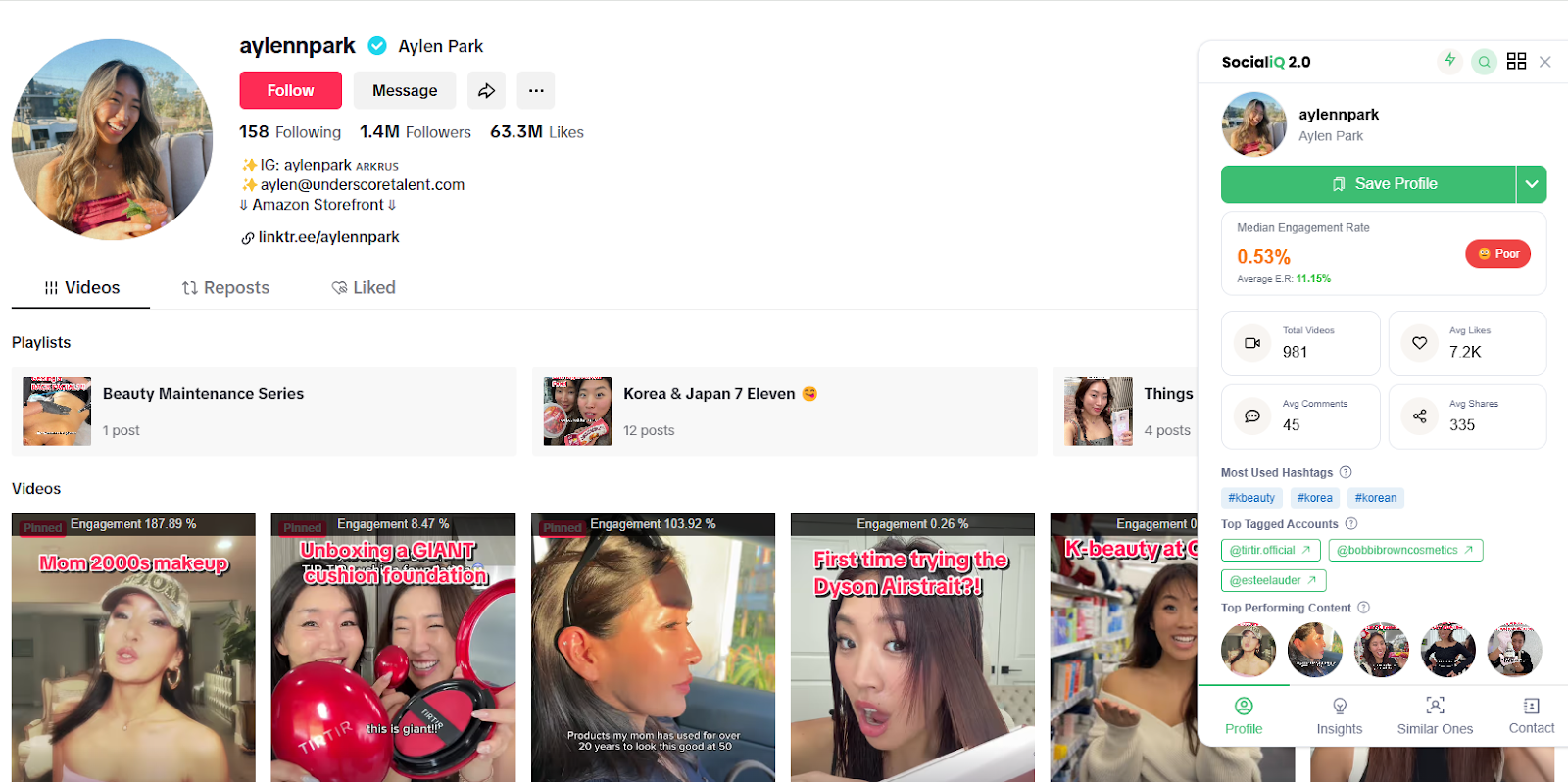 Engagement rates of a TikTok influencer; source: Impulze
Once the connection is established, it’s time to hammer out the details with a brief that covers everything the creator needs. This includes campaign goals, content format and tone, key messages and hashtags, brand dos and don’ts, and posting schedule.
Make sure to give structure but leave room for the influencer’s voice, especially if they have a proven track record of creating bold and viral campaigns for other brands. Trusting the process is more likely to result in authentic content that resonates with the intended audience. Now, let’s break down these and other consequential steps that lead up to a successful campaign.
Engage users on TikTok
Use our drag-and-drop builder to create AI-powered TikTok chatbots that sell, support, and connect. Run campaigns, share updates, and convert leads hands-free.
Get started for free
How to build a holistic TikTok influencer marketing strategy beyond one-off campaigns
Once you’ve amassed a pool of trusted creators who get your brand, you can shift your focus toward developing long-term thinking that will guide all of your future campaigns — not just the one at hand. With the help of TikTok-native and AI tools, you can ensure your TikTok influencer marketing efforts are consistently appreciated and rewarded by your audience.
Step #1. Define your goals and KPIs
The first step on the way to success is to define what that looks like. The goals outlined in the creator’s brief should be in line with your overarching strategy — not just for the current campaign, but for the long haul.
This may include:
Think beyond likes and reach — how does each collaboration contribute to long-term brand equity, customer loyalty, or a growing library of UGC videos that can be reused across paid and owned channels?
To be able to make informed influencer marketing decisions and track your efforts across multiple channels, you may need AI-powered tools like GetViraly or FastMoss.
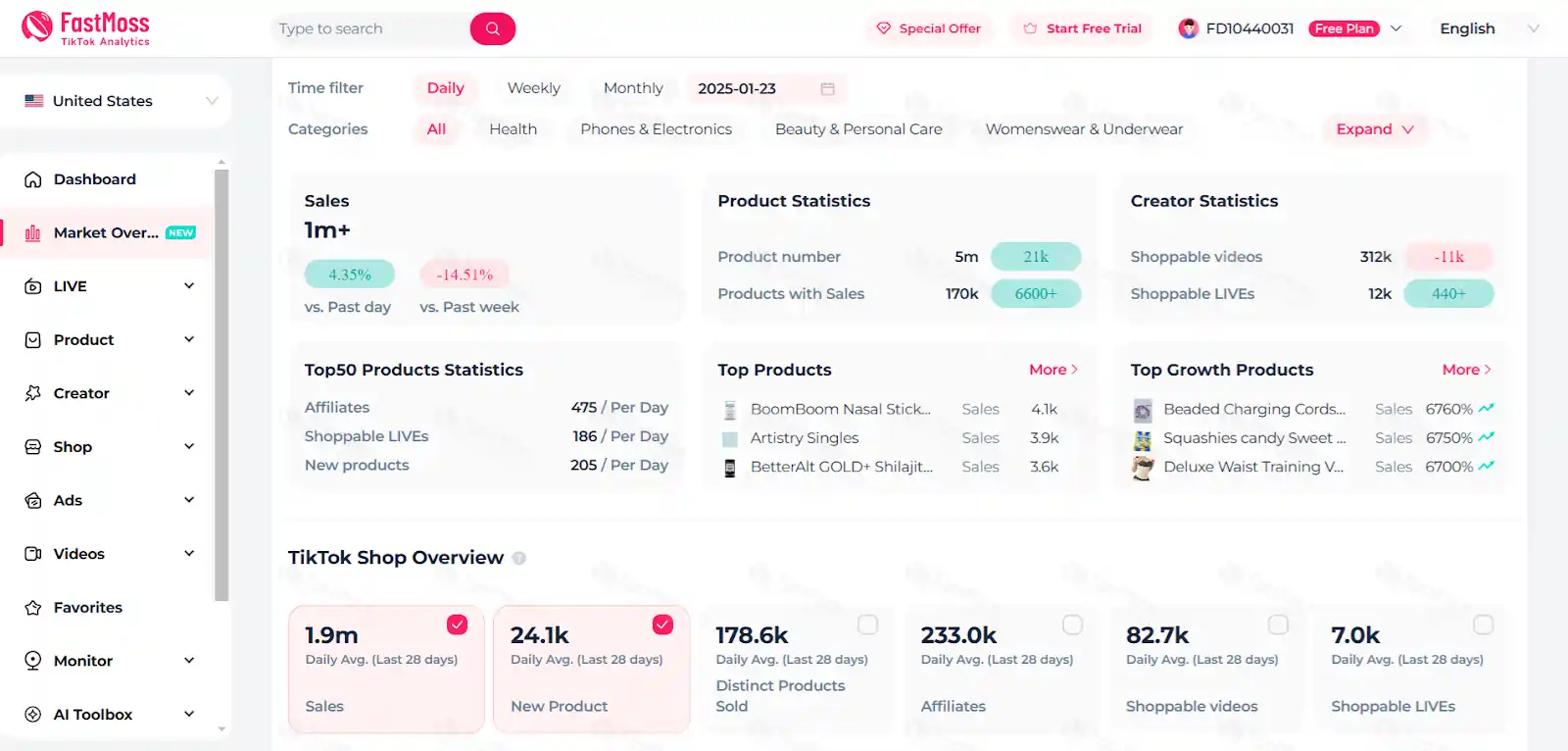 TikTok analytics dashboard; source: Aff.Ninja
FastMoss also helps identify trending products on TikTok and livestreams, giving you inspiration for future campaigns.
Step #2. Understand your audience on TikTok
TikTok influencer campaign ideation is meaningless if you don’t understand how your target audience behaves on TikTok. Here’s what you need to do before pumping out new campaigns:
- analyze your current followers or customer personas;
- research trending search queries, sounds, and hashtags in your niche;
- study which content formats perform (storytime, how-tos, aesthetic edits, memes).
The best part is that you can conduct this type of research with free native TikTok creator tools.
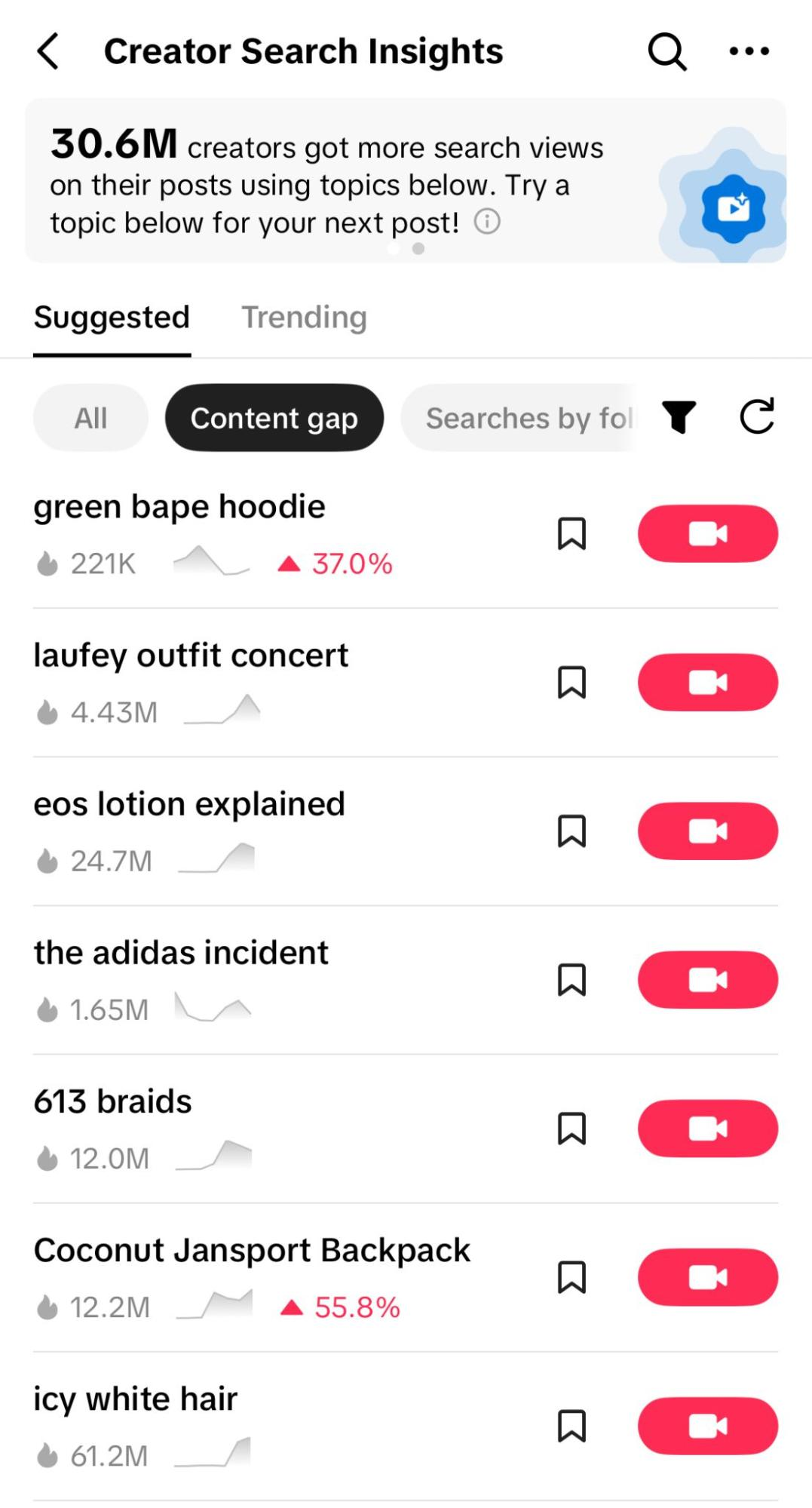 Using Creator Search Insights to uncover new content ideas
To see what’s trending in your niche, simply enter “creator insights” in your TikTok search bar and open the suggested Creator Insights hub. There, you can discover niche trends and even content gaps — exciting topics with big viral potential and few relevant posts.
Step #3. Plan your campaign architecture
The core idea here is to move away from short, generic product-centered videos and to start thinking like a publisher. When it comes to TikTok influencer marketing, potential video formats are quite diverse:
- hero campaigns for big launch moments;
- micro-moment collabs (reactive content, trends, events);
- challenge campaigns;
- storytelling series;
- “a day in my life using X”;
- explainer content for educating consumers on your brand;
- humorous skits with subtle product placement;
- giveaways and contests;
- live shopping events with direct checkout;
- ambassador programs (recurring content from the same creators);
- duets and stitches for more spontaneous interactions with creators;
- UGC pipelines (influencers as content creators for ads and TikTok Shop).
Each of them can serve a distinct strategic purpose within your broader marketing strategy and help create a multi-faceted business presence on TikTok. By mastering a variety of these formats, you’ll have an easier time aligning your influencer content with the current needs of your target audience. It will also allow you to match the right creators with the right message, ensuring your collaborations always feel natural and goal-driven.
Step #4. Negotiate pay
This step, while an essential part of the influencer scouting process, is often overlooked, which leads to missed sales opportunities. It’s easy to pay out a flat fee and get it over with, but it may result in unintentionally disincentivizing the creator. Without a performance-based element, there’s little motivation for them to actively push your product beyond the initial post.
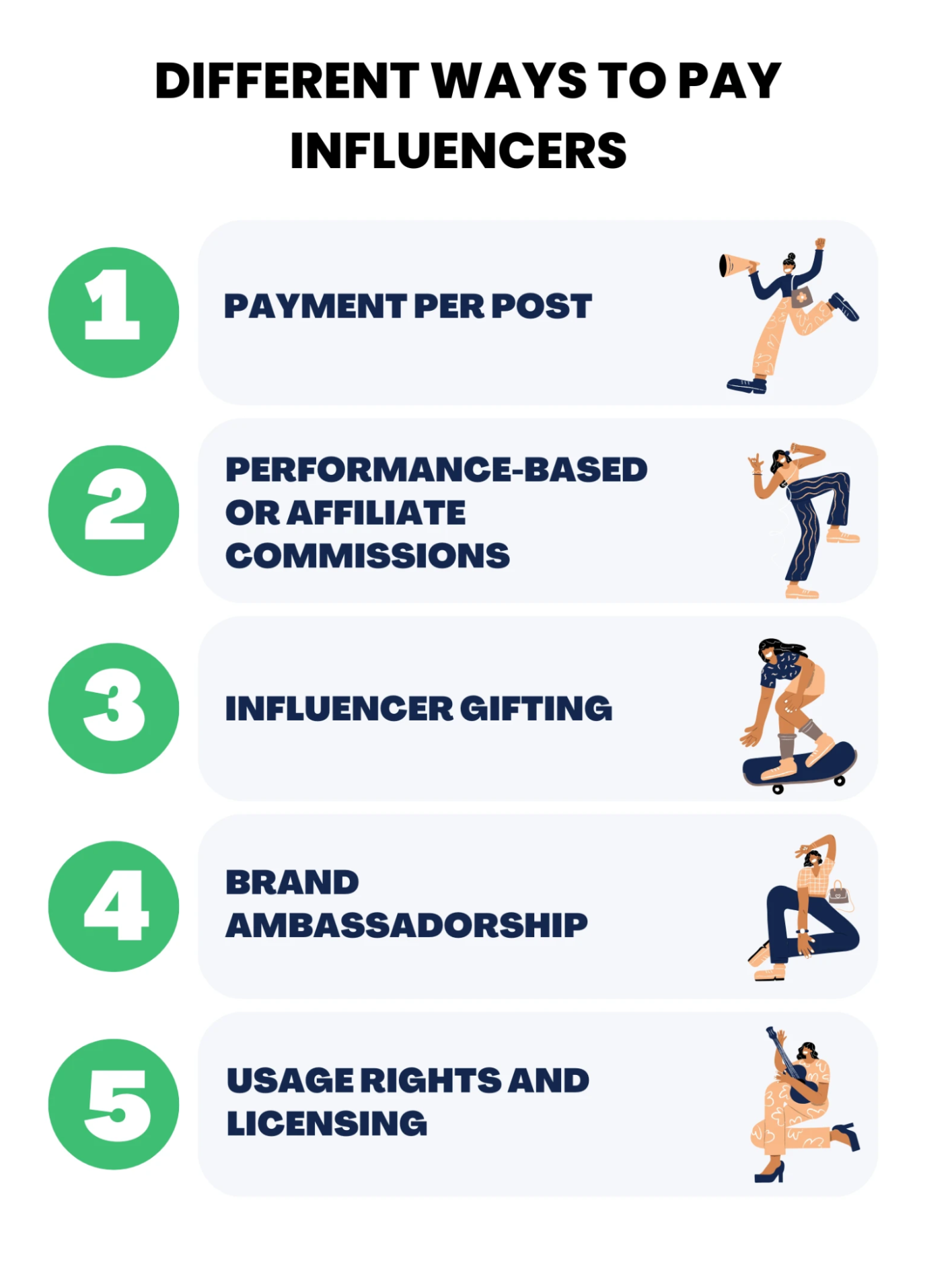 Different ways to pay TikTok influencers; source: Impluze
That’s why, in some cases, it makes sense to explore less conventional payment structures — for instance, a combination of a flat fee and a performance-based bonus. It can be either a straight percentage of sales or a tiered commission (the bonus gets better as the creator brings in more sales).
If you take this route, make sure to set minimum payout thresholds, clear payment schedules, and the duration of the offer. Each creator should have a unique discount code — it makes it easier to track sales and motivates purchases.
You can enter the negotiation process with confidence with the help of online tools like the Influencer Pricing Calculator and the built-in invoicing and contract systems that some influencer management platforms like Modash offer.
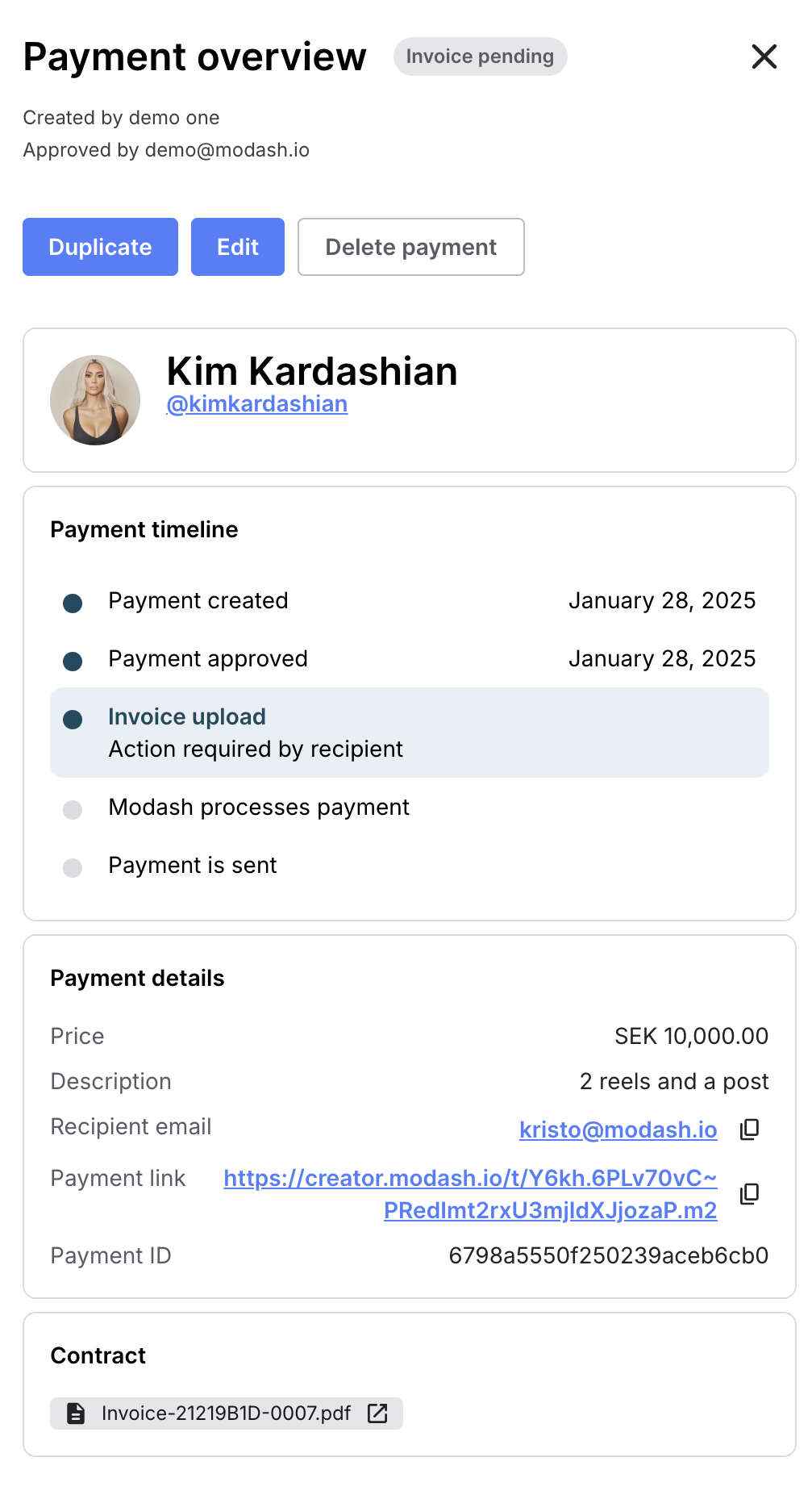 Payment overview
As your TikTok influencer pool keeps growing, you may find yourself in need of a dedicated automation solution like Lumanu, which will make it easier to not only navigate creator payouts but also to maintain immaculate relationships with the bloggers.
Step #5. Craft smart briefs and visualize each step of the campaign creation
As we’ve already established, creating detailed TikTok influencer campaign briefs is crucial because the platform is all about creativity, speed, and nuance. Without clear direction, even the most talented creators can miss the mark, leading to off-brand content, diluted messaging, and wasted budget.
It is possible to dramatically speed up your brief and accompanying content creation with tools like:
- Gamma AI — a prompt-based slide builder;
- Envato — an AI-powered creative asset library and visual editor;
- Templafy — enterprise-grade AI content creation tool.
Another benefit of using a dedicated influencer discovery platform is that you can capture and track all that information in a single place. Your core message and goals, product details or talking points, CTAs, content examples, and hashtags — all can be stored, shared, and updated within a centralized system that keeps everyone aligned.
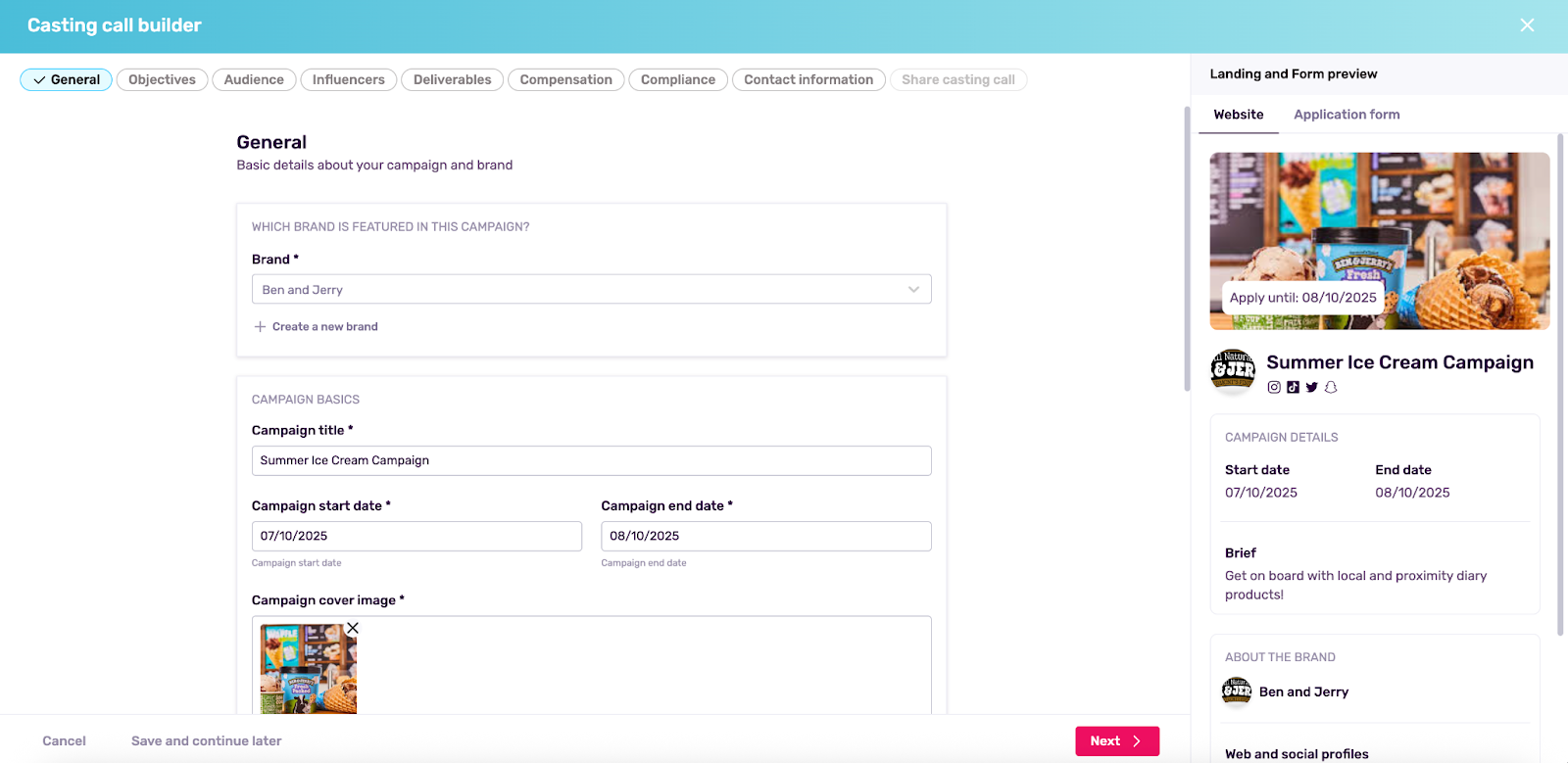 Creating an influencer casting call; source: Influencity
This reduces back-and-forth communication and ensures consistency across all creator content, especially in multi-influencer campaigns. Tools like Influencity, CreatorIQ, or Grin allow you to manage everything from creator outreach and briefing to approval workflows and performance analytics.
By integrating briefing and tracking in one platform, you make it easier to scale campaigns, stay organized, and pivot quickly if trends or priorities change. Finally, when every creator has access to the same well-structured content library, they’re more likely to deliver on-brand, high-performing campaigns.
Step #6. Discuss and monitor digital usage rights
Few things are more frustrating than having a content asset with viral potential and not being able to use it freely. For brands, this usually comes down to not having negotiated digital usage rights up front.
Without clear agreements, you may be legally restricted from repurposing content from influencers across paid media, your website, email campaigns, or even reposting it on other social channels.
On TikTok, top-performing influencer videos can be turned into Spark Ads or repurposed for TikTok Shop, Instagram Reels, or programmatic advertising, so having full usage rights is everything. If you’re investing in creator content, you should think of it as a media asset with long-term value, not just a one-time post.
Pay attention to the following aspects before locking down an attractive TikTok influencer campaign deal:
- clearly define usage terms in contracts (platforms, duration, geographic scope);
- negotiate extended licensing for top-performing content that can be used in future campaigns or as social proof;
- clarify ownership of raw footage if you’re collaborating on co-produced content;
- ensure all influencer statements are compliant — this matters for repurposing sponsored content into paid ads.
Thankfully, there are ways for brands and creators to automate rights and permissions management with tools like Meegle.
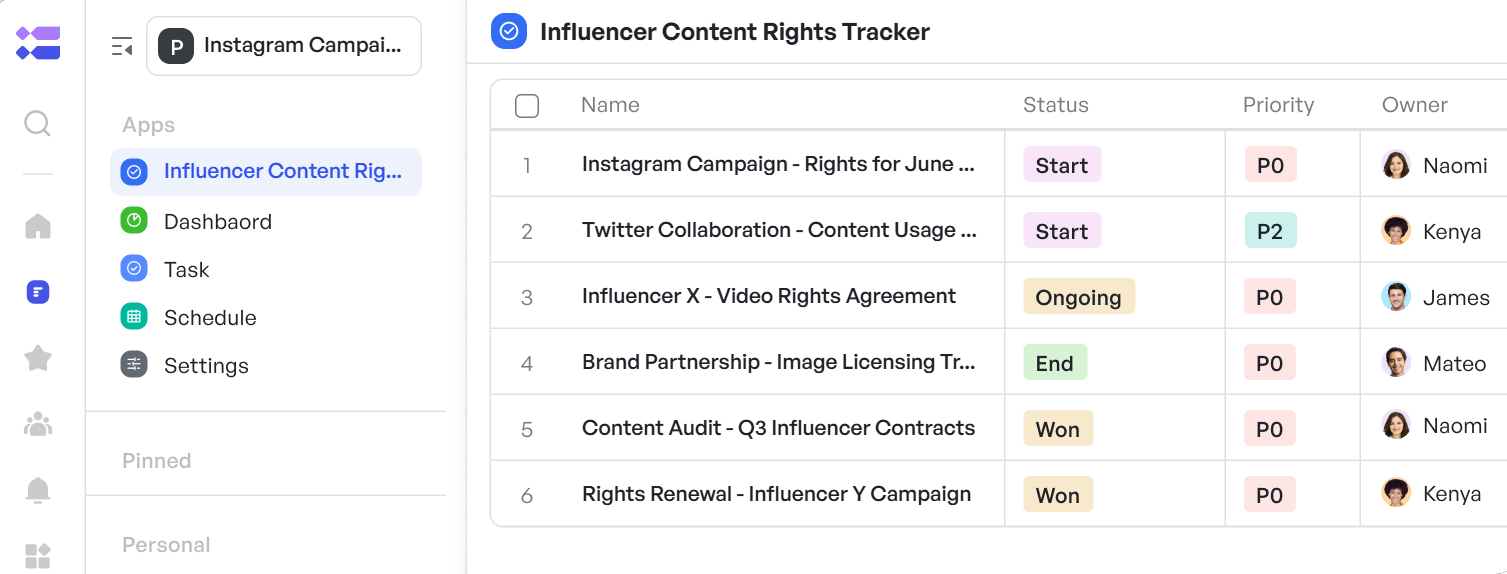 The Influencer Content Rights Tracker by Meegle; source: Meegle
Using a dedicated influencer content rights tracker is an easy way to offload the complexity of managing who owns what, for how long, and on which platforms. The tool automatically flags nearly expired campaigns and sends reminders, preventing unauthorized content usage.
Step #7. Activate creators thoughtfully
It helps to think of creators as strategic brand partners, not just content producers. To ensure they deliver the best result possible, you need to equip them with proper resources ahead of time.
That means providing early access to products or news — the creator must develop the feel of your brand in order to authentically express themselves later on in the video. If you host branded events, consider organizing creator experiences to foster deeper brand connection and generate behind-the-scenes content that feels genuine and exclusive.
Once the influencer content is live, you can give it a boost using Spark Ads, extending its reach while retaining the effortless feel of a native video.
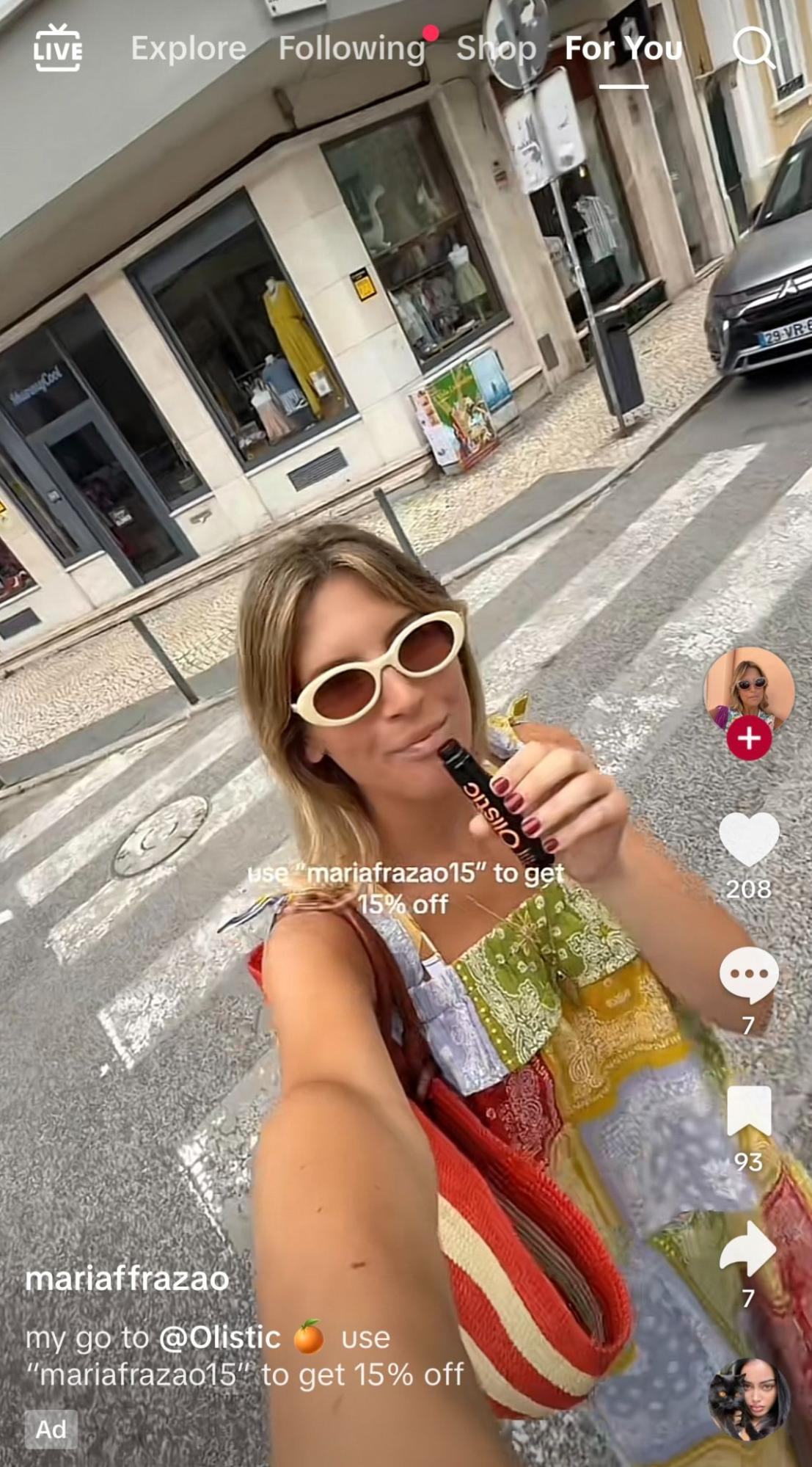 A Spark Ad example on TikTok
This ad format enables you to run TikTok influencer content as paid media directly from their accounts — with their authorization. When the video already has enough likes and comments, that activity can serve as social proof, generating FOMO and making the ad more convincing. Spark Ads retain duet, stitch, and sticker features, and they even allow viewers to click on the post’s music.
Step #8. Make sure everything is ready on your backend
To turn a brand impression into a measurable conversion opportunity, your backend needs to be just as polished as the content itself. That means having streamlined TikTok link pages, product landing pages, and conversion tracking infrastructure in place before any campaign goes live.
If your goal is to drive traffic to multiple products, try SendPulse for creating unified link pages, where all of your relevant resources are available at a glance. Our visual builder is also useful for crafting mobile-first, distraction-free product pages in minutes. The integrated AI writing assistant is there to help you instantly translate or improve your copy.
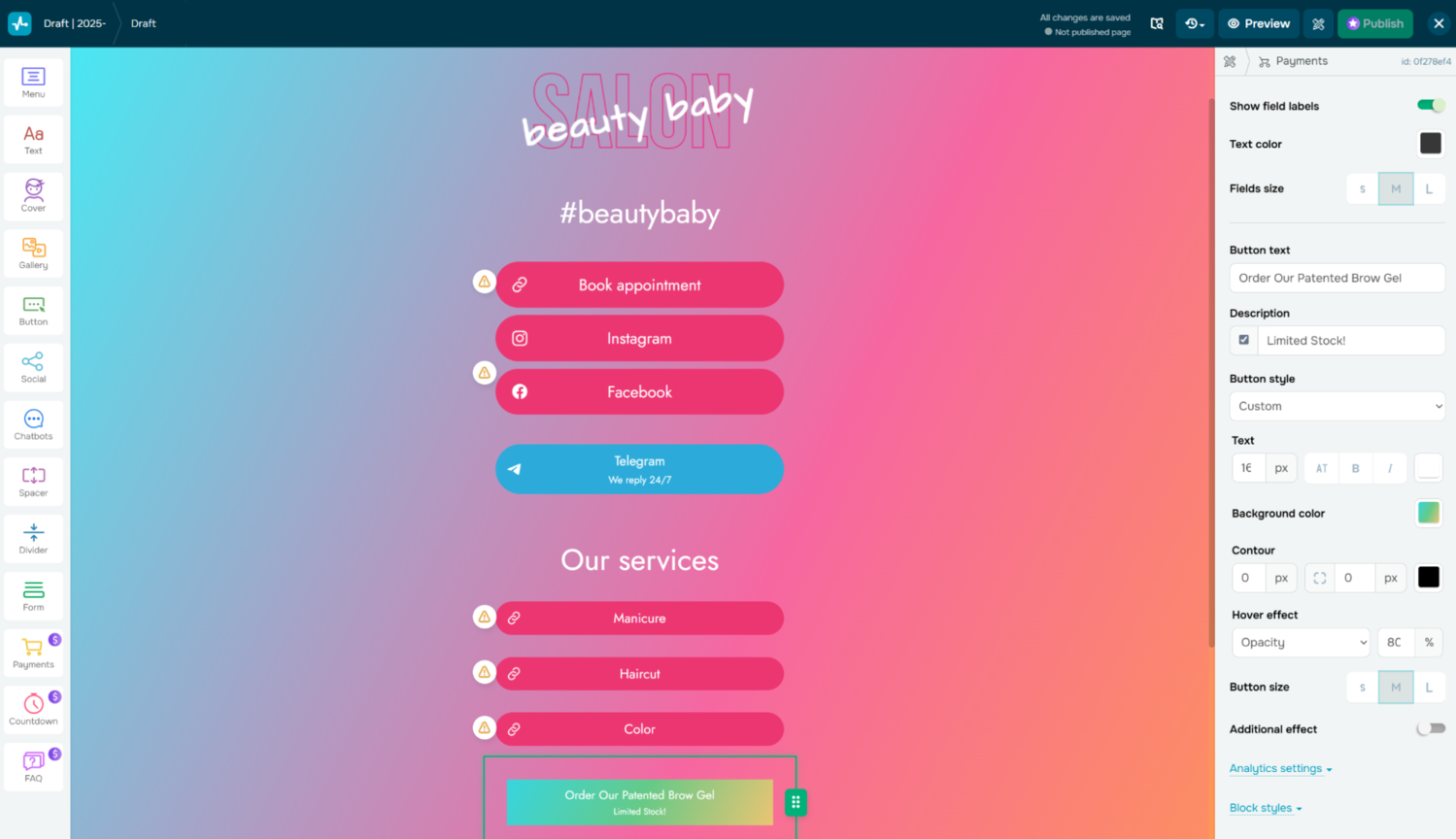 Creating a TikTok link page in SendPulse
In addition, SendPulse allows you to create AI-powered TikTok chatbots for websites and messaging apps and link to them in your landing pages for TikTok, which ensures superb responsiveness and customer service even for the most impatient social media users. If you don’t sell directly on TikTok, you can accept purchases right from your link and product pages, thanks to the frictionless integrated checkout.
For TikTok Shop integrations, ensure that all product listings are optimized with high-quality visuals, accurate tags, and clear descriptions. If you’re routing users off-platform, your landing pages should be fast, lightweight, and aligned with the messaging and visuals used in the influencer content.
Finally, make sure your UTM tracking, promo codes, and pixel setups are properly configured to measure performance across every stage of the funnel. A smooth backend setup is a must in order to capture and analyze every conversion, helping you prove ROI and properly react to the fluctuating demand.
Step #9. Track performance and iterate
By paying attention to the right metrics, you can transform your TikTok influencer marketing game from a creative experiment into a strategic growth engine.
- views, likes, shares, saves — surface-level engagement indicators that reflect reach, perceived value, and algorithmic favor;
- link clicks, sales, use of promo codes — metrics that measure direct action;
- UGC style, clarity, and brand tone match — indicate brand alignment and content repurposability;
- cost per acquisition (CPA), cost per engagement (CPE) — essential metrics for benchmarking influencer campaigns against other digital marketing channels.
TikTok Studio’s native tools can help you — or the influencers you’re collaborating with — access individual analytics that break down the performance of each of your videos. You can find out how your viewers discovered your posts, average watchtime, viewer demographics and activity data, retention rate, etc.
TikTok Ads Manager combined with TikTok Pixel is useful for tracking user behavior after they click on TikTok content and visit your website. TikTok Events Manager can be used for monitoring how often users take desired actions on your website after interacting with your brand on TikTok.
With the help of Advanced Matching, you can match your website visitors with people on TikTok for retargeting or other purposes — this is another way to better understand ROI and the impact of your influencer campaigns.
For more granular analysis, consider using tools like VidMob. Which scenes, visuals, or captions drive drop-off or hook users right away? What content elements consistently perform best? The platform can answer these and other complex questions by providing you with unmatched data-driven insights.
Step #10. Build long-term creator relationships
While TikTok users are known for their short attention spans, it doesn’t mean that you as a brand shouldn’t turn your top-performing influencers into brand ambassadors. Here’s why:
- Repetition means credibility. When followers see a TikTok influencer repeatedly endorse a brand over time, the message sinks in more deeply and feels less transactional.
- Familiar faces cut through the noise. Audiences scroll quickly, but they pause when they recognize someone they trust. If your brand works consistently with the same creators, you’ll likely benefit from creator recognition.
- More impactful brand integration. Long-term partnerships allow creators to better study your product and organically incorporate it into their routine. Instead of scripted promotions, they can share real-life usage results over time.
- Beneficial for community building. Top TikTok influencers with ongoing brand relationships can build conversation loops with their audience via comments, Q&As, duets, or live streams, allowing your brand to tap into that ongoing dialogue.
You can sustain relationships with your favorite bloggers by offering exclusive perks or early product drops, involving them in content strategy or feedback, featuring them on your brand channels, and renewing contracts for long-term collaborations.
Influencer Hero can help you with this particular task — this platform acts as a dedicated influencer CRM, making it easy to communicate with trusted creators, track their performance, payouts, UGC, and dispatch products to them.
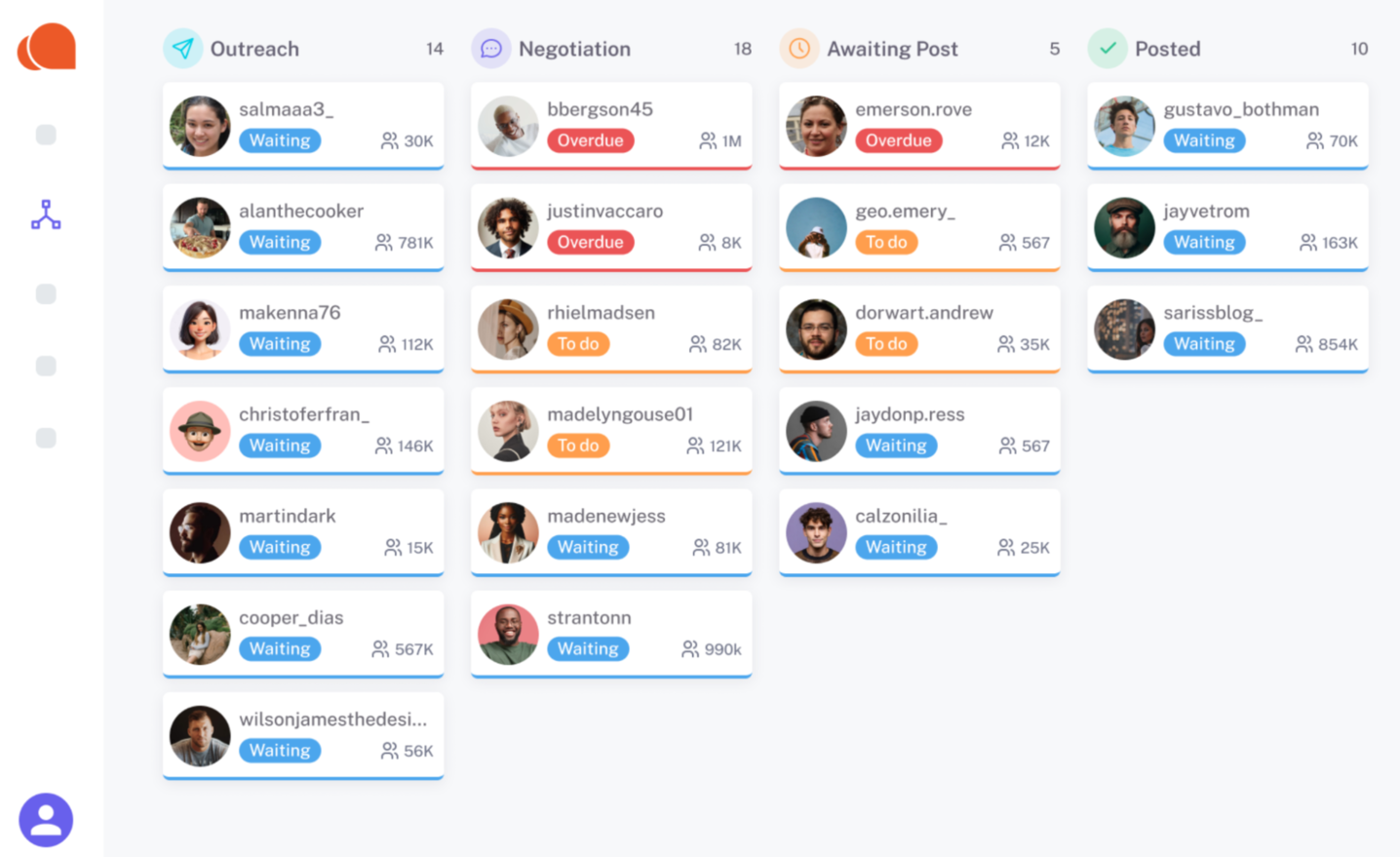 Managing influencers in a CRM by Influencer Hero; source: G2
Mistakes to avoid when launching a TikTok influencer campaign
Here’s a quick overview of common mistakes when preparing and kicking off a TikTok influencer campaign:
- Unrealistic expectations. Influencer marketing is best used for top-of-funnel marketing and community building. If making quick sales is your only goal, you should consider other promotion channels.
- Misunderstanding the algorithm. Not every video goes viral in an instant. Some content has a longer shelf life, and word of mouth takes time. Some niches have longer attribution windows because consumers don’t always buy immediately — they research first.
- Choosing too popular TikTok influencers for the job. If you are not digitally native, it might be challenging to discover lesser-known high-value creators who feel authentic in your category. When looking at the numbers, prioritize comments and shares over the bloated follower count.
- Over-scripting or over-controlling influencer content. TikTok thrives on spontaneity and authenticity. Giving influencers too many creative restrictions can kill the vibe and make content feel like a typical ad.
- Launching influencer campaigns without a plan. Your TikTok campaigns should be in line with your broader marketing strategy and correspond with your actual order processing, stock, and delivery capacity.
- Ignoring comments and community response. The comment section is where TikTok’s culture lives. Negative comments can give you more valuable insights into your audience’s needs and pain points than any fancy forecasting tool.
- Failing to properly track and attribute conversions. Running pricey influencer posts without a clear tracking setup is a waste. You need proper UTM links, promo codes, or affiliate tracking to know which creators are delivering value.
By paying attention to these details, you’ll contribute toward building a sustainable TikTok influencer marketing strategy where each campaign contributes to the bigger goal.
Increase your online visibility with SendPulse
Create websites, landing pages, and online stores compatible with mobile devices — it’s easy and fast, no code required. You can build a unique site from scratch or select one of our free pre-made templates.
Get started for free
5+ examples of brilliant yet realistic TikTok influencer campaigns
Now, onto the best part. The following TikTok influencer marketing examples will demonstrate just how powerful the platform can be when creators are empowered to tell stories, build trust, and spark action — and all of that without any flashy gear, highly curated aesthetics, and overly rehearsed pitches.
Oatly
In 2024, Oatly partnered with @SylvanianDrama to create a mini soap opera featuring Sylvanian figurines and Oatly Barista Edition. It wasn’t a conventional product review but a comedic story integrated seamlessly with the product.
The silent drama format of nostalgic toy characters in everyday absurd scenarios makes the product placement hit the spot in an unexpected way. Although the setting itself is highly fictional, the emotional tone and mundane situations reflect relatable human experiences, allowing Oatly’s presence to feel natural, humorous, and oddly grounded within the chaos.
This is a textbook example of a story-driven narrative with unexpected characters and unrestrained creativity. The creator was given a green light to maintain their signature tone, aesthetic, and episodic structure, resulting in a seamless and entertaining campaign.
The Ordinary
The Ordinary is known for its high-performance, ingredient-focused products, and its influencer campaigns match that ethos by leaning into authentic, visually striking user experiences — like the “vampire blood” TikTok, which highlighted the product’s bold red color and dramatic effect in a way that was both educational and wildly shareable.
@kaelyn ✧・゚#duet with @kaelynwhitee Also helps with acne scars and uneven skin tone✨ #greenscreen #AsGoodAsTheOG #touchdowncelebration #CleanFreshHype #fyp
The Ordinary collaborated multiple times with @kaelynwhitee to promote the viral “vampire blood” peeling solution, leveraging her authentic skincare storytelling and raw, honest transformation visuals.
The brand had a clear objective — to drive product trials through shock-value demonstrations that resonate deeply with Gen Z and skincare geeks. This couldn’t have worked better, as savvy TikTokers were quick to appreciate the potential of the product and make it one of the company’s bestsellers.
Warby Parker
Warby Parker initially built its brand by appealing to millennials — offering stylish, affordable glasses through a sleek DTC model that emphasized convenience, social good, and minimalist design. But as Gen Z emerged as a dominant cultural and consumer force, Warby Parker has shaken up its strategy a bit. On TikTok, the brand now targets Gen Z with playful, creator-led content that feels spontaneous, inclusive, and, sometimes, subtly ironic.
One standout micro‑influencer created a funny TikTok where they rated different Warby Parker glasses as if they were people they might date: “I would love him to do my taxes” vs. “Pass. This guy is way too cool for me.”
The campaign worked because it positively highlighted the features of each frame while delivering it through a relatable dating metaphor. As a result, engagement soared as viewers chimed in, sharing which “glasses” they fancied or found unapproachable.
This is a good example of a legacy brand that remains culturally relevant while expanding its audience — keeping the core millennial base engaged and pulling in a younger generation that chooses self-expression over polish.
JetBlue
JetBlue recently partnered with the geography-based game GeoGuessr to launch a custom, branded game mode called “Guess‑tination” — a JetBlue-themed map that challenged players to identify real JetBlue destinations based on Google Maps Street View clues.
To start the campaign with a bang, JetBlue enlisted Trevor Rainbolt, TikTok’s most famous GeoGuessr creator. He hosted a livestream tournament featuring eight top GeoGuessr players, where the challenge revolved entirely around JetBlue’s flight network.
@georainboltisland finding. try yourself with @JetBlue’s latest custom GeoGuessr game. link in bio. #JetBlueGuesstination #JetBluePartner
The event was streamed across TikTok, YouTube, and Twitch. Rainbolt shared clips of the challenge on TikTok, highlighting tough guesses, funny moments, and JetBlue’s diverse destinations.
Trevor is a notorious GeoGuessr player able to identify obscure locations from just a few pixels, whether it’s a blurry road sign, a tree type, or the color of a curb. Partnering up with him gave JetBlue and GeoGuessr instant credibility and viral appeal. Suddenly, a simple online quest turned into an exciting challenge that inspired a wave of UGC and interest toward JetBlue’s routes as fans tried to show off their skills.
Mooncup
Mooncup, a menstrual cup producer, is a zero-waste staple and aligns with sustainable lifestyle trends. Naturally, the brand wanted to highlight the environmental impact of switching from disposables to a Mooncup — and it managed to do so in a satirical, highly TikTok-native format.
This particular video is brilliant because it gently mocks a traditional-wife type of TikTok influencer while also positively setting its product apart from its worse-for-you disposable alternatives, made of questionably processed plastic.
@MooncupChanneling my inner Nara Smith👩🍳P.s Conventional pads have alot more plastic than you think🫣 #NaraSmith #PlasticInPeriodProducts #FromScratch #Mooncup
This turned out to be a great chance for the brand to demonstrate its sharp wit and trend awareness, which is what appeals to Gen Z, known for its no-fluff approach.
In general, Mooncup focuses on working with small-scale body positivity influencers to grow grassroots momentum, reduce stigma around menstrual products, and bond with its community over sensitive moments.
Rains
Rains, the Danish rainwear brand known for its sleek, minimalist aesthetic and high-fashion appeal, flips the script on TikTok by embracing a tone that’s anything but serious. Despite its runway-ready designs, the brand encourages influencers to create playful, absurd, and even chaotic content that subverts traditional luxury marketing — and this is something Gen Z absolutely loves.
Instead of polished fashion shoots, TikTok creators often showcase Rains jackets in quirky, unexpected ways, from dramatic slow-motion walks in puddles to peddling on the bottom of a lake or faking a rainstorm with a garden hose for engagement, like in this video.
@RainsShoutout to the hose. @Vita Kari
This approach not only makes the brand feel more likeable and culturally in tune, but also feels like a breath of fresh air after being exposed to hyper-staged fashion content. At the same time, no matter how satirical the videos get, they never miss the point — the product remains the hero. The functionality, design, and aesthetic of Rains jackets are consistently spotlighted, whether it’s through exaggerated weather dramatics or tongue-in-cheek fashion parodies.
Try SendPulse for TikTok link pages, influencer outreach, and beyond
Our all-in-one marketing and sales platform has everything you need to connect with diverse audiences and create a strong online presence across different channels. From automated emails, 360 automations, and a website builder to an AI-powered chatbot builder, lead-capture forms, and a native CRM system, our toolkit allows you to manage your contacts, campaigns, and deals from a single tab.
Create your free account today and give it a try!