An HR team at a construction company automated routine candidate communication and operational tasks using a Telegram chatbot. As a result, the team can now process three times more job applications without hiring additional recruiters.
This case study shows how AI automation streamlined early-stage candidate screening and reduced manual HR workload.
Project overview
Channel: Telegram
Platform: SendPulse
Implementation partner: AICoreBot, a studio specializing in corporate chatbots and AI assistants, which designed and launched the chatbot in just five days
Current status: live and actively automating early recruitment stages to increase HR team efficiency

Engage users on Telegram
Use our drag-and-drop builder to create AI-powered Telegram chatbots that sell, support, and connect. Run campaigns, share updates, and convert leads hands-free.
Get started for free
About the client
The client is a leading construction company that continuously hires qualified specialists. Its recruitment needs cover a wide range of roles, from skilled labor positions to management-level jobs. This constant demand makes speed, consistency, and clear communication critical to successful hiring.
Why the company implemented a chatbot
Before launching the chatbot, the HR team faced several issues that slowed down recruitment and reduced overall efficiency.
High HR workload and routine tasks
The HR team received a high volume of candidate inquiries, making it difficult to process applications quickly and consistently. Much of their time was spent on repetitive tasks, such as sharing basic company information, explaining standard job requirements, and manually collecting initial candidate data.
As a result, HR specialists had less time for in-depth candidate evaluation and interviews with applicants who were a strong fit for open roles.
Limited communication outside working hours
Many blue-collar candidates searched for job openings and submitted applications in the evening, after finishing their shifts. However, the HR team could not provide support around the clock or respond to inquiries 24/7.
This gap in availability caused delayed responses and increased the risk of losing qualified candidates who expected faster feedback.
Unstructured and fragmented data collection
Hiring in the construction industry requires detailed information about candidates’ experience, qualifications, and required documentation. Short contact forms were not sufficient to collect this data in a structured way.
The issue became more serious as candidate inquiries arrived from multiple channels, including phone calls, emails, and social media. As a result, candidate information was scattered and could not be stored in a single, structured system.
Difficulty evaluating and screening candidates
When candidate data arrived incomplete, unstructured, or spread across multiple sources, HR specialists struggled to assess applicants quickly and accurately.
As a result, the team often spent time communicating with unqualified candidates while delaying responses to those who were a strong fit for the role.
How the сhatbot supported the HR team
The SendPulse-powered chatbot handled the first stage of candidate communication, taking over routine questions and basic requests from the HR team. This made the early recruitment process faster and far less manual.
Automated initial candidate consultations
The chatbot shares essential information about the company and provides a full list of open positions, including role requirements and working conditions. It also answers up to 80% of common questions related to construction industry jobs.
This cuts out repetitive conversations and gives HR specialists more time for one-on-one interviews with candidates who are truly interested and well-suited to the role.
Chatbot as the main candidate entry point
The chatbot became the main channel for candidates coming from targeted Instagram and Facebook ads. Each ad led directly to Telegram, where candidates could explore job opportunities and start the application process right away.
When setting up the campaigns, the company focused on people aged 18–50 who were actively looking for a job, interested in the construction industry, or had relevant work experience. The best-performing ads featured real photos from construction sites and a clear call to join a professional team.
24/7 candidate communication
Unlike HR specialists with fixed working hours, the chatbot is available around the clock. It can handle unlimited conversations simultaneously, so candidates receive instant responses without waiting in line.
If the information provided by the chatbot is not enough, candidates can easily connect with an HR manager directly in the chat to ask individual questions or get additional clarification.
Structured candidate data collection
The chatbot automatically collects complete candidate profiles based on nine key data points. All responses are sent to Google Sheets and stored in a single, structured format.
This makes applications easier to review and helps the HR team track candidates clearly at every stage of the recruitment pipeline.
Instant notifications for new applications
As soon as a candidate completes an application, the SendPulse notifications bot alerts the HR team in a dedicated Telegram group. Each notification includes:
- a direct link to the completed application in Google Sheets;
- a link to the candidate’s chatbot conversation in SendPulse;
- key candidate details for quick review.
This setup helps the HR team respond to new applications faster and quickly assess candidate fit, so they can focus on the most qualified applicants first.
Build your chatbots with AI
Let AI help you create a perfect bot scenario on any topic — booking an appointment, signing up for a webinar, creating an online course in a messaging app, and more. Sign up now and run up to three bots for free!
Get started for free
Chatbot flows for candidate engagement in detail
Candidate communication is handled through two automated chatbot flows: a welcome flow and a main flow.
Welcome flow
When a candidate enters the chatbot from a targeted ad, they receive the welcome flow. It consists of a single message explaining the chatbot’s capabilities. These include company information, available job openings, application submission, and answers to common questions.
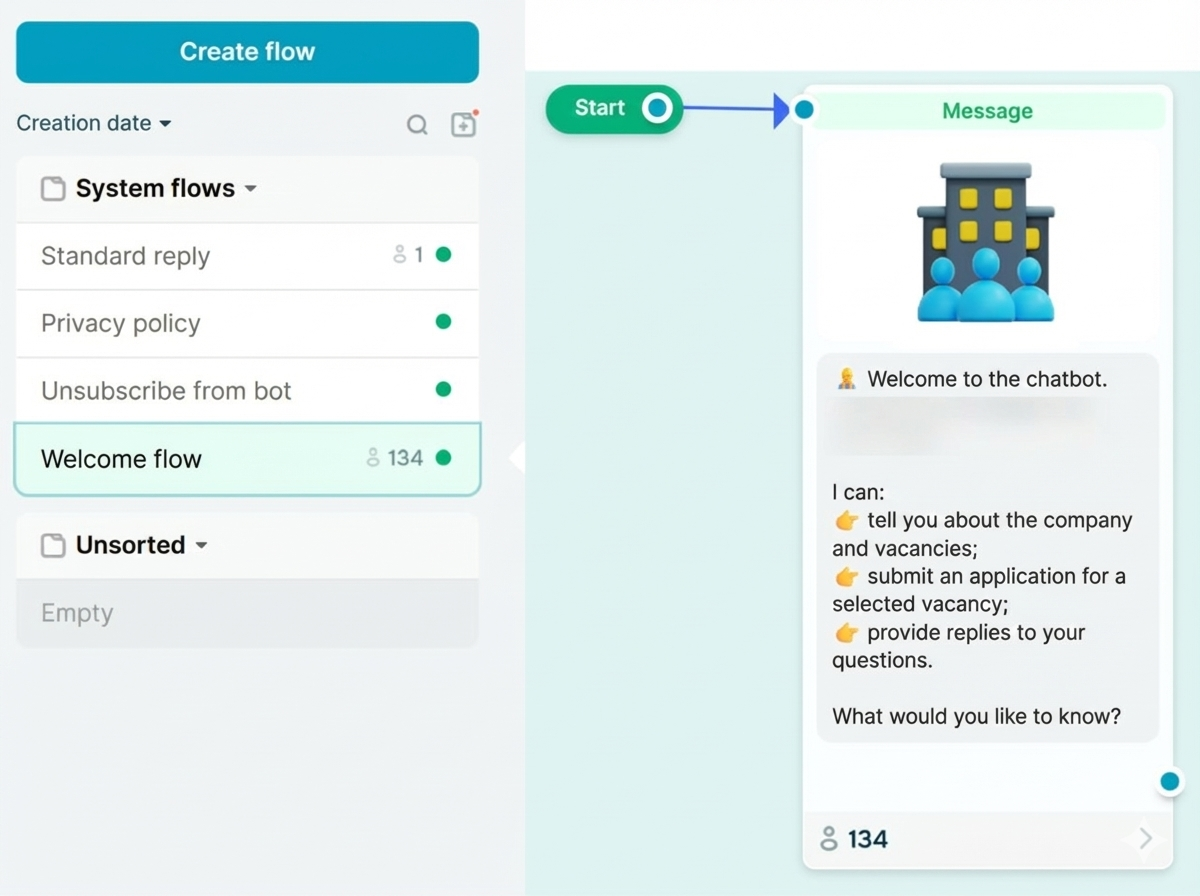 The welcome flow for the HR cahtbot
After reading the message, the candidate selects what they are interested in directly in the chat. This action triggers the second flow, where AI takes over the conversation.
At this stage, the chatbot handles detailed consultations and collects candidate data automatically. The next section breaks down how this flow works in practice.
Standard reply flow
The Standard reply flow uses two AI Agent blocks to connect the chatbot with artificial intelligence. The chatbot sends candidate questions to the AI, which then generates responses based on predefined instructions and the context of each request.
These instructions include detailed information about the construction company, a dynamically updated list of open positions managed through global variables, and examples of common candidate questions with suggested answers. This setup helps the AI provide responses that are accurate, relevant, and consistent.
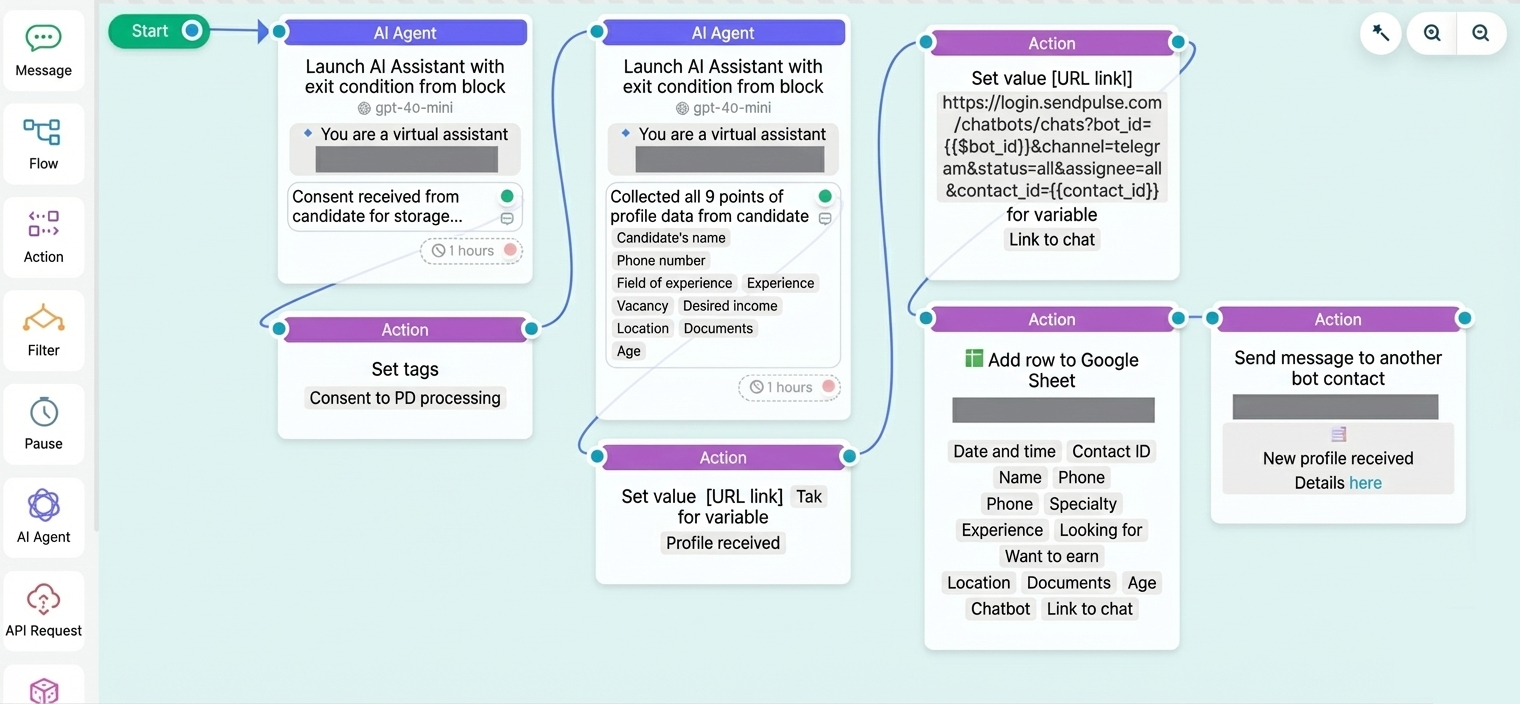 The standard reply flow with AI agent blocks
The instructions also define clear limitations. The AI is not allowed to respond to requests unrelated to the company, employment opportunities, or working conditions. This ensures focused conversations and prevents resources from being spent on irrelevant inquiries.
In addition to content guidelines, the AI agent blocks include the following technical settings:
| AI model |
GPT-4.1 mini |
| Context window |
the last 50 messages |
| Maximum response length |
500 tokens (approximately 375 words) |
| Temperature (creativity level) |
0.5 |
| Execution mode |
conditional exit |
Each AI agent block has its own exit condition. This condition defines when the conversation goal is met and automatically moves the candidate to the next step in the flow. Below, we take a closer look at these blocks.
First AI agent for candidate guidance and consultation
At the start of the conversation, many candidates have limited information about the company, available roles, or job requirements. The first AI agent is designed to guide them through these basics. It introduces the company, lists relevant open positions, explains working conditions, and answers questions as they come up.
The goal of this block is to prepare the candidate to complete the application form and give consent to personal data processing in line with GDPR requirements. Once the candidate is ready, the chatbot automatically moves them to the next AI agent block.
The exit conditions also cover cases where a candidate needs more clarification or wants to speak directly with an HR manager. In these situations, the candidate can request contact details or leave a message in the chat, which is automatically sent to the HR team via notifications.
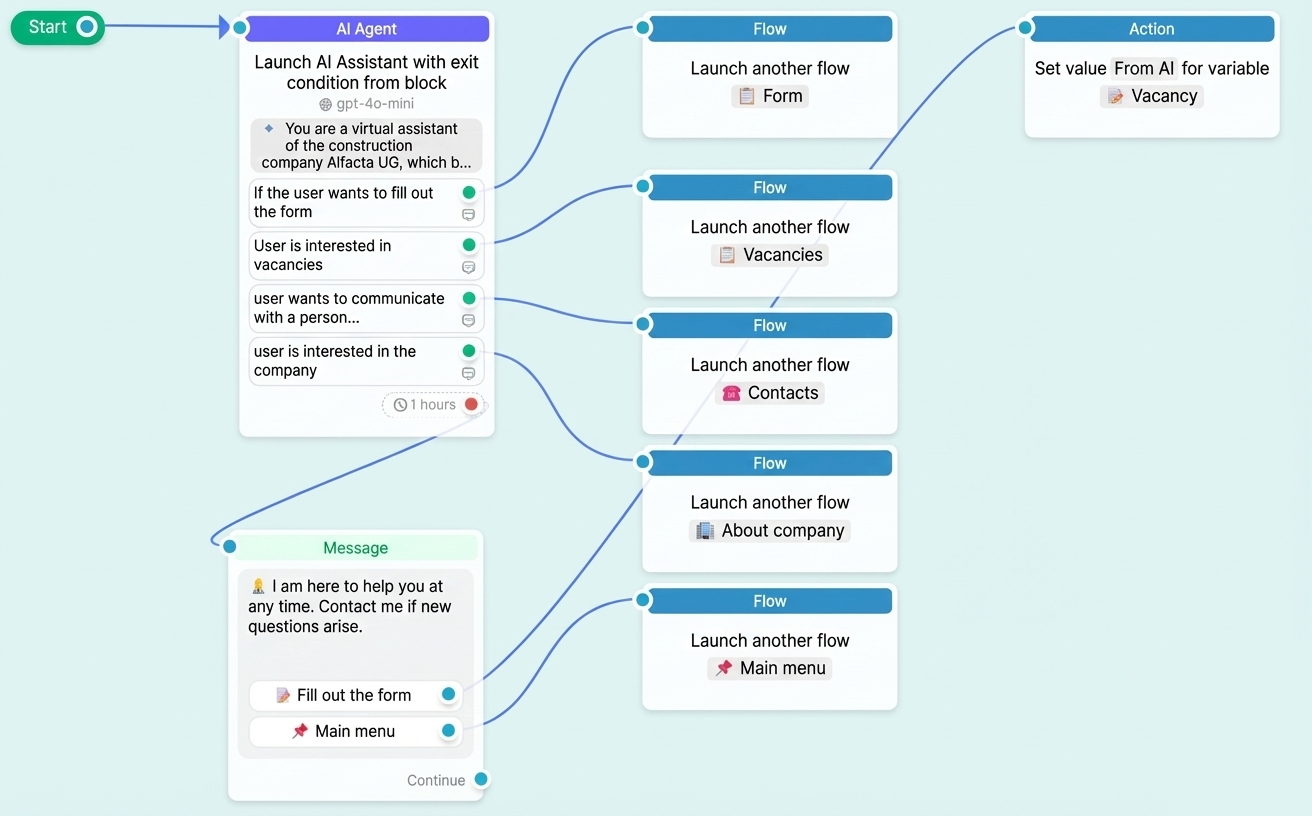 Users can switch to an HR manager at any stage of the conversation
Second AI agent for structured candidate data collection
The second AI agent focuses on collecting complete and structured application data from candidates. To move forward, the candidate answers nine questions in sequence:
- name;
- phone number;
- profession;
- work experience;
- desired position;
- expected income;
- location;
- availability of required documents;
- age.
During the application process, candidates can still ask questions about the company or working conditions. If the information is available in the AI instructions, the chatbot provides an answer and then automatically returns the candidate to the application flow.
This approach keeps the conversation focused on collecting complete and accurate data. At the same time, it allows candidates to clarify important details along the way.
Once all questions are answered, the chatbot thanks the candidate and lets them know that an HR manager will contact them shortly to discuss suitable opportunities. At the same time, the HR manager receives an automatic Telegram notification with a link to the completed application in Google Sheets. This makes it easy to review key details quickly and decide on the next steps without delay.
Results achieved with the chatbot
After integrating the chatbot into the recruitment process, the company achieved measurable improvements:
- 70% of initial candidate communication automated;
- 24/7 information delivery and application collection without HR involvement;
- application processing time reduced from 2-3 days to just a few hours
- 3 times more applications handled without expanding the team;
- 100% structured candidate data across all applications.
Below is a comparison of manual HR work and chatbot-driven automation, based on data provided by AICoreBot:
| Criteria |
Chatbot |
HR manager |
| Working mode |
24/7 |
8-hour workday |
| Simultaneous conversations |
Unlimited |
1-2 at most |
| Time per initial consultation |
Up to 10 minutes |
Up to 30 minutes |
| Data structure |
100% structured |
Depends on the specialist |
Beyond measurable gains, the company also saw important qualitative improvements. By handing over routine interactions to the chatbot, HR specialists gained more time for in-depth interviews with qualified candidates. This led to better hiring decisions and a stronger focus on candidate quality.
Candidates now receive instant, accurate, and complete answers to their questions, which increases trust and loyalty toward the company. Even applicants who were not hired reported a positive experience with the recruitment process.
This case demonstrates how AI-powered automation can significantly improve recruitment workflows and strengthen an employer’s competitive position. By implementing an HR recruiting chatbot, the team used its expertise more effectively and increased overall hiring efficiency.
Want to achieve similar results? Create your own chatbot in SendPulse to automate candidate communication and scale your recruitment process with less manual effort.