
WhatsApp marketing is a type of messenger marketing, which implies promoting a brand through WhatsApp. This channel helps brands reach an enormous audience, build strong relationships with customers, and increase sales.
In this video, Alex, a marketer at SendPulse, explains how to boost your marketing efforts on WhatsApp.
Why Should You Use WhatsApp Marketing for Your Business?
WhatsApp is the most popular messaging platform in the world. In 2025, its audience is more than 3 billion active users monthly. This marketing channel is a must-have for businesses that want to connect with audiences in developing countries. For instance, there are around 795.67 million monthly WhatsApp users in India. However, the platform is also an excellent choice for promotions in the US market. As of 2024, 100 million Americans access this messenger.
WhatsApp marketing allows you to stay in touch with your customers – more than half of WhatsApp users check the app every day. Better yet, you can be sure they will get your offers, as text messages have a 98% open rate.
According to the report, 78% of clients communicate with businesses using different messengers, including Facebook Messenger, Instagram, and WhatsApp. They appreciate such interaction because it’s fast and direct.
However, there are more reasons to implement WhatsApp in your marketing strategy. Read on to learn a few more benefits of this marketing channel.
Benefits of WhatsApp Marketing for Your Business
Using messengers is a golden opportunity to improve your marketing strategy. There are four positive outcomes of using WhatsApp for your business promotion.
Profound relationships with customers
Over 55% of people feel more connected to a brand if they use messaging apps. It makes WhatsApp marketing a bulletproof strategy for building long, profound relationships with customers. Maintaining such a connection helps brands cut expenditures as customer retention is 5-25 times cheaper than acquisition.
Out of the box, WhatsApp provides businesses with a robust set of opportunities for personalization. For instance, you can send personalized welcome messages, special offers, birthday congratulations, and so on. Such an approach keeps customers more engaged with a brand – 78% of consumers say they expect personalized marketing messages.
Higher conversion rate
Choosing a perfect channel for your initial contact with customers is crucial. People may get disgruntled with phone calls while staying inaccessible through email or social media.
Here is where WhatsApp comes in handy to nudge your prospects towards the purchase. Businesses say that customers answered 40% of their WhatsApp messages. Better yet, messaging drives conversions. Namely, messaging after initial contact with a prospect can increase the conversion rate by 112.6%.
Better sales
WhatsApp marketing works as a sort of magic wand for your sales. According to statistics, 66% of users have bought a product after interacting with a company using WhatsApp.
It seems like the opportunity to reach a brand through any messaging app alone instills confidence in potential customers. At least 66% feel more optimistic about purchasing from a company if it is active on messengers.
Better yet, you can consider WhatsApp a stand-alone sales channel for your business. It’s possible with the growing tendency for people to buy through messaging apps. Roughly 60% of consumers believe they will use messengers more to make purchases in the future.
Lower cost of marketing
WhatsApp is still a very affordable marketing channel, which makes this platform enticing for small businesses. All you need to get the ball rolling is to install an app and connect to the internet.
Meanwhile, the chances that your message will reach the customer are sky high. On average, a user checks WhatsApp over 23 times a day.
Now that you know the benefits of using WhatsApp marketing, let’s find out the solutions this messenger offers to businesses of different sizes.
WhatsApp Marketing Solutions
As a platform for communication with a vast audience, WhatsApp offers several solutions for people who interact with their customers using its services. In this section, we’ll uncover them in detail one by one. Let’s dive in.
- WhatsApp Messenger. This communication platform allows individuals to send text messages, images, videos, documents, voice messages, and make voice and video calls over the internet. You can also add stories to provide information that is available for 24 hours. Messenger doesn’t support business profiles, auto replies, and catalogs, making it not convenient for businesses. If you want to communicate with customers using WhatsApp, it’s necessary to take advantage of the WhatsApp Business App or API, depending on the size of your company.
- WhatsApp Business App. Small business owners can take advantage of the app without having to allocate a special budget because it’s free. This allows small brands to create their business profile while adding their names, logos, working hours, websites, and catalogs. The app enables you to manage all the chats with prospects and customers manually or hire customer support agents for this task. With quick replies, labels, and auto-messages, it's possible to handle all the repetitive questions faster.
- WhatsApp Business API. If you have a well-established business and many interactions with customers, you need the WhatsApp Business API. It helps you access various marketing tools, including automation, CRM integration, and bulk messaging, to simplify communication with your clients and ensure that they get instant help. API is perfect for businesses striving to scale and provide an excellent customer experience. It also allows you to create chatbots and connect analytics.
WhatsApp marketing drives more conversions, improves sales, allows you to build deep, quality relationships with customers, and costs next to nothing in terms of marketing expenditures. Read further to learn how to build a WhatsApp marketing strategy.
WhatsApp Marketing Strategy
- Define your goals and KPIs
- Pin down your target audience
- Get the business app for small businesses
- Create a brand persona
- Build a contact list
- Design your communication
- Deliver great customer service
- Take advantage of the WhatsApp Business API for larger companies
A well-made strategy underlies the effectiveness of every marketing channel. It enables you to plan your steps and change paths if something goes wrong. Here are a bunch of tips to help you craft your WhatsApp marketing strategy and get great results.
1. Define your goals and KPIs
To get your WhatsApp marketing strategy started, determine your marketing objectives. This step will help you focus your attention on meaningful activities and draw the line on unnecessary things.
Start by revising your marketing funnel and finding weak spots. Think of business goals you can pursue with your WhatsApp marketing strategy. Pinpoint the KPIs that will help you understand whether you have met these goals.
Here is an example to help you understand this scheme: If your business has issues retaining customers, you can address them by sending promotional messages through WhatsApp. In this case, your KPIs might be clicks, engagement, and customer retention rates.
2. Pin down your target audience
Knowing your target audience underlies all your marketing efforts and defines their success. You can try several approaches to determine your target audience. A classic one is customer profile creation. To explore it, follow our guide on building a buyer persona.
Another way is to use the jobs to be done (JTBD) framework. If you decide to follow this one, ask yourself these questions:
- Why do people use your product?
- What value do they want to get from it?
- What outcomes do they want to achieve?
Whatever approach you choose, avoid guesses and speculation; explore your audience instead. To start with the JTBD framework, interview 10-15 of your current customers who have made a purchase lately.
For customer profile creation, you can conduct surveys on social media and add data from Google Analytics, your CRM, Facebook, Google Ads, and so on. These tools will help you spot demographic and geographic characteristics of your typical customers.
3. Get the business app for small businesses
To meet small and large firms' needs, WhatsApp launched a stand-alone application, WhatsApp Business. This tool has some helpful extra features, such as:
A business profile with essential information: your address, business description, email address, and website.
- Catalog – a virtual showcase of your products.
- Labels to organize your chats with customers. For instance, you can label conversations according to the stage of the sales funnel.
- Quick and automated replies to stay in touch with customers and provide answers immediately.
- Statistics to track sent, delivered, received, and read messages.
4. Create a brand persona
People prefer to communicate with others rather than with an impersonal business. Therefore, to execute successful WhatsApp marketing, you need to develop your brand persona. A brand persona consists of the traits, attitudes, and values that your brand embodies.
Remember market leaders? All of them have personas. For instance, Apple appears to be creative and intellectual, Fanta – jolly and easy-going, Nike – passionate and vigorous. Your brand probably also has some personality; try to explore it and spot the most meaningful traits. This persona will underlie your tone of voice and communications with prospects on WhatsApp.
Create a feeling that your customers deal with a person. Use a person's name as a signature, which works better than a company's name.
5. Build a contact list
If you’re going to use WhatsApp for more than just customer support, you need a contact list. The best way to obtain one and acquire new contacts is to utilize subscription forms. Place these on various pages of your website and offer a lead magnet, such as an eBook or discount.
Consider going for multichannel forms – they allow your subscribers to choose where they want to receive updates, via email, WhatsApp, Facebook Messenger, and so on. This approach creates higher engagement and boosts conversions. However, before sending any type of content to users using WhatsApp Messenger, you should receive their consent first and ensure that users understand what they sign up for. It should be explicit and clear. Mention your business name and type of messages to avoid misleading or deceiving users, because it might negatively affect your brand reputation.
Remember to segment your audience to send the most relevant campaigns and deliver personalized experiences. Follow our guide on mailing list segmentation – though we’ve created it with email marketing in mind, you can apply the same tactics to WhatsApp marketing as well.
6. Design your communication
WhatsApp messages have impressive open rates in comparison with other channels. However, if you offer irrelevant or poorly produced content, your marketing strategy on this channel will be dead in the water.
Pinpoint your main topics and the messages you want to deliver. Try not to limit yourself to only promotional messages; remember to entertain and educate your audience. Keep your communications short and sweet – people often check WhatsApp on the go and have no time to read long messages.
Reinforce your messages with multimedia files, such as videos, animations, or pictures. Emojis are also appropriate in WhatsApp marketing. If you want to play around with them, choose smiley faces or people rather than business-themed objects.
Another point to consider is message frequency. If you bombard your readers with messages every hour, they’re likely to become annoyed with your brand.
7. Deliver great customer service
Most customers use messaging apps to get brand support. 59% of people believe they get responses faster via messengers, and 50% find better advice and care in this communication channel. Here is the point where WhatsApp marketing comes in handy.
WhatsApp allows your brand to get queries immediately and provide customers with real-time support. This feature becomes crucial, as long as 28% of customers expect to get help within an hour, and 18% anticipate an immediate response.
Keeping such a pace seems arduous, but WhatsApp allows you to provide customer support around the clock. All you need is to employ a chatbot and feed it with typical questions and answers to them. Such an approach may help you cut customer support costs by 30%.
8. Take advantage of WhatsApp Business API for larger companies
When you have a medium or large business, it’s essential to use Business API to manage FAQs, make appointments, and send automated messages. API supports all the necessary marketing tools like automation, CRM integration, and bulk messaging. Once you have them integrated, you can seamlessly interact with customers without having to handle various tasks manually.
API enables you to train your chatbots and provide answers to repetitive questions on autopilot while letting human agents manage the rest. After setting up automation, you’ll be able to connect analytics and keep an eye on performance. You can always improve your service and make users even happier with your brand.
To sum it up, creating a WhatsApp marketing strategy encompasses setting goals, exploring your audience, delivering great content, and maintaining good relationships with your customers. Some brands have mastered these techniques flawlessly. In the next part, we’ll delve into some examples and ideas for your WhatsApp marketing.
5 WhatsApp Marketing Ideas and Examples
WhatsApp marketing is all about relationships with the audience and delivering value. However, there is space for some creativity in these conditions. Let’s take a once-over of WhatsApp campaigns from all sorts of businesses and get a dose of inspiration for your own brand promotions.
Klook – transactional messages
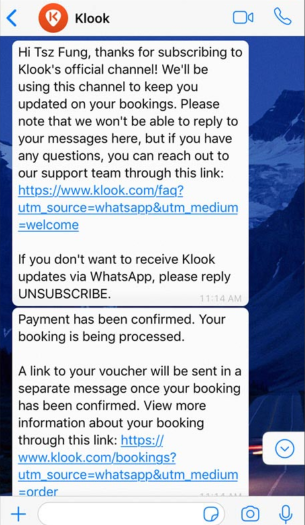
The online travel platform Klook uses WhatsApp to boost customer satisfaction and improve retention. Thus, the company centered its marketing strategy on updates and notifications regarding bookings.
Klook kept its clientele's best interests at heart and needed to find the most convenient communication channel. As the company has an enormous audience in the Asia-Pacific region, the choice fell on WhatsApp – the app is widespread in this area.
The travel platform invited its website and app visitors to subscribe to WhatsApp notifications, order updates, and reminders. As a result, the opt-in rate for WhatsApp turned out to be 63% higher than for the Klook app’s push notifications. The customer retention rate grew by 40%.
Netflix – personal recommendations
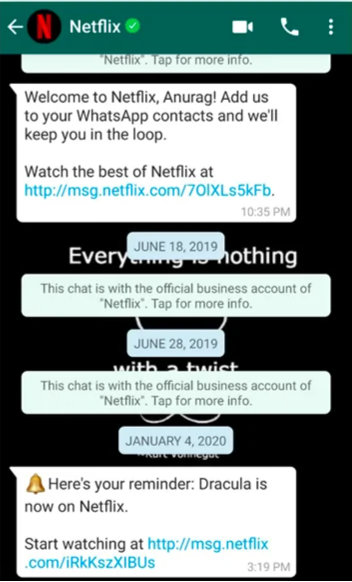
The streaming giant, Netflix, knows a little something about keeping its users engaged with the service. The service offers personal recommendations in its mobile application. In 2017, the company extended this practice to WhatsApp.
Netflix launched this campaign in January 2017 in India, WhatsApp's biggest market. Users who had both Netflix and WhatsApp installed on their smartphones saw the offer to stay in touch through WhatsApp Messenger. If a person clicked “I’m in,” they started to receive messages about their account and TV program and film suggestions. Half a year after Netflix offered the same opportunity for its users in the UK.
The trick here was to keep interacting with customers even after they’ve canceled their Netflix subscription. New show announcements and reminders triggered recipients to resubscribe to the streaming platform.
Agent Provocateur – profound counseling
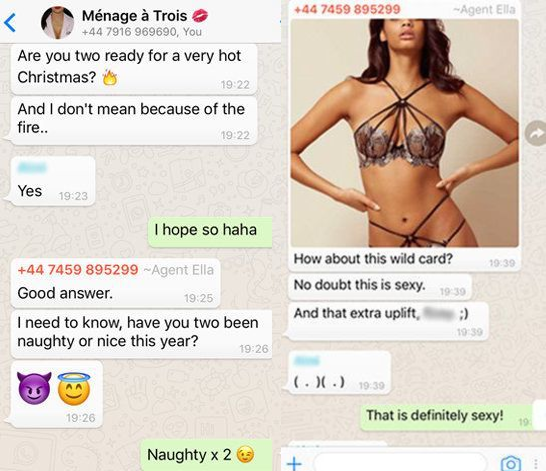
The upmarket lingerie brand, Agent Provocateur, decided to go a bit further with recommendations to customers. A couple of years ago, the company started its Ménage à Trois campaign dedicated to Christmas.
Agent Provocateur offered couples to start a group chat with the brand assistant on WhatsApp. During the conversation, the company representative gave personal recommendations and facilitated the discussion of what the prospects wanted for Christmas. 31% of these conversations resulted in in-store visits, and 61% converted into website traffic. The campaign was so successful that Agent Provocateur made WhatsApp counseling a permanent service for VIP customers.
Saffola – real-time help
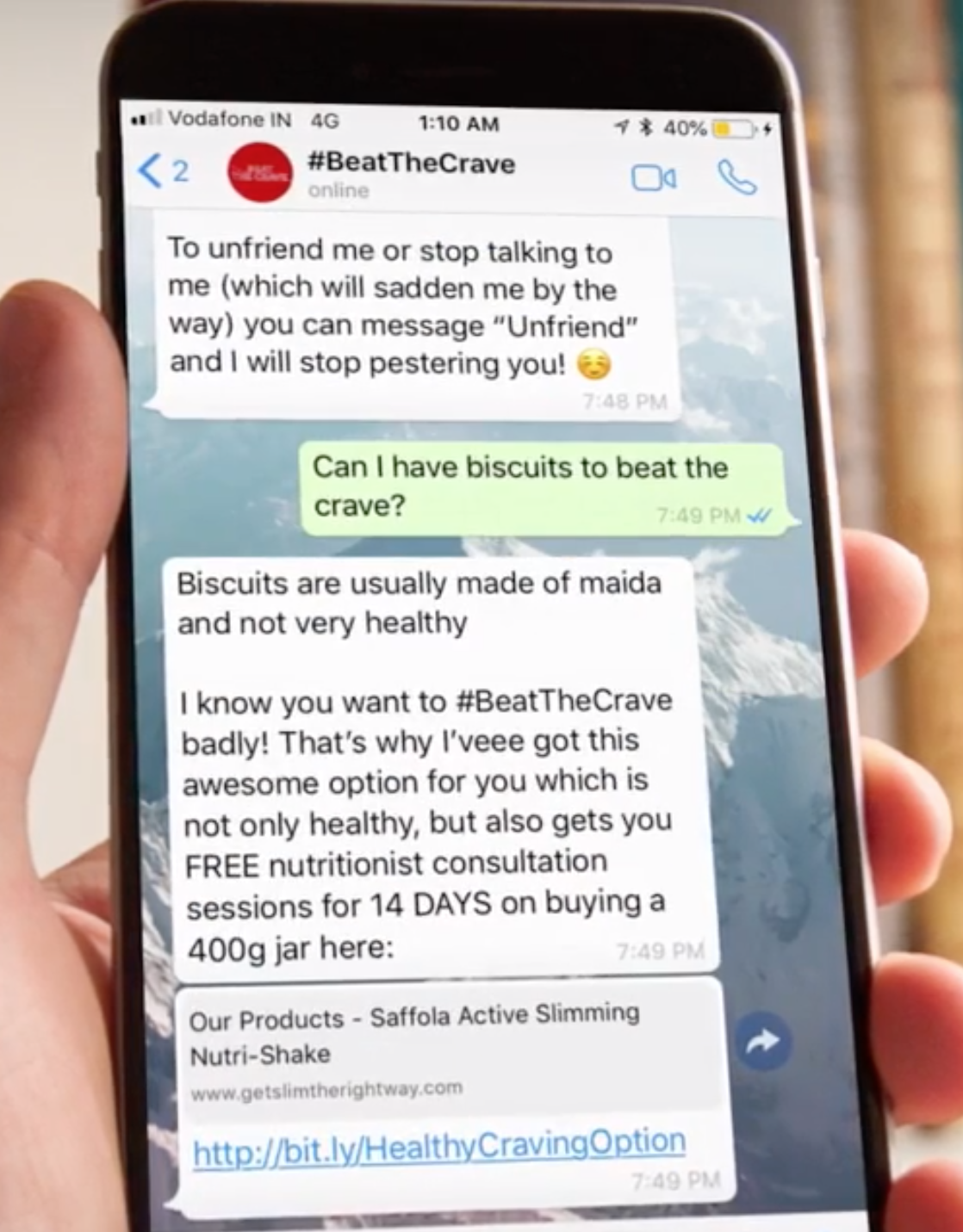
If you've tried any diet, you are probably familiar with the cravings for a slice of pizza or a cookie. The Indian healthcare brand, Saffola, builds its campaign around fighting this want for unhealthy food.
To help people combat their harmful eating habits, Saffola crafted a WhatsApp chatbot. A user could send a message to this bot when they felt a longing for some comfort food. In turn, the chatbot tried to distract a person with pre-recorded positive reinforcements, puzzles, and even a rap song. The latter promoted Suffola’s new active slimming drink.
Adidas – tackling audiences’ issues
The sportswear brand Adidas used WhatsApp as a part of its new shoe promotion campaign. The brand focuses on a narrow audience – amateur football players – and helps them tackle their specific issue.
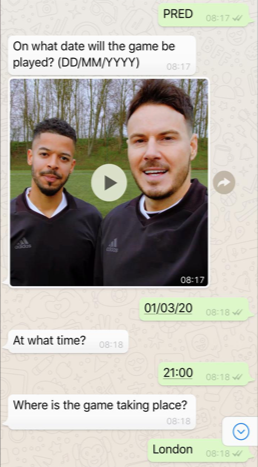
Football teams fairly often experience troubles with stuff. Some players may drop out at the last minute before a match, and there might be no replacement. Adidas offered to find a substitute through WhatsApp. All you need to do is send a message to a WhatsApp hotline and share essential information about the match. In return, Adidas will send a top-notch football player to your game.
Although the campaign only lasted for six days and targeted a specific audience, it has delivered impressive results. In particular, Adidas got a lot of buzz in football media, retail websites, blogs, and so on.
Some of these examples are simple yet effective, while others are difficult to recreate. However, they illustrate the main rules of successful marketing: listen to your audience and know their needs, provide value, and be creative. Want to learn more WhatsApp hacks? Read further.
10 WhatsApp Marketing Tips
- Create broadcast lists
- Use group chats
- Enable greeting message
- Use away message
- Employ WhatsApp statuses
- Use one-way communication
- Let users share reactions
- Craft a product catalog
- Create a WhatsApp link
- Take advantage of the Communities feature
We’ve unpacked quite a few tricks for building a WhatsApp marketing strategy. Now it’s time to explore some more specific techniques.
Create broadcast lists
In a nutshell, a broadcast list is a group of recipients gathered together. Сontacts can not see each other and receive your messages separately, which makes them similar to segments in your mailing lists.
These peculiarities make broadcast lists the perfect feature for sending relevant campaigns. For instance, you can gather all your VIP customers in one list and send them exclusive offers or ask existing clients for referrals, and so on. Use this feature to retain and engage your audience.
Use group chats
This feature resembles the previous one at first sight, but there’s a difference between them. Unlike broadcast lists, group chats allow members to see each other and share their opinions with the whole group.
So, group chats may be useful if you want to encourage discussions between your customers. For instance, you may set up a group to warm up participants before an offline event or webinar.
Another case is when your clients make purchasing decisions in groups. It’s a common practice for businesses with elaborate and expensive products, such as IT solutions, industrial equipment, and so on. Although consumer good sellers may benefit from this tool as well – remember the Agent Provocateur example.
Enable greeting message
After you customize this first message, WhatsApp will send it to users who interact with your business for the first time automatically. It also sends the same message in case these prospects haven’t interacted with your brand for 14 days. This is a great way of starting communication with potential customers without making them wait for this initial contact.
Use away message
This is a useful tool when you don’t have a chatbot connected because it helps you notify users that your human agents are away. After enabling this message, customers will receive a customized message informing them that you are busy or aren’t available online at the moment on autopilot. It’s a great feature that allows you to show that you care about each of your customers and let them know when you are offline.
Employ WhatsApp statuses
If you're familiar with Facebook or Instagram stories, WhatsApp statuses may ring a bell for you as well. This feature allows you to share text and multimedia files with all your contacts and receive their feedback. While publishing the update, you may also share it on Facebook. The status expires in 24 hours.
In Instagram marketing, stories are among the most effective tools, and WhatsApp statuses work well too. You can use them to share special offers, product updates, promo codes, and so on. For instance, you may set up a one-day flash sale for WhatsApp users only.
Use one-way communication
This feature is perfect when you want to send messages to large audiences without letting them reply. With its help, you can effectively share announcements, updates, alerts, and broadcasts. Whether you have a small or a large business, this one-way communication ensures that customers get all the necessary information about your brand, sales, promotions, pricing adjustments, etc.
Let users share reactions
When you share some updates with customers, you can let them react to this news using emojis. This WhatsApp feature allows not only to see the number of active clients but also to find out how customers react to specific updates. Some of them might be more popular than others, meaning that you should focus on those with the most impressions to encourage engagement and more purchases.
Craft a product catalog
In 2019, WhatsApp launched product catalogs that allow users to showcase their products. The feature has great potential—Instagram even launched a similar tool called Instagram Shop.
You can add up to 500 items to your WhatsApp product catalog. Your potential customers may browse through it and share links to some products or ask you questions about them. You may also send catalog items to WhatsApp users or share a link to the whole showcase anywhere online. Catalogs are extremely helpful for small businesses or aspiring entrepreneurs with no websites.
Create a WhatsApp link
It might be difficult for users to initiate conversations with brands on WhatsApp since they need to find your phone number, save it, and start a chat. Luckily, there's an awesome solution—a WhatsApp link. You can create such a link and place it on your website, in chatbots, on your landing page, or add it to your email campaigns. To start communicating with your brand, a user only needs to click it, and they will see a pre-made message. With the SendPulse WhatsApp link generator, you can create such a link in several minutes and absolutely for free.
Take advantage of the Communities feature
This feature enables you to gather people who share the same interests and explore related topics. The platform allows anyone who wishes to organize individuals into groups to create communities. Admins can add valuable updates, announcements, and relevant groups. Members of these communities are encouraged to open discussions. You can also create events, share polls, send files, and have total control over everything using the admin panel.
WhatsApp marketing is an excellent way to reinforce your brand and build deep, long-lasting relationships with customers. To achieve better results, go beyond WhatsApp and master all the channels your customers prefer. Try Facebook and Telegram messages as well, and reinforce your marketing strategy with email and web push notifications campaigns.
or