Customize your cart page
A cart page appears on your online store's website automatically once it is activated. On this page, visitors can select a payment method, delivery option, and other details when placing an order.
In the Cart widget settings, you can customize the style of your product card and cart icon, turn on a mini-cart, add available payment methods and more information, and connect analytics.
You can also add other elements to your cart page and adjust its style to match your brand visuals and needs. For example, you can add a top menu, page footer, or related product recommendations.
Let’s talk about how to customize the style of the Cart widget and its elements and set up a mini-cart.
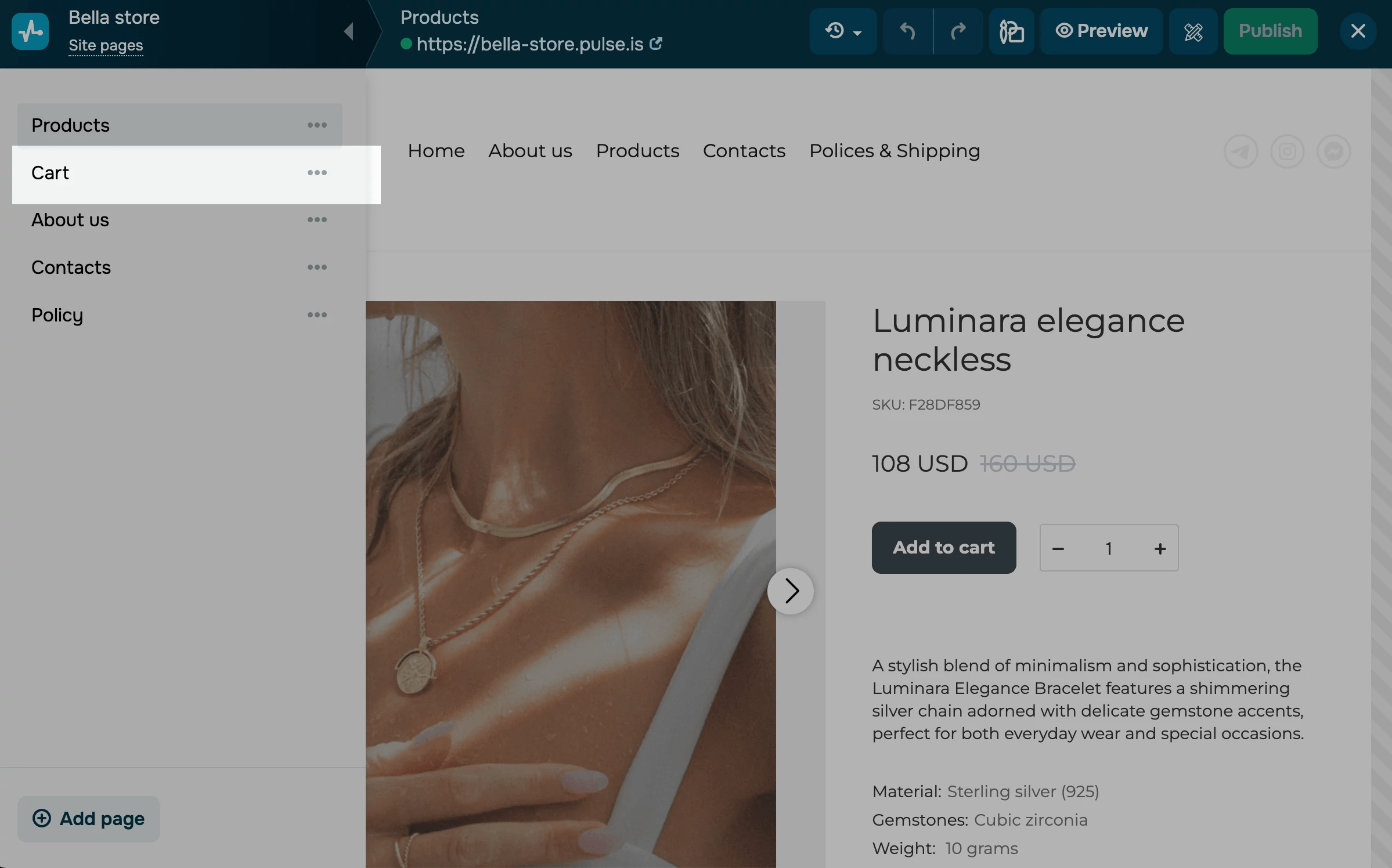
Go to the website page list, and select Edit from the menu next to the Cart page. You can also access your cart page from the list of pages in the builder.
Click the widget, and in the element editing panel, select the element you want to customize.
Customize your cart appearance
In the Cart style section, click the element you want to update.
Cart
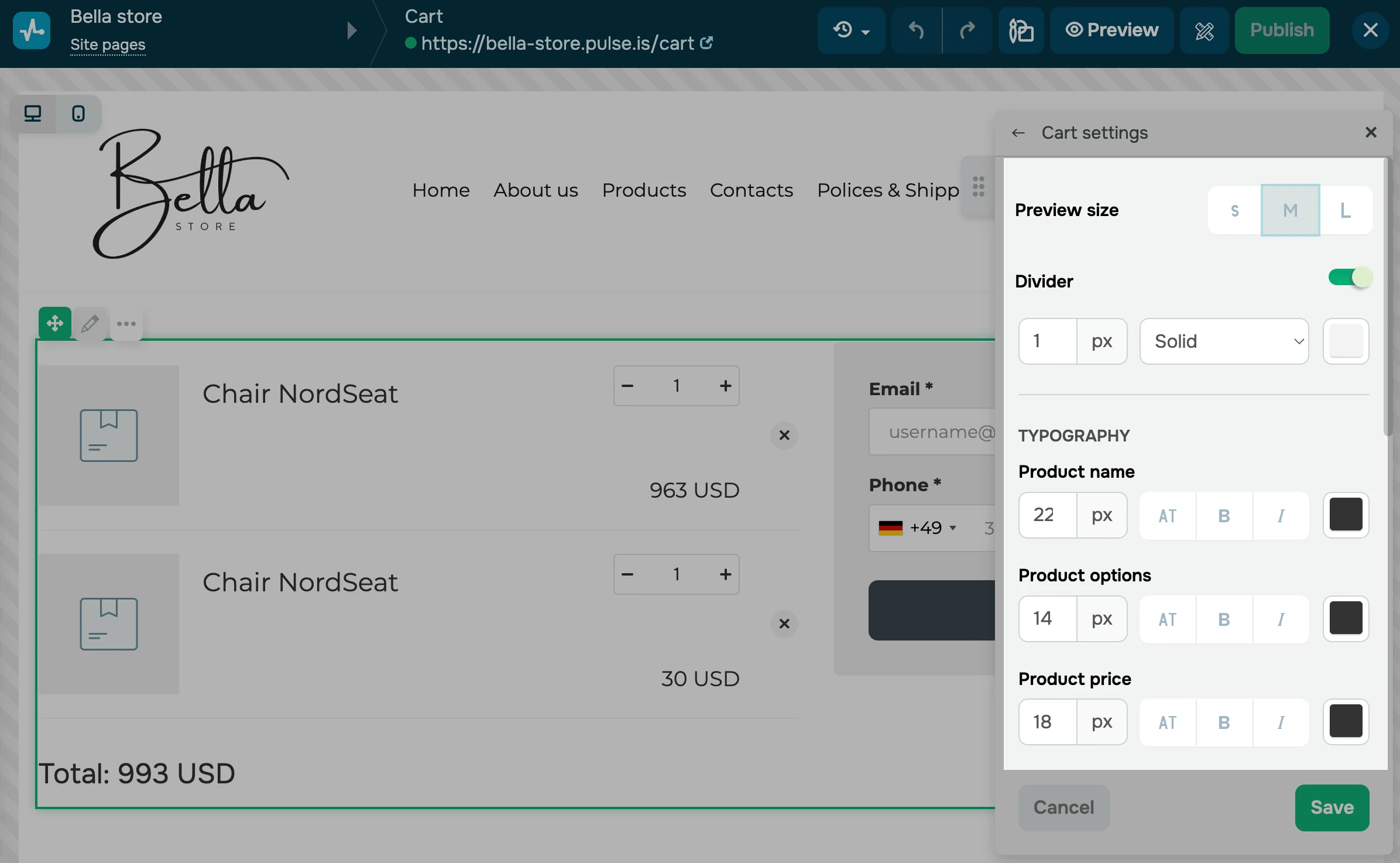
In the Cart settings section, you can customize the element style in your added product card:
| Preview size | Changes your product preview size. Select S, M, or L. |
| Divider | Adds spacing between product previews. Choose a size, style, and color. |
| Typography | Changes your text style size in product previews. Select a text size, format, and color of your product name, option, price, and total amount. |
| Delete product button | Changes the cart’s remove icon. Select an icon color and background color. If you add a color, the icon will be circular. |
| Card product counter | Changes the style of the counter where users can select how many items to add to their cart. Select a field style, color, rounding, and size. |
Cart icon
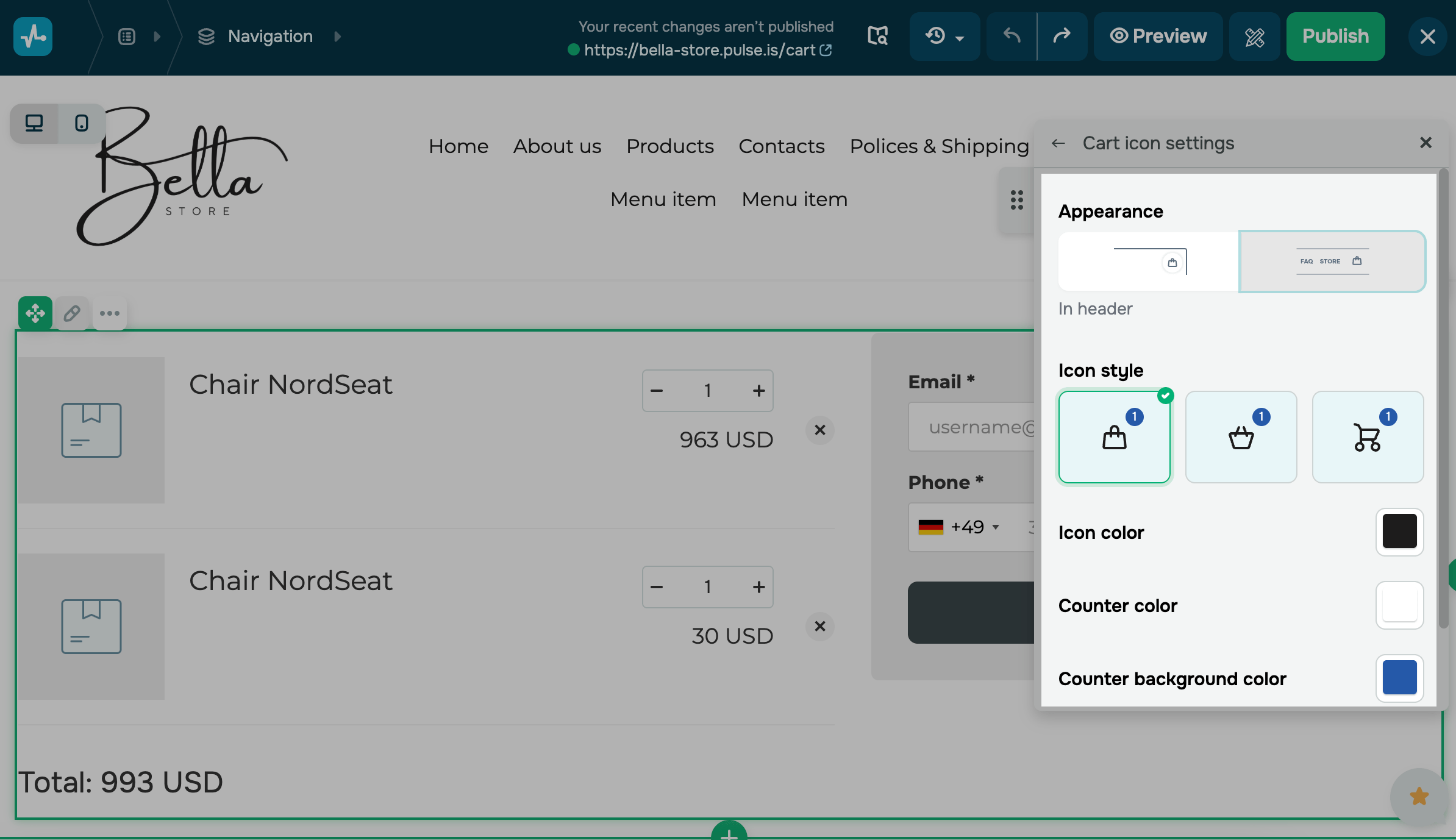
In Cart icon settings, you can set icon styles that will appear on every page of your website. In Appearance, select an icon style.
| Floating | The cart icon will be pinned to the right corner of the screen and stay in place as users scroll. |
| In header | The cart icon will be embedded in your header. |
Select an icon shape, element colors, rounding, and size.
Use preview mode or visit your published website to see how the cart icon appears.
Set up a mini-cart
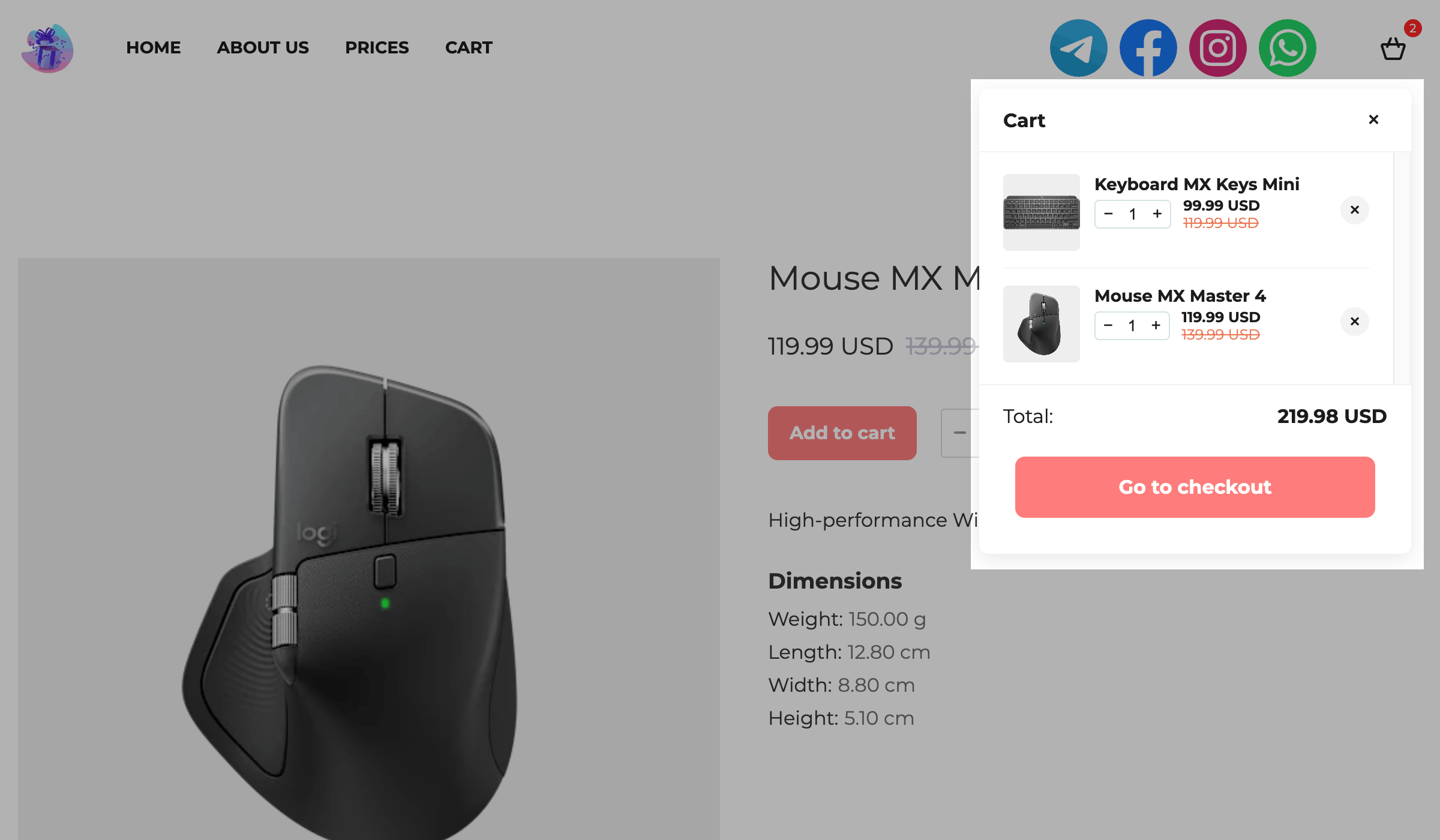
A mini-cart is a compact pop-up window with the products a customer has added to the cart. It appears next to the cart icon when a customer adds a product or clicks the icon.
In the mini-cart, customers can view the added products, change their quantities or remove them, and check the order total without leaving the page.
For example, an electronics store's customers can add a keyboard and keep browsing for a matching mouse on the same page.
Turn on the mini-cart
To show the mini-cart on your website, go to Websites, select your website, and click Edit next to the Cart page. In the website builder, click the Cart widget.
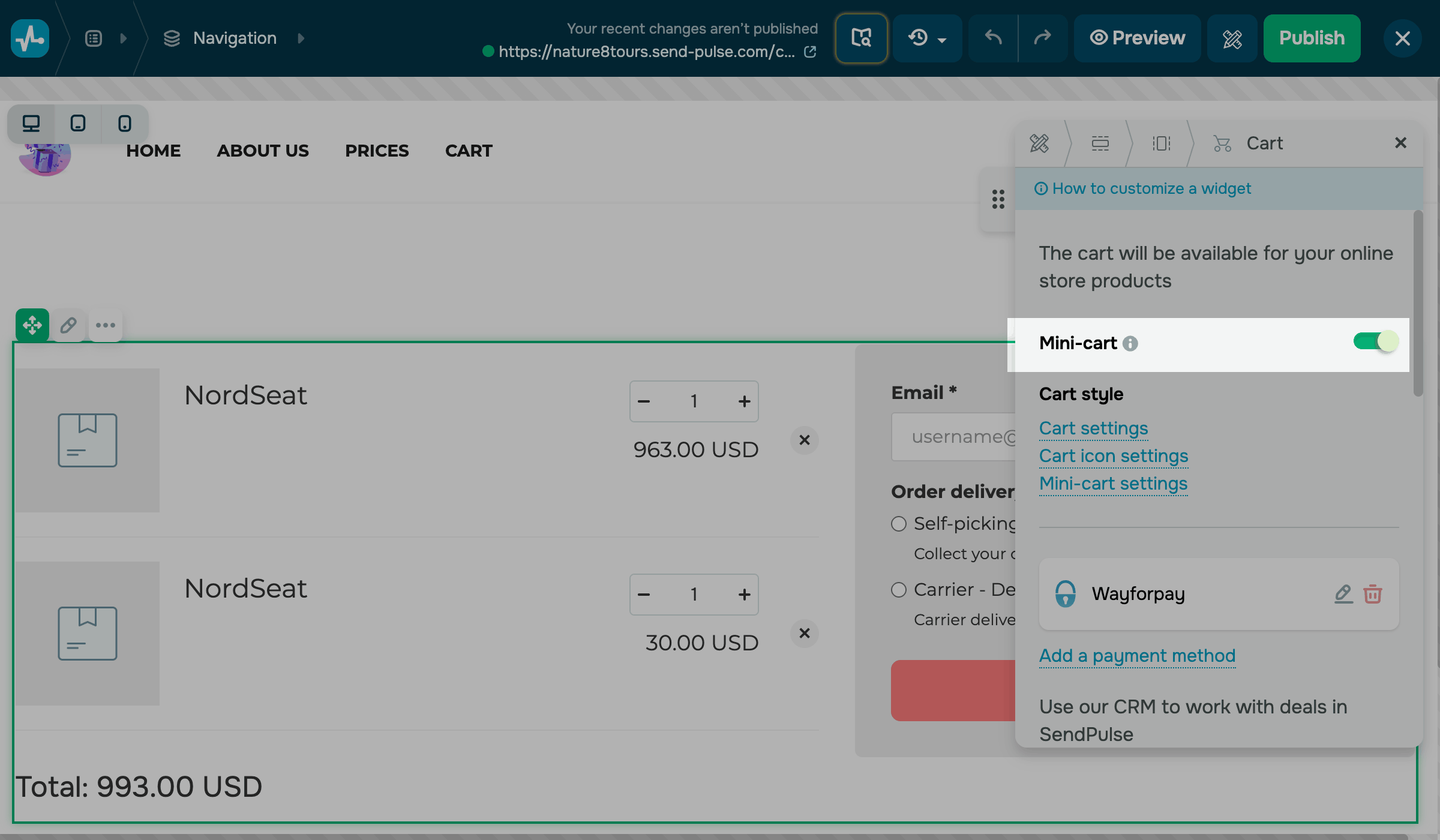
In the element editing panel, turn on the Mini-cart toggle. When you connect an online store, this toggle turns on automatically.
When the toggle is on, the cart icon opens the mini-cart instead of the cart page.
If the Automatically redirect to the cart after adding a product checkbox is selected in your online store settings, customers go straight to the cart page after adding a product, even when the mini-cart is on. To show the mini-cart instead, clear this checkbox.
Customize the mini-cart style
To match the mini-cart to your website design, change its colors and rounding. The mini-cart uses the text styles set in Cart settings.
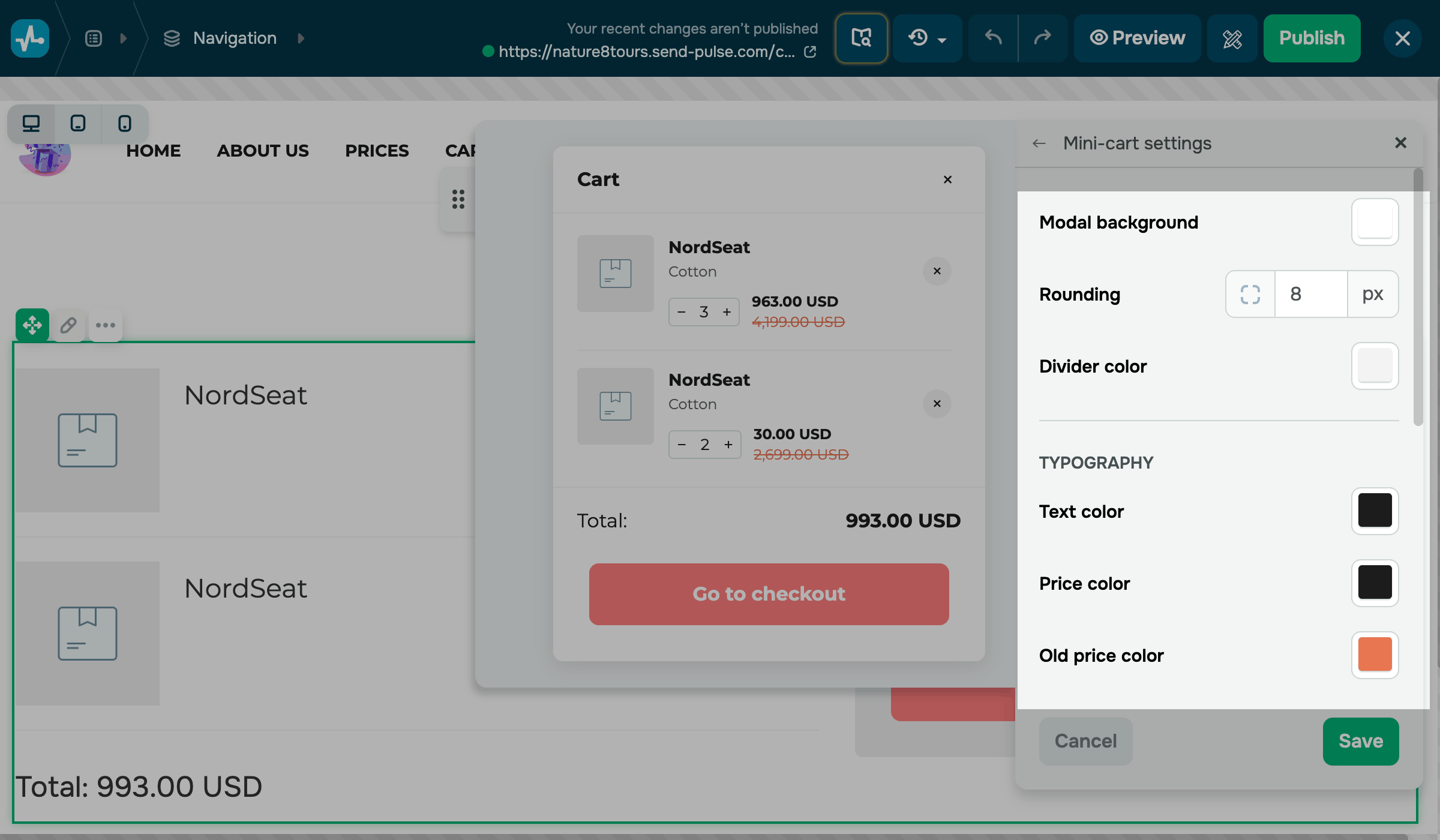
When the Mini-cart toggle is on, in the Cart style section, click Mini-cart settings. A mini-cart preview appears next to the settings.
To customize the mini-cart window, use the following settings:
| Modal background | Sets the background color of the mini-cart window. |
| Rounding | Rounds the corners of the mini-cart window. Enter a value in pixels. |
| Divider color | Sets the color of the lines that separate the title, products, and total. |
In the Typography section, set the following text colors:
| Text color | Sets the color of the title, product names, and other text. |
| Price color | Sets the color of product prices and the total. |
| Old price color | Sets the color of old prices, which appear crossed out. |
In the Delete product button section, set the following colors for the icon that removes a product:
| Icon color | Sets the color of the deletion icon. |
| Background color | Sets the color of the circle behind the deletion icon. |
In the Cart product counter section, customize the quantity field using the following settings:
| Text color | Sets the text color in the counter. |
| Background color | Sets the fill color of the counter. |
| Border color | Sets the color of the counter outline. |
| Rounding | Rounds the counter corners. Enter a value in pixels. |
To apply your changes, click Save.
Change the mini-cart button
The mini-cart button takes customers to the cart page, where they fill in the order form and pay. By default, the button reads Go to checkout.
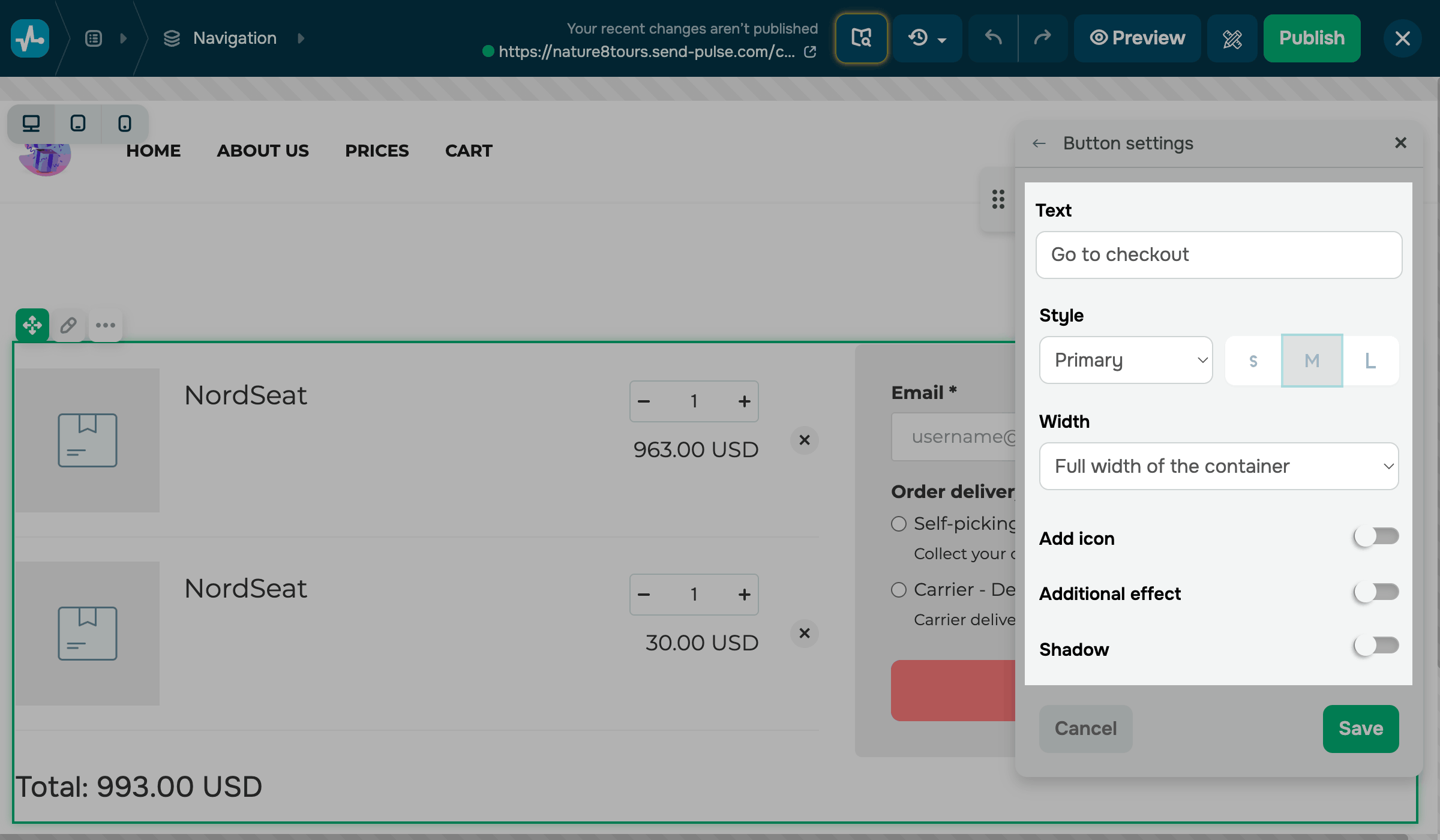
To change the button, click the pencil icon in the Mini cart button section.
In the Text field, enter the button text. This field is required.
In the Style field, select Primary, Secondary, or Custom, and select a button size.
You can also change the button width, add an icon, or turn on the Additional effect and Shadow toggles.
To apply your changes, click Save.
Read more: Select a button style.
View the mini-cart on your website
To see the mini-cart with your styles and button text, publish your website. Then add a product to the cart or click the cart icon.
To change a product's quantity, customers click − or + or enter a number in the counter. Digital products have no counter.
Customers can click a product's image or name to return to the page where they added the product.
To close the mini-cart, customers click the × icon next to its title or anywhere outside it.
Customize your order form
Specify a payment method
To add a new payment method, click Add a payment method. To edit an existing payment method, click the pencil icon next to it.
Select the payment system you will use to accept payments. If you accept payments through multiple methods, you can add an additional one.
You need to add payment methods that use the same currency as your store. If the currencies don't match, the payment amount will be incorrect.
To learn more about how to connect various payment methods, refer to the Accept Payments section.
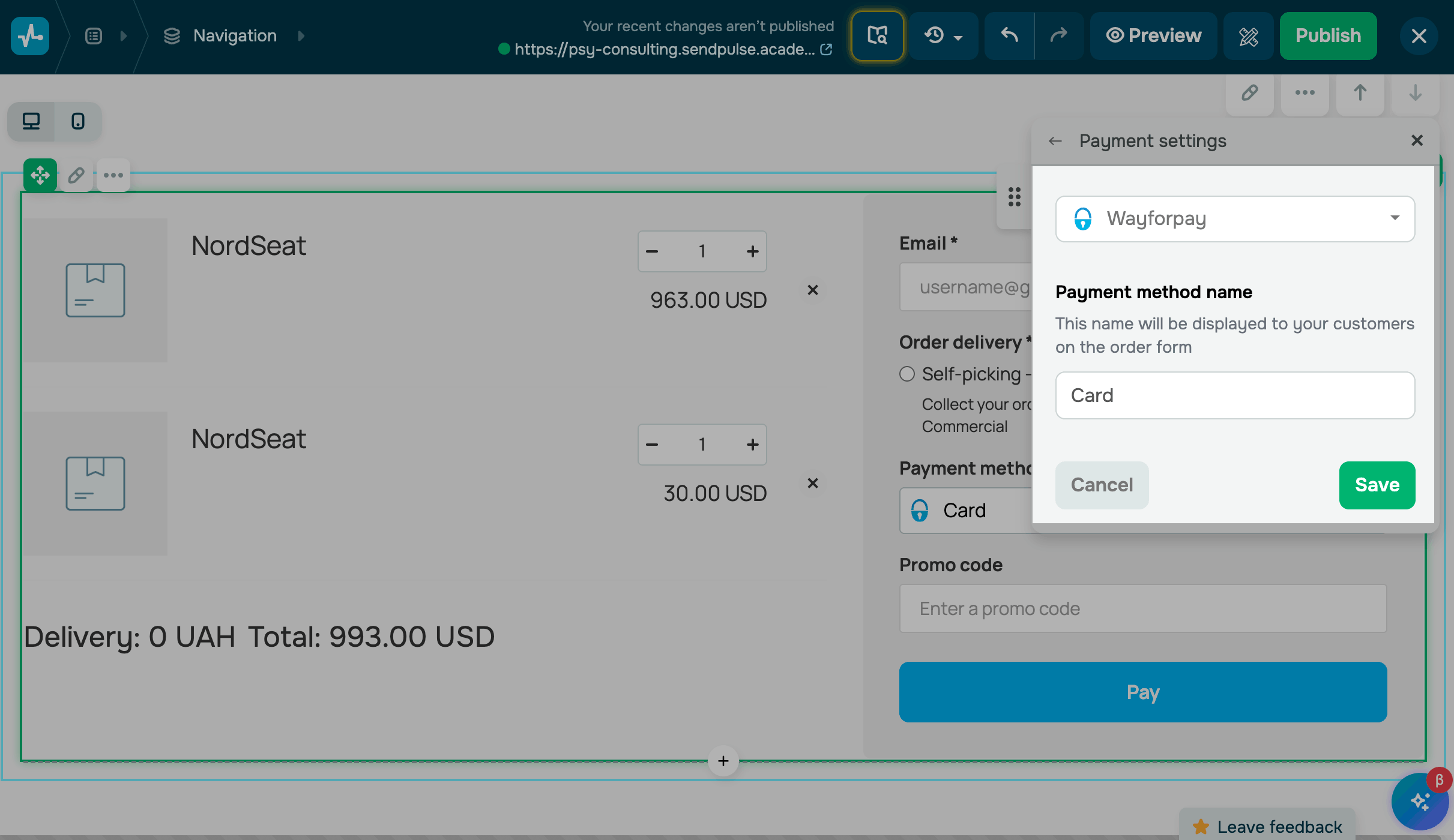
You can also enter a custom name for your payment method. Site visitors will see this name at checkout. In the Payment method name section, enter the name you want to display.
You can also redirect users to a specific page after payment confirmation. To do this, scroll down, and select the Additional Form Settings section. Select or enter the link to the page that should appear after payment confirmation.
During checkout, the system checks if your CRM products are in stock. If a product is out of stock or there are not enough items in stock, your customer will see a message saying their purchase cannot be completed. The product amount and total price in their order will be updated based on your current stock.
Add fields
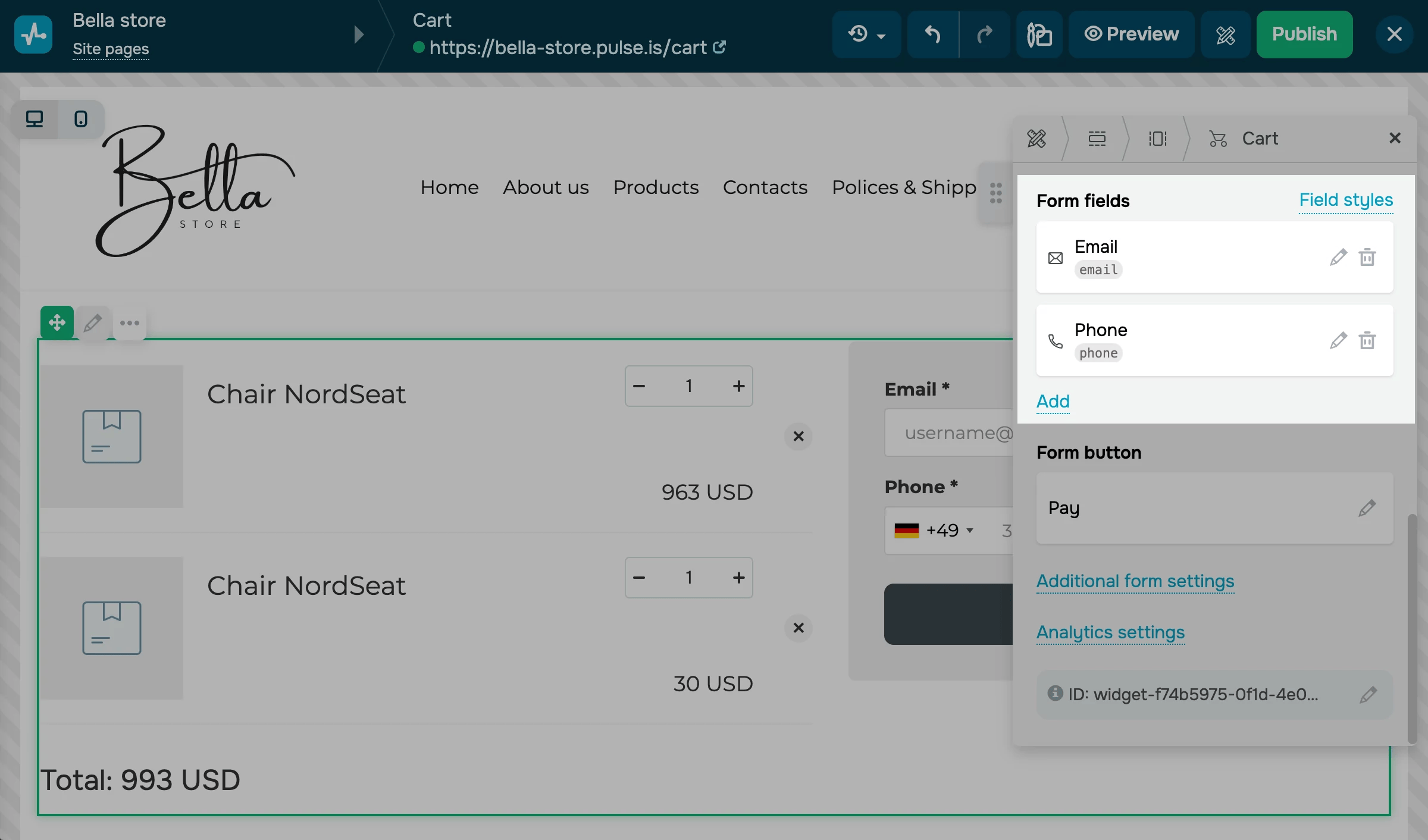
By default, your order form already includes the Email field which the system uses to identify customers across all SendPulse tools. You can also add your own fields to collect more information, including names, addresses, and phone numbers.
Click Add in the Form fields section. To configure a field, click the pencil icon next to it. Select a field type, enter its name and placeholder, and link it to CRM fields. You can also move and delete fields.
Read also: Which custom field types you can configure.
Integrate with other tools
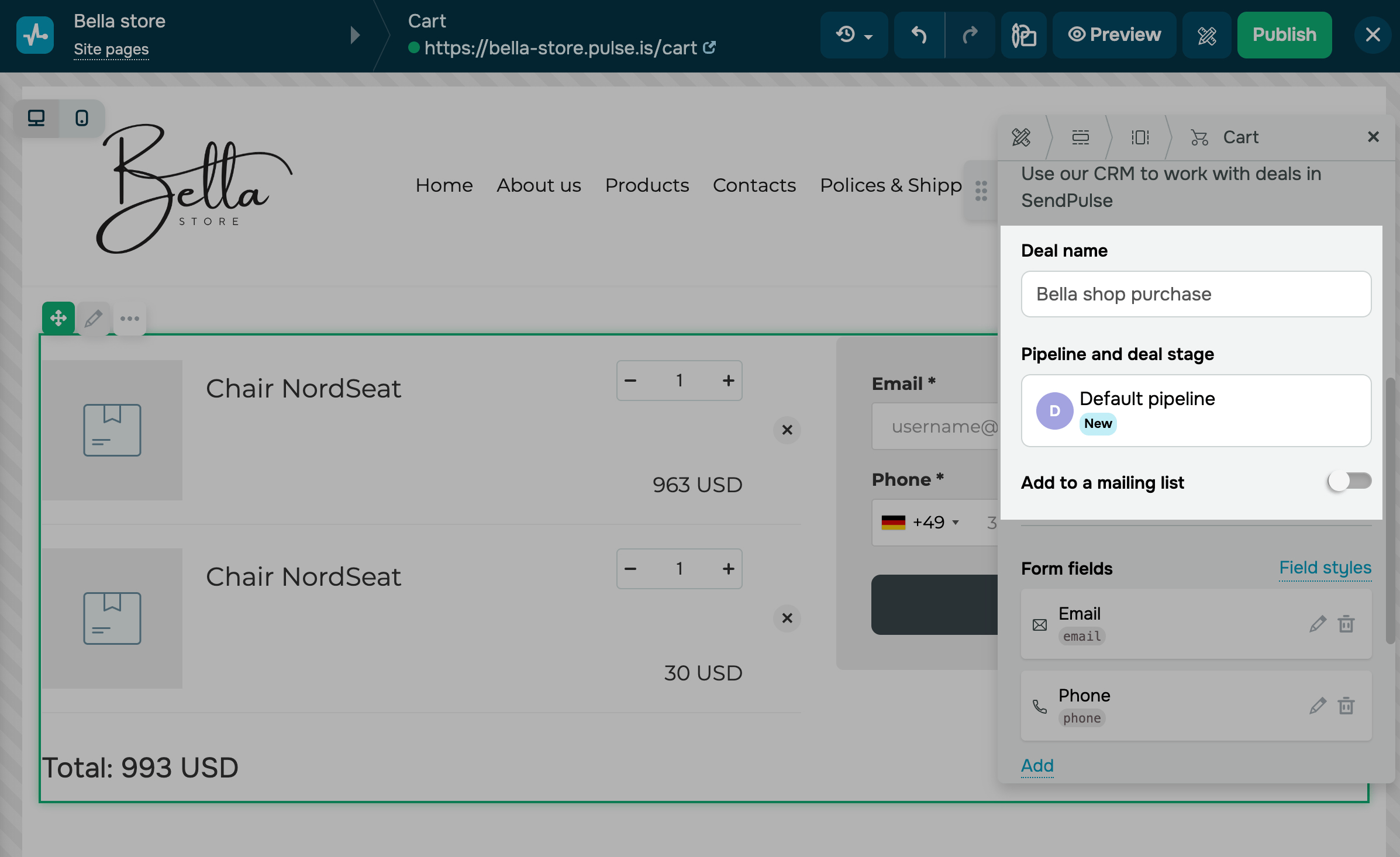
To integrate with the CRM system, enter a deal name, select a pipeline, and set the deal stage where your deal should be saved. When your website visitor places an order, a deal and contact will be created in the CRM system using the cart field data they entered, and their ordered product list will be added to the deal's comments.
To save contacts with specific CRM tags, turn on the Assign tag to a contact toggle and select the tags. The list includes all tags created across all pipelines and CRM system tabs.
You can also integrate with the Email section. Turn on the Add to a mailing list toggle, and select a mailing list.
Select a delivery option
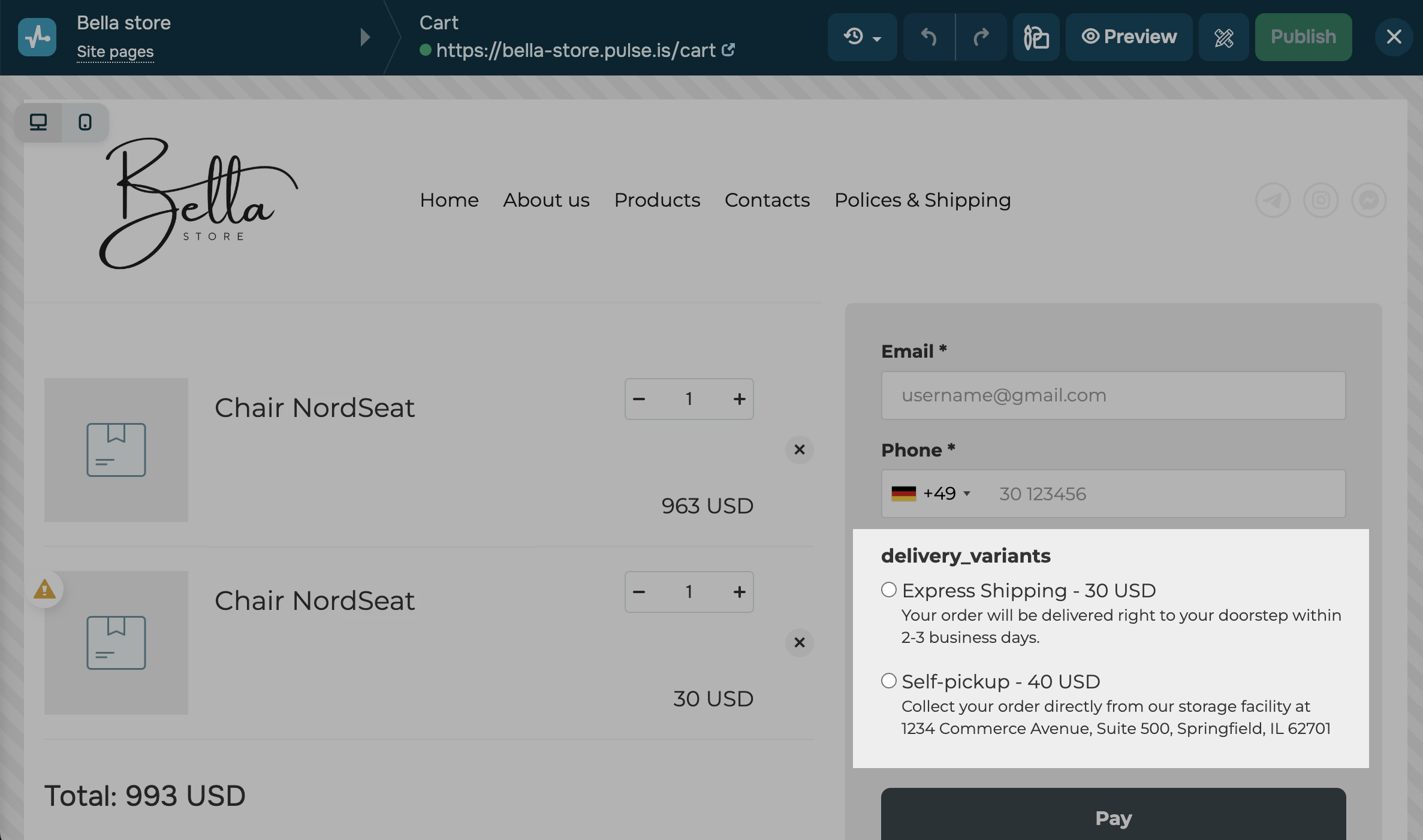
Once you add physical products to your online store settings, available delivery options will appear automatically.
If users add only digital products to their carts, no delivery options will be shown.
Customize the payment button
To customize the Payment button, click the pencil icon in the Button section. In the Text field, enter your button text, and in the Style field, select a button size and style. Primary and Secondary follow your general page style, while Custom allows you to set a text color, background color, border, and hover effects.
Add the post-checkout page
You can redirect users to a specific page after payment confirmation. Use payment pages to guide customers on their next steps.
To add a page, scroll down and select Additional form settings. Add the link to the page where users will be redirected after successful payments. You can also select a website page from the menu or add a chatbot link.
Read more: Create a page after successfull payment.
Add a promo code
You can allow users to apply promo codes from the CRM system at checkout, which helps offer discounts or bonuses.
Go to Additional form settings, turn on the Add a promo code field toggle, and decide which promo codes can be used.
In the Title field, enter the text that will appear above the field, such as "Apply a promo code." In the Placeholder field, enter the helper text that will appear within the field. In the Promo code field, choose one or more promo codes.
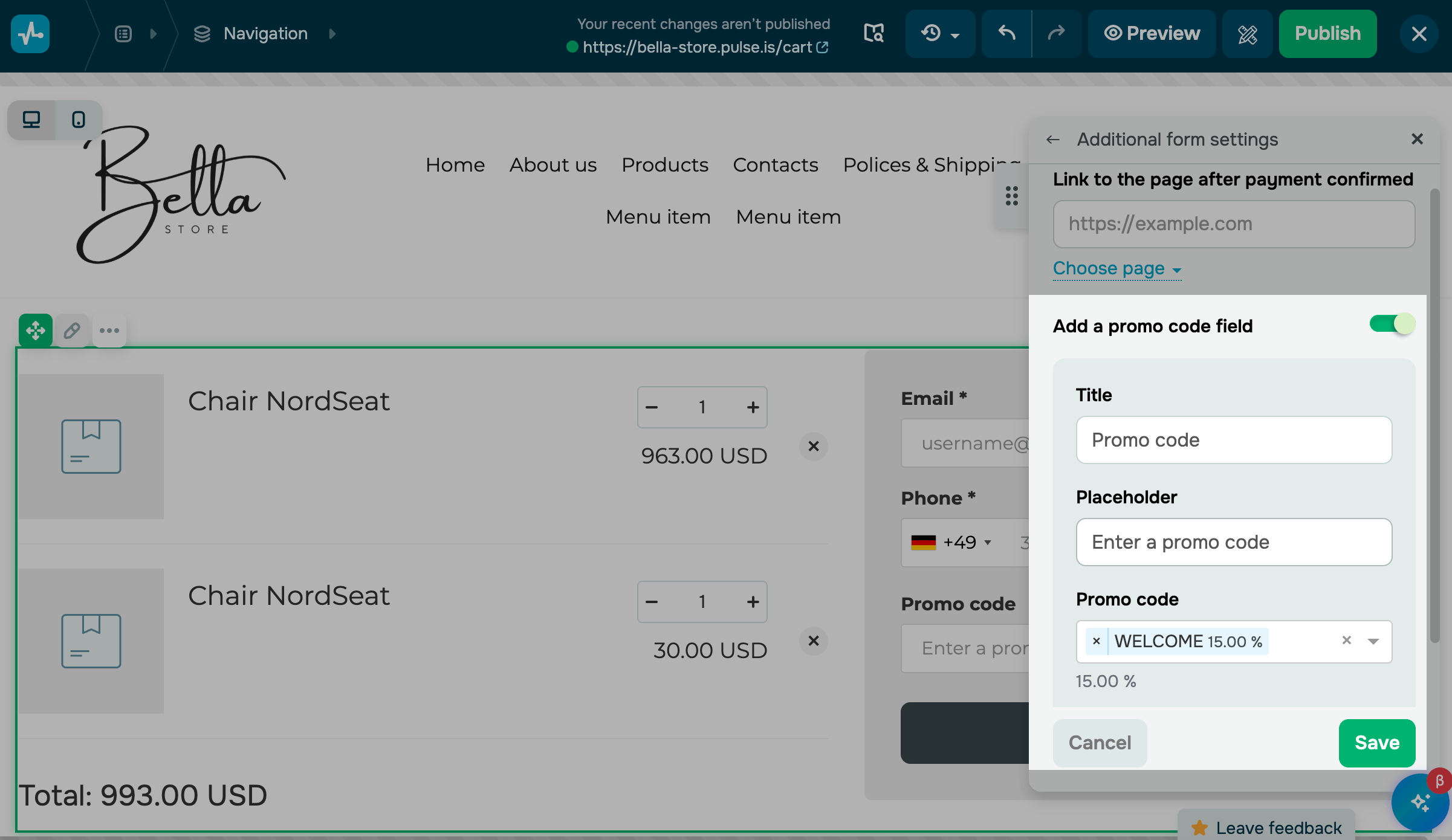
Once you publish your website, its payment form will include a field where users can apply promo codes. When they enter a promo code, the system will validate it automatically. If valid, the discount will be applied to the order total.
Set up analytics
You can transfer goals from your form to Google Analytics and Facebook Pixel events. Click Analytics settings.
Turn on the Transfer the goal to Google Analytics or Transfer the goal to the Facebook pixel toggle.
To complete your data transfer, add the Facebook pixel and Google Analytics code to your website settings. Read more: How to connect Google Analytics to your site and How to connect Facebook pixel to your site.
After you finish editing your cart page, click Publish.
 Last Updated: 29.10.2026


or