“WhatsApp gets a 98% open rate.” You’ve probably come across this statistic before. It’s one of the most persistent claims in marketing through messaging apps, yet it usually traces back to recycled vendor pages and listicles instead of transparent, large-scale data. More importantly, it says very little about the results most businesses actually get.
So we turned to our own data. We analyzed six months of broadcast campaigns from 1,166 top SMB accounts on SendPulse across three messaging channels that support broadcasting at scale: WhatsApp, Facebook Messenger, and Telegram. What we didn’t expect was that Messenger consistently outperformed WhatsApp on read rate — 75% vs 63% for a typical account and 81% vs 66% when weighted by sending volume. In other words, WhatsApp isn’t the default engagement leader many marketers assume it is.
This study puts the underlying numbers on the table. We compare delivery, read, and link click rates for all three messaging platforms, each reported as a per-account median and a pooled rate. Comparisons of this kind are rare since most benchmarks cover only one platform or just quote one number. Ours is a cross-platform view from a provider that runs broadcasts across all three.
One quick note before we move on to the findings: this study covers broadcast campaigns only. It doesn’t include chatbot flows, one-to-one support replies, or transactional and event-triggered template messages. We explain how we collected the data, discuss the study’s limitations, and clarify why we left Instagram out, which turned out to be an interesting finding on its own.
TL;DR Key findings from our SMB broadcast study
We analyzed the 1,166 highest-volume unique SMB accounts that use SendPulse to send WhatsApp, Facebook Messenger, and Telegram broadcast messages. Here’s a summary of what we found:
- Messenger consistently achieves higher read rates than WhatsApp. The median read rate, which is the best benchmark for a typical SMB, is 75% on Messenger compared to 63% on WhatsApp. Weighted by sending volume, the gap grows to 81% versus 66%. Even when we use messages sent instead of delivered as the denominator for a stricter comparison, Messenger still leads at 68% versus 62%. No matter how we calculate it, the result is the same.
- Volume-weighted averages don’t tell the whole story. WhatsApp’s pooled click rate is 8.3%, but the median account records just 0.6%. A few high-volume senders raise the pooled rate far above what most businesses see, which explains why published industry averages often don’t match your results.
- Telegram operates at a completely different scale. Over six months, the top 500 Telegram accounts sent 2.2 billion broadcast messages, compared to 8.4 million on WhatsApp, roughly 260 times fewer. Still, that’s not a sign that one platform outperforms the other. It points to how businesses typically use them. Telegram is primarily used for very large audiences, whereas WhatsApp is where businesses tend to reach smaller, higher-intent subscriber lists.

Power up your business with smart tools
From solo creators to global brands, thousands of customers trust SendPulse to run email campaigns, chatbots, automations, and more — all in one place.
Get started for free
How we gathered and interpreted data
These benchmarks are based on six months of SendPulse broadcast data collected between November 2025 and April 2026. We extracted the 500 highest-volume small and medium-sized business (SMB) accounts per messaging platform on WhatsApp, Facebook Messenger, and Telegram.
Then, we filtered the dataset to include only accounts that sent at least 1,000 broadcast messages and where delivered messages did not exceed sent ones. Together, these filters removed about 35% of Messenger records and 29% of WhatsApp records.
The final dataset consists of 355 WhatsApp, 325 Messenger, and 500 Telegram account records, respectively, 1,180 datasets across 1,166 unique businesses, as 14 companies used two apps for broadcast campaigns. All datasets are fully anonymized, with no business identifiers, contact information, or industry-level breakdowns.
Before we get to the results, there are two more concepts worth breaking down: the three metrics we measure and the two ways we report them.
We calculate every metric the same way across all three apps. Delivery rate is the percentage of sent messages that were delivered. Read rate is the percentage of delivered messages that were opened. Click rate is the percentage of delivered messages that generated a click on a personalized SendPulse-tracked link. One important limitation: button clicks, such as quick replies and URL buttons, aren’t measured consistently across messaging platforms yet, so overall engagement is likely underreported, particularly on WhatsApp and Messenger.
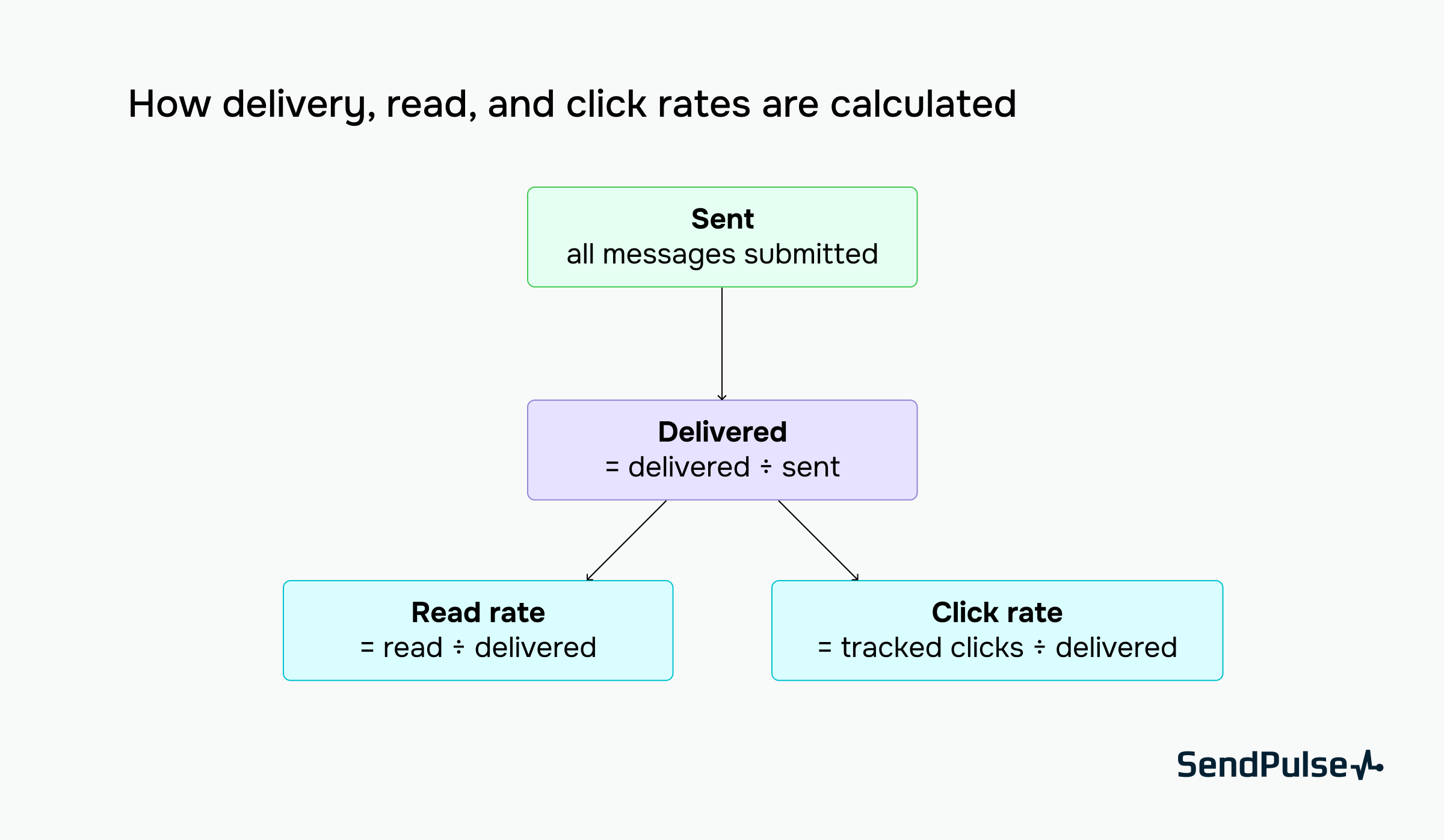 The same method applies to all three messaging channels
We also report each rate in two different ways. Pooled rate combines all messages across every account into a single platform-wide rate, giving more weight to higher-volume senders. Per-account median calculates the rate for each account individually and reports the middle value, showing what a typical business is more likely to experience.
The gap between the pooled and median rates comes down to one thing: how evenly broadcast volume is distributed across accounts.
Messenger is the clearest example of this. A handful of businesses account for most of the platform’s broadcast volume — the highest-volume sender alone broadcasts about 29% of all messages, while the top five account for roughly 57%. When those few high-volume accounts have different read rates from the rest, the pooled read rate can shift noticeably, even if most businesses don’t see the same pattern.
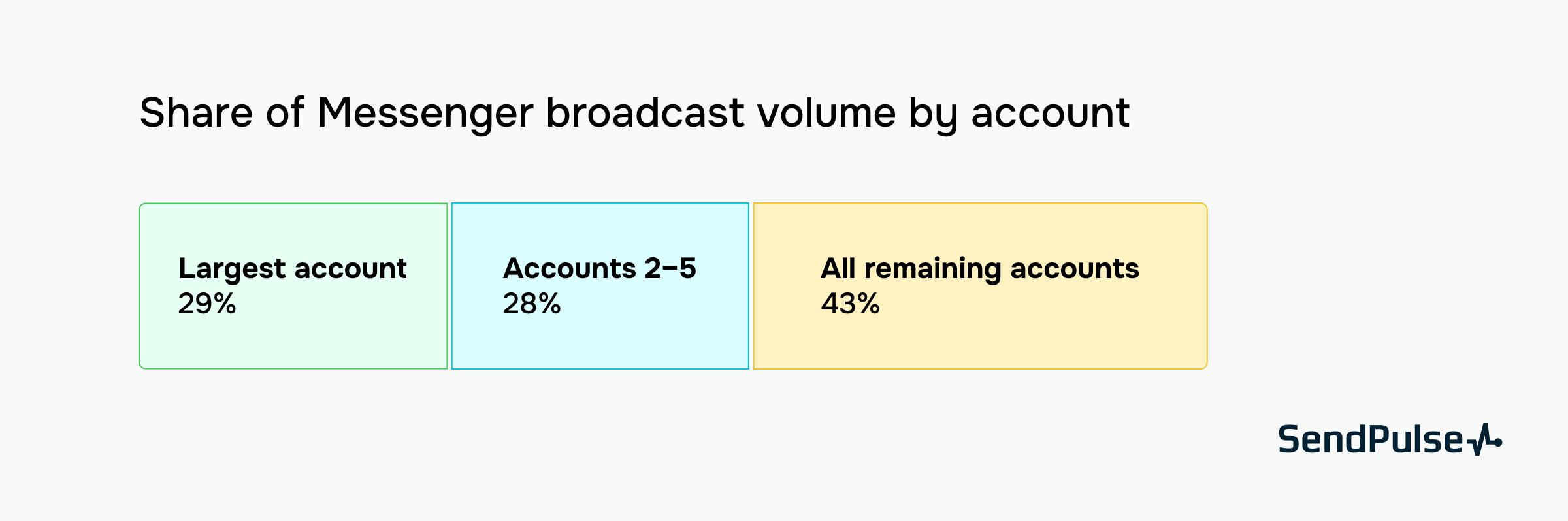 Most Messenger broadcast volume comes from the top five accounts
That’s why we report both rates throughout the study. The median represents the results of a typical account, while the pooled rate reflects overall messaging performance in a given app. As a robustness check, we also measure the read rate against messages sent.
One result is easy to misinterpret. Messenger’s pooled delivery rate is about 84%, while its median delivery rate is close to 98%. That doesn’t mean most Messenger campaigns struggle with deliverability. Instead, it’s driven by a small number of high-volume senders that account for much of the platform’s volume and show lower delivery rates. For a typical Messenger account, delivery remains close to 98%.
Telegram is a special case. Its Bot API counts every sent message as delivered and doesn’t expose read receipts for chatbot messages. As a result, we report a 100% delivery rate as a platform characteristic and mark the read rate as N/A.
Read rate is where the popular “WhatsApp has the highest engagement” assumption breaks down. We measured it in two ways for every messaging platform: as a per-account median and as a pooled rate. Messenger came out ahead of WhatsApp on both.
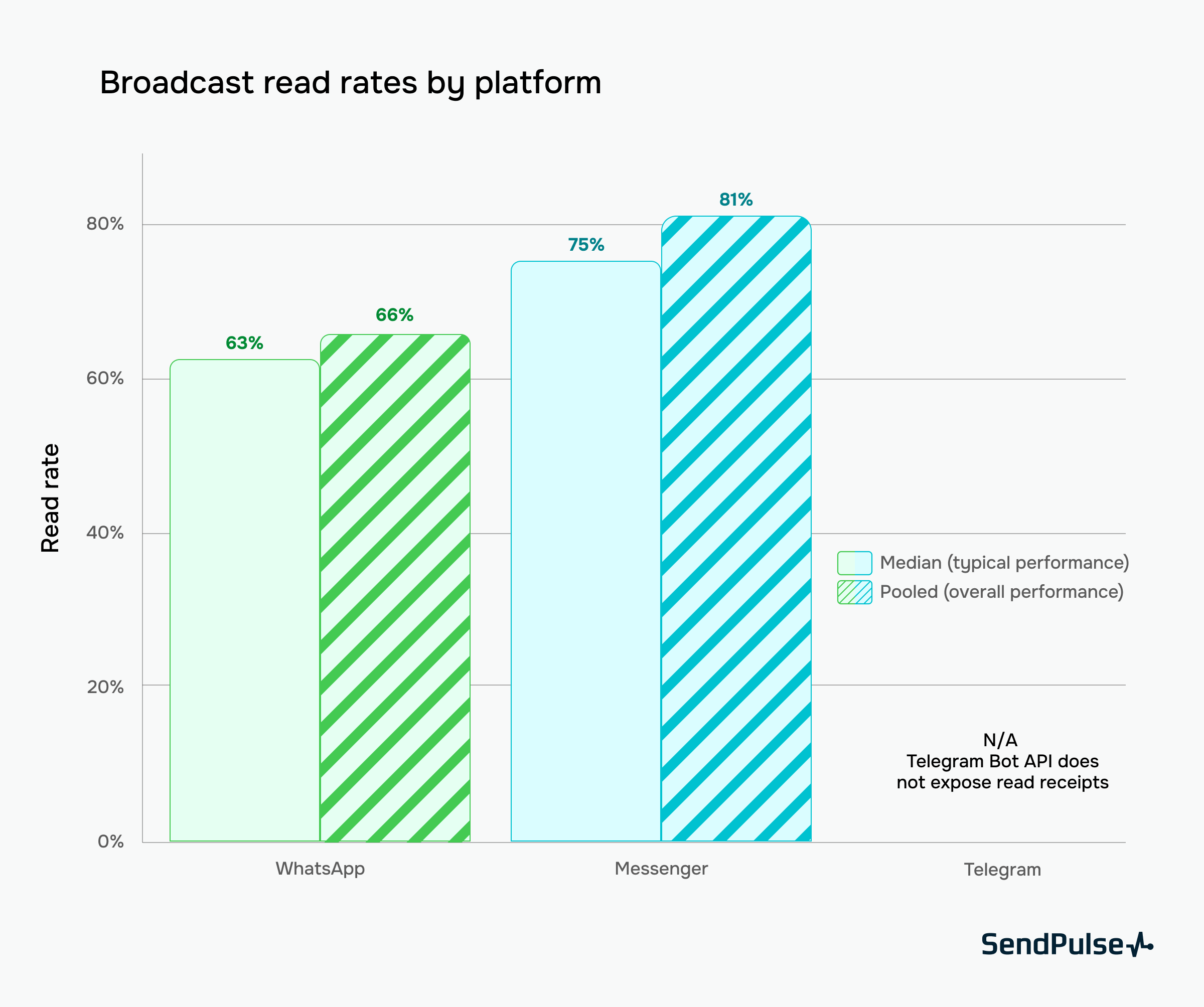 Messenger read rates beat WhatsApp on a typical account
The difference is substantial. The median read rate reaches 75% on Messenger compared with 63% on WhatsApp. Looking at all delivered messages instead, the gap widens to 81% (from Messenger’s pooled dataset of 233 million delivered messages) versus 66%.
Because the pooled read rate uses delivered messages as its denominator, it’s especially sensitive on Messenger. So we also measured read rate against messages sent instead of delivered. Messenger still came out ahead, 68% versus 62%. The gap shifts depending on the method, but the overall result does not change.
The WhatsApp numbers deserve a closer look, too. A 63% median read rate (or 66% pooled) is still strong, but it’s nowhere near the widely cited 98% open rate. That headline figure comes from a very different, largely undocumented methodology. Our own study, based on over a thousand SMB accounts, paints a more realistic picture of actual broadcast performance.
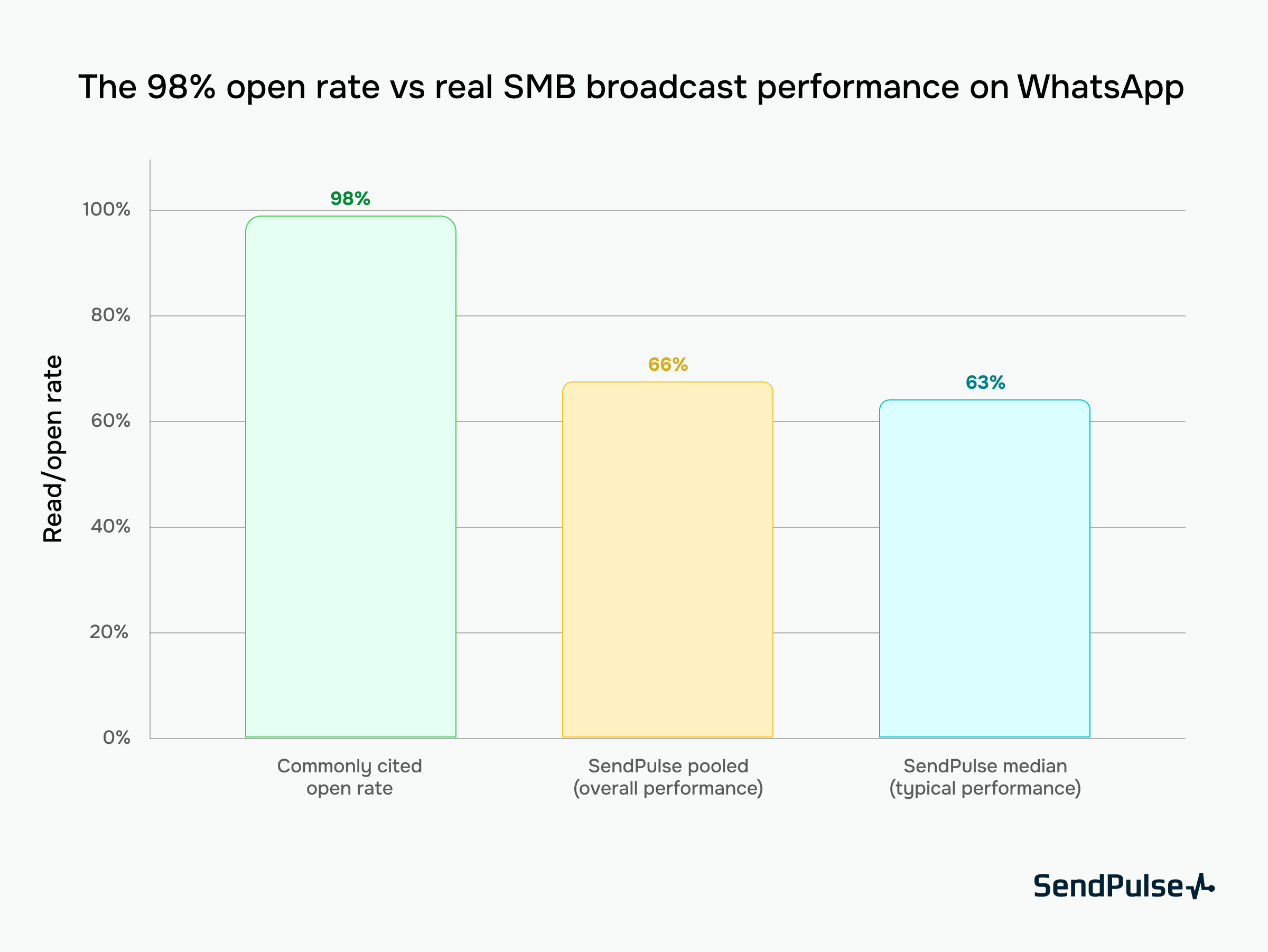 The widely cited 98% doesn’t match SMB broadcast performance on WhatsApp
So why does Messenger have a higher read rate? We can’t prove it from these datasets since we’re comparing different groups of businesses, not the same audience across messaging apps. Still, a few factors likely play a role.
In our sample, Messenger broadcast campaigns typically reach people who already have a direct, active relationship with the business, like Page followers or recent chat participants. WhatsApp subscriber lists, though usually smaller and more intentional, often grow from one-time interactions, say, an order or booking, and don’t always turn into ongoing conversations. As a result, businesses on WhatsApp may broadcast to customers who haven’t engaged with them recently. Messenger also benefits from being part of Facebook, an app many people open multiple times a day, which makes broadcasts more likely to be noticed.
However, these are informed hypotheses. Some of the differences may simply come down to the types of businesses that choose each messaging app in the first place.
None of this means you should swap WhatsApp for Messenger. Read rate tells you whether a broadcast message got seen, but it gives you no clue about the sales, leads, or other outcomes it drove. It also doesn’t capture the conversational and transactional use cases where WhatsApp performs particularly well. What our study does show is that WhatsApp’s engagement advantage is far less universal than it’s often presented.
Industry averages don’t tell the whole story
If there’s one takeaway that can help you benchmark your own campaigns, it’s this: the headline average is rarely the number you should compare yourself against. The graph below demonstrates why.
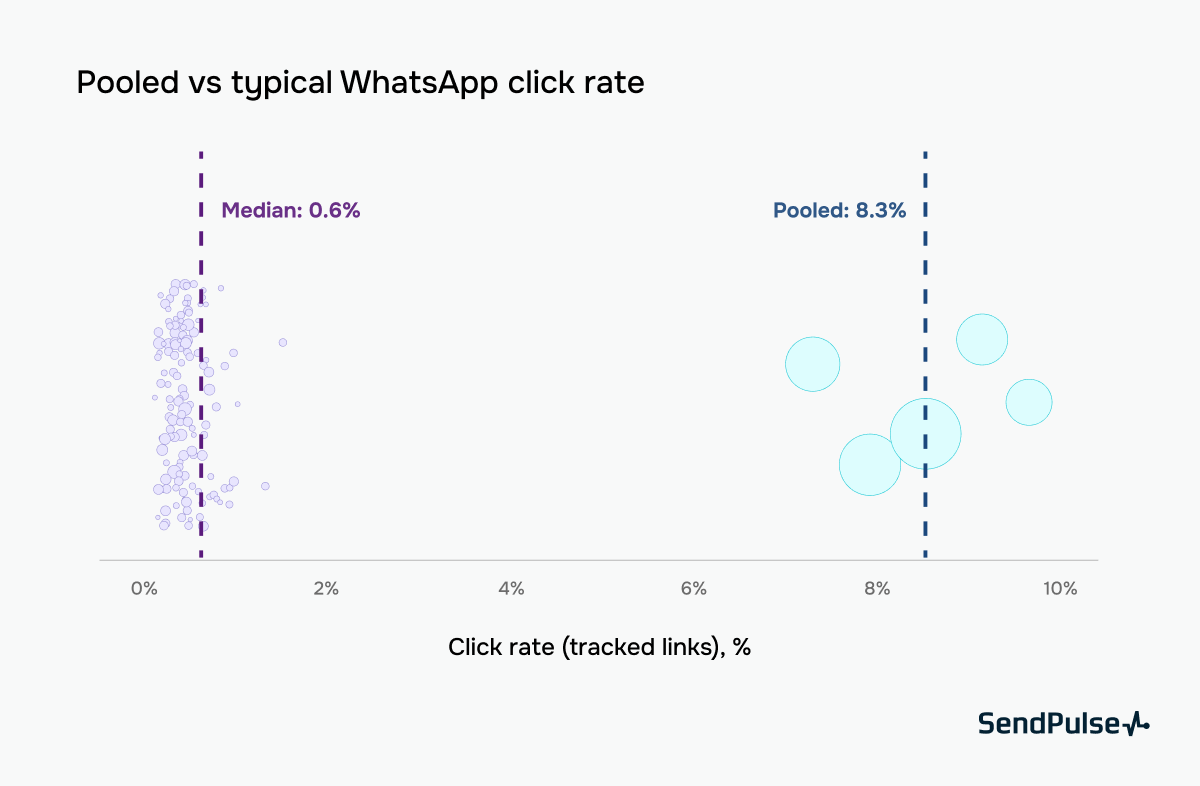 Illustrative spread (the 0.6% and 8.3% endpoints are real) to show that the pooled WhatsApp click rate doesn’t reflect a typical account
The pooled WhatsApp click rate is 8.3%, while the median account records just 0.6% — a difference of around 14 times. That’s not a calculation error. A small number of high-volume accounts carry much more weight in the pooled rate, so their performance pulls the platform average far above what most businesses achieve. Each point in the graph represents one account, and its size indicates the broadcast volume. Most businesses cluster near the lower end, while a few large senders lift the pooled rate.
Messenger follows the same pattern, although at lower rates: a 0.8% pooled click rate against a 0% median. In fact, more than half of the Messenger accounts in our sample didn’t record a single tracked link click.
So when you read about an “average WhatsApp click rate” in a marketing article, it’s almost always a pooled, volume-weighted figure that reflects overall platform performance. Unless you’re sending at the same scale as the largest accounts, expect your results to be much closer to the median.
WhatsApp and Messenger both have the pooled rate sitting above the median. Telegram indicates a different trend.
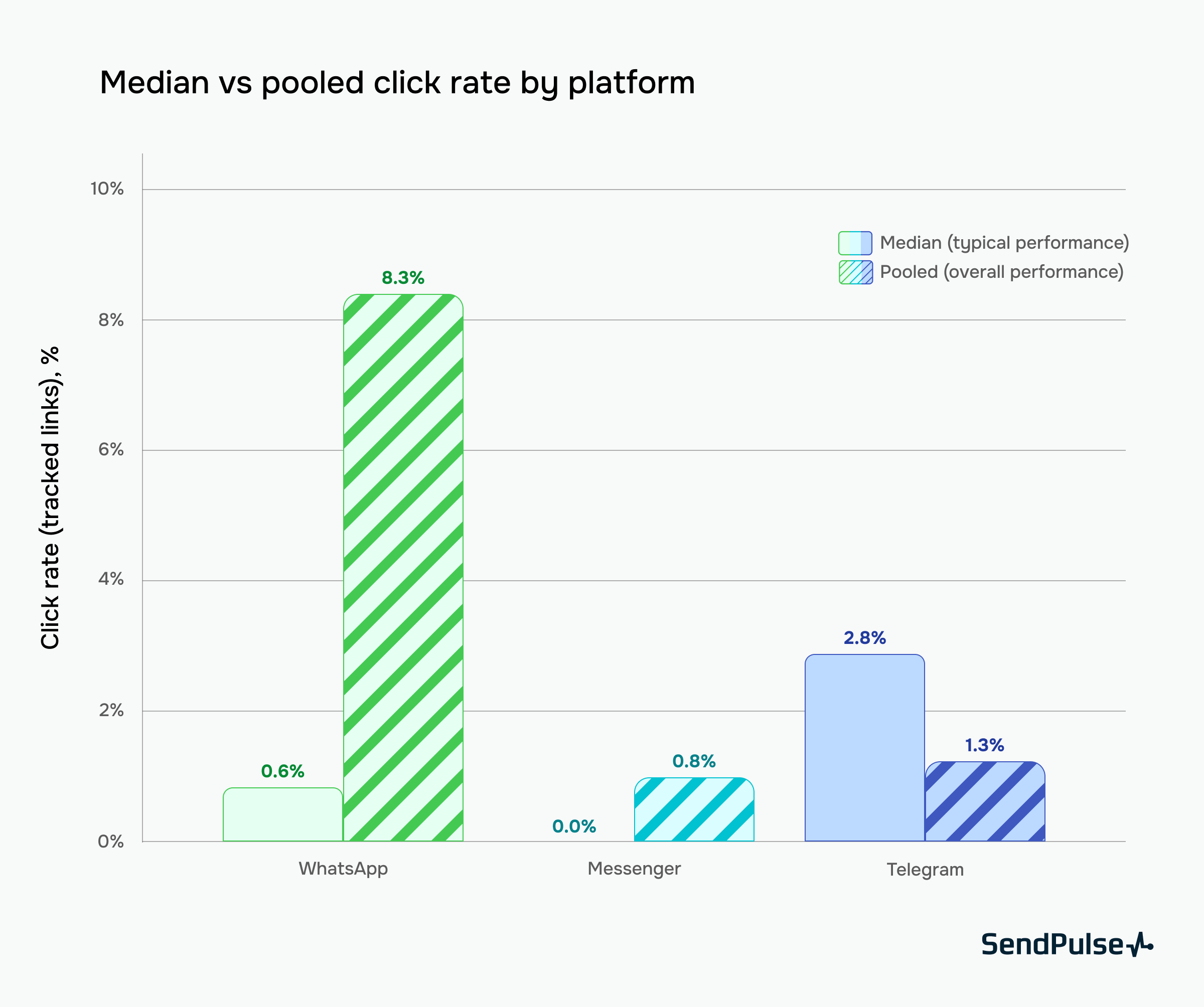 Telegram’s typical account beats its average on click rates
Telegram’s pooled click rate is 1.3%, while the median reaches 2.8%. This means a typical Telegram account outperforms the platform-wide average. That’s because high-volume broadcasters tend to generate fewer clicks per delivered message than lower-volume ones. This pattern matches the overall picture in our dataset, where businesses primarily use Telegram for mass broadcast campaigns.
Whether the pooled rate ends up above or below the median, the conclusion is the same. If you’re benchmarking your own performance, use the median. Pooled industry averages mostly mirror the platform’s highest-volume senders, which might not be your case.
So far, we’ve looked at performance. Now, let’s examine broadcast volume, which shows how businesses actually use each messaging app. The differences are dramatic — in fact, the gap is so wide that the graph below uses a logarithmic scale, where each gridline indicates a tenfold increase.
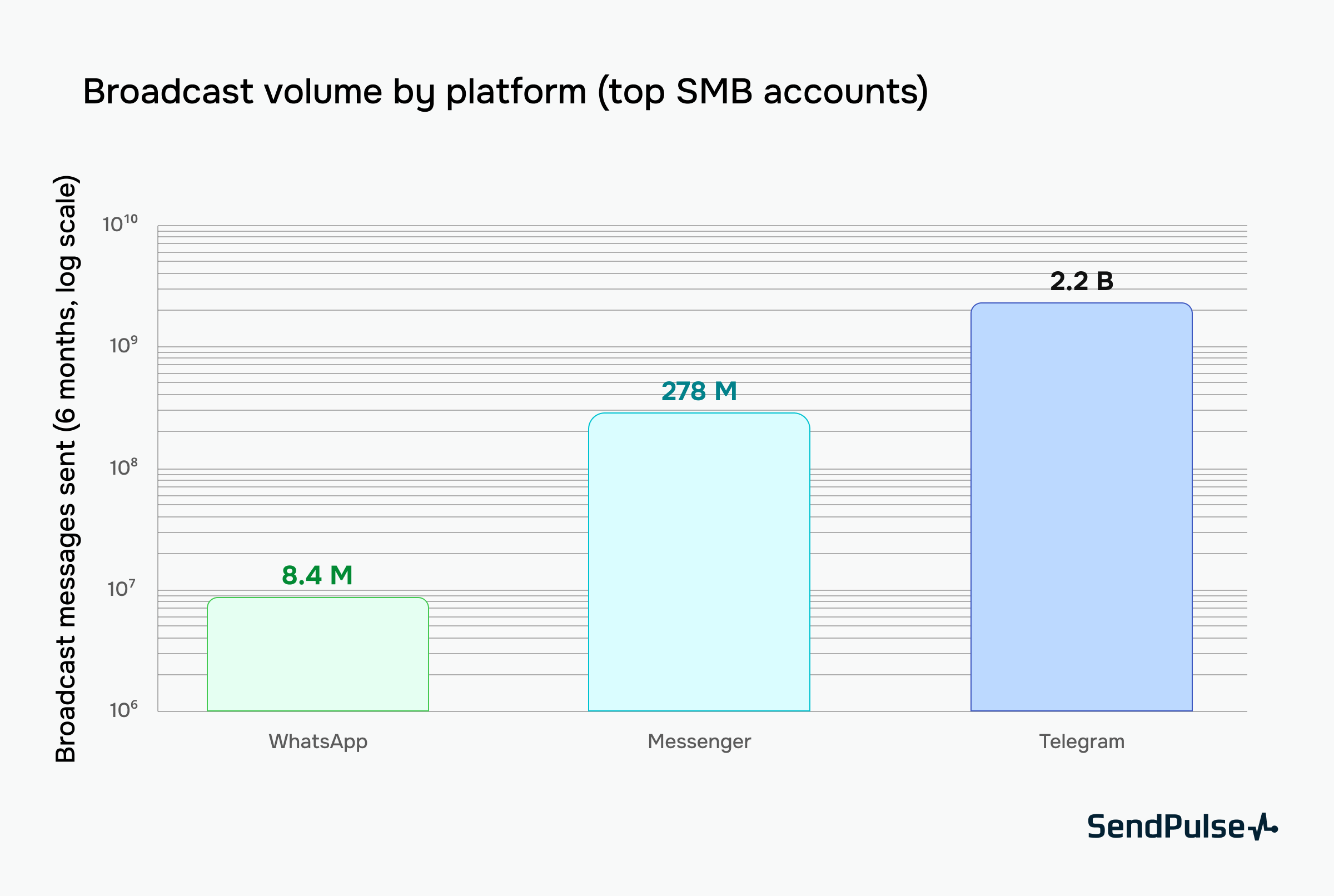 Telegram broadcasts at roughly 260× WhatsApp’s volume
Telegram is in a class of its own. In our dataset, the top 500 Telegram accounts sent 2.2 billion broadcast messages over six months. By comparison, the top 325 Messenger accounts sent 278 million, and the top 355 WhatsApp accounts sent 8.4 million, which is roughly 260 times fewer than Telegram. These numbers point to the fact that businesses use each messaging platform for different types of communication.
- Telegram is an app for mass broadcasting. Many public channels have hundreds of thousands or even millions of subscribers who receive news, media updates, or other broadcast-style content. Low messaging costs, high throughput limits, and a subscription-based opt-in model make Telegram a good fit for this purpose.
- WhatsApp is mainly used for high-intent customer communication. Businesses typically use it for smaller, curated subscriber lists. Many of its valuable uses, such as order updates, appointment reminders, and support follow-ups, are transactional or event-triggered, so they fall outside this broadcast dataset. On top of that, Meta’s pricing model and messaging limits make mass broadcasting less common on WhatsApp than on Telegram.
- Messenger strikes a balance between scale and engagement. It supports meaningful broadcast volume and has the highest read rates in our dataset. This makes it a strong choice for businesses that want to reach many people without sacrificing visibility.
What this tells us is that volume, engagement, and business impact each measure different aspects of performance. A messaging app can lead in one area without leading in any of the others. Take WhatsApp as an example: in our study, businesses send the fewest broadcast messages using this platform, but it can still generate the highest revenue per message, depending on the use case.
Why Instagram doesn’t belong in this comparison
Originally, we were going to include Instagram in this study. However, after reviewing the platform’s messaging rules and our own data, we chose not to. As a matter of fact, this decision says a lot about Instagram’s unique role as a messaging channel.
Unlike WhatsApp, Messenger, and Telegram, Instagram has much stricter limits on business messaging. In most cases, a business can only message someone within 24 hours of their last message, except for a few Meta-approved notification types. These rules are designed to support conversations, not mass outreach, so running high-volume broadcast campaigns like on Telegram or WhatsApp is basically impossible.
Our data reflects that. We reviewed 447 SendPulse-powered SMB accounts using Instagram, but only 64 accounts (about 14%) sent at least 1,000 broadcast-style messages during the same six months. The remaining 86% sent fewer, often far fewer, because the platform simply doesn’t allow the same kind of broadcasting other messaging apps do.
The numbers we did collect are still interesting. Across these 64 accounts, Instagram recorded a 70% median read rate and a 61% pooled read rate. Still, these numbers represent follow-up conversations within Instagram’s 24-hour messaging window, not the broadcast campaigns we compare in this study. Putting them alongside WhatsApp, Messenger, and Telegram would imply a like-for-like comparison that simply isn’t the case.
So, think of Instagram as a platform for one-to-one conversations and triggered messages: abandoned cart follow-ups within the 24-hour window, Story reply automations, or replies to Click-to-DM ads. These are valuable use cases; they just deserve their own benchmarks instead of being compared to broadcast-first platforms.
Curious how to actually set those up? Our guide to Instagram automation walks through Story-reply bots, Click-to-DM flows, and cart follow-ups from scratch.
What this SMB broadcast study doesn’t cover
Like any dataset, this one has its limits. Some details are missing either because of how we collected the data or because we don’t yet have the tools to track them. Case in point: we don’t report reply rates since they aren’t tracked consistently across WhatsApp, Messenger, and Telegram. We also exclude conversational chatbot flow performance (completion rates, drop-off, and fallback triggers) because this study focuses exclusively on broadcast campaigns. Lastly, we don’t break the results down by industry or region because it requires account tagging that isn’t yet available.
The biggest limitation is not what we measure, but who we measure. Most businesses in our dataset use only one of the three messaging platforms, and only 14 send broadcasts on two. Without these industry labels, we can’t adjust for differences in audience, content, or business type. In the end, the higher read rates we observe on Messenger might be due to the platform itself, or they can reflect the types of businesses that prefer Messenger over WhatsApp or Telegram.
In other words, this study gives a clear picture of how broadcast campaigns perform on SendPulse right now. It’s not a controlled experiment where the same businesses send the same content across multiple messaging channels.
How to apply these findings
Here are a few practical takeaways from the data:
- Use the medians from this broadcast study as your baseline. A typical small or medium-sized business sees read rates of about 63% on WhatsApp and 75% on Messenger, while link click rates span around 0.5–2%.
- Don’t overlook Messenger if you already have an engaged Facebook audience. It showed the highest read rates in our dataset, probably because broadcasts go to people who have recently interacted with a business or have chosen to hear from it. If you’ve invested in growing your Facebook Page, Messenger broadcast campaigns may be one of the most overlooked tools in your marketing strategy.
- Use Telegram for effective broadcasting. It led in broadcast volume with 2.2 billion messages in six months, but that doesn’t always mean more engagement per message. In fact, the typical Telegram account achieved a 2.8% click rate, compared with a 1.3% pooled rate, which suggests that smaller broadcasters often do better than the largest ones. Telegram may not be that popular in some Western markets, but it’s a strong choice for broadcast messaging if your audience uses it regularly.
- Add tracking tags to your links. Some accounts in our dataset recorded zero tracked clicks, not because their campaigns failed, but because they used untagged URLs. Without tracked links, you can’t tell how your WhatsApp bulk messaging is actually performing or improve your future campaigns.
You don’t need a higher budget or a new platform to follow these tips. All it takes is using your own data and industry benchmarks more thoughtfully.
The bottom line
The most important takeaway is to benchmark against the median rather than the industry average. A few high-volume senders can significantly skew averages, which makes the median a more reliable point of comparison.
Just as a single benchmark doesn’t tell the whole story, neither does a single study. This one covers broadcast performance across WhatsApp, Messenger, and Telegram. So we’re already working on a more complete one: a cross-platform study that will also include chatbot flow data, coming in Q4 2026.
These broadcast benchmarks may be cited with attribution and a link to SendPulse.
FAQ
What's a good WhatsApp open (read) rate for a small business?
Somewhere in the 60–70% range is standard. Across our 355 WhatsApp SMB accounts, a typical account gets about 63% of its broadcasts read; counting every message across all accounts together, it works out to 66%. The much-quoted “WhatsApp’s 98% open rate” comes from a different, mostly unsourced way of counting, and almost no real SMB account actually hits it.
What is the click-through rate for WhatsApp?
For clicks on tracked links, something in the 0.5–2% range is standard for a typical account — our per-account midpoint was 0.6%. When weighted by sending volume, pulled up by a handful of massive senders, it’s much higher — 8.3%, but that isn’t a realistic target for most businesses.
Is it better to use WhatsApp or Messenger for broadcast campaigns?
It depends on what you’ll use each platform for and where your audience already is. In our broadcast data, Messenger has higher read rates than WhatsApp: 75% versus 63% for a typical account. It works best for recently engaged Page followers and chat participants, while WhatsApp is a strong option for transactional and one-to-one commerce.
Where do these benchmarks come from?
SendPulse’s own anonymized broadcast campaign data: 1,166 SMB accounts across WhatsApp, Messenger, and Telegram, each sending at least 1,000 messages between November 2025 and April 2026. Full methodology is in the study above.