You may have heard about WhatsApp’s 24-hour customer-service window. Once 24 hours have passed since a customer’s last message, you can’t simply ping them with a casual “How are you?” to restart the conversation. You need an approved WhatsApp message template.
Here is the good news. WhatsApp templates are no longer “non-promotional only.” Marketing is allowed too, as long as it meets Meta’s requirements. But not every message qualifies.
In this guide, we’ll break down the three WhatsApp template categories, namely marketing, utility, and authentication, and explain when to use each. Next, we’ll dive into Meta’s approval process and look at rejection fixes. Most importantly, you’ll learn how to submit your template and get it right on the first try.
Key takeaway: Getting a WhatsApp template approved
- Every template belongs to one of three Meta categories (marketing, utility, or authentication), and your content must match the one you choose. If your content doesn’t match the category, Meta may switch the template to the appropriate one.
- Templates can be submitted through WhatsApp Manager, Meta Business Suite, or a Business Solution Provider like SendPulse, but Meta reviews and approves them in every case.
- Approval usually takes a few minutes. In some cases, the review process can take up to 24 hours. Rejections can be fixed by checking Meta’s reason, correcting it, and resubmitting.
- Approved templates get an ongoing quality rating (green/yellow/red); repeated negative feedback can pause or disable them.

Engage users on WhatsApp
Use our drag-and-drop builder to create AI-powered WhatsApp chatbots that sell, support, and connect. Run campaigns, share updates, and convert leads hands-free.
Get started for free
What is a WhatsApp message template?
A WhatsApp template is a pre-made, Meta-approved message businesses use to contact customers after the 24-hour messaging window expires. Your WhatsApp Business API provider may help you submit templates, but it’s Meta’s job to review and approve them.
By requiring this approval, Meta successfully limits unwanted or misleading communications. It also helps customers distinguish expected updates and offers from unsolicited messages.
Every template is built from the same basic parts: a category, a language, variables for personalization, and optional buttons that can link to your website or event. You can also add an image, file, or video, plus a footer.
Why it matters: WhatsApp templates give you a structured way to reach customers with relevant, predictable messages, from order updates and appointment reminders to marketing offers and login codes. No need to write every message from scratch — you can prepare and get common messages approved in advance.
WhatsApp template categories you need to know in 2026
As of 2026, every WhatsApp message template must belong to one of three categories defined by Meta: marketing, utility, or authentication. The category determines what kind of message you can send, and it’s up to Meta to decide whether yours fits the criteria. Let’s look at what each category covers, when to use it, and how to choose the right one for your use case.
Utility template
Utility templates are for messages that carry specific, non-promotional information about a particular transaction, order, account, or service interaction. They’re usually triggered by something the customer has done or an event that affects them.
This category is intended for order confirmations, shipping updates, payment notifications, appointment reminders, and account alerts.
Use case: An eCommerce business notifying a customer that their order has been dispatched.
Example: Your order #45821 has been shipped! Your package is expected to arrive on November 8. Track its progress here: [tracking link]
What utility WhatsApp templates aren’t: A way to sneak promotional content into transactional messages.
Marketing templates
Marketing templates are for texts that promote your business, encourage purchases, or bring customers back. They aren’t limited to discounts or sales pitches – product announcements, newsletters, special offers, and abandoned cart reminders all fall into this category.
Marketing templates come with per-message pricing and stricter quality monitoring. You must obtain clear, purpose-specific consent beforehand, and if your templates receive poor feedback, Meta may limit delivery.
Use case: An online store reminding a customer about products they added to their cart but haven’t purchased.
Example: Still thinking about those running shoes? Your favorites are waiting in your cart. Complete your order today and find the perfect fit for your next run: [store link]
What marketing WhatsApp templates aren’t: limited to hard-sell discounts. Product news, re-engagement, and even mixed-content or unclear messages can qualify as marketing.
New in 2026:
WhatsApp’s pricing changed on October 1, 2026. Service messages and in-window utility templates are now billable, while marketing and authentication templates stay charged per message. If budgeting matters for your campaigns, check out our full breakdown of the WhatsApp service message pricing changes.
Authentication templates
Authentication templates are used to verify a customer’s identity or confirm that they have access to a particular account, service, or device. Their most common use is sending one-time passwords (OTPs) during login, account registration, or password recovery.
Unlike the previous two categories, authentication templates have strict formatting requirements. They must contain a verification code and can include an optional copy-code button. No URLs, promotional content, or unrelated text are allowed.
Use case: A SaaS company sending a one-time password (OTP) when a customer logs in to their account.
Example: Your verification code is 847291. Don’t share this code with anyone.
What authentication WhatsApp templates aren’t: General account notifications, security advice, or updates — those are more likely to fall under utility instead.
How to create and get your WhatsApp template approved, step by step
First things first, there is more than one way to submit your templates for Meta’s review. You can create and submit them directly through WhatsApp Manager or Meta Business Suite, or use a Business Solution Provider that usually gives you an intuitive environment to create and manage templates, so you don’t have to navigate Meta’s tools and API requirements on your own.
To demonstrate each step in practice, we created and submitted a real utility template in SendPulse, an official WhatsApp Business Solution Provider, for Maple & Co., a made-up online store. It’s a shipping update with the order number, delivery date, and a “Track order” button. All the screenshots in this walkthrough are from that template.
To follow our steps, go to the “Chatbots” section, select your WhatsApp chatbot, open the “Templates” tab, and click “Add template.”
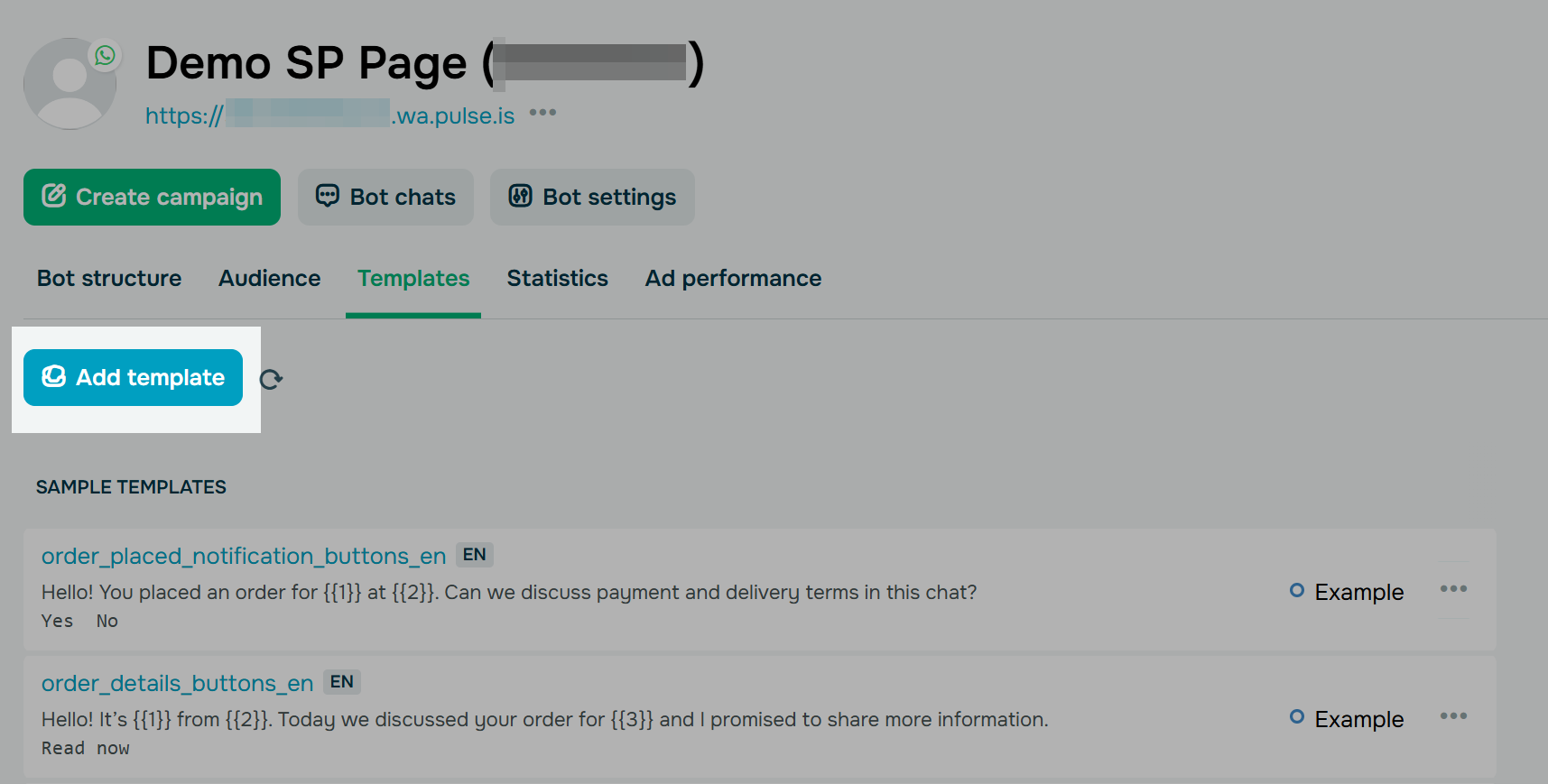 Opening the “Templates” tab to add a new template
Step #1. Choose the right category
Before writing your message, specify your goal. Are you updating a customer about an existing order or appointment (utility), encouraging them to make a purchase or return to your store (marketing), or verifying their identity (authentication)?
Choose the category based on the message’s actual purpose — not on the label that “will make approval easier.” Meta looks at what your message says and why you’re sending it, so your content must match the selected category.
In SendPulse, you select either “Marketing” or “Utility” from the “Category” drop-down list. You can’t create authentication templates in the editor; they’re only available in WhatsApp Manager.
For the Maple & Co. shipping update, we picked “Utility” because it’s about an existing order. Right under the drop-down, SendPulse warned us that Meta can automatically change the template category to “Marketing” if the message uses promotional language.
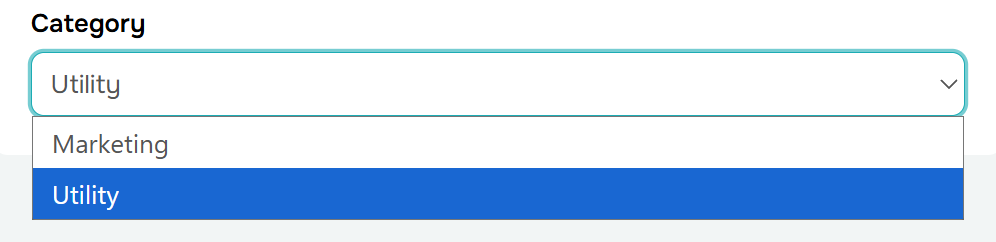 Choosing “Utility” for a shipping update
Step #2. Name your template correctly
Your WhatsApp template needs a short, clean, descriptive name that tells you what the message is for. Meta requires template names to use lowercase letters, numbers, and underscores only. No spaces, capital letters, hyphens, or special characters.
Good examples of how to name a WhatsApp template:
- order_confirmation;
- shipping_update;
- appointment_reminder.
Bad examples of how to name a WhatsApp template:
- Order Confirmation — contains spaces and capital letters;
- shipping-update — contains a hyphen;
- New!_offer — contains capital letters and a special character.
Basically, you should treat your template name as an internal identifier, not the message customers ever see.
In SendPulse, you enter this in the template’s name field. We named ours order_shipped_update.
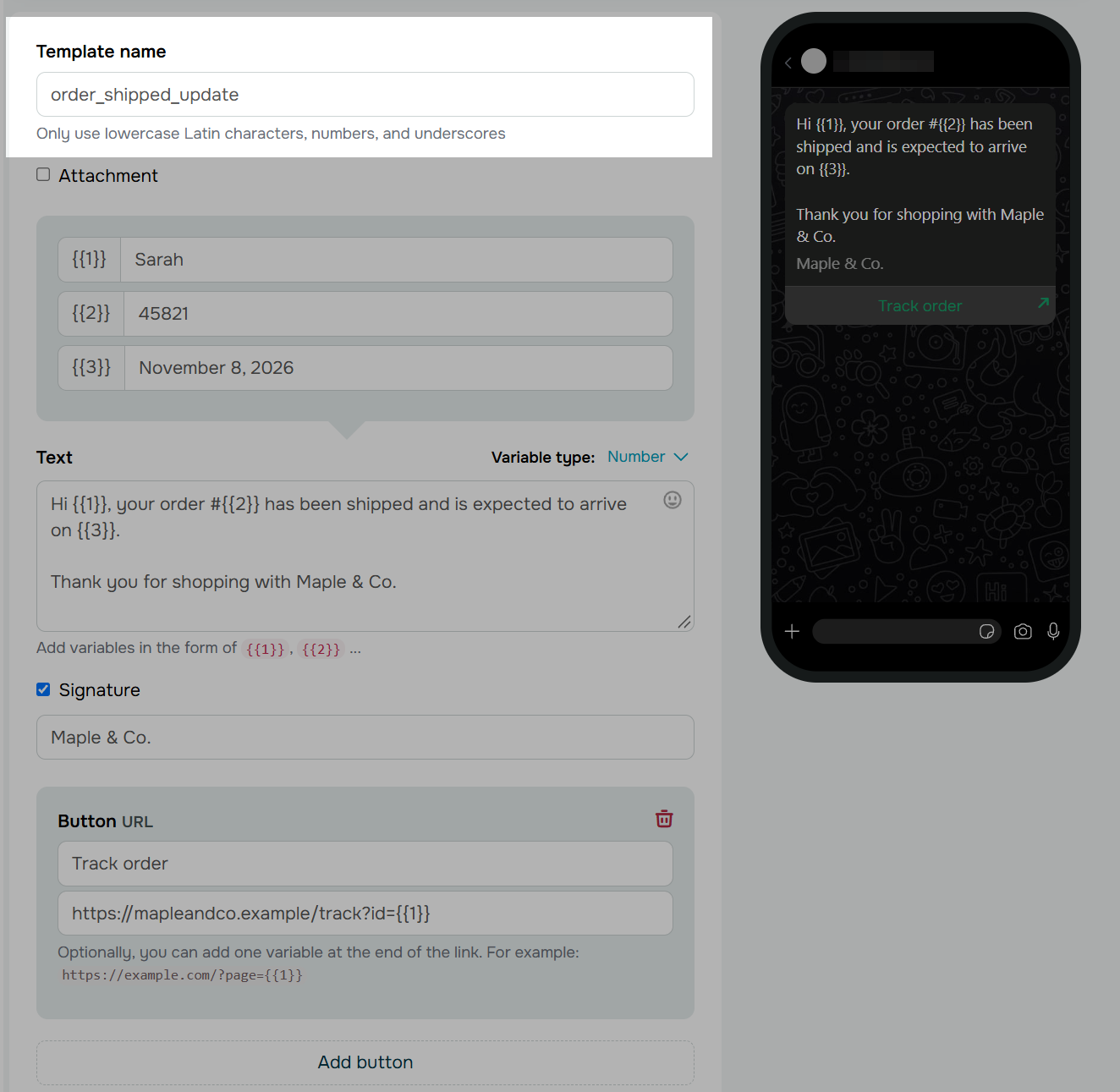 Naming the template order_shipped_update
Step #3. Write the content
The actual message your customers will receive can contain up to three main text components:
- Header (optional, up to 60 characters). A short title that gives context to the message. Instead of text, it can hold an image, video, or file.
- Body (required, up to 1,024 characters). Keep your main message clear, useful, and focused on one purpose. The 1,024-character count includes spaces and punctuation.
- Footer (optional, up to 60 characters). A short line of supporting text, typically used for a disclaimer, sign-off, or additional context.
Most importantly, make sure the content reflects the selected category.
When using SendPulse, type your message in the editor. Avoid using tabs or four or more spaces in a row, as WhatsApp treats that as broken formatting. To add a header, tick “Attachment” and upload an image (up to 5 MB), a video, or a PDF file. Word and text documents are not supported. You can also add a signature to your template, which will appear as a footer.
We included two lines in the message body: the shipping details and “Thank you for shopping with Maple & Co.” This line was required to ensure the last variable was not at the end. For the sign-off, we selected “Signature” and added “Maple & Co.”
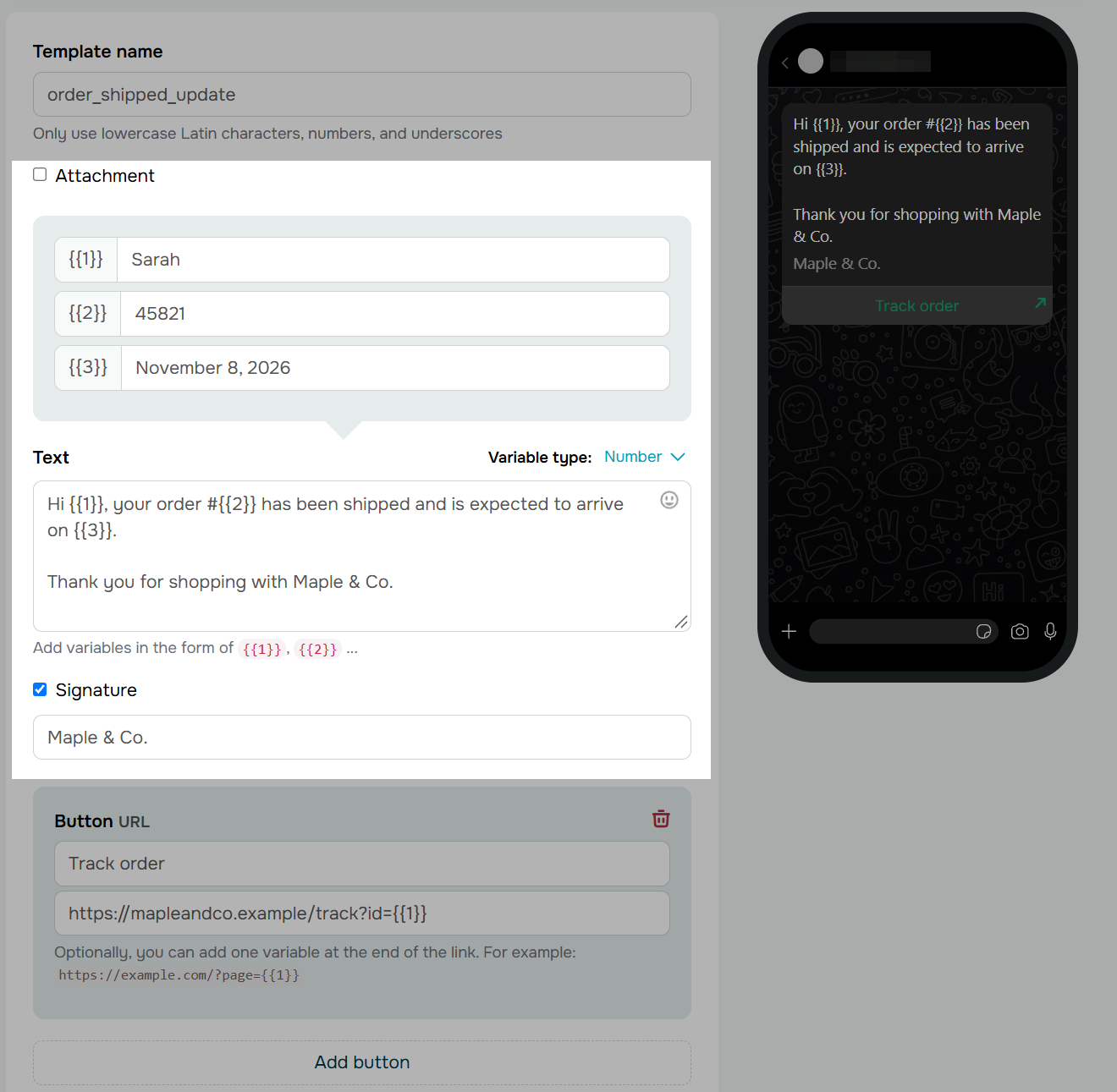 Writing the body with three variables and a closing line
Step #4. Add variables and sample values
You can also personalize WhatsApp templates using variables, written as numbered placeholders in double curly brackets: {{1}}, {{2}}, and so on. These can be either numbers or names. Just don’t place one at the very start or end of the message — Meta rejects templates that begin or end with a variable, so keep some fixed text around your placeholders.
You must also provide a sample value for every variable when submitting your template for review. The same goes for media headers: Meta needs an example file to review them.
Here’s the body we submitted:
Hi {{1}}, your order #{{2}} has been shipped and is expected to arrive on {{3}}. Thank you for shopping with Maple & Co.
And the sample values we gave Meta:
- {{1}} → Sarah
- {{2}} → 45821
- {{3}} → November 8, 2026
These examples show Meta what kind of information each placeholder will contain once the actual message goes out. Leaving them blank is a common cause of rejection — and so are messy values: a sample (or real) value can’t contain line breaks, tabs, or more than four consecutive spaces, or it won’t pass review and may fail to send.
In SendPulse, choose a variable type from the “Variable type” drop-down list — either sequential numbers ({{1}}, {{2}}) or names ({{order_id}}, {{customer_name}}). We used the number type for our variables.
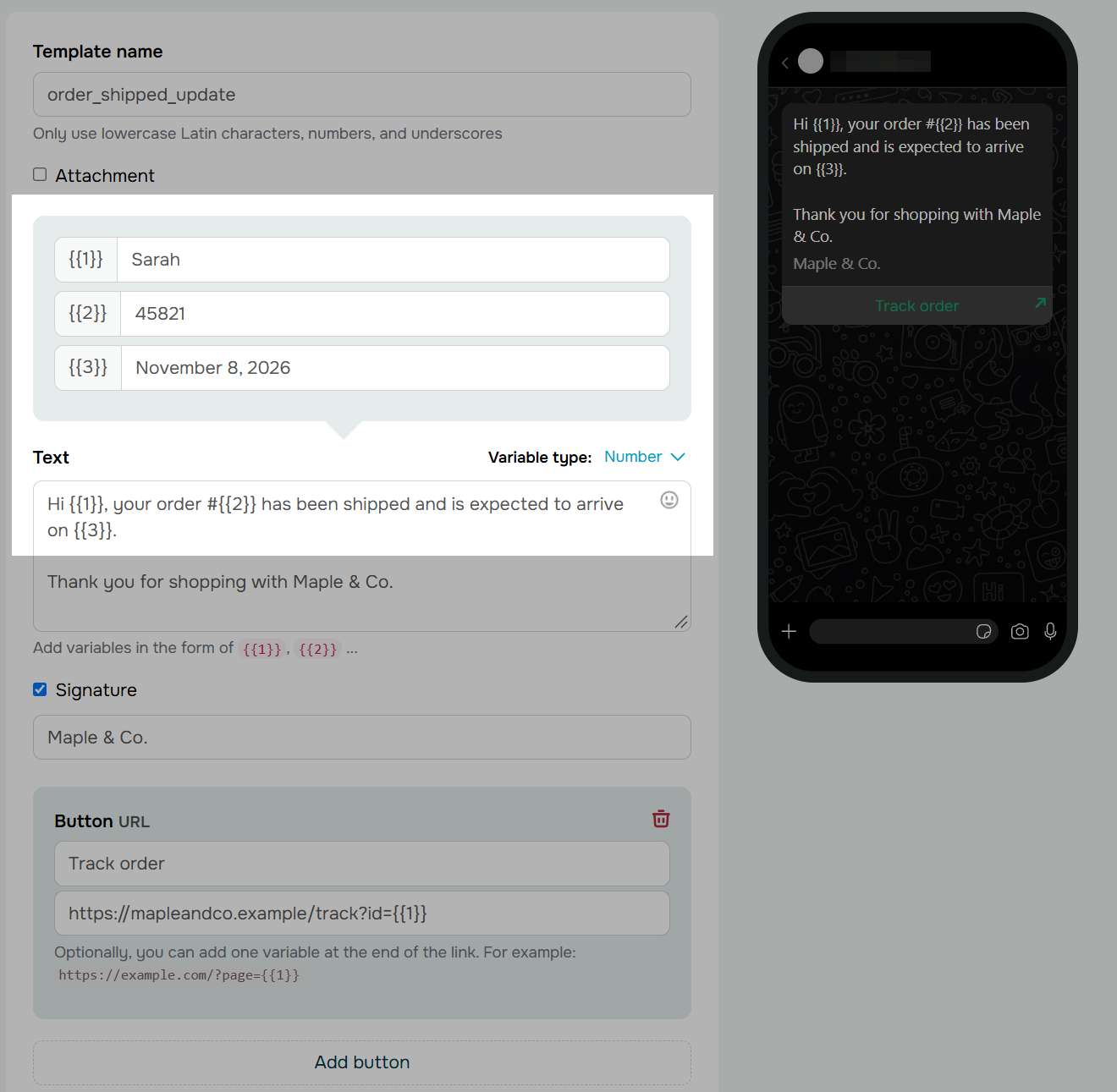 Adding sample values for each variable
Step #5. Add buttons, media, and components
It’s possible to make your WhatsApp template interactive by adding buttons — as long as they help customers take the next step without making the message unnecessarily complicated.
Here are your main options:
- quick-reply buttons to let users respond with a predefined answer instead of typing;
- call-to-action (CTA) buttons to encourage customers to take a specific action, such as visiting your website or calling your business;
- URL buttons (static or dynamic) to open a webpage when tapped.
WhatsApp templates can have up to ten buttons in total. If yours contains over three buttons, only the first two display, and the rest collapse under a “See all options” button, so put the most important ones first.
In SendPulse, click “Add button,” type in your button text, and check “Add link” to select URL or Call. If you use a URL, you can add one variable at the end to make it dynamic. If you leave out the link, the button works as a quick reply. You can also use a trigger word in the button text to launch a related chatbot flow when someone clicks. Link only to domains your company owns, and percent-encode any special characters in dynamic URLs (New York → New%20York).
We added a URL button called “Track order” that links to mapleandco.example/track?id={{1}}. This way, each customer gets a unique tracking page.
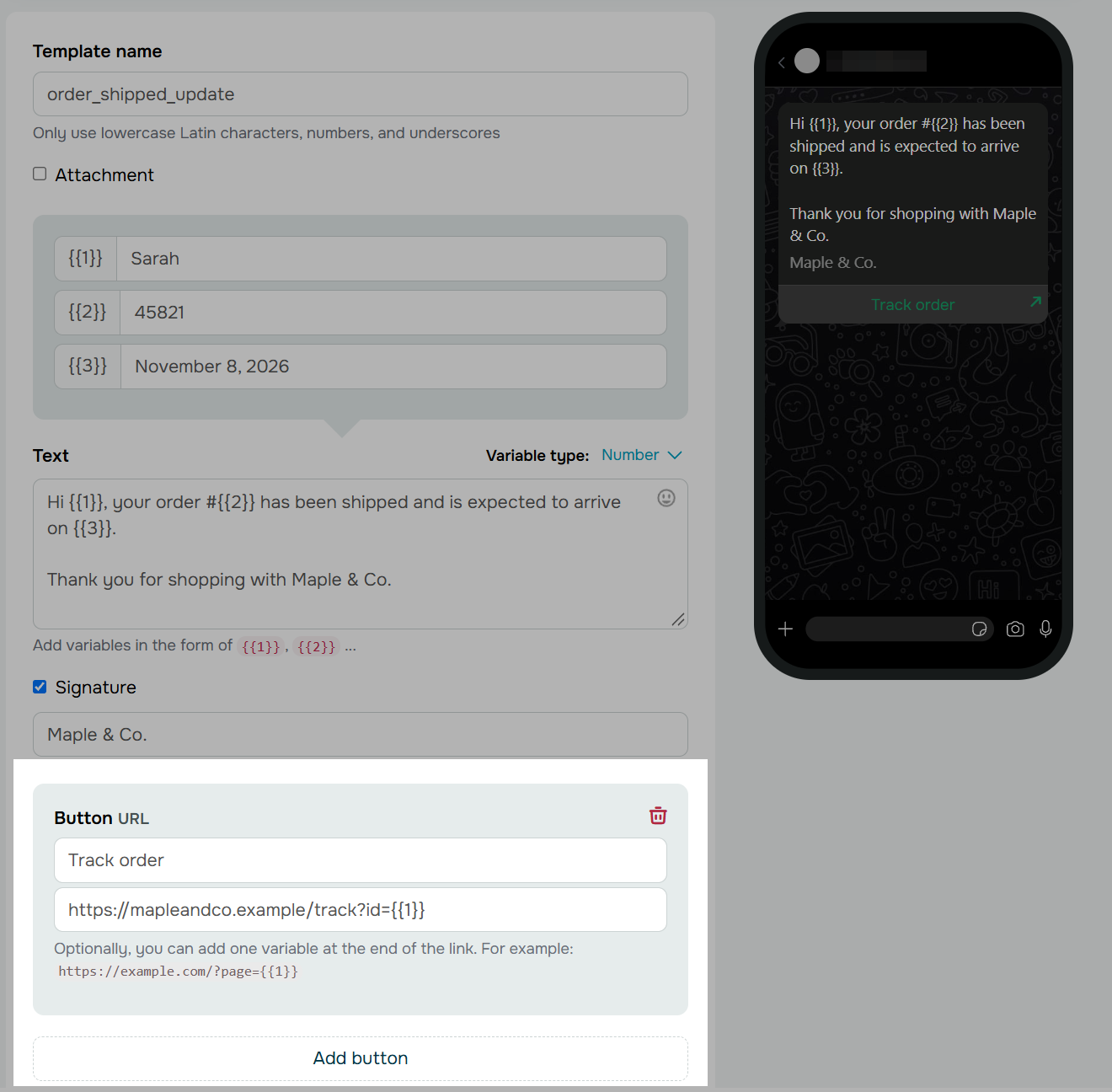 Adding a “Track order” button with a dynamic link
Step #6. Submit for review
Once you’ve successfully gone through the steps above, select the template’s language, and it’s time to submit your WhatsApp template for approval. The review process itself is a combination of automated systems and manual checks intended to prevent any spam, scam-like content, or other WhatsApp policy violations from getting through.
In SendPulse, just click “Save.” The template is sent to Meta for review automatically, with no separate submit button, and you can track its progress right there.
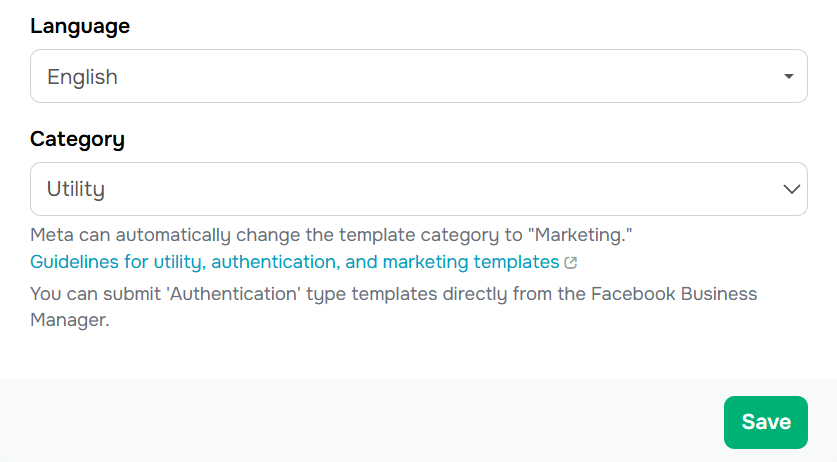 Confirming the language and category before saving
What happens after you submit a WhatsApp template for review
Here’s what to expect once you finish preparing your new template and click “Save.”
WhatsApp template statuses
When you submit a template in SendPulse, it first shows as “Pending.” After review, the status changes to “Approved” or “Rejected.” If Meta blocks a template after you use it, its status switches to “Disabled.”
Our template was marked “Pending” right after we saved it, and it changed to “Approved” within minutes.
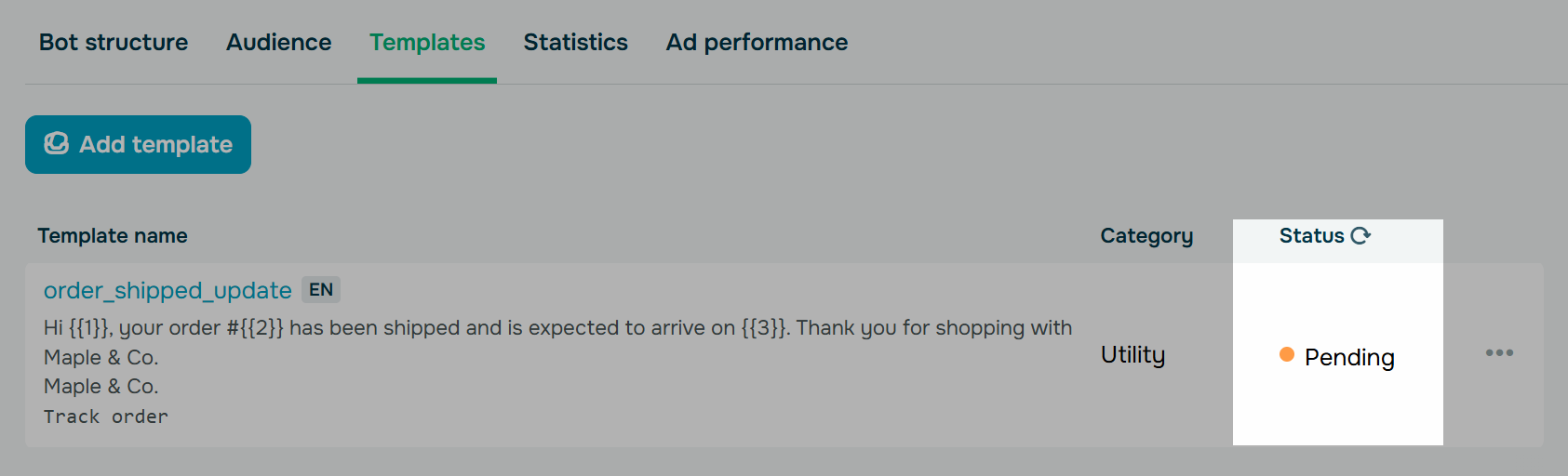 Checking the template status in the “Templates” tab
We then selected it in a “Message” element in a test flow. On the “Template” tab, it appears as UTILITY: order_shipped_update (en), and each variable has a drop-down to map it to the subscriber’s data.
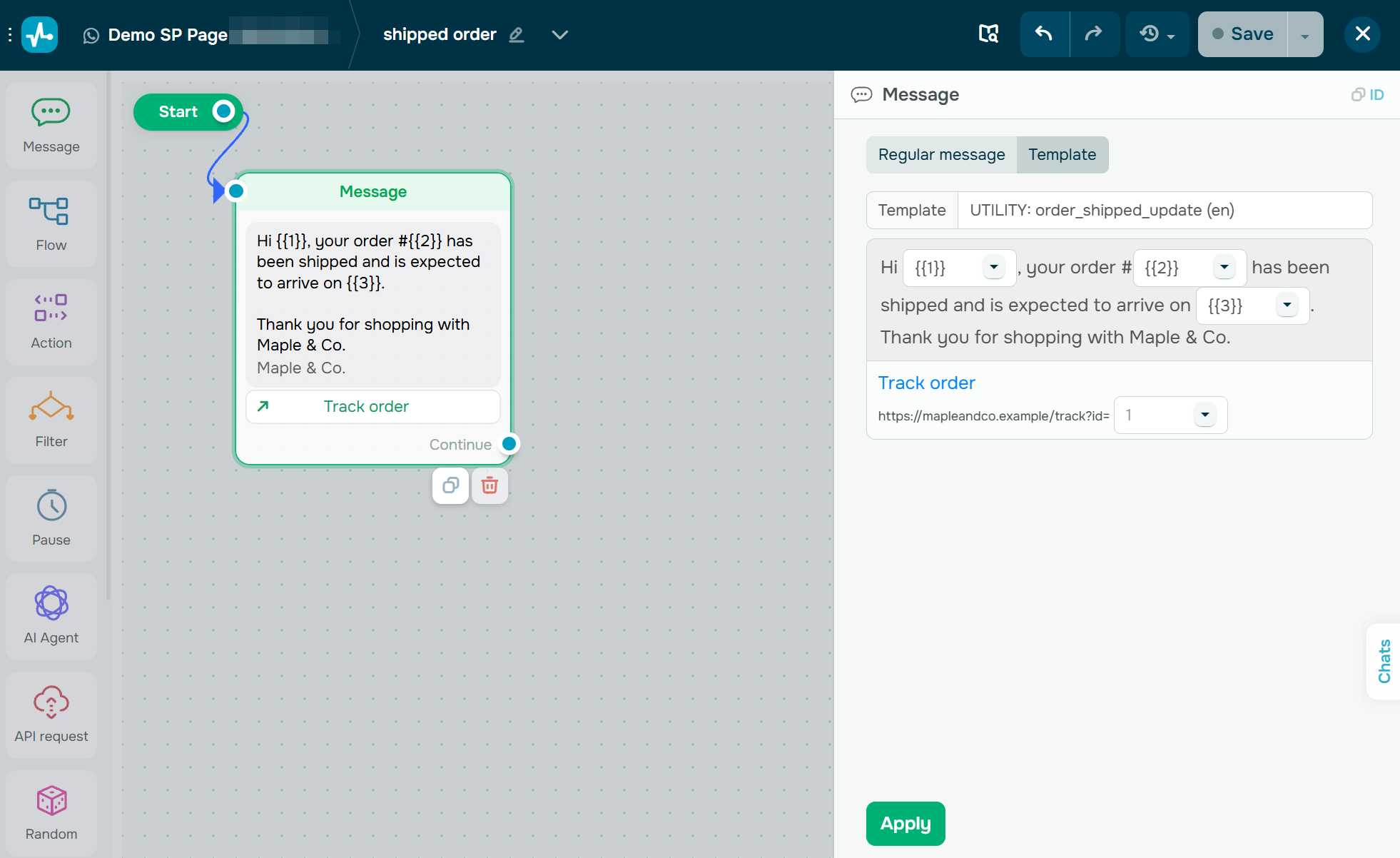 Using the approved template in a chatbot flow
Template quality rating
Getting your template approved is only half the battle. Meta also monitors how customers respond to it once you start sending messages. Every active template receives a quality rating based on how often recipients block your business or report messages as spam and the read rates.
The rating uses a simple traffic-light system:
- Green. High quality. Little or no negative feedback. Your template is performing well.
- Yellow. Medium quality. Negative feedback is increasing. Your template is at risk of being paused if things get worse.
- Red. Low quality. Noticeable negative feedback. Your template is likely to get paused.
- Unknown. Not enough data yet. You can send the template, but Meta may pace its delivery at first.
Templates that haven’t reached a green rating yet, including newly approved ones, may be subject to pacing. Meta sends them out gradually to collect customer feedback before delivering at full capacity.
What happens if your rating turns red? If the quality of your template sinks, Meta can pause it for three to six hours or disable it entirely, giving you a chance to rectify the issues, be it the content itself or how you target it.
If you keep sending low-quality templates, your phone number may eventually be negatively impacted.
How long does Meta’s approval take?
Meta’s review can take a few minutes, but in some cases, approval can take up to 24 hours. While your template is pending, you can check its status in WhatsApp Manager or through your Business Solution Provider.
Access the WhatsApp Business API — no setup or extra fees
With SendPulse, you get everything you need, from a visual editor with a library of ready-made chatbot flow templates to user-friendly analytics, to help you effectively engage your customers on WhatsApp.
Get started for free
Why your WhatsApp templates get rejected and how to fix each
Below are the most common problems and how to troubleshoot them, according to Meta’s official guidelines.
In November 2026, we made several copies of an approved shipping update template, changed one thing in each, and submitted them through SendPulse to verify how these rules play out. Some templates were caught before they even reached Meta; others were approved, even though Meta normally rejects submissions like these.
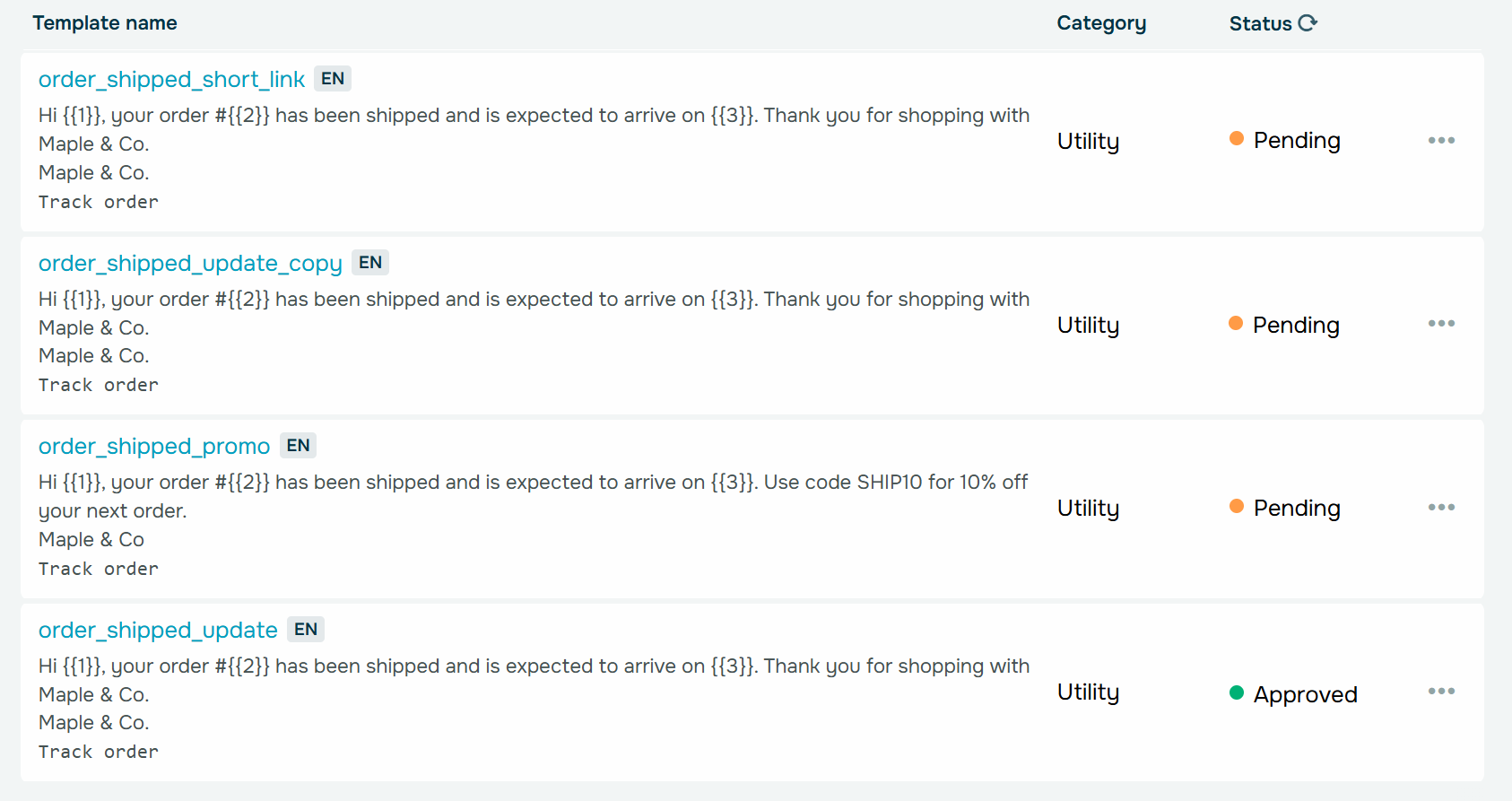 Checking template statuses shortly after they were submitted
Just a note: these results are a snapshot from one account at one point in time. Meta’s review process is automated and changes over time. It has tightened category enforcement more than once, so if something was approved, it only means it worked this time — not always. The guidelines below are the safest and most reliable way to get your template approved, no matter what the review lets through.
Wrong or mismatched category
Why it happens: Your message doesn’t match the category you selected. For example, a utility template that includes a discount code or encourages customers to shop again goes against that category’s guidelines.
How to fix it: Remove promotional wording if the message is genuinely transactional, or submit it as marketing if its purpose is to promote a product, service, or offer.
In some cases, Meta recategorizes the previously approved template for you instead of taking it down — for instance, if the utility messages your template sends no longer meet the category guidelines and should be sent as marketing instead.
In our test, we added a promotional sentence with a discount code to an approved template copy and submitted it as “Utility.” After a few minutes, its category switched to “Marketing” — all while its review was still in progress. It was approved as a marketing template for WhatsApp campaigns later that day.
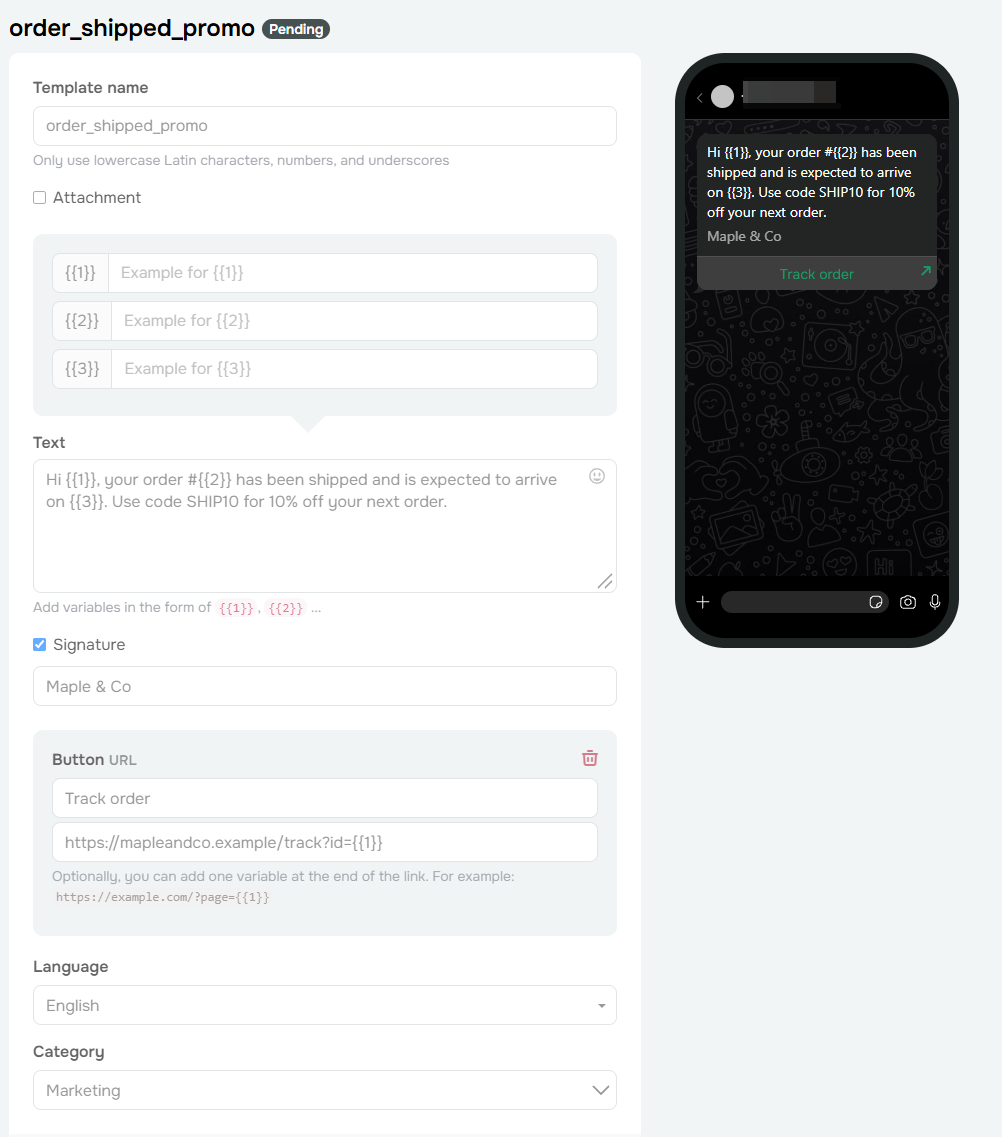 Checking a utility template that switched its category to “Marketing” during Meta’s review
So, a mismatched category oftentimes triggers a silent switch instead of a rejection. What’s important is that the switch moves your template to marketing pricing as well.
Formatting and variable errors
Why it happens: Besides the wording, Meta checks the structure of your template. Common mistakes include:
- missing or mismatched curly brackets (use {{1}}, not {1});
- variables containing special characters such as #, $, or %;
- variables appearing out of sequence (for example, {{1}}, {{3}});
- variables dangling at the very beginning or end of a message;
- too many variables compared with the amount of fixed text;
- character-limit violations or incorrect text formatting;
- too many emojis in the body of the template.
How to fix it: Review the formatting requirements of your respective template category. Remove tabs, newlines, and excessive consecutive spaces where they clash with the guidelines. Provide realistic sample values for every variable. Trim variables or emojis where possible.
SendPulse won’t let you submit a template if the variables aren’t placed correctly or if there are too many. When we ended our message with {{3}}, the editor showed the “Variables can’t be at the start or end of the template” error and didn’t save it, even with a period after the variable.
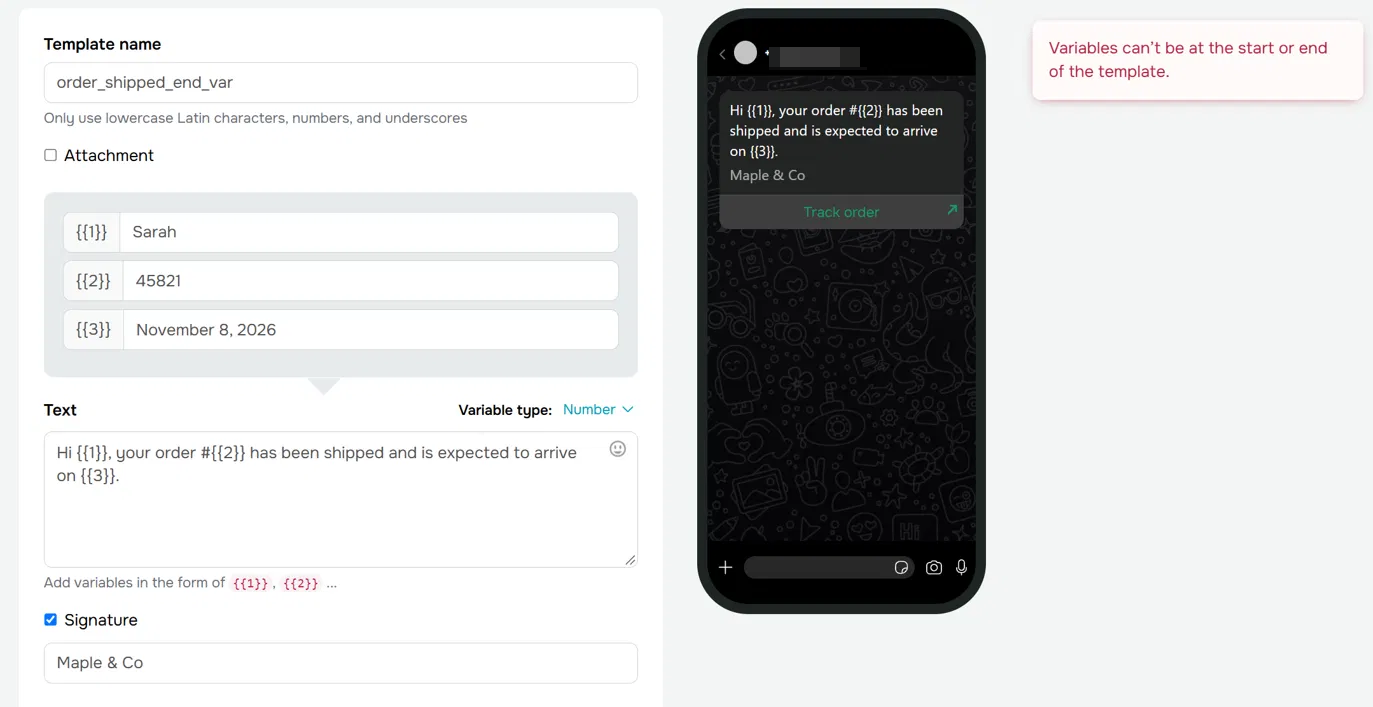 Creating a template with a variable placed at the very end of the message
When we tried a message with six variables and only three words of fixed text, we got the error: “This template has too many variables for its length. Reduce the number of variables or increase the message length.” Neither version could be saved, so neither was sent to Meta.
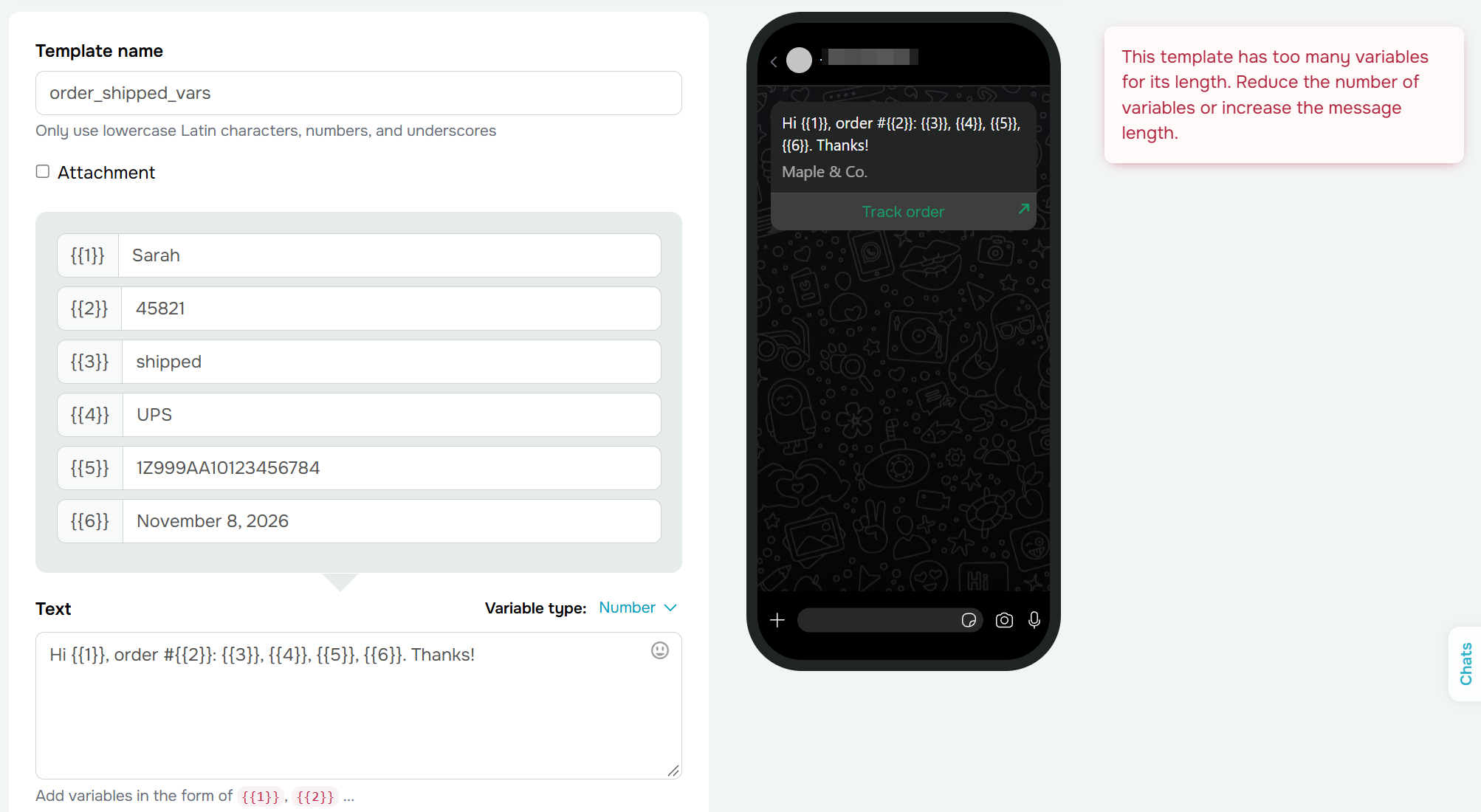 Trying to submit a template with six variables
It’s important to note that this safety net is provided by SendPulse, not Meta. When you build your template through WhatsApp Manager or the API, those errors reach review unchecked.
Policy violations
Why it happens: Your message includes content that WhatsApp doesn’t allow. This can be abusive or threatening language, even if it’s an April Fool’s joke, threatening customers with legal action, asking for sensitive personal data like credit card numbers, posing as another business or person, or promoting prohibited goods or services.
Prize and lottery promotions may also go against WhatsApp’s policies, depending on their content and applicable restrictions.
How to fix it: Review Meta’s Business Messaging Policy and Messaging Guidelines. Remove prohibited content, avoid requesting sensitive information, and rewrite awkward or problematic wording in neutral, professional terms. If you operate in a restricted industry, check WhatsApp Business Platform Policy Violations to make sure you’re allowed to promote your business.
We didn’t test this one because it’s not worth risking a real account, but it’s the category Meta enforces most strictly.
Link and button issues
Why it happens: Links and interactive elements can be an issue when they obscure the destination, appear misleading, or are associated with suspicious content. Shortened URLs are best avoided because they hide the final destination.
How to fix it: Use full, transparent URLs pointing to legitimate destinations associated with your business. Avoid URL shorteners, check that dynamic parameters are correctly formatted, and make sure button labels accurately describe where they take the user.
SendPulse validates your URL before it ever reaches Meta. If you enter a malformed one, like htps:// instead of https://, the link field turns red, and the “Save” button stays disabled until you fix it.
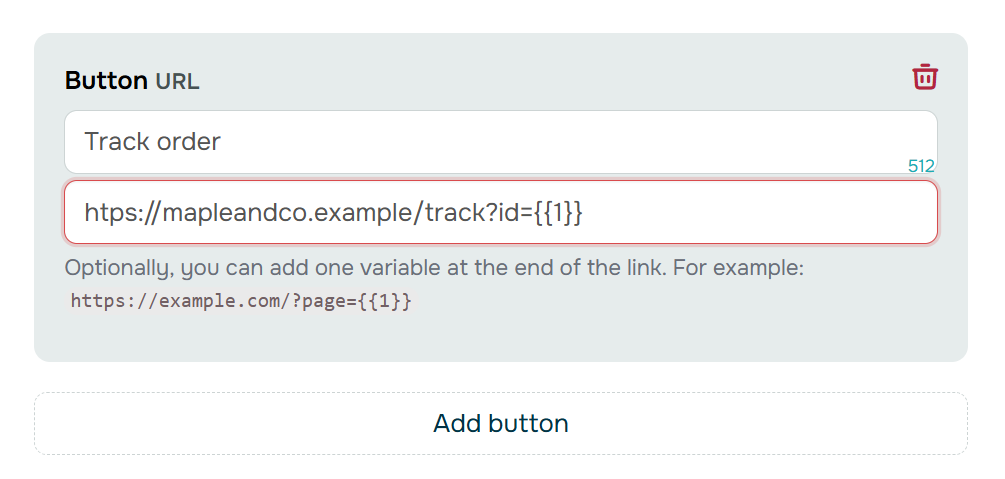 Testing a wrong protocol for the URL button
A valid but shortened link is a different story. For our test, we submitted a template with a bit.ly link in the “Track order” button. It took the longest to get reviewed out of all our copies but was approved anyway.
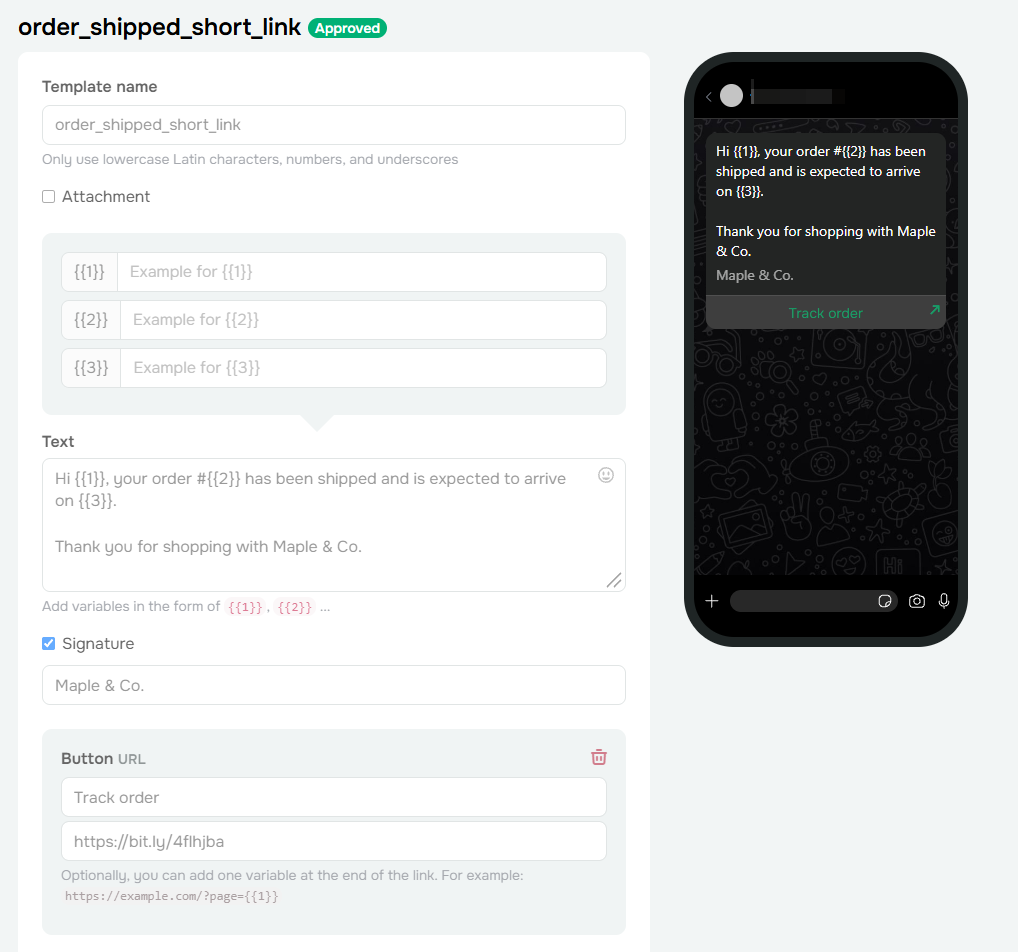 Looking through an approved template with a shortened link
It’s a reminder that passing review doesn’t guarantee long-term approval, and hidden links can lower your template’s quality rating once it’s live.
Duplicate templates
Why it happens: Meta can reject your template if its body and footer are too similar to an already existing template in your account. This does not apply to authentication templates.
How to fix it: Check whether you already have an approved template that serves the same purpose. Reuse it if possible, or write genuinely different content if you need a separate template. Simply renaming the template won’t solve the duplicate problem.
For our test, we saved an exact copy of an approved template under a new name. Meta’s rules say a template with the same body and footer as an existing one gets rejected, yet our duplicate cleared review, just a few hours behind the others. That doesn’t mean the rule is gone. Review is largely automated and doesn’t always catch duplicates, so don’t rely on it. Duplicates also aren’t worth it: near-identical templates split your quality data, clutter your account, and could still be caught in a later review.
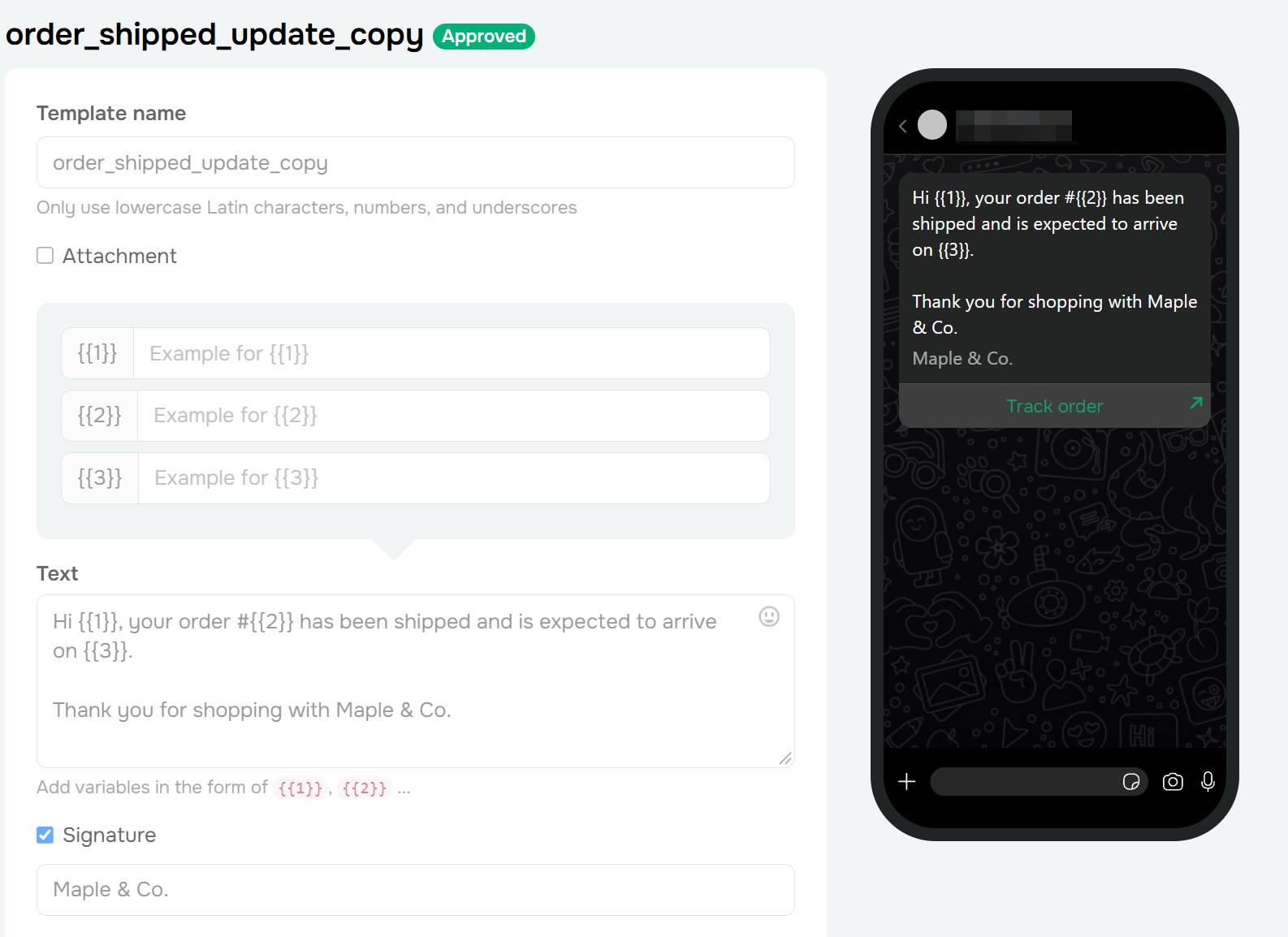 Reviewing a duplicate template that cleared review
Our tests showed that review approved more templates than we expected, and SendPulse caught several issues before they reached Meta. However, an approved template doesn’t mean it’s safe, and review behavior changes over time. Recategorization, quality ratings, and later pauses can all happen after approval. That’s why it’s best to follow the official rules right from the start.
Final thoughts
An approved template is really just the starting point. The real value comes from putting your templates to work: automating order updates, recovering abandoned carts, following up with leads, and more — all without manual input.
Our AI-driven platform helps you automate WhatsApp campaigns and customer chats, build chatbot workflows, and manage conversations from a single inbox. And now, with its own MCP server, SendPulse opens up another way to connect custom AI assistants and run complex marketing tasks with a single prompt. Get your free account today and give it a try!
WhatsApp template FAQ
Why was my WhatsApp template rejected?
If Meta rejected your template, the likely reasons are the wrong category, promotional content mixed into utility or authentication, wrong variable formatting, missing sample values, or WhatsApp policy violations. Check and address Meta’s rejection reason before resubmitting.
Can Meta change my template’s category automatically?
Yes. If your content doesn’t match the category you chose, Meta often recategorizes the template instead of rejecting it. When we tested a utility template that included a discount, Meta changed it to “Marketing” during review and approved it as a marketing template.
Will a shortened link get my template rejected?
Not necessarily. In our testing, a template with a bit.ly link in its button was approved. It just took longer than usual. Still, shortened links hide the destination, which can lower your template’s quality rating once it’s live and might cause it to be paused later, so it’s best to use full, transparent URLs.
Where do I submit a WhatsApp template for approval?
You can submit templates through WhatsApp Manager, Meta Business Suite, or an official WhatsApp Business Solution Provider (BSP), such as SendPulse. Meta is responsible for review and approval regardless of where you submit.