Four days. 71,000+ attendees. 150+ countries. 1,800+ investors. 2,700+ startups. 850+ speakers. These numbers are huge, although they don’t do justice to the scale of Web Summit, one of the world’s largest and most influential tech conferences.
From November 10 to 13, Lisbon became the global stage for conversations about marketing, artificial intelligence, business growth, and digital transformation. Of course, SendPulse was there.
Join us as we recap our experience at Web Summit 2025. We had a great time connecting with the community and uncovering fresh, inspiring insights.
What is Web Summit?
Web Summit is a significant technology conference that usually attracts a great mix of professionals, including founders, CEOs, investors, creators, and notable names from the global tech sector. The main conference happens every November in Lisbon, Portugal, but the organization also hosts international editions in Brazil, Qatar, and Canada throughout the year.
Over four days, attendees engage in programming, networking, and exploration, making it a key event for those interested in the future of technology and innovation. This conference provides a unique opportunity for startups, enterprises, and investors to connect, learn, and grow. It features meetups, workshops, partner masterclasses, interviews, panel discussions, onstage pitching battles, company exhibition booths, and much more.

Power up your business with smart tools
From solo creators to global brands, thousands of customers trust SendPulse to run email campaigns, chatbots, automations, and more — all in one place.
Get started for free
SendPulse’s experience at Web Summit Lisbon 2025
SendPulse is an all-in-one sales and marketing automation platform that helps businesses attract, engage, and retain customers across multiple communication channels. Today, more than 200,000 customers rely on our tools, sending over 1.2 billion emails and 300 million chatbot messages every month.
As in previous years, SendPulse participated in Web Summit Lisbon 2025 with a fully interactive booth dedicated to innovation and automation. Throughout the event, our team connected with visitors, customers, and partners, showcasing the full potential of our multi-channel platform for marketing, sales, and customer support.
At our booth, guests could explore each of our products in action — from automated chatbots for WhatsApp, Instagram, Facebook, TikTok, Telegram, and websites, to email marketing, smart pop-ups, website builder, CRM system, online course creator, automation builder, and more.
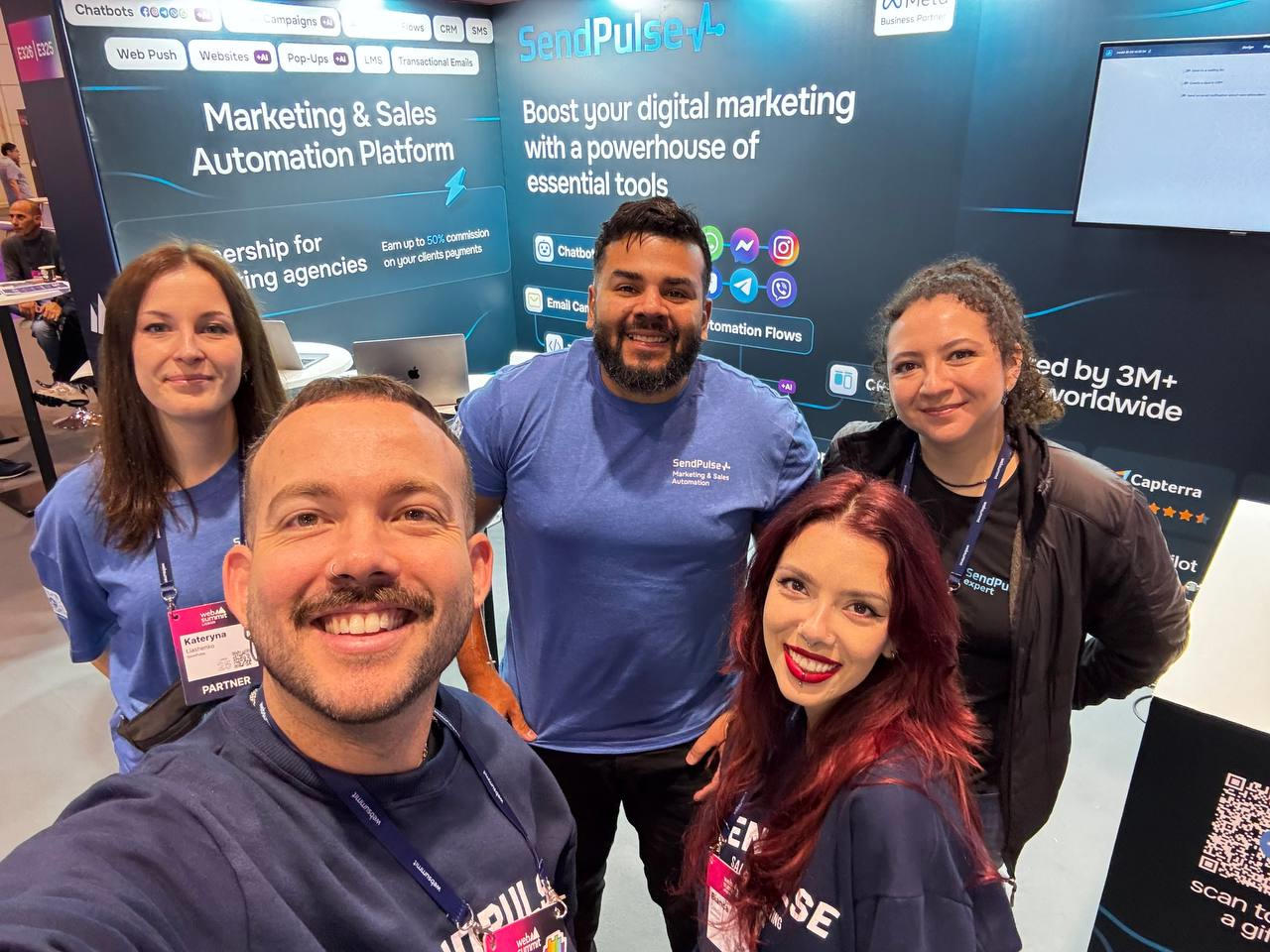 SendPulse’s team at Web Summit Lisbon 2025
If there was one central theme at Web Summit this year, it was definitely artificial intelligence. While AI has been a hot topic in previous years, in 2025, it truly took center stage — it appeared in talks, interviews, demos, and conversations all around the venue.
SendPulse has long been ahead of this trend. Long before AI became a mainstream topic, we were already integrating advanced AI features into our tools to help users work faster, smarter, and more efficiently.
For example, in our chatbot builder, AI can generate complex conversational flows from simple prompts, dramatically reducing the time you need to develop one from scratch. You can also incorporate the “AI Agent” element in your chatbot so that it can deliver more natural, contextual, and intelligent responses to engage audiences in dynamic conversations.
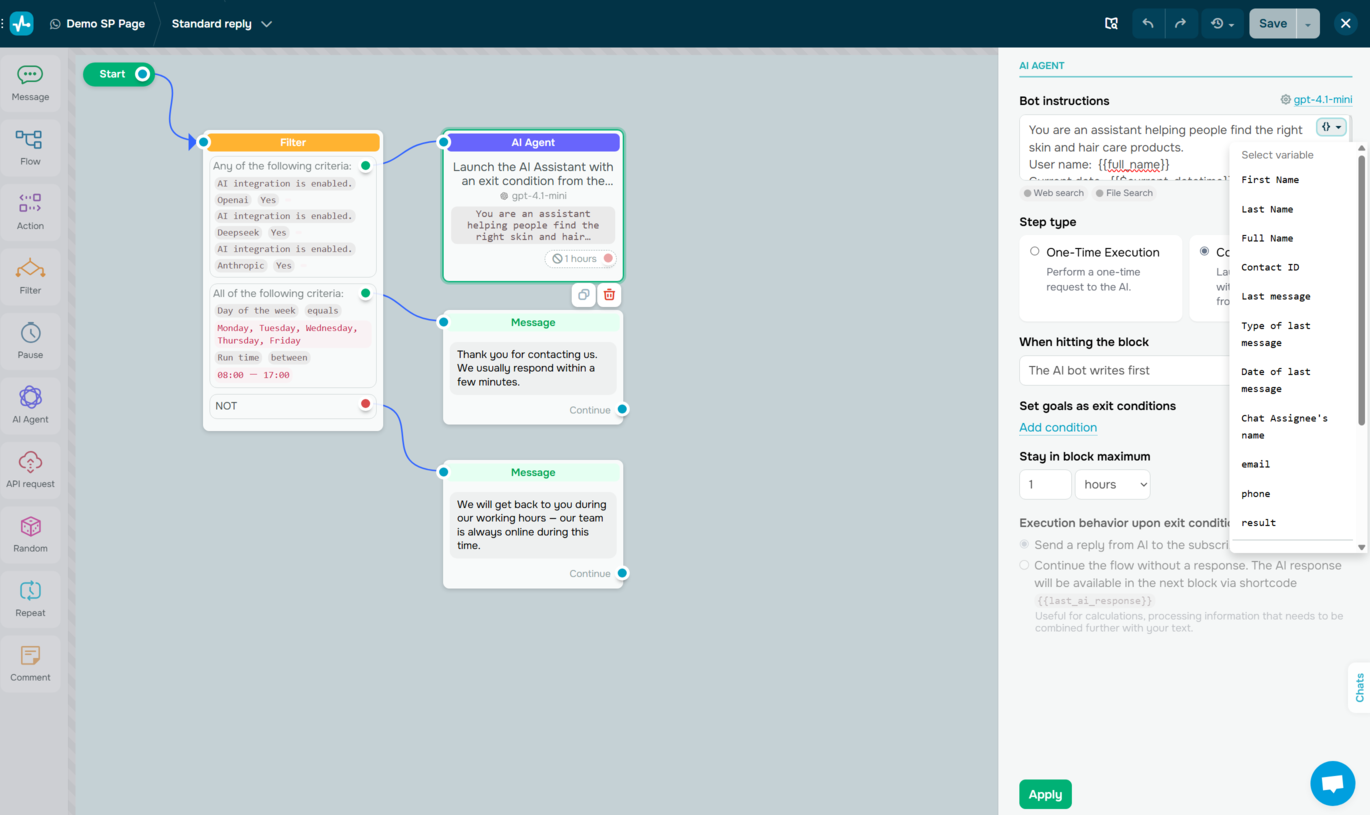 “AI Agent” element in the chatbot builder
In our email marketing platform and website builder, AI helps you write original content or refine your existing copy. Thanks to built-in AI features, you can also generate pop-up templates with fully customizable layouts, elements, and text.
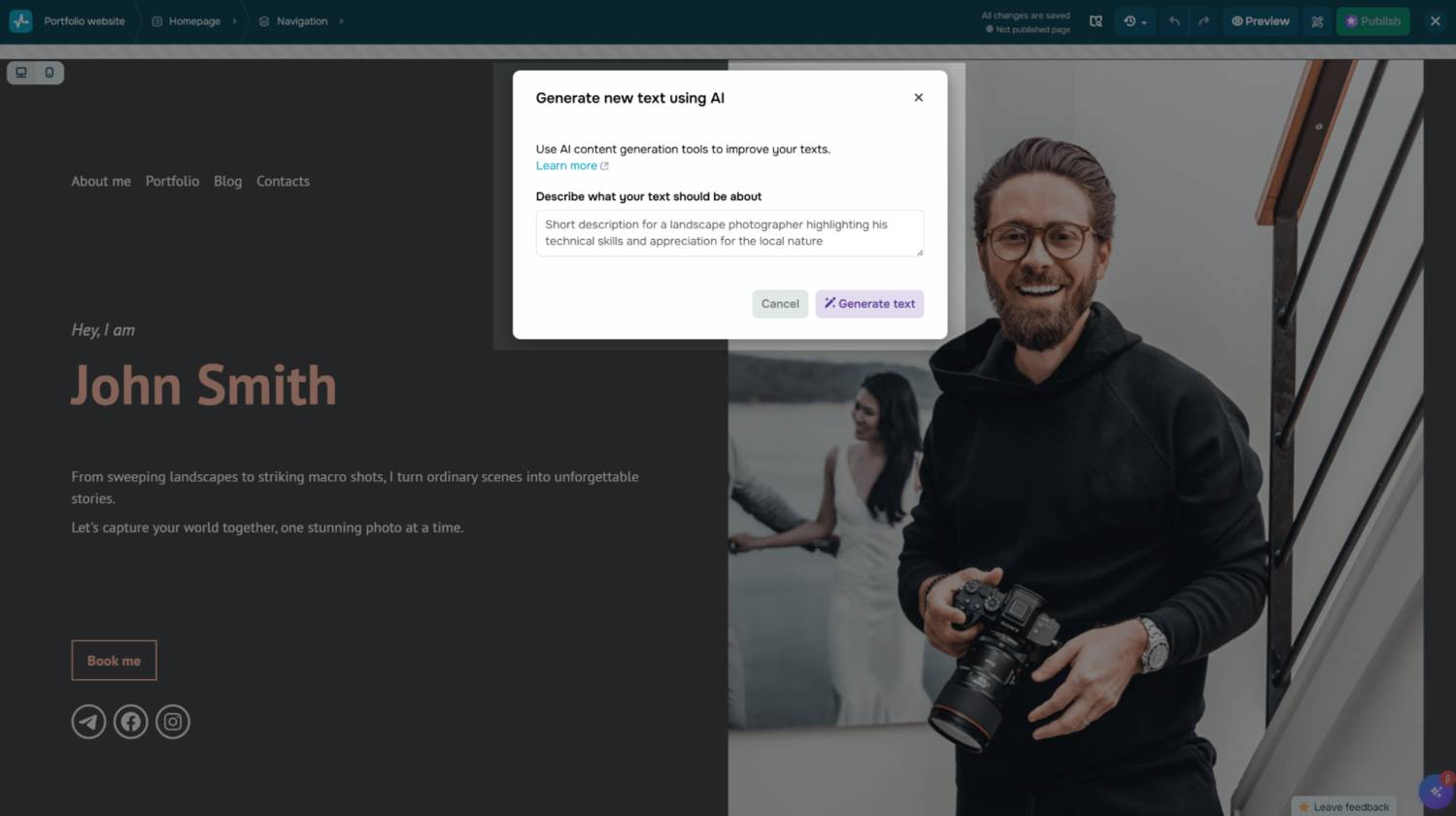 Using the built-in AI assistant to generate website copy
Highlights from the Web Summit Lisbon 2025 talks
Across various stages and content areas, hundreds of speakers took turns over four days. On the main stage, we heard inspiring discussions about the further development of AI, sustainability, journalism, entrepreneurship, and much more.
Below is a recap of the key moments from each day on the Centre Stage.
Opening night
The event officially kicked off on November 10, and the MEO Arena was completely packed. Paddy Cosgrave, founder and CEO of Web Summit, opened the tenth edition in Portugal with a direct and engaging speech.
Ten years ago, it already felt like the world was changing fast, but it’s nothing compared to how fast the world is changing today.
SourcePaddy Cosgrave
Web Summit CEO
“The era of Western tech dominance is fading,” Web Summit founder Paddy Cosgrave said. He pointed out the rapid rise of Chinese artificial intelligence, something that seemed impossible just a few years ago. Paddy also referenced the worldwide impact of the Brazilian digital payment system PIX, which has sparked conversations about the future of financial monopolies.
Lisbon’s mayor, Carlos Moedas, and Portugal’s minister, Gonçalo Matias, then took the stage to thank attendees and emphasize the importance of Web Summit for the country and for the broader tech ecosystem.
The evening’s first major talk featured athlete-turned-entrepreneur Maria Sharapova and IBM’s Chief of Corporate Affairs & Brand Officer Sarah Meron, who discussed how AI is transforming sports, from training athletes before the competition to speeding up recovery time and engaging fans.
Next, influencer Khaby Lame joined Visa’s Global Head of Production Mark Nelsen for a light, entertaining conversation about turning creativity into a business and taking content creators seriously as entrepreneurs.
Anton Osika, CEO of Swedish unicorn Lovable, wrapped up the opening night discussions by lifting the lid on his vision for a new era of app and website development — one where you can build digital products simply by talking to AI. He shared real case studies and future-focused predictions that generated a lot of excitement.
It was an inspiring and energetic start — exactly what Web Summit is known for.
Day one
The first full day of talks began with bold ideas and forward-thinking perspectives on the future of technology.
Cristóbal Valenzuela, Founder and CEO of Runway, opened the morning discussion by talking about the concept of world models — AI systems capable of predicting actions and consequences within simulated environments.
Arthur Gregg Sulzberger, The New York Times Chairman and Publisher, followed with a meaningful conversation about the importance of media independence in a time of falling social trust and rising political polarization. He stressed that a free press is a central pillar in democracy.
In the business and investment space, Nigel Morris, co-founder and Managing Partner of QED Investors, shared his predictions for the venture capital landscape in 2026, while Qualcomm President and CEO Cristiano Amon discussed the shift from app-centric to agent-centric experiences, emphasizing AI’s role in anticipating user needs and allowing for real-time responses.
Later, Gen Z creators and entrepreneurs Josh Richards and Grace Beverley reflected on a new generation of corporate leaders — creative, digital-native, and not afraid to challenge traditional business models. Shortly after, Microsoft President Brad Smith spoke about how AI will shape the next 25 years of technology, including its risks and opportunities.
On the science side, Max Hodak, founder and CEO of Science Corp, presented the groundbreaking neural implants PRIMA. Media experts Jessica Sibley and Christian Broughton discussed the evolving state of digital publishing, and Max Tegmark delivered an impactful speech advocating for trustworthy AI aligned with human values.
The second half of the day kept the momentum going.
Alex Schultz, CMO of Meta, shared behind-the-scenes insights and trends shaping global digital marketing. Then, Etosha Cave from Twelve, Joe Paluska from Commonwealth Fusion, and Greg Jackson from Octopus Energy discussed technological innovations for climate solutions. Niki Buys of Pledge Ventures presented inspiring initiatives from entrepreneurs who commit a portion of their earnings to social causes.
Later, the conversation shifted to sports and cybersecurity with Laurent Mekies of Oracle Red Bull Racing and David Faugno of 1Password, who highlighted the importance of speed, trust, and data protection as a competitive advantage.
The audience also explored the future of social media platforms with Irina Novoselsky from Hootsuite and Rose Wang from Bluesky. They discussed the growing role of social intelligence in today’s digital ecosystem.
Back on the AI track, Shishir Mehrotra from Superhuman (formerly Grammarly) explained how their product is evolving beyond basic writing assistants. Peter Koerte from Siemens and Rev Lebaredian from Nvidia then showcased how industrial AI is reshaping factories, robotics, and large-scale digital simulations.
To wrap up the day, Andrew Macdonald, COO of Uber, revealed how autonomous vehicles may soon transform urban transportation. Henna Virkkunen from the European Commission ended the session by outlining strategies to strengthen technological sovereignty and innovation in Europe.
Day two
The second day of Web Summit Lisbon 2025 kicked off with a main stage full of bold ideas and thought-provoking discussions.
The morning opened with Tao Zhang, Co-Founder and CPO of Manus AI, who outlined a future where AI agents move beyond assistance into independent thought and action. He explored how autonomous systems could reshape entire industries and challenge our understanding of control, creativity, and accountability.
Next, Khartoon Weiss from TikTok took the stage, showing how the platform is redefining search, strengthening communities, and opening new opportunities for creators worldwide. Right after her, author and activist Cory Doctorow delivered one of the day’s standout talks, introducing his concept of “enshittification.” He explained how digital platforms tend to decline over time when profit becomes their top priority.
Accel’s Philippe Botteri then shared insights on global trends in the AI race, followed by Dow Jones CEO Almar Latour examining whether journalism can survive increasing automation.
The conversation then shifted to Europe’s technological competitiveness, with Archie Hollingsworth from Fyxer and Ling Ge from Tencent. Shortly after, Tom Hale from Oura highlighted how wearable tech is becoming a powerful ally in preventive healthcare.
A panel with Cristina Fonseca of Indico Capital Partners and Rainer Markle of HV Capital discussed how venture capital can help Europe overcome its business and innovation challenges.
The day also had lighter moments; influencer Max Klymenko made a spontaneous appearance on stage, performing his signature “Career Ladder” act, getting a round of applause.
In the enterprise AI segment, Anu Bharadwaj from Atlassian, Jesse Zhang from Decagon AI, and Timothy Young from Jasper broke down what it takes to build AI systems that offer genuine value.
Then, Robert Playter from Boston Dynamics followed with an impressive demonstration of robots capable of near-human mobility and precision. Soon after, Chris Smith from Bloxx and actor Cliff Curtis presented a surprising, impactful topic: how fintech can democratize access to homeownership.
The discussions continued with Arvind Jain (Glean), Sarah Franklin (Lattice), and Jaroslaw Kutylowski (DeepL), who explained how AI agents, “our new digital colleagues,” will transform productivity, communication, and management.
Lyft CEO David Risher shared his experience of personally driving app users to better understand their pain points.
The Brazilian delegation brought important insights, too. Luis Fernandes, Executive Secretary of Brazil’s Ministry of Science, Technology, and Innovation, joined economist William Lazonick to discuss the global influence of PIX, the country’s revolutionary payment system.
Later, Greg Glenday, CEO of Acast, and actress, activist, and podcast host Jameela Jamil shared an inspiring conversation about the future of podcasting. Michele Catasta from Replit then offered fresh perspectives on robotics, smart product development, and the emerging “pay-per-crawl” model.
The day wrapped up with the highly anticipated PITCH semi-finals, where ten startups had three minutes each to present their businesses and compete for a spot in the final round. Three startups made it to the finals: Granter, VarsityScape, and SegmentStream.
Day three
The third day of Web Summit brought the world’s brightest minds to the main stage and offered plenty of powerful insights.
The morning opened with three founders who each raised more than $100 million: Varun Anand of Clay, Dani Yogatama of Reka, and Darrick Horton of TensorWave. In an honest and insightful conversation, they broke down what it really takes to secure a nine-figure investment in today’s competitive tech landscape.
Next, veteran astronaut Drew Feustel invited the audience to envision new horizons in space exploration as he unveiled Vast’s ambitious plan to launch the first commercial space station in 2026.
The spotlight then shifted to Evan Sharp (Pinterest) and Biz Stone (Twitter), who discussed building technology “with soul.” They introduced their new company, West Co, which aims to encourage a more intentional lifestyle, guided by purpose rather than algorithms.
Following that, investors Larry Li and Brett Gibson explained why the traditional venture capital playbook needs a complete overhaul. Immediately after, Laura Chambers of Mozilla and Matthew Prince of Cloudflare discussed the new AI-driven “browser wars.”
Robotics took center stage, with Tye Brady of Amazon Robotics showcasing major advancements in giving machines near-human capabilities.
Two past PITCH winners, Yasir Khokhar and João Guimarães, shared how the competition transformed their companies. Then came one of the most anticipated moments of the event: the PITCH final. All three finalists — Granter, VarsityScape, and SegmentStream — impressed the audience, but Granter won the top prize.
Keily Blair from OnlyFans kept up the momentum, discussing the importance of trust in the creator economy, followed by Des Hogan’s reflections on the challenge of regulating innovation at today’s rapid pace. At the intersection of Hollywood and AI, Jonathan Yunger of Arcana Labs and actor Scott Eastwood showed how technology and creativity can coexist without losing artistic integrity.
Actor and filmmaker Joseph Gordon-Levitt delivered one of the most emotional moments of the day with a talk about digital autonomy and creativity. Shortly after, DJ Armin van Buuren and Ole Obermann, Global Head of Apple Music, led a lively conversation about the future of music and technology.
Before the closing ceremony, Minister Manuel Castro Almeida reflected on the event’s significance for Portugal.
And finally, a perfect ending: Tim Berners-Lee, the inventor of the World Wide Web, joined John Bruce of Inrupt to discuss how to build a future web that truly serves people — a brilliant finale to an unforgettable day at Web Summit.
Before you go
Web Summit is a unique opportunity to learn, grow, and connect. The 2025 event highlighted how fast the tech landscape is evolving and how much potential there is in AI for business growth.
At SendPulse, we offer AI-powered and automation tools to enhance your marketing and sales strategies. Our platform comes with 24/7 support, a free plan, and an intuitive help center. Create your free account today and start exploring our email builder, 360 automations, chatbot builder, and more!