Whether you’re building a personal brand, a business, or a creator career on Instagram, managing your comment section by hand means you’re already behind.
Instagram trends blow up and die off within days, and the users propelling them aren’t patient. They drop a comment, maybe ask a question, and if nothing comes back, they keep scrolling. An ignored comment means that “nobody’s home.”
This is especially true if your post goes viral and suddenly you’re getting hundreds of comments. Keeping up with that manually is simply unreliable and unsustainable, as you’ll always be a few hours late to the conversation, which is as good as missing it entirely.
Let’s break down Instagram comment automation and how it lets you stay authentic and present in your comment section at 2 AM, respond to unexpected spikes, and make sure no follower, customer, or potential collaborator feels ghosted. We’ll also show you how to set up tailored Instagram auto-replies to comments in a code-free way with SendPulse.
Here are the most common use cases for automated comments on Instagram at a glance.
| Use case |
Trigger type |
Public reply |
DM follow-up goal |
Best for |
Main risk |
KPI to watch |
| Lead magnet delivery |
Campaign-specific keyword |
Short confirmation |
Deliver the asset and turn the commenter into a follower |
Creators, coaches, B2B |
Repetitive replies |
Comment-to-DM rate, followers gained |
| Product launches and direct sales |
Campaign-specific keyword |
Confirmation without revealing details |
Move the commenter from interest to purchase fast |
Brands and service providers |
Killing the momentum by selling too hard |
Conversion rate |
| Giveaways and contests |
Tag in comments |
Visible entry confirmation |
Confirm entry details and compliance with the rules |
Growing businesses |
Attracting giveaway-only audiences |
Entry-to-follower ratio, post reach compared to baseline |
| Webinar and event registration |
Campaign-specific keyword |
Quick confirmation that reinforces urgency |
Deliver the registration link or calendar invite immediately |
Creators, coaches, organizations |
Sending the link too late or without a reminder sequence |
Sign-ups, registration-to-attendance rate |
| Customer support and FAQs |
Broader keyword or phrase detection |
Minimal and discreet invite to check DMs |
Resolve the actual issue or route to a human agent |
eCommerce, SaaS, retail |
Filters mistakenly removing frustrated comments |
First-response time and resolution rate |
Now, let’s discuss what automated Instagram comments look like today and why this practice has nothing to do with shady bot tools from 2018.
nstagram comment automation is a workflow that detects incoming comments on your posts and triggers pre-set replies without you needing to be online. Instead of manually reading and responding to each comment one by one, you define the rules: which keywords or phrases trigger a response, what that response looks like, and what happens next.
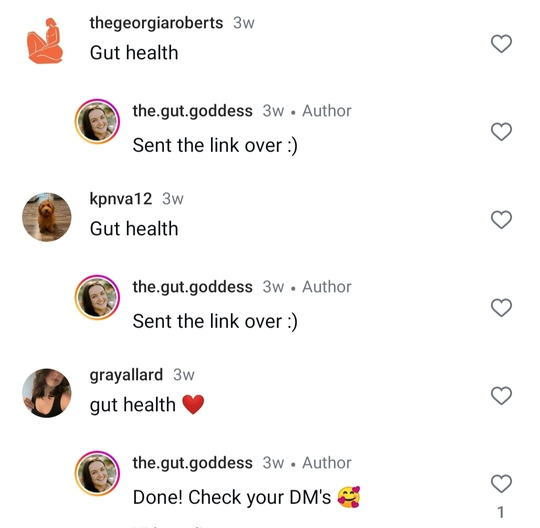 An example of Instagram comment automation
Most Instagram comment automation tools, including ManyChat, Respond.io, and SendPulse, work through Meta’s API or approved third-party platforms built on top of it. When someone comments on your post, the system scans it for trigger conditions, say, a specific word, a question, or a keyword tied to a campaign, and fires the appropriate reply within seconds.
Today’s Instagram comment automation spans several distinct use cases:
- public auto-replies — automatic responses posted directly under comments on your feed posts or Reels, visible to everyone;
- comment-to-DM funnels — a public comment triggers a private message, moving the conversation off the feed and into a one-on-one exchange;
- comment moderation — automatically hiding, filtering, or flagging comments that contain spam, slurs, or competitor mentions, keeping your comment section clean and respectful;
- support triage — routing FAQs to pre-designed flows and flagging complex inquiries for a human agent to pick up.

Engage users on Instagram
Use our drag-and-drop builder to create AI-powered Instagram chatbots that sell, support, and connect. Run campaigns, share updates, and convert leads hands-free.
Get started for free
You can automate your Instagram comments, as long as you do it the right way. It’s worth stating plainly, because the word “automation” still carries baggage from the spam-bot era.
Instagram draws a hard line between two fundamentally different types of automation. Activity-based tools, including auto-likers, bulk-followers, and mass-comment bots, work by faking human behavior directly inside the app and are explicitly banned. In turn, API-based automation is actively supported by Meta.
Auto-commenting has nothing to do with spam. It’s simply an enhancement of “natural” replies. Because the automated comments come from your original account and are context-based, they don’t read as robotic or out of place. This isn’t a bot flooding strangers’ posts with unprompted generic responses. It operates entirely within your own content, from static posts and Reels to Stories and LIVE videos, unless someone proactively tags your account outside of that scope.
When set up well, auto-comments on Instagram are indistinguishable from manual ones, because you’re the one tailoring them to your voice, audience, and specific triggers. It’s a fully legal and Meta-compliant way to manage your comment section at a speed and scale that handcrafted replies simply can’t match.
The short answer is that you can natively automate Instagram comments only partly. Instagram and Meta offer a few free, built-in options, but they won’t help you build an actual comment-to-DM funnel.
- Instagram app. Within the app, the built-in tools are limited to Quick Replies, also known as Saved Replies. They are pre-written messages you can quickly send in a DM using a keyboard shortcut. While they help you reply faster, they don’t send messages automatically and don’t get triggered by anything happening in the comment section of your posts or Reels.
- Meta Business Suite. It comes closest to offering native comment automation. In the “Inbox” section under “Automations,” you can set up instant replies, away messages, FAQs, and a Comment-to-Message automation that sends a pre-set DM when someone comments with a specific keyword. This tool is free and works well for a single campaign, but it limits you to about five keywords per automation, always sends the same message, and doesn’t allow for any advanced settings. Basically, it’s a simple setup: someone uses a keyword, and they get one canned DM.
If you just need a basic keyword-to-DM setup for one post, Meta Business Suite can handle it. If you want more advanced features like varied replies, flexible keyword matching, multi-step DM flows, lead qualification, tagging, CRM sync, or a human handoff, the native tools won’t be enough. That’s where platforms using the Graph API can add these extra capabilities on top of the official system.
Every legitimate Instagram comment automation tool, without exception, operates through Meta’s Graph API. Here’s what you need to know about it.
How IG comment automation works under the hood
When someone comments on your post, Reel, Live broadcast, or Story, Meta’s Graph API sends an instant notification to your automation tool via a webhook. The tool then checks that comment against the rules you’ve set:
- Does it contain a trigger keyword?
- Does it match a specific post?
- Does it meet any other conditions you’ve defined?
If it does, the tool sends an API call back to Instagram, either posting a public reply under the comment, dropping a private DM to the commenter, or both. The whole exchange typically happens in a matter of seconds, and you can adjust that delay to make near-instant replies feel more natural.
Some Instagram comment automation tools only support comments under feed posts, while others also enable you to respond to mentions and reactions to Stories.
Meta’s Graph API comment automation requirements
Any type of approved Instagram automation is only possible with a Business or Creator account. For comment automation specifically, Meta’s Graph API permits the following on your own content:
In all of these cases, the interactions are user-initiated. Professional accounts cannot just start conversations out of nowhere.
Meta’s Graph API comment automation limits
A note on limits as of 2026: Meta reviews and adjusts these thresholds periodically and has steadily tightened its messaging and consent rules over the past couple of years. The figures below reflect the Graph API as it stands in 2026, so treat them as your working baseline, but always confirm the current numbers in Meta’s official documentation before you scale a campaign.
It all boils down to Instagram Business Use Case rate limiting, which governs how many API calls your app can make within a given window. Here are the thresholds most relevant to Instagram comment automation:
- Graph API allows up to 750 calls per hour per account for comment-to-DM replies on posts and Reels.
- You can only send one comment-triggered DM within seven days of when the original comment was posted.
- Follow-up DMs can only be sent if the user responds, and must be sent within 24 hours of the response.
- Private replies to Live video comments can only be sent during the broadcast itself, no more than 100 calls per second per account.
However, Meta also enforces dynamic, impression-dependent ceilings. Because of that, many Instagram automation apps conservatively cap sending at 200 DMs per hour to prevent queuing.
There are some nuances for certain markets and regions, too. For instance, Meta explicitly calls out businesses that serve Californian and/or German audiences — they must disclose upfront that the user is interacting with a bot, not a human.
The payoff of automating your comment section shows up right across the funnel, and the numbers back it up. Here are the key benefits:
- Lead generation and sales. For starters, 48% of brands rank Instagram in their top three for ROI. But the opportunities Instagram provides are only as good as the tools you use to harness them, and the native toolkit offers neither cross-platform handoffs nor conditional branching, not to mention the lack of CRM synchronization.
- Speedy service and support. 60% of Instagram users already interact with brands at least multiple times a week. About a quarter of consumers who regularly spend time on the platform also prefer to use it for their customer support needs. The open nature of comments and DMs makes it more likely that a complaint is noticed and processed quickly.
- Reach and engagement. Creators who reply to comments under their posts tend to see about 21% higher engagement rates on average. Every reply is an investment in a relationship, as it gives the person who commented a reason to come back, stick around longer, and keep interacting with your content.
Moreover, the comment-to-DM conversion specifically is the highest-ROI play of all. A comment or Story reply indicates someone is active right now, and that they liked your content enough to type something. Moving that public comment into a private conversation is where the numbers get serious. By following up on the comment with a strategic, perfectly timed DM, you initiate a direct exchange and bring them closer to conversion.
Instagram DMs are phenomenally good at capturing something most marketing channels never get: users’ undivided attention. They achieve open rates of 85–95%, compared to email’s ~20% average (and even that’s inflated by privacy tools). For the funnel itself, comment-to-DM setups tend to convert better than standard bio links. Put plainly: nearly everyone who receives your DM will open it, and the ones who do are far more likely to act on it than someone who passively clicks a link in your bio.
Finding the right tools is just half the battle. The real question is how you configure them. Let’s go through the dos of automated comments on Instagram:
- Reply within the first hour of a comment being posted. Instagram’s algorithm treats early engagement as a signal of content quality and pushes it to more users. Automation allows you to deliver sub-minute response times at any volume, and the delay can be set individually.
- Use keyword triggers that match what your audience already types. If your followers ask “how much?” or “where can I get this?” set those phrases as triggers instead of guessing at formal language. This makes the automation flow feel less contrived.
- Vary your automated replies to avoid repetition. Seeing the exact same response under every comment is a dead giveaway that it’s a bot. Most tools let you rotate between several response variations or even have AI rewrite each comment.
- Match the casual, conversational tone Instagram users expect. Corporate, stiff replies may sound off-putting to average social media users looking for easy chats and entertainment. Contractions, emojis, cultural references, and the occasional question back to the commenter are better suited for the platform.
- Use public auto-replies to confirm that a DM is on its way. When a keyword triggers a comment-to-DM flow, post a brief public reply (“Sent! Check your DMs 👀”) to close the loop and signal to everyone else that you’re staying on top of things.
- Keep automated replies specific to the post or campaign. Tying the reply to a product, a topic, or a specific offer makes the interaction feel intentional rather than templated.
- Give people a reason to reply in DM. A comment-triggered DM only keeps the conversation open if the person taps a button or writes back, so your first post-comment DM has to include quick replies or a continue-flow button that invites a response. A link-only button doesn’t open that messaging window, so without a genuine reply prompt, the conversation closes before it starts, and the lead is lost.
Here are some crucial don’ts of Instagram automated replies to comments:
- Don’t waste your one Private Reply on a greeting. The Graph API only allows one automated DM per comment, so make it count. Lead with the asset, link, or information the person actually asked for.
- Don’t end the first DM without a reply prompt. A DM with only a link or with no buttons at all doesn’t open Instagram’s 24-hour messaging window, so you won’t be able to follow up. Always give people a quick reply or a continue-flow button to click so the conversation stays open.
- Don’t drop multiple questions at once. Asking three or four things in a single automated message is a fast way to get no response at all. One question per message, and wherever possible, make it a forced choice.
- Don’t use vague trigger keywords. Generic keywords like “info,” “help,” or “yes” cast too wide a net and fire on irrelevant comments, revealing unpolished automation. Use specific, action-oriented keywords like “PRICE” or “LINK” that signal real interest.
- Don’t skip tagging and tracking. Keep a tight set of six to eight intent and outcome tags, and review what’s converting weekly.
- Don’t let automation handle high-intent or complex conversations solo. The moment someone asks a nuanced question or signals they’re close to a purchase decision, the human should step in and take it from there.
- Don’t leave it running unattended. Set up alerts for unusual spikes in activity. A news event, a viral misquote, or a sudden wave of negative comments can make a cheerful automated reply land badly in a matter of minutes.
Thankfully, most Instagram comment automation software lets you run test flows and apply conditions, filters, and delays for more natural and spot-on messaging.
The mechanics are easy enough to understand in theory, but the real value becomes obvious once you see how creators and businesses are actually using it day to day. That’s why we’ve put together these real-world Instagram comment automation examples.
Lead magnets and free resources
Distributing lead magnets through Instagram comment automation has little in common with the traditional email opt-in route. Instead of pulling someone off the platform, sending them to a landing page, and hoping they complete a form, the entire exchange happens inside Instagram — where they already are. The barrier to entry is a single comment.
In practice, it looks like this. A fitness coach posts a Reel demonstrating a mobility drill, which ends with a single CTA: “First 100 commenters get a free routine.” The moment someone types the keyword, the automation kicks in. A public reply confirms the freebie is on the way, and a DM delivers the PDF link within seconds.
 Instagram comment automation for lead magnet distribution
The scarcity cap makes the comments spike in the first hour, which signals high engagement to Instagram’s algorithm and pushes the Reel to more non-followers. In turn, the coach collects 100 warm leads without answering a single message manually.
Product launches and direct sales
Since many Instagram users already browse with a buying intent, comment automation can be just as effective for moving them straight into a sales conversation. The person commenting is already emotionally invested in what they just watched, which makes them more perceptive to your offer, given that it arrives instantly.
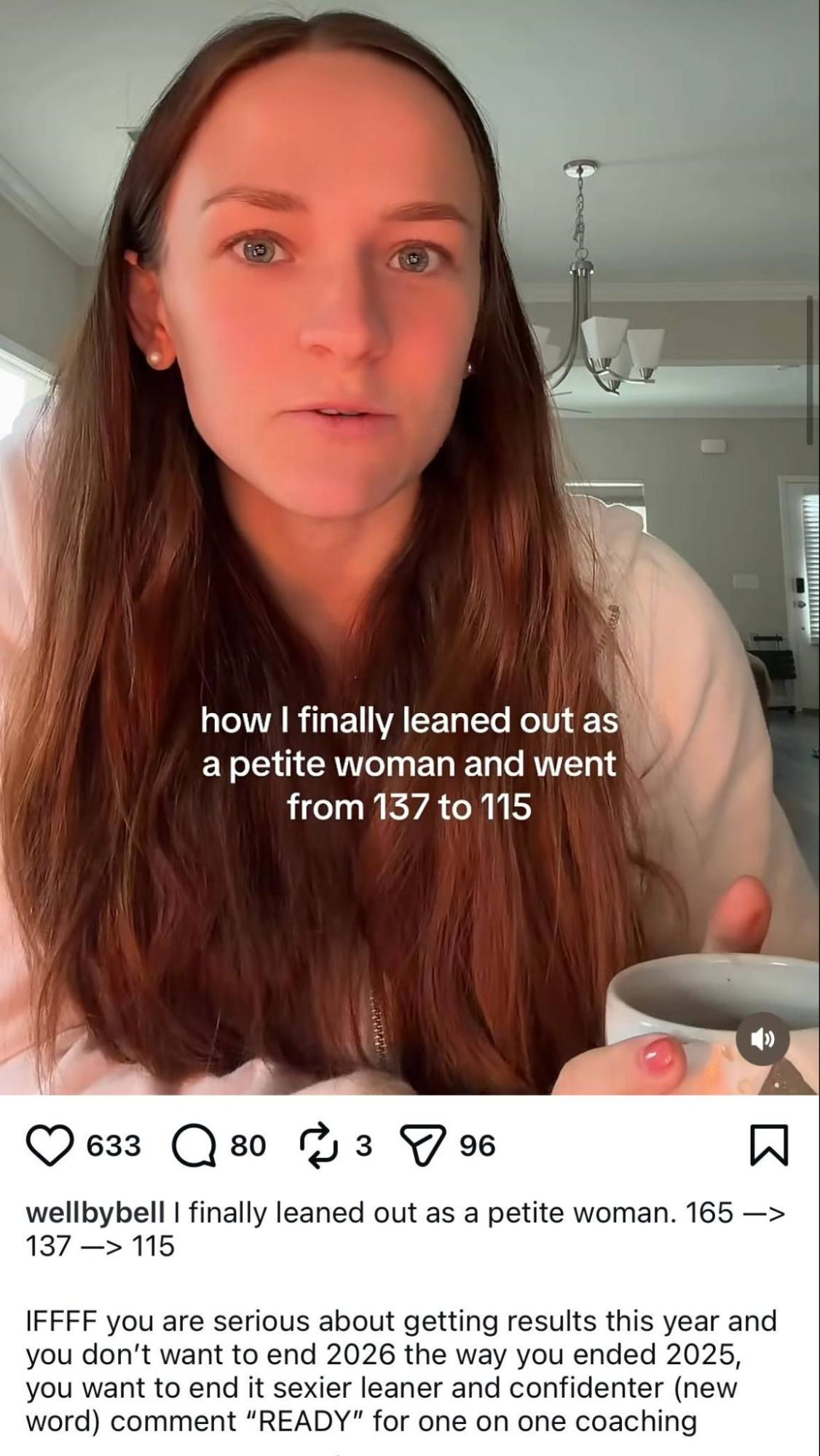 Instagram comment automation for direct sales
A nutrition and lifestyle coach posts a video walking through her own weight-loss journey — the struggle, the turning point, the result. At the end, she invites viewers to comment “READY” if they want to book a session with her.
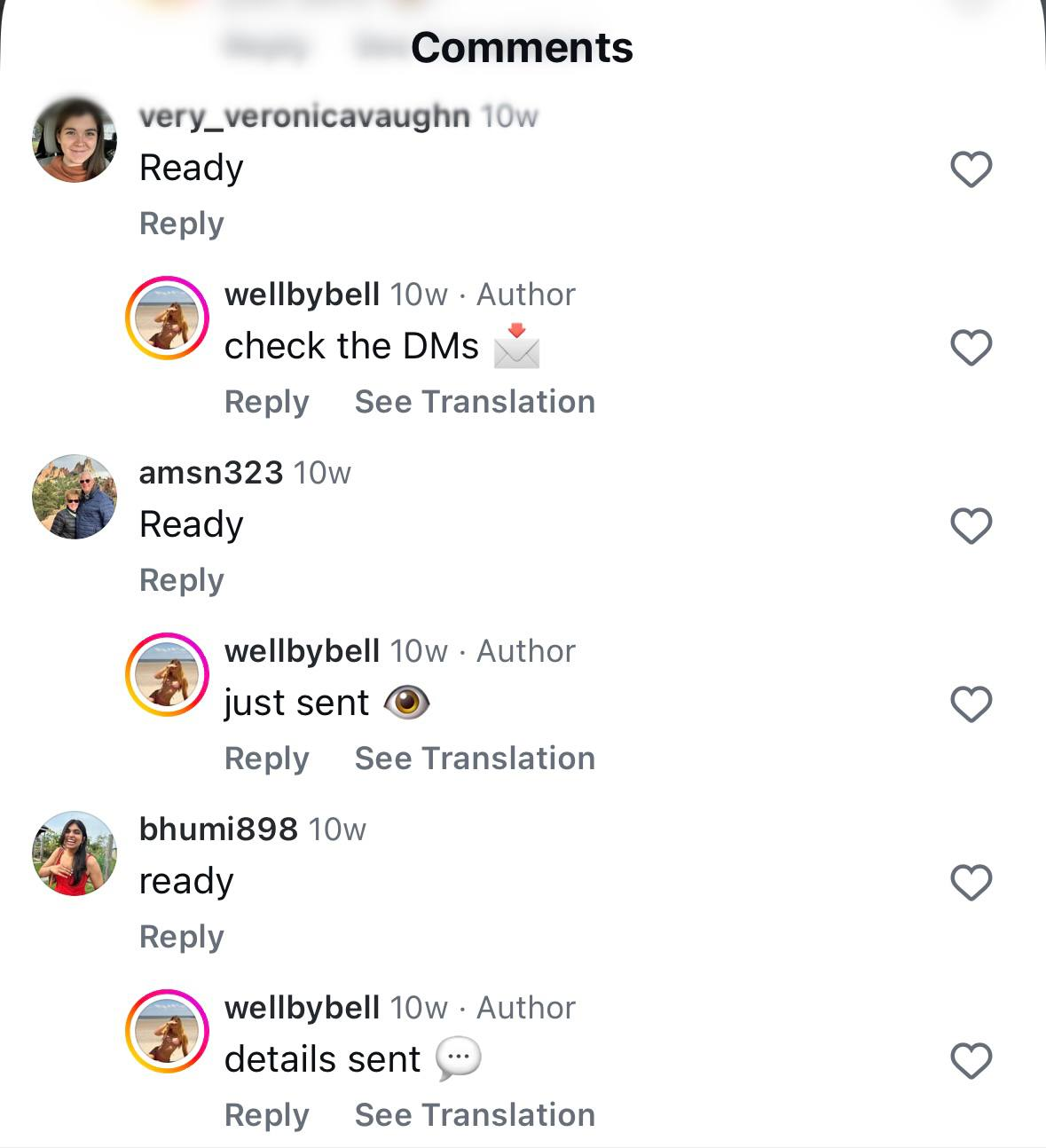 Instagram comment automation for distributing booking details
The automation fires while the emotional impact of the video is still fresh. As a result, the conversion is far higher than it would be if that same viewer had to go searching for a contact form later.
Giveaways and contests
Giveaways are one of the oldest growth tactics on the platform, but pairing them with Instagram comment automation is something more sustainable. Instead of manually tracking hundreds of entries and replying to confused commenters asking if they’re “in,” automation handles confirmation in real time.
Wonder Bread ran exactly this kind of campaign: a giveaway post asking followers to tag friends in the comments to enter, with a tight, clearly stated deadline. The tag mechanic meant every entry brought new eyes to the post — each tagged friend got a reason to check it out, boosting visibility without any ad spend.
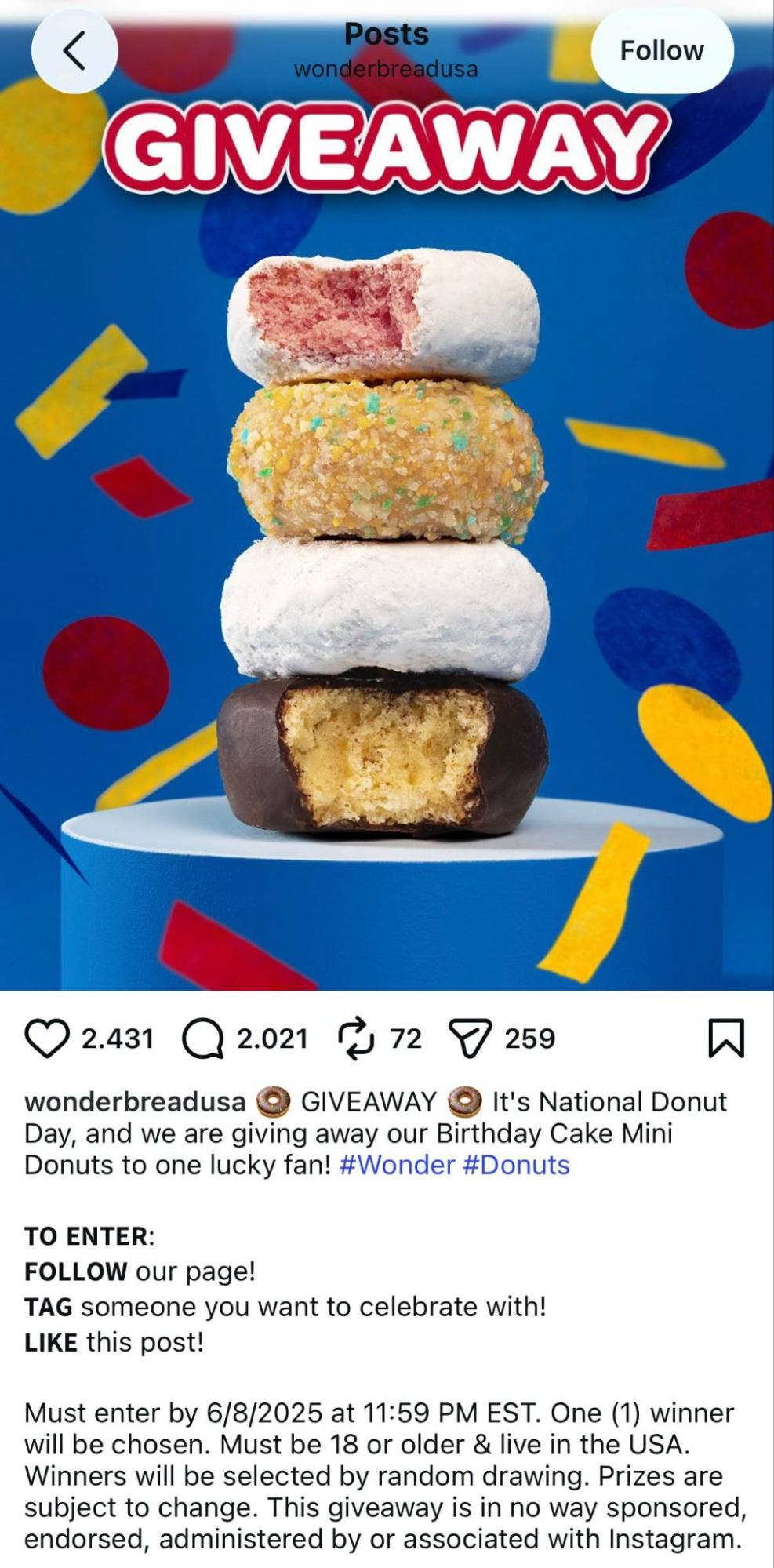 Instagram comment automation for giveaways and contests
In addition, comment automation confirmed entries publicly as they came in, which reinforced to anyone watching that the giveaway was active and real.
Webinar and event registration
Another popular use case for Instagram automated comments is promoting events like challenges, webinars, or workshops because it removes the lag between someone seeing the invite and actually signing up.
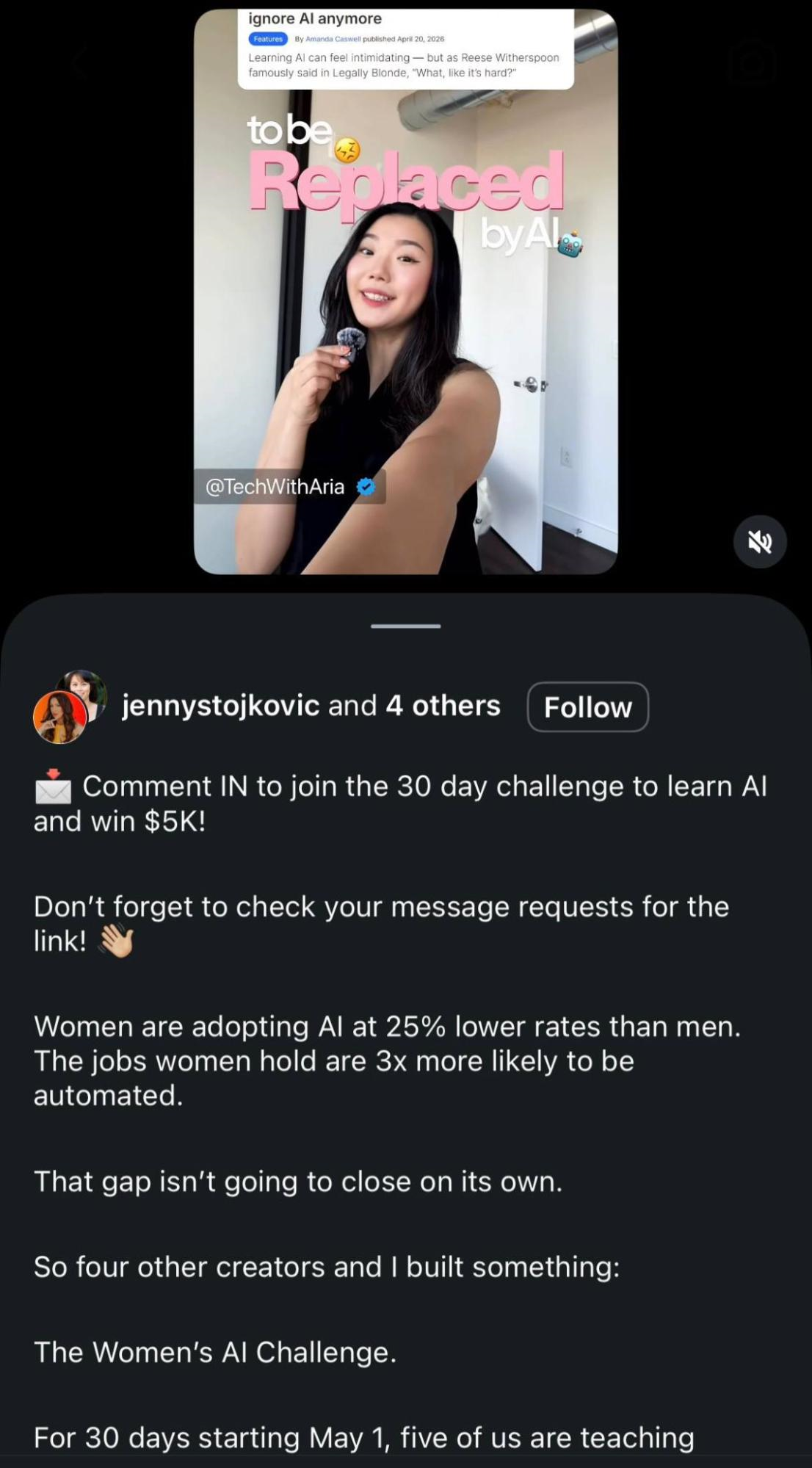 Instagram comment automation for event and webinar sign-ups
In this example, a career and networking coach posts an invite for a 30-day “Learn AI” challenge aimed at women in her audience, asking interested followers to comment a keyword to join. The offer works because her audience is already paying attention: they’ve been getting consistently useful tips from the creator, so when she shows up with a structured offer, there’s trust.
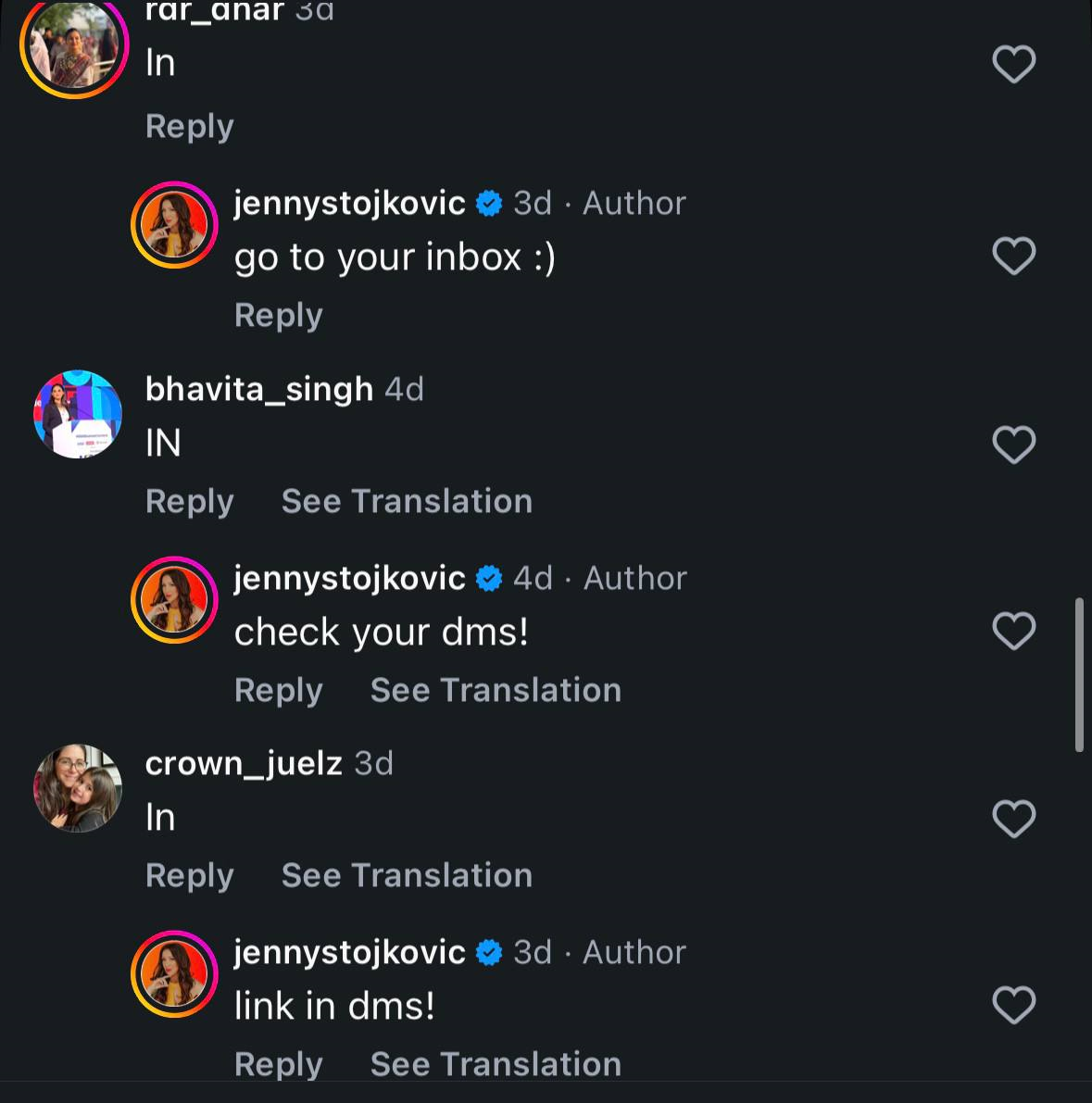 Instagram comment automation for promoting events
The automation just makes sure that the moment someone says yes, the registration link and challenge details land in their DMs before the interest fades.
Customer support and FAQs
Comment sections are public by nature, which makes them a poor place to actually resolve anything sensitive. But that’s where people instinctively go first to get a brand’s attention fast.
ASOS’s Instagram comment automation bridges that gap. It catches the publicly flagged issue (brand impersonation), acknowledges it immediately, and pulls the conversation into a private channel before any sensitive detail gets typed out in front of thousands of strangers. From there, it gets potentially rerouted to a human agent equipped to deal with fraud.
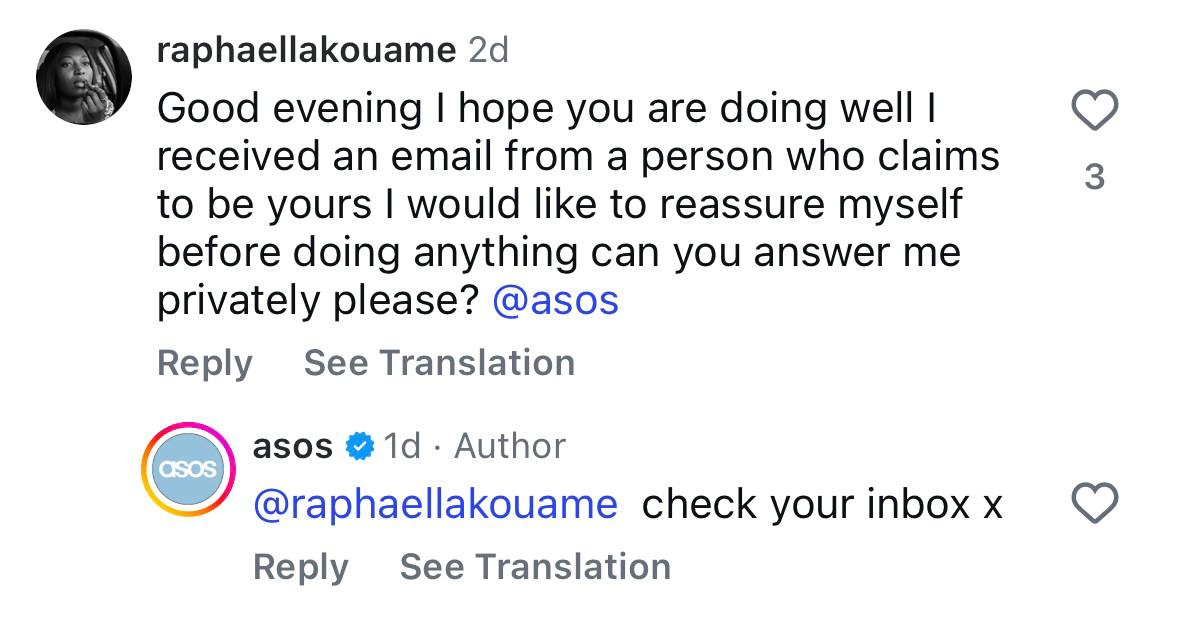 Instagram comment automation for support and FAQs
To make these use cases work, you need more than Instagram’s built-in tools. They require a dedicated platform. If you’re comparing options or just want to see what a strong solution looks like, here’s what sets a real automation platform apart from a basic auto-responder. This is the standard the rest of this guide will use.
- Official Graph API connection. This is a non-negotiable. If a tool promises comment automation without a Business or Creator account and API access, it’s operating in banned-bot territory.
- Reply variations. A tool that posts the identical reply under every comment outs itself as a bot instantly. Choose one that rotates replies. Also, look for a tool that lets you incorporate AI to respond in your brand voice in case the conversation keeps going after your first automated DM.
- Coverage beyond feed posts. The strongest tools also trigger on Reels, Stories mentions, and reactions.
- Flexible keyword matching. Relying only on exact keyword matches can cost you leads.
- Multi-step DM flows with branching. Look for features like buttons, quick replies, and conditional logic, so the conversation changes based on what each person chooses.
- Tags, variables, and CRM sync. Every lead should be captured, segmented by intent, and available for follow-up, not left behind in your DMs.
- A clean human handoff. The tool you choose should offer a reliable way to route high-intent or sensitive conversations to a real person.
- Omnichannel reach. It’s even better if the platform also supports other communication channels like WhatsApp, TikTok, or email, so your Instagram data isn’t isolated.
SendPulse checks every one of these boxes, which is why the rest of this guide uses it to walk through a full setup.

Power up your business with smart tools
From solo creators to global brands, thousands of customers trust SendPulse to run email campaigns, chatbots, automations, and more — all in one place.
Get started for free
A comment-to-DM flow only works if every piece of it is built deliberately, from the trigger to the fallback. The good news is you don’t need any special skills to set up your first automated Instagram flow. SendPulse gives you easy-to-use visual tools powered by AI, so you can control each step as you go.
To show you how it works in practice, we’ll build a comment-to-DM flow from start to finish, turning a comment on a balayage post into a new follower.
Get the basics in order
To use Instagram automation, you need a Business or Creator account. If you haven’t switched yet, open the Instagram app and find this option in your profile settings under “Account type and tools.”
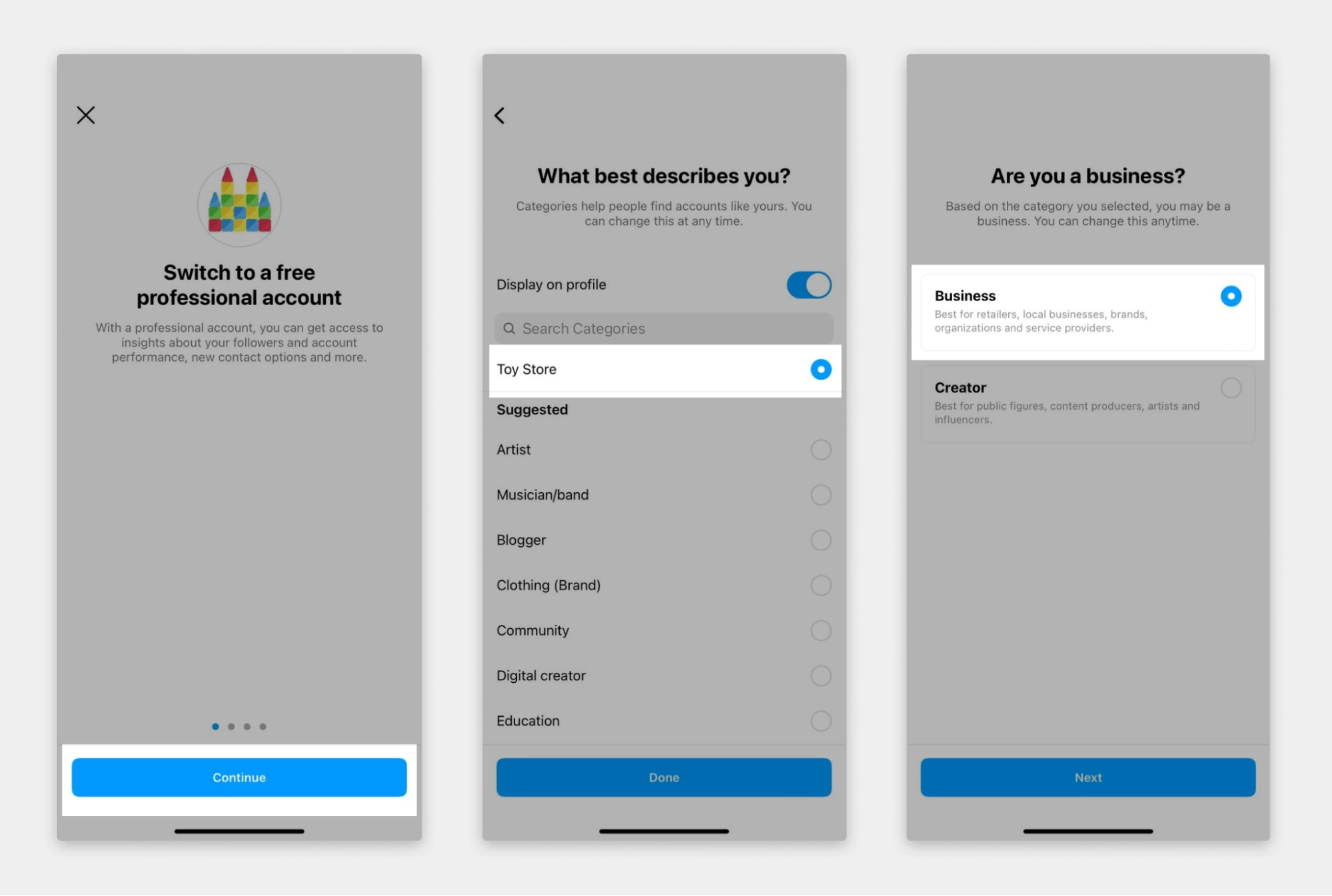 Switching to an Instagram Business account
Next, get three things ready for your comment-to-DM flow: the trigger keywords, your first DM asset (a lead magnet, coupon, or link), and the post you’ll use.
Connect Instagram and build your base flow
To set up Instagram automation, connect a new chatbot with your Instagram account or through Facebook Business, and allow the app to access your messages. You’ll also need a second personal Instagram account to test your chatbot.
Our help center has a checklist for troubleshooting Instagram bot connection issues.
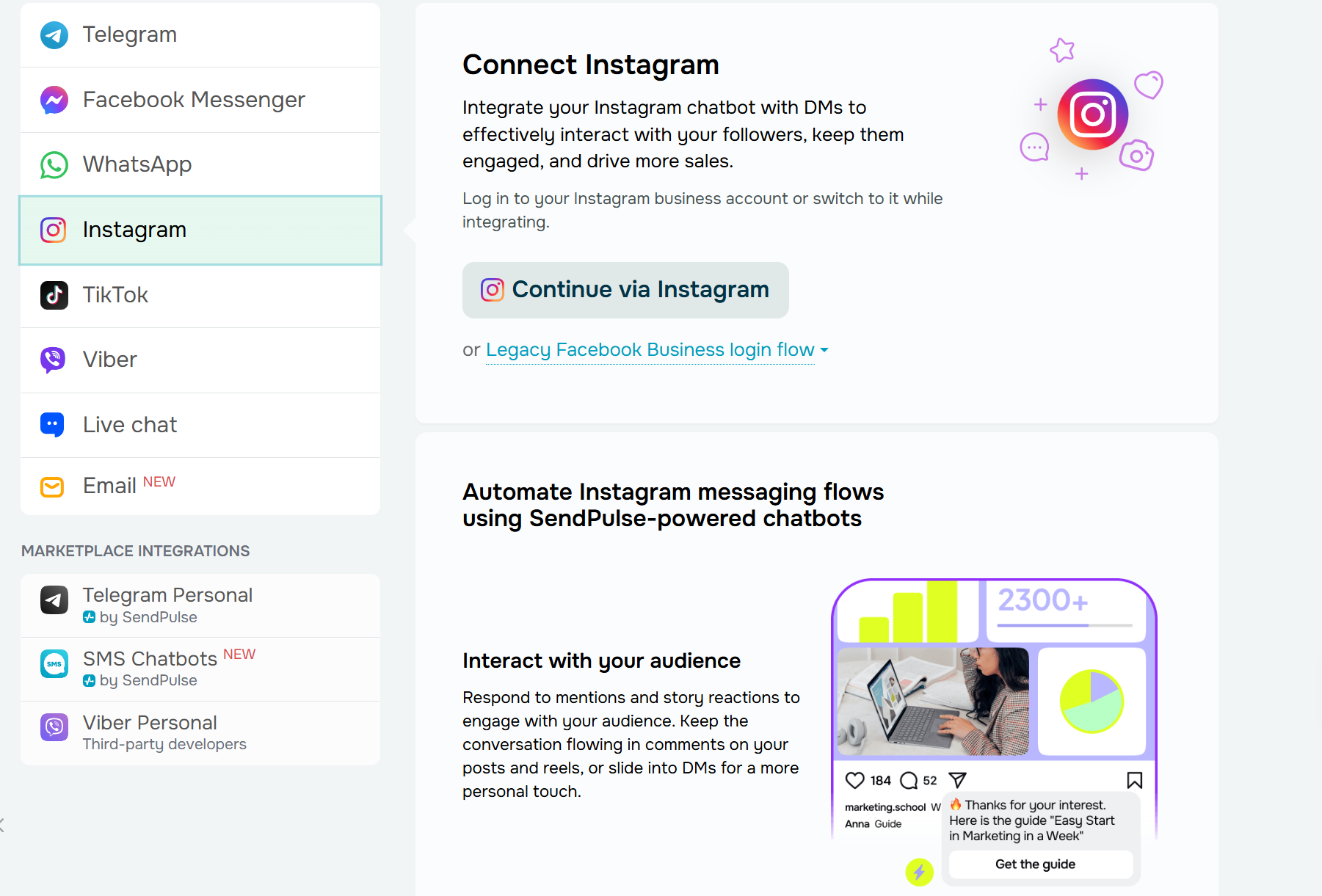 Connecting your Instagram Business account to SendPulse
Once you’re all set, go to “Chatbots,” select your Instagram bot, and click “Create a flow” under the “Flows” section. It makes sense to customize the “Welcome message,” “Standard Reply,” and “Unsubscribe” flows before your bot goes live. The visual chatbot builder allows you to lay out and rearrange the logic of each flow easily.
Choose a trigger
Not every post should trigger the same way, and picking the wrong trigger type is one of the fastest ways to either miss leads or spam your whole audience. There are three main approaches:
- Any-comment triggers fire on literally any comment, regardless of content. Use this sparingly, since it’s best suited for simple acknowledgments (“thanks for the comment!”) or for posts where you want to capture every single entry, for example, during giveaways.
- Keyword-triggered flows only fire when a comment contains a specific word or phrase (“PRICE,” “GUIDE,” “READY”). It filters for intent, so you’re only engaging people who’ve actively signaled interest.
- Campaign-specific triggers are flows limited to a single post or a small set of posts, often with their own unique keyword, tracking, and DM sequence. Use this when running a specific promotion, challenge, or launch separate from your evergreen content.
For our flow, we’ll go with a campaign-specific trigger. To set it up, head to “Chatbots” and choose your bot. Click “Create a new trigger” and choose the “Comment on your post or reel” one. You can select specific posts that are part of your lead capture campaign and specify the exact trigger keywords that should fire the comment automation flow.
In this example, we’ll use the balayage post, set a single keyword “LOOKBOOK,” add a few rotating public replies, and set a throttle so repeat commenters don’t get spammed.
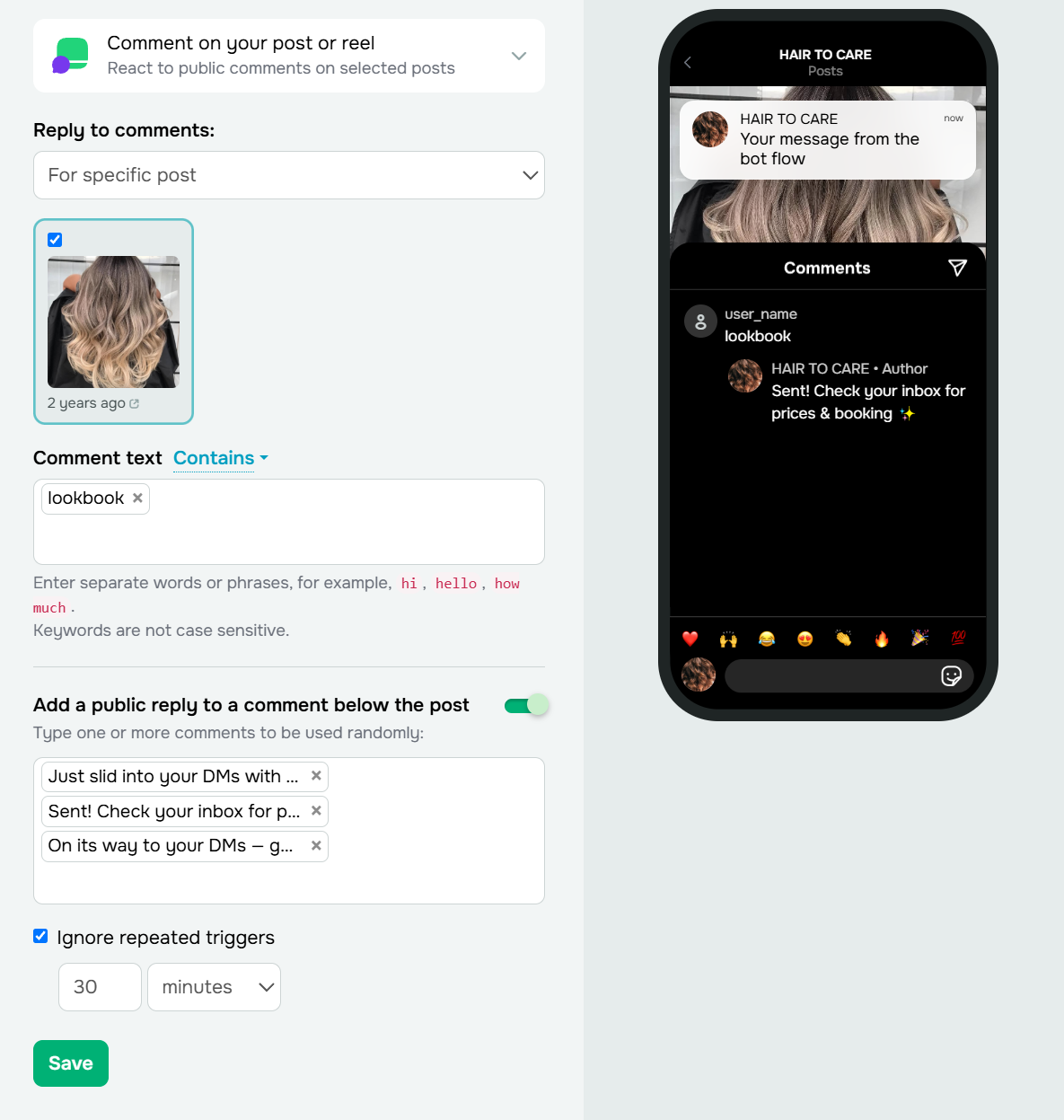 Setting up a “Comment on your post or reel” trigger in SendPulse
A few touches keep your public reply from reading like a robot: write up to ten variations, add a short, randomized delay before the public reply posts, and match your actual tone, since contractions, emoji, and short sentences beat stiff corporate copy on Instagram.
Think about all possible scenarios: for instance, what happens if someone mistypes the keyword. “LOKBOOK” instead of “LOOKBOOK” won’t match an exact-string trigger, so use flexible matching or add the common variants.
Write the first DM
Meta allows your first private reply to be one message with either a button or several quick replies. Make it earn its keep. In our flow, the first DM tells the commenter their lookbook is on the way and offers one quick reply to tap: “Great, send it! 💛”.
This automated DM is meant to earn that tap, because Instagram opens the conversation window only after the person replies or taps. No tap, no lookbook, so keep it to one clear action. When a user clicks, they subscribe automatically, and you can continue the conversation.
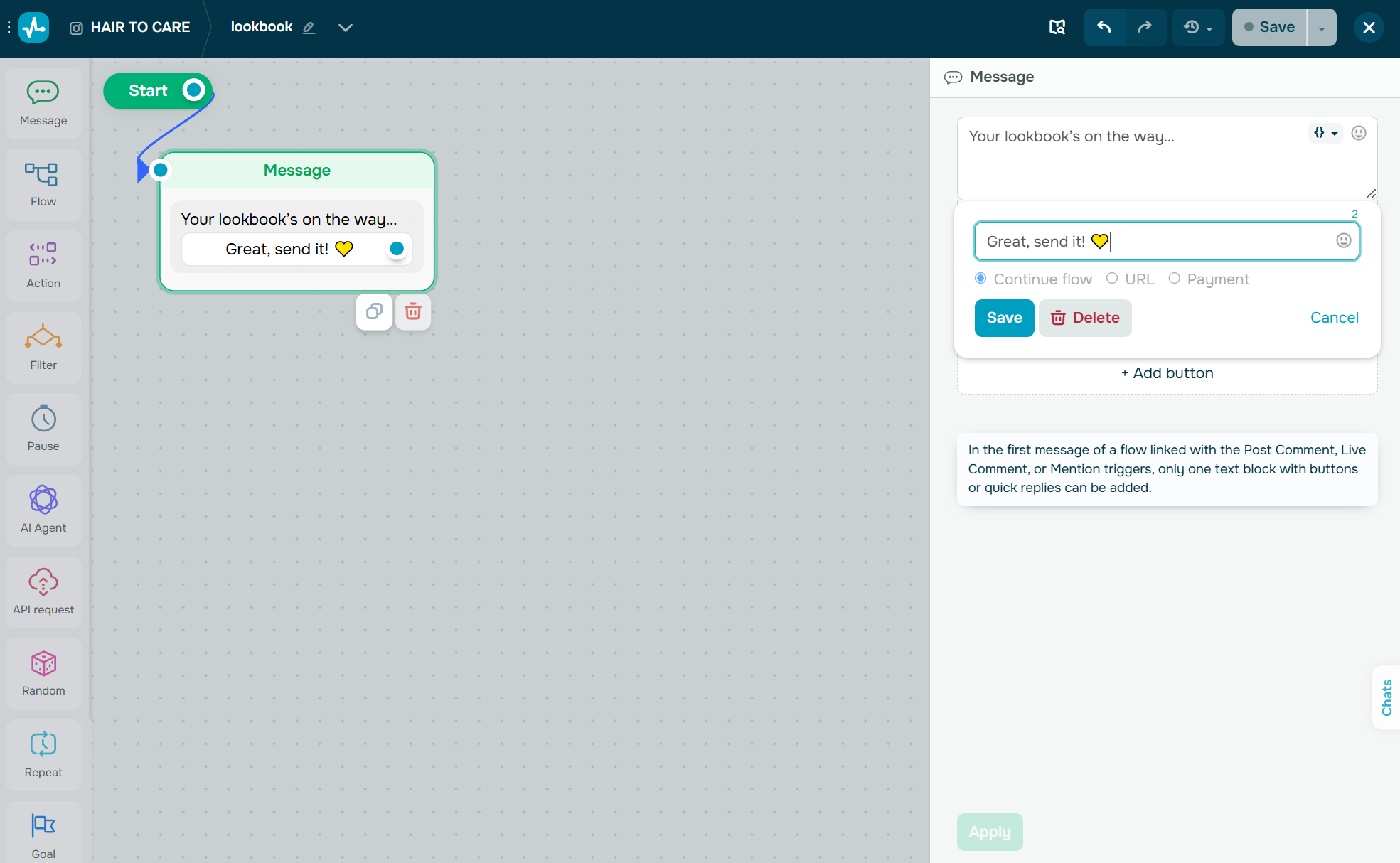 The first DM consists of one message and one quick reply built to earn a click
Then, the flow goes straight to a single check that actually matters: do they already follow you?
Add a filter and check the Instagram profile follow
Add a “Filter” element right after that first reply and choose the “Follows your page” condition. Followers get the lookbook and their first-timer code delivered behind a “Get lookbook” button right away. Everyone else is prompted to follow the page and click “Done” to unlock it. The “Done” button also loops back into the “Filter” to re-check the condition.
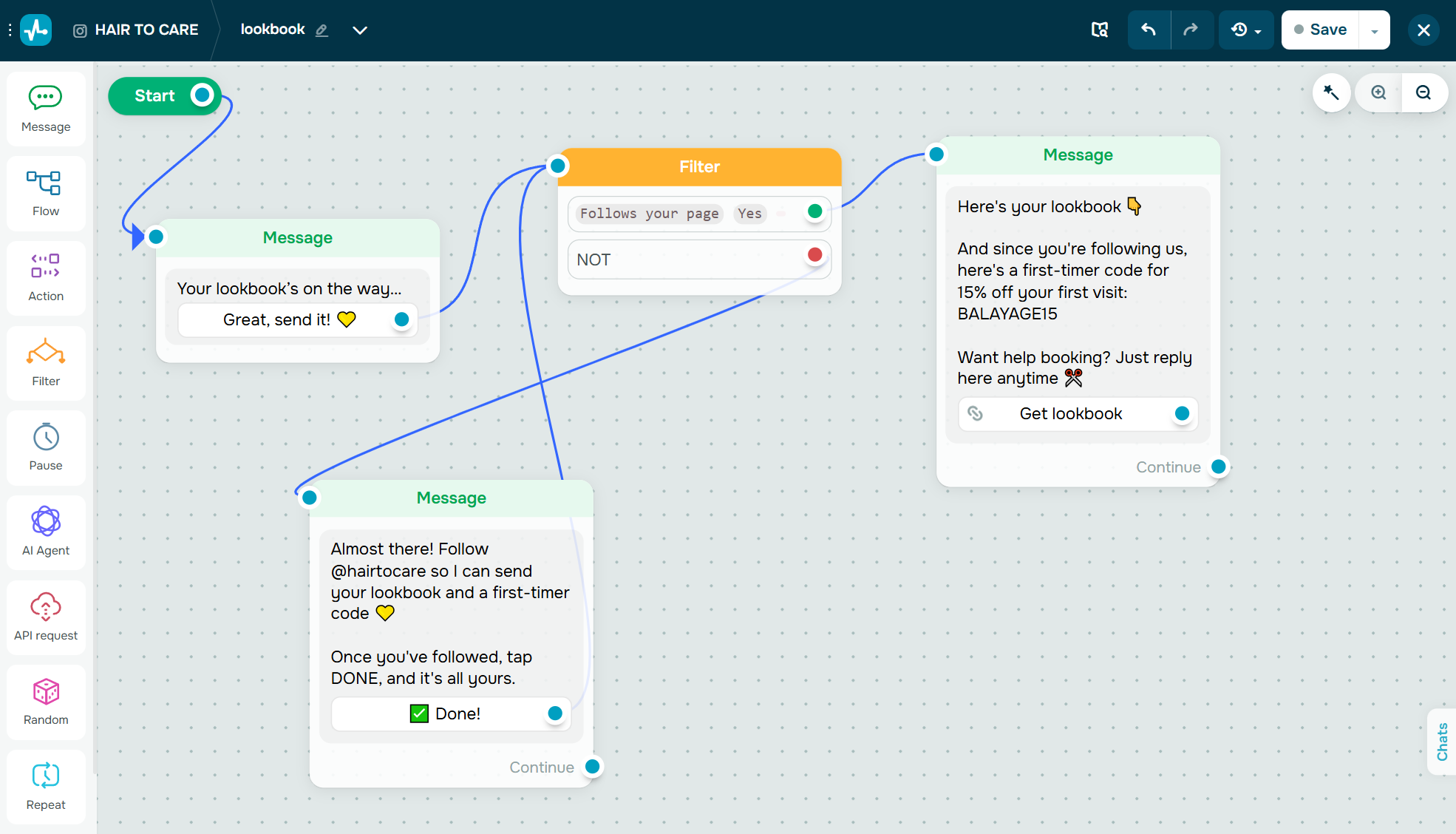 Delivering the lookbook behind a “Follows your page” filter condition
That’s basically everything you need to launch the comment-to-DM automation.
Take the flow further (optional)
The lookbook doesn’t have to be the end of the conversation. Since the person has already clicked to get it, the 24-hour window is open, and you can hand them into a second flow to keep going. In our example, we’ll nurture leads toward a booking.
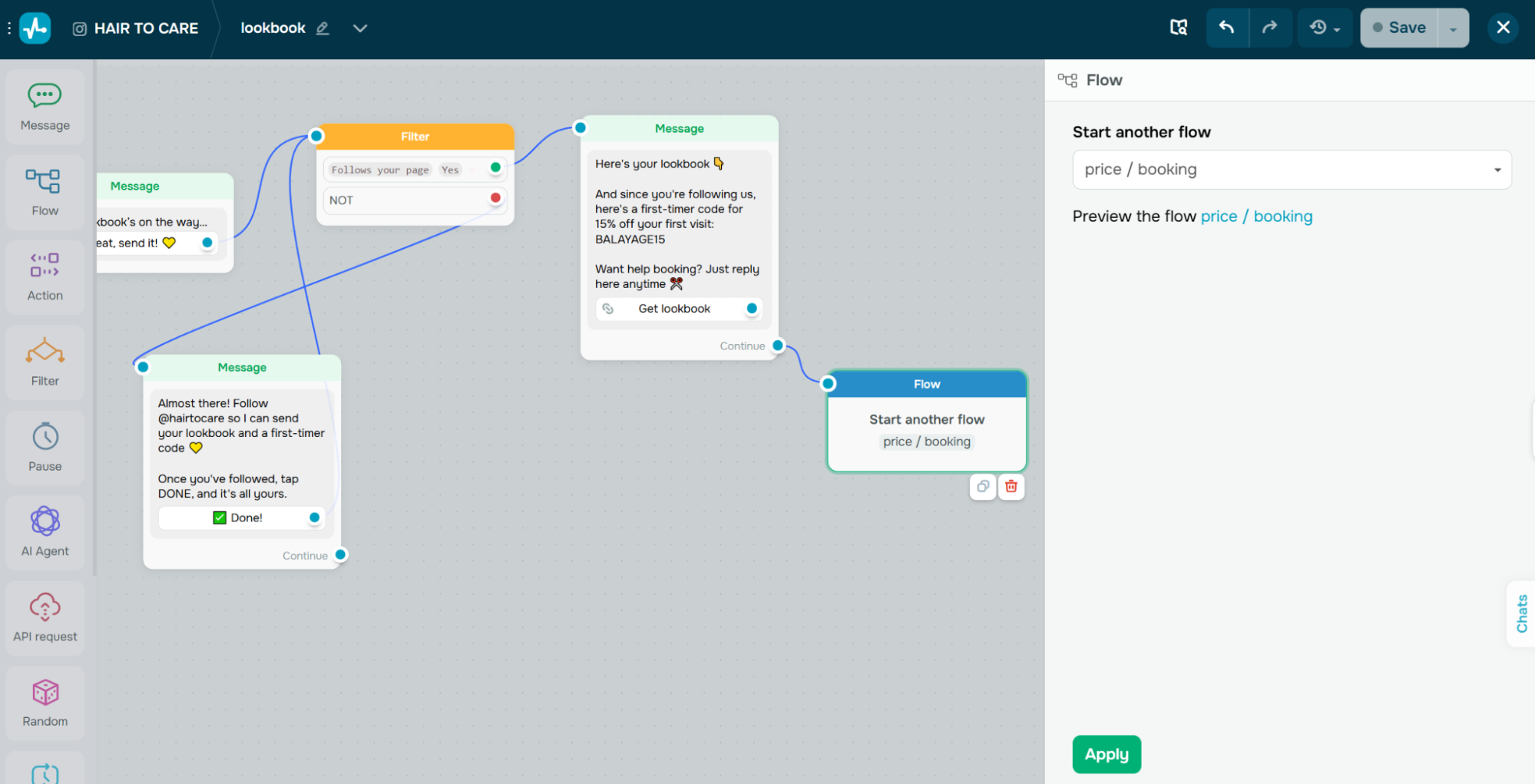 Expanding into the booking flow using a “Start another flow” step
Here’s what that second flow can do, and when each piece is worth adding.
Hand your highest-value leads to a human
The second flow starts with a quick “where are you at?” question; the branch comparing prices then lets people pick a budget. From there, the bot shouldn’t handle everything. The higher the intent or the price, the sooner a real person should step in. Build explicit handoff rules for complaints or anything emotionally charged, high-intent or high-value prospects, and questions the chatbot can’t confidently answer.
In the example below, a budget question tags each lead, and the top tier is handed straight to a stylist with the “Open the chat” action, which moves the conversation into your “Chats” inbox and pauses the bot, so your team can take over without interruption.
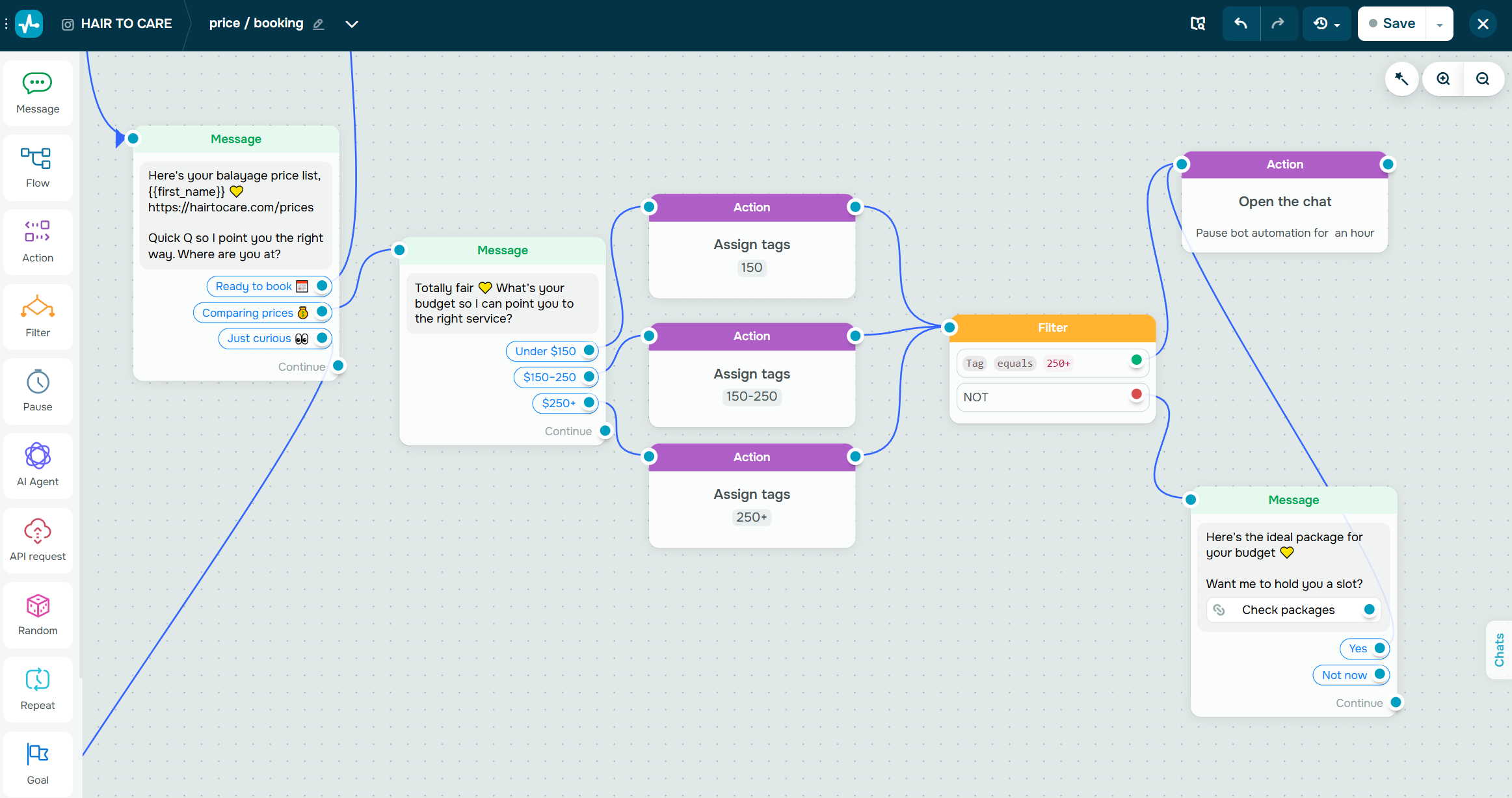 A budget question routes the highest-budget leads right to a stylist
Let an AI agent take the open-ended questions
Once the conversation window is open, you can hand the free-form questions to an AI agent instead of scripting every reply. You give it instructions and a goal that doubles as its exit condition (say, the person wants to book or asks for a human): when the goal is met, it routes them onward; if they go quiet, a timeout can trigger a gentle re-engagement. It’s the one spot AI fits a comment-to-DM flow — remember it can’t power the first DM, only the conversation after that first tap or reply.
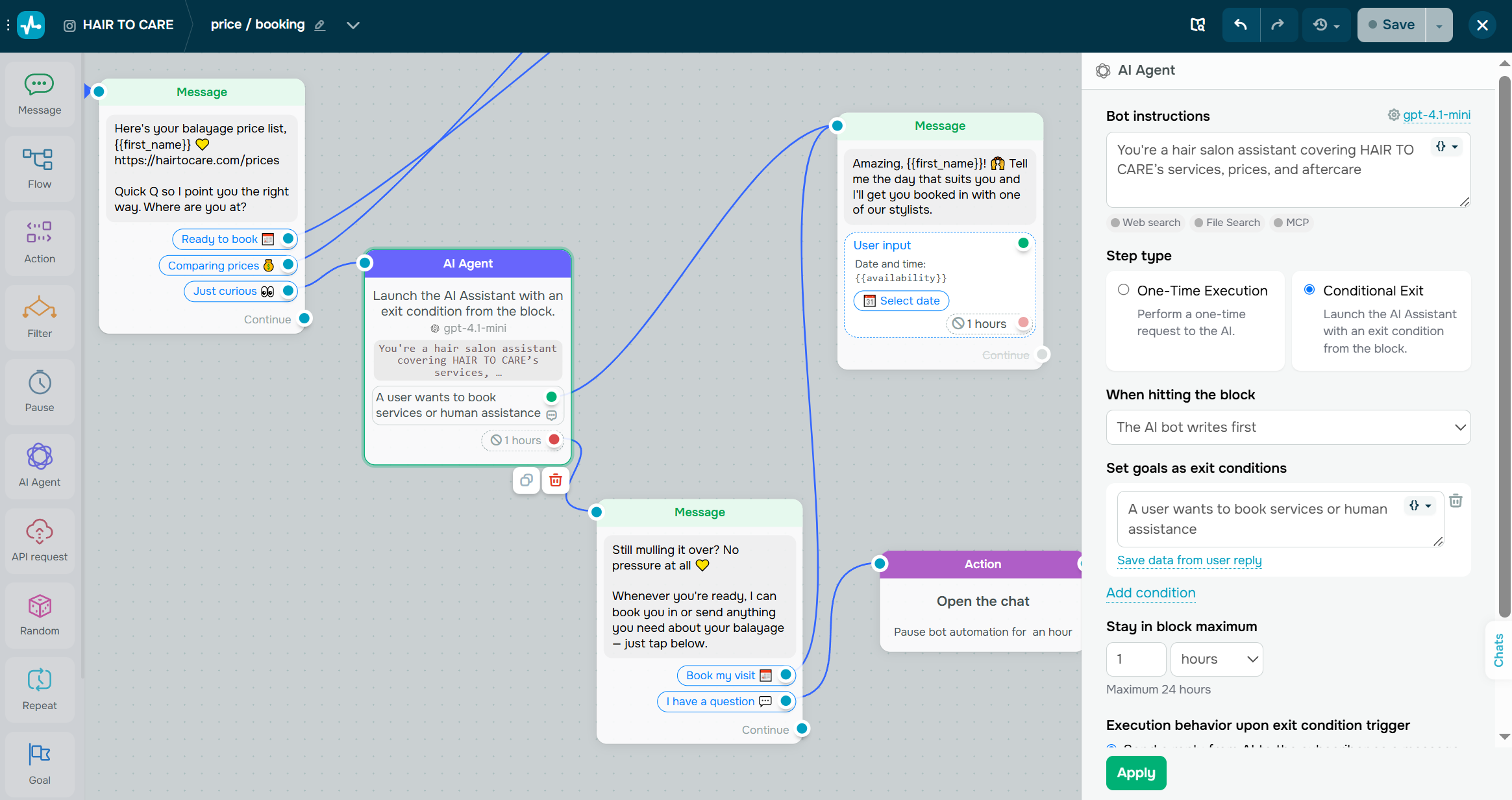 An AI agent engages with leads, routes them onward, and re-engages quiet ones
Turn qualified leads into CRM deals automatically
When someone books a time or clears a budget bar, you can create a CRM deal right from the flow. An “Action” set to “Create deal” drops them in the pipeline you choose, assigned to the right person, and ready for your team to work like any other deal.
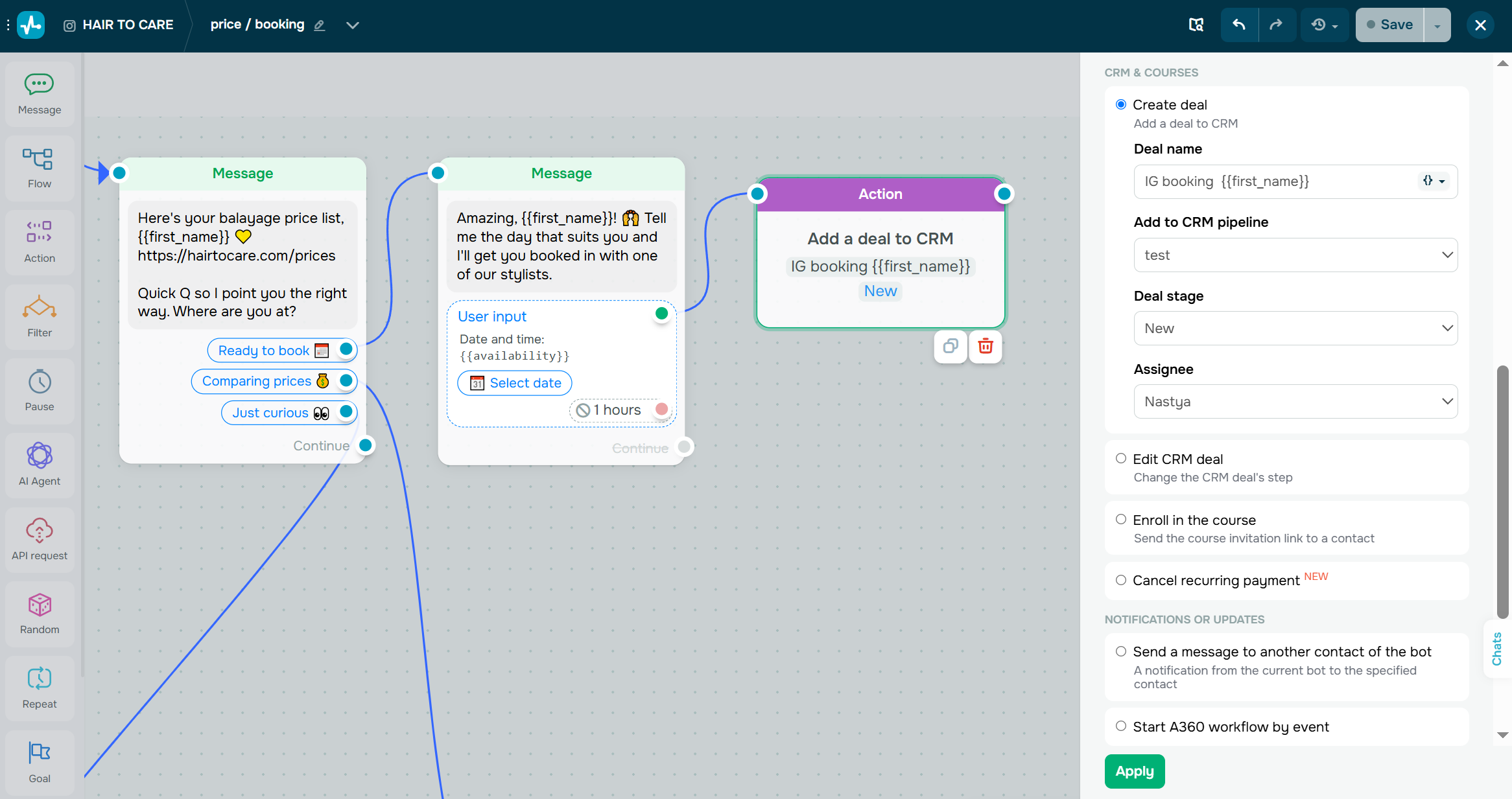 A new CRM deal is created when a lead books from the flow
Go live and test
When your setup looks good, turn on the Instagram trigger and test it yourself. Use your second account to comment with your keywords. You’ll see the public reply under the post and get a DM within seconds.
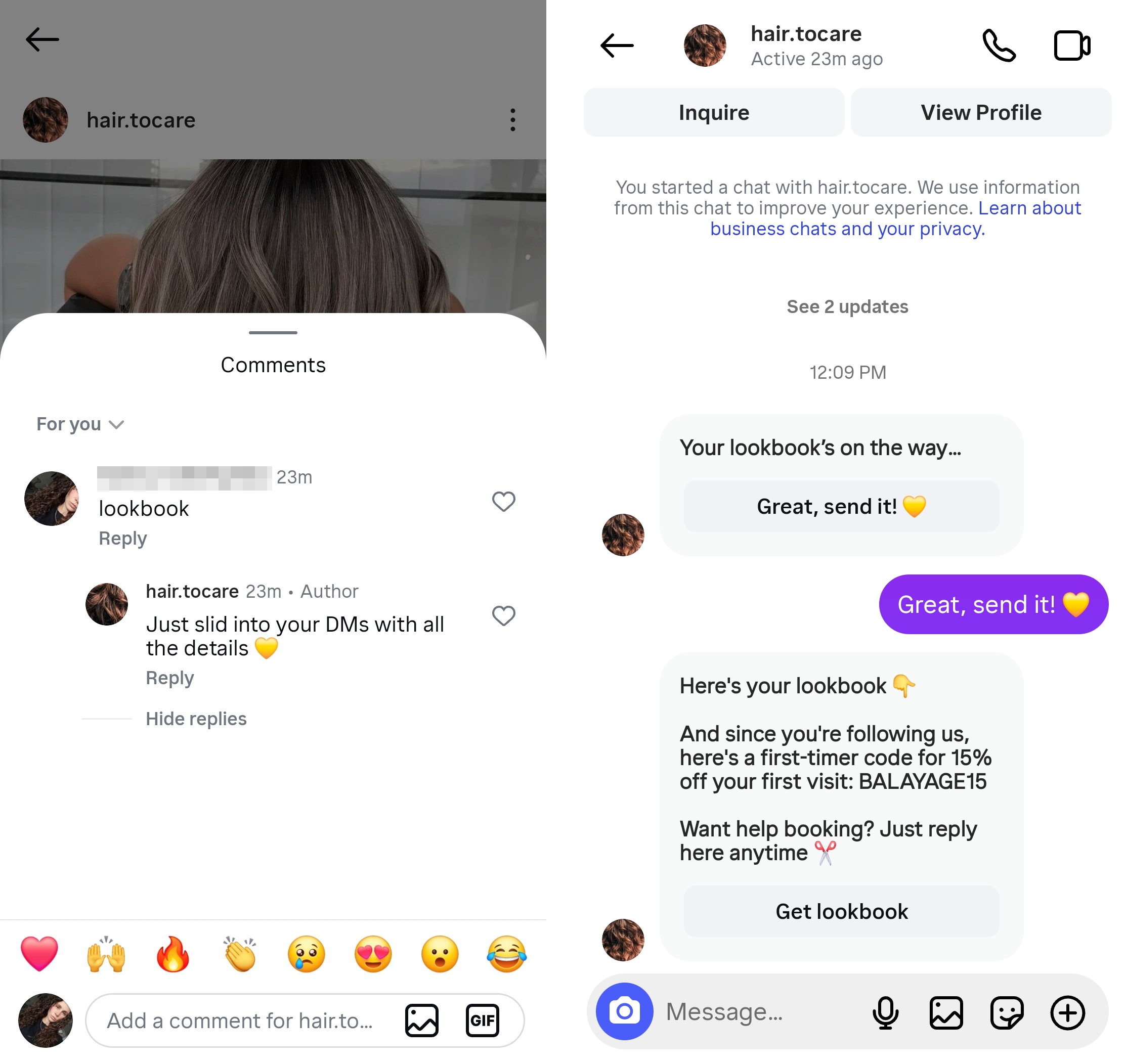 A comment under the post triggers the public reply and DM within seconds
You can watch the whole conversation in the “Chats” inbox. The lookbook and first-timer code are delivered to followers, and non-followers get the follow-to-unlock nudge.
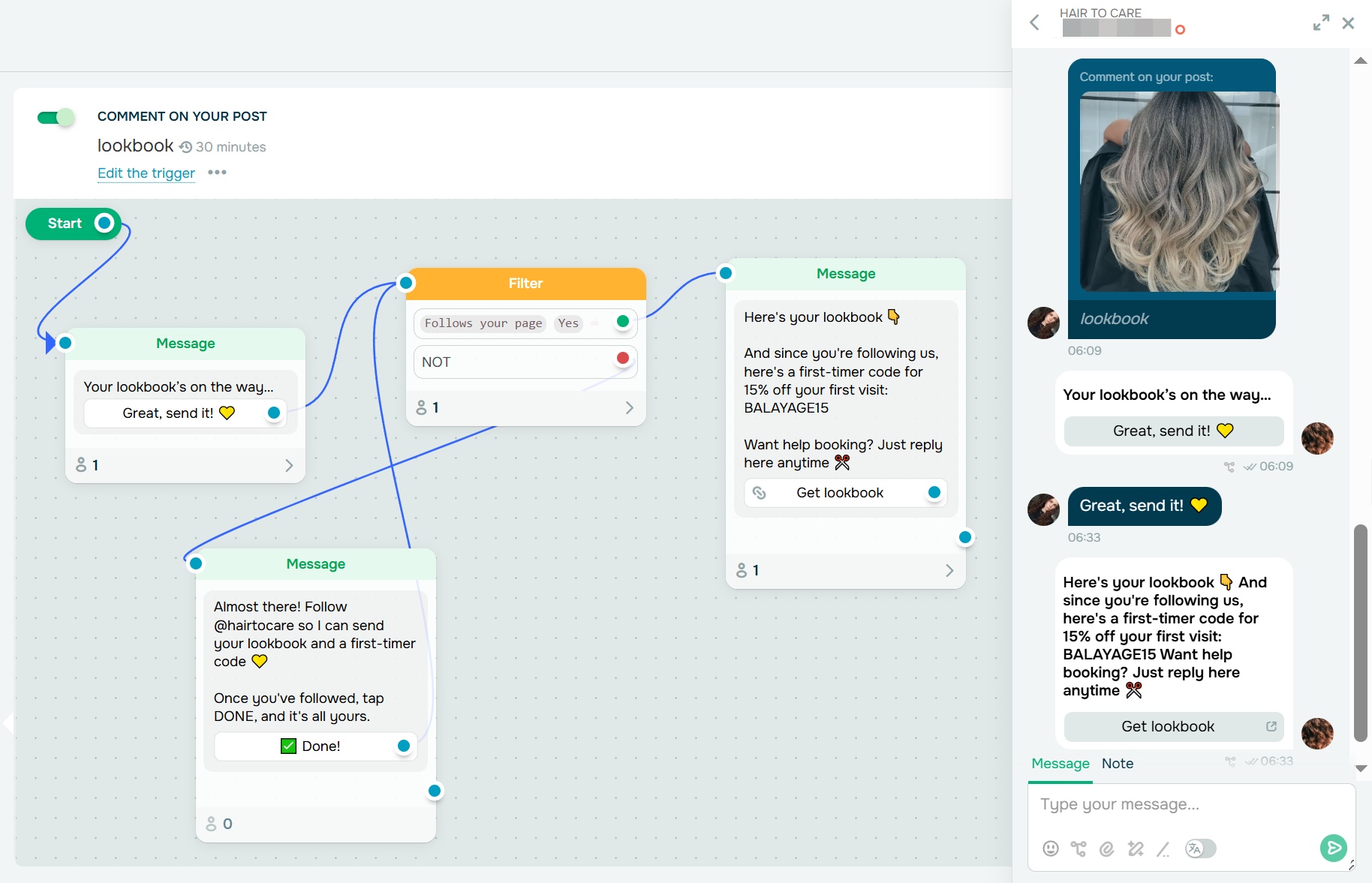 The flow preview on the left, and the live DM it produces on the right
Analyze results
Without proper visibility into your Instagram comment automation, it’s impossible to tell if it works as intended or only adds noise. Here are some key metrics to track:
| Metric |
What it means |
| Profile followers gained |
How many people actually followed your profile through the subscription-check filter to unlock the offer |
| Comment-to-DM rate |
What % of triggered comments actually result in a successfully delivered DM |
| Reply rate |
Whether your first DM earns engagement |
| Click rate (with UTMs) |
Which specific posts and campaigns bring the desired traffic |
| Qualified leads |
How many users made it through your branch logic and earned the “qualified” tag |
| Conversion rate (synced back to your CRM) |
How many qualified leads became bookings, sales, or sign-ups |
| Human handoff rate |
Whether the automation actually saves you time and resources |
Any links you share in DMs should be equipped with UTM parameters, namely source, medium, and campaign tags that let you trace every click back to the specific post, keyword, and flow that generated it.
79% of customers expect seamless communication with a brand across departments. Achieving that is only possible if you have a single source of truth, and that’s where Instagram comment automation on its own starts to hit a ceiling.
SendPulse offers a holistic approach for automating conversations across messaging channels. The unified inbox pulls Instagram, WhatsApp, TikTok, and email into a single view, while the built-in CRM system keeps all of the captured customer data in one place, from tags and past conversations to purchase intent and contact details.
Our toolkit also includes chatbots for websites and Telegram, as well as sales automation, a website builder, SMS campaigns, and an online course builder. You can pay for each tool separately, purchasing only the volume you actually need, with paid plans starting at around $10 a month, billed monthly. Or you can test the tools with a free account for as long as you need.
FAQs
How to auto-comment on Instagram?
To auto-comment on Instagram, you need a Business or Creator account connected to a verified comment automation tool through Meta’s official Graph API. Unofficial third-party scrapers aren’t permitted. From there, set your trigger keywords, prepare reply variations, and limit the automated flow to selected posts. The tool then automatically posts a public reply whenever a matching comment comes in, usually within seconds.
How to set up comment-to-DM on Instagram?
Comment-to-DM automation works via Meta’s Private Reply API, which lets you send one automated DM per qualifying comment within seven days of when it was posted. You need to select a trigger keyword and prepare a DM asset. Then, configure an Instagram comment automation tool of your choice to detect that keyword, post a public confirmation, and deliver the lead magnet automatically. From there, add quick replies or branch logic inside the DM to qualify the lead and walk them down the funnel.
Is automating Instagram comments against the rules?
No, as long as it runs through Meta’s official Graph API on your own content. Activity-based bots that fake likes, follows, or mass comments are banned; API-based automation is explicitly supported by Meta. If you serve California or German audiences, you also need to disclose that users are interacting with a bot.