When you’re just getting started, Google Sheets feels like enough, and sometimes it is. But there comes a point in every growing business where manual processes break apart — and you are faced with forgotten follow-ups, stranded leads, messy invoices, abandoned checkouts, and a general lack of structure and visibility.
The good news is that the tools to fix this are more accessible than ever. Furthermore, they are far less expensive than the revenue you’re quietly losing to chaos. Whether it’s automating your email outreach, keeping your sales pipeline clear, or simply making sure your team knows what needs to happen next, you can gradually hand off those tasks to the right software and never look back.
In this post, we’ll be testing and reviewing 15 small business tools, from AI marketing automation and website creation to customer relationship management, bookkeeping, and team productivity. Expect an honest look at their pros and cons, as well as pricing plans — let’s go!
Disclosure: This guide is published by SendPulse. Although we cover our own product alongside competitors, we aim to present each tool fairly.
Here’s a quick overview of some of the best tools for small businesses on the market.
| Tool |
Purpose |
Price |
AI capabilities |
Key advantage |
Best for |
| SendPulse |
Marketing, CRM, and sales automation |
$11/mo |
AI for email, chatbot, website, and automation building |
All-in-one toolkit for lead generation and relationship management |
Small teams managing multiple communication channels |
| Loomly |
Social media marketing automation |
$65/mo |
Customizable omnichannel AI assistant |
End-to-end social workflow from scheduling to unified inbox |
Social-first brands and content teams |
| Dex |
Professional CRM-like contact management |
$20/mo |
AI conversation starters and assistance |
Automatic LinkedIn sync that keeps contacts and job titles current |
Solo founders and consultants |
| Bigin |
Customer relationship management |
$11/mo per user |
AI agents (coming soon) |
Rich contact and payment management tools, access to the Zoho ecosystem |
Small businesses new to CRM |
| Folk |
Customer relationship management and deep context preservation |
$30/mo per user |
AI-powered outreach, contact enrichment, recaps, and follow-ups |
Contact enrichment from 6,000+ sources with built-in AI assistants |
B2B teams, agencies, and partnership managers |
| Daylite |
Customer relationship management |
$20/mo |
AI writing assistance |
One-click task and project management, complete customer context preservation |
Apple-only service businesses |
| Pixpa |
No-code website building for creatives |
$9/mo |
AI website copy generator |
Built-in lead capture forms, eCommerce features, and SEO tools |
Photographers, illustrators, and independent creatives |
| Shopify |
Local and global cross-platform sales |
$39/mo |
AI enhancement at every touchpoint, from product image editing to chat automation |
One-click Shop Pay checkout, agentic AI, email automation, integrations with 8,000+ apps |
Product-based businesses selling across channels |
| Elementor |
WordPress website and store building |
$6/mo |
AI for web accessibility, hosting management, and website creation |
Pixel-level design control on WordPress with AI layout generation |
WordPress teams and agencies |
| Wave |
Accounting, invoicing, and payments |
$19/mo |
None built in |
Bookkeeping, branded invoices, online payments, deposits, receipt capture, and payroll |
Freelancers and micro-businesses (1–5 people) |
| QuickBooks |
Cloud accounting, invoicing, forecasting, and inventory management |
$38/mo |
Accounting AI for reconciliation, automated lead management, and planning |
All-in-one ecosystem for automated expense tracking, professional billing, bank reconciliation, financial reporting, and payroll |
Growing businesses with inventory or payroll |
| Dext |
AI-powered bookkeeping automation |
$31.50/mo |
AI Assist for transaction categorization, data entry, automation suggestions, and scenario building |
Receipt and invoice capture, expense management, document storage, and payments |
Businesses with high receipt volume and external bookkeepers |
| Notion |
AI-enhanced task and project management |
$12/mo |
AI deep context search, meeting notes, and admin controls |
Flexible building blocks and templates for personal and professional productivity |
Startups, marketing teams, and solopreneurs |
| Lindy |
AI admin collaborator |
$49.99/mo |
No-code AI agents for email, meetings, scheduling, and cross-app tasks |
Visual flow editor for building autonomous AI agents without code |
Time-strapped solopreneurs and consultants |
| Superhuman |
AI-powered email productivity |
$40/mo |
AI-drafted replies, smart triage, and auto-scheduling |
Keyboard-first speed and AI drafts that eliminate inbox backlog |
Professionals processing 100+ emails daily |
As you can see, our list leans into specialization — each tool covers very particular aspects of running a small business, making it more likely that you’ll find at least one that speaks directly to the problem.
If you’ve shopped around for CRM systems or other automation tools, you may have noticed that most platforms out there are built with a very different customer in mind — enterprises or scaling SaaS companies that already have established processes. Everything, from the lingo to the pricing structure, can feel like it was designed for someone with a larger headcount and budget.
That disconnect is real. Here’s how to approach the software discovery process without getting lost in features that don’t apply to you yet:
- Identify your bottlenecks and repetitive tasks. Before you sign up for anything, spend a week paying attention to what’s actually slowing you down. Are inquiries coming in but rarely getting followed up on? Is your team copy-pasting data because there’s no shared system? The clearest sign that a tool is worth paying for is that it eliminates something you’re currently doing by hand.
- Start with a conversational CRM system. A good CRM system brings your social and messaging conversations into one place. It maintains a clean contact history and context for every interaction, and gives your leads simple, trackable lifecycle states. Build a single source of truth first and let the other pieces fall into place around it.
- Look for tools that are built to talk to each other. Standalone tools that don’t integrate create islands of data, resulting in more manual work down the line. Prioritize software that connects natively with what you’re already using, whether that’s your email platform, your CRM solution, or your project management tool.
- Assess scaling costs before you commit. Many tools are priced attractively at the entry level but become expensive fast as your contact list grows, your team expands, or you unlock eCommerce features you actually need. Before migrating, look at what the next two pricing tiers look like — and whether it’s sustainable to pay that bill every month for the next two or three years.
- Consider tools with a low setup-to-value ratio. Small businesses rarely have the time or resources for a months-long onboarding process. Favor tools that offer clear templates, step-by-step guides, ready-to-go automation recipes, and don’t require a dedicated admin to maintain. If you need to hire a consultant just to configure it, that’s a signal it was built for a much larger operation than yours.
- Prioritize ownership, control, and transparency. The tools running your business should never feel like a black box — they should empower you to iterate and improve. With no-code platforms and drag-and-drop interfaces, logic is visual, editable, and written in plain language.
These pointers alone should help you eliminate noise and zero in on the small business tools that are realistic to implement.
All features, pricing, and positioning below are accurate as of June 1, 2026.
We’ve arranged our picks to match the typical path of growing a business, starting with spreading the word and closing deals, then moving on to building your online presence, managing finances, and keeping your team organized.
We looked at each tool’s setup process for small teams, entry-level pricing, integration options, and AI features. Where possible, we signed up for free trials and tried the tools ourselves. For the rest, we analyzed verified user reviews and independent assessments.
Best marketing tools for small businesses
From sending out personalized updates to automating social media replies and networking, these small business tools reliably handle the communication part of marketing, while keeping each interaction authentic.
SendPulse
Ratings. G2: 4.6/5 | Capterra: 4.6/5
SendPulse is an omnichannel marketing and sales automation software that covers email and chat automation and offers lean tools for sales tracking, website building, and online course creation.
We tried out SendPulse’s AI automation builder by prompting it to set up a welcome flow for new subscribers, including a promo code email, an “Opens” condition with a two-day wait, and a follow-up for people who didn’t open the first email. The AI assistant generated the whole flow from just one prompt, with email content and delay logic. We only had to make a few small edits, which saved us about 15 to 20 minutes compared to doing it all manually.
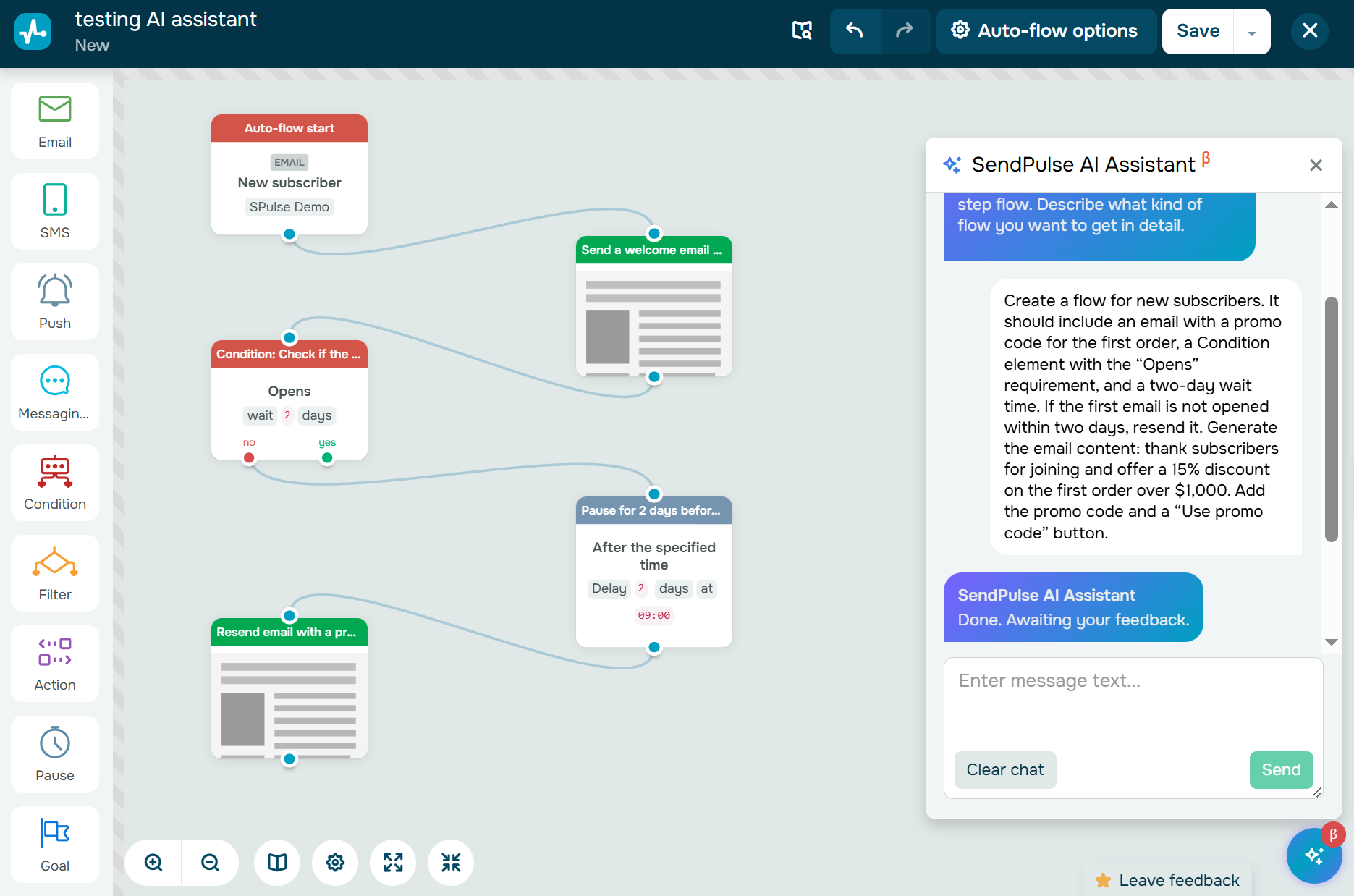 SendPulse’s AI assistant building a multi-step welcome flow from a text prompt — generated in under a minute during our test
Here’s what makes SendPulse stand out as an all-in-one platform for small business owners:
- AI email campaign builder with 140+ templates;
- AI visual automation builder with pre-made scenarios;
- transactional emails and SMS;
- live chat widgets for web;
- AI chatbot builder for TikTok, WhatsApp, Instagram DMs, and other channels;
- AI multi-page website builder with 120+ responsive templates;
- product cards and integrated checkouts for chatbots and websites;
- integrations with Stripe, Shopify, Zapier, Klarna, and 40+ other systems;
- embeddable lead capture forms and pop-ups;
- built-in CRM system with customizable pipelines and task assignment;
- omnichannel inbox with collaboration tools and direct connection to the CRM system;
- invoice and contract generator with payment status tracking;
- digital subscriptions via WayForPay;
- LMS with an option to promote and sell online courses;
- SendPulse pixel for advanced user behavior tracking and targeted messaging;
- built-in analytics for each channel, including individual agent performance.
Best for. Any one- to ten-person team looking to manage their cross-channel campaigns, launch digital products, track sales, and manage customer relationships from a single tab, without the enterprise-grade price tag and the need to hire a developer.
Limitations. SendPulse doesn’t yet offer autonomous agentic AI assistance or social media content planning tools. Most tools are billed separately, which gives you flexibility but also means the total cost can creep up as you activate more features.
Pricing. You can explore most of the basic features on the free plan. Each capability is billed separately, based on your sending volume — flexible paid plans start at $11 a month (billed monthly) for 500 subscribers and unlimited emails. An annual subscription gives you 20% off.
Our take. SendPulse is the strongest option on this list for small businesses that want to stop paying for five separate tools. You sacrifice some depth in some tools, but the time saved by managing everything from one dashboard compounds fast.

Power up your business with smart tools
From solo creators to global brands, thousands of customers trust SendPulse to run email campaigns, chatbots, automations, and more — all in one place.
Get started for free
Loomly
Ratings. G2: 4.6/5 | Capterra: 4.7/5
Loomly is a social media management toolkit powered by AI. The platform supports over ten channels and is suited for every stage of creating and managing customer engagement on social media.
When we signed up, we created a test calendar and noticed that Loomly uses a one-account-per-platform-per-calendar model. It means that if you manage multiple Instagram accounts, for example, you’ll need a separate calendar for each one. This setup keeps your content organized, but you need to consider the extra calendars when comparing pricing tiers.
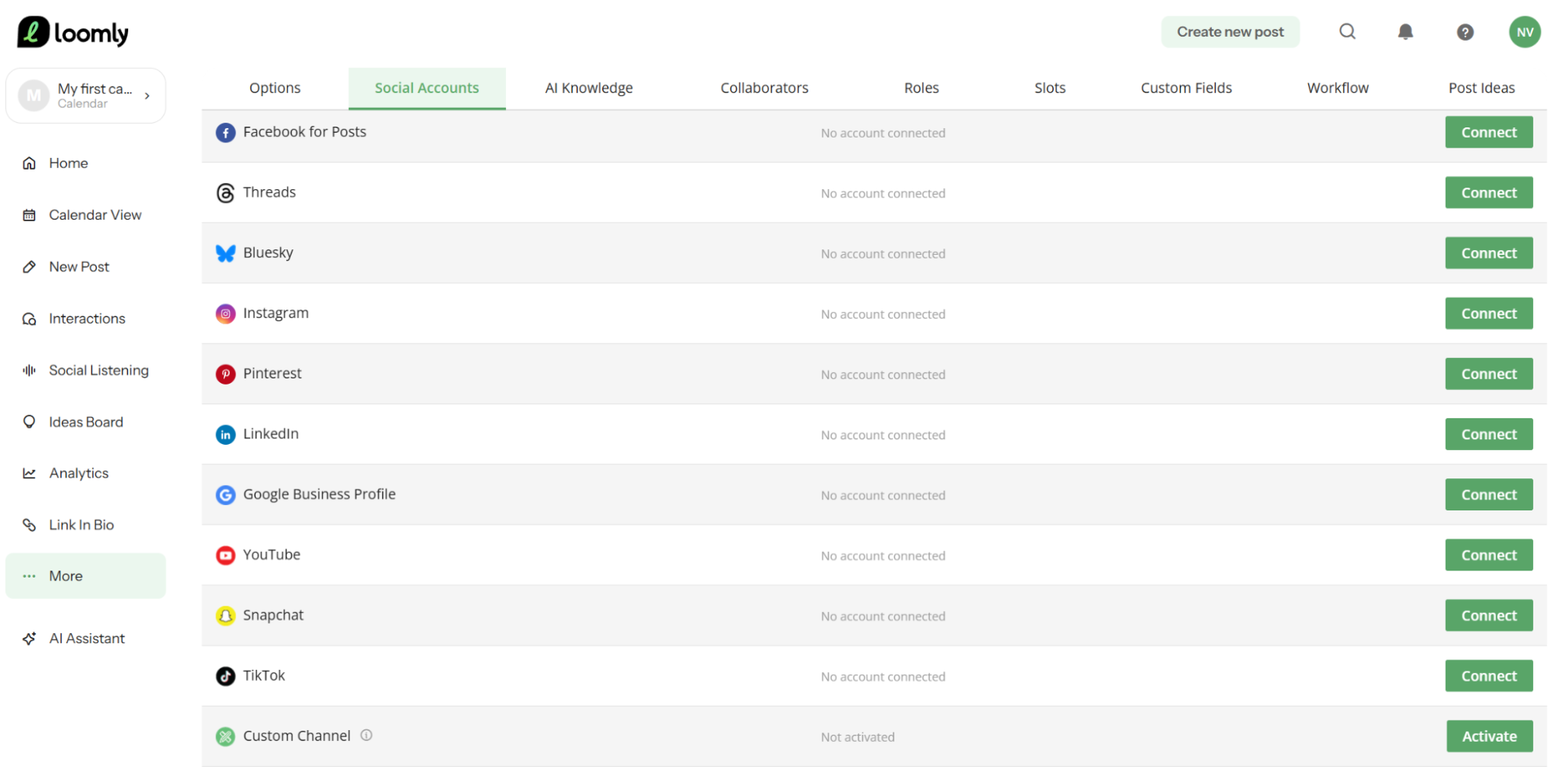 Loomly’s Social Accounts tab showing supported platforms — one account per channel per calendar
Loomly’s feature list includes:
- visual social media scheduler;
- AI suggestions for best timing, topics, and content;
- AI-generated captions, visuals, and variations;
- content library and templates;
- collaboration tools and streamlined approval workflows;
- AI brand knowledge;
- customizable omnichannel AI assistant;
- AI-powered Instagram automation;
- brand mentions monitoring;
- competitor listening tools;
- two-way integration with Canva;
- AI-powered analytics and recommendations based on historical data.
Best for. DTC product shops, personal-brand businesses, or just small teams that run their business on social media, get lots of comments and DMs, and want AI to manage their presence without sacrificing authenticity.
Limitations. Since Loomly is primarily a social media management and scheduling platform, it lacks proper CRM functionality. While testing, we noted that native video editing tools are absent, too.
Pricing. Loomly offers a free plan for 1 user seat and up to 3 social media accounts connected to 1 calendar. Paid plans start at $65 per month (billed monthly) for 3 user seats and up to 12 social media accounts connected to unlimited calendars. Paying yearly makes the subscription 25% cheaper.
Our take. Loomly does exactly what it promises and nothing extra. For a social media tool, that’s actually a good thing. The price only feels high if you manage fewer than three active channels.
Dex
Ratings. G2: 4.3/5 | Capterra: 5/5
Dex is a CRM-like centralized inbox management tool for consolidating contacts and building professional relationships.
Reviewers consistently single out its LinkedIn auto-sync, which quietly keeps job titles and contact details up to date, as the feature that sets it apart from generic contact apps.
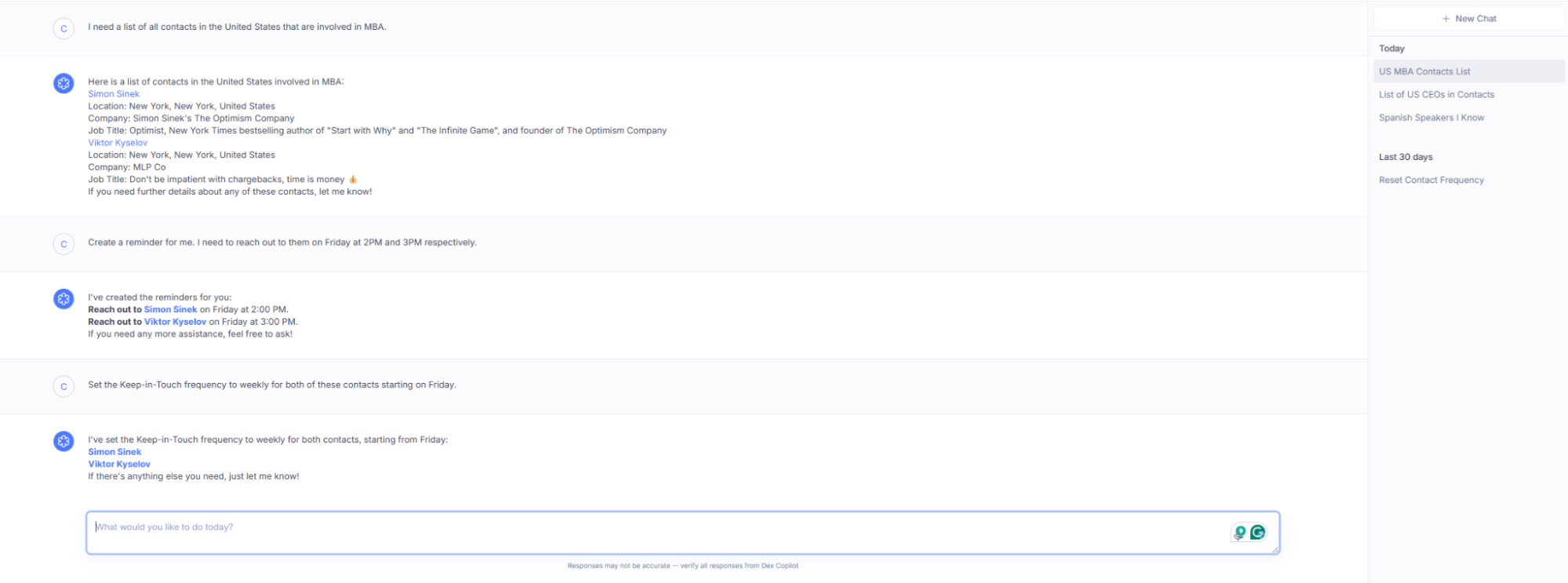 Using Dex’s AI assistant for networking; source: Dex
Below are the features that make Dex irreplaceable for busy founders and solopreneurs:
- intuitive contact navigation and prioritization system;
- rich contact notes;
- automatically synced LinkedIn job title and contact updates;
- customizable reminders and to-do lists;
- AI conversation starters and assistance;
- integrations with LinkedIn, Facebook, and Gmail;
- Dex map for networking while traveling;
- dedicated browser extension and a mobile app.
Best for. Founders and solo consultants whose network is their pipeline — people who meet dozens of contacts at events or on LinkedIn and need a tool to track and maintain these relationships.
Limitations. Dex won’t replace a conventional CRM system, since there’s no shared workspace, collaborative pipelines, or multi-user access. It also lacks truly automated outreach and follow-up sequences.
Pricing. Dex offers a 7-day free trial with a credit card required. Paid plans start at $20 a month, billed monthly. An annual subscription comes with a discount.
Our take. Dex is a niche tool with a narrow but loyal audience for a reason — one reviewer called it “unquestionably the best personal CRM out there.” If you’ve ever lost a deal because you forgot to follow up with a contact, the platform pays for itself in the first month.
Best CRM tools for small businesses
For small businesses, the real challenge is finding a CRM tool that isn’t built for someone else — bloated with enterprise features you’ll never use and priced to match. After sorting through the sea of options, we found three systems that get it right.
Bigin
Ratings. G2: 4.6/5 | Capterra: 4.7/5
Bigin is a small-business-first CRM solution by Zoho that claims a straightforward 30-minute setup, deep customization, and 360-degree customer context.
We signed up for Bigin’s free trial and, just as advertised, had a sales pipeline ready in under 15 minutes. The “Clone from a Template” option is a nice touch: Bigin offers pre-built pipelines for specific industries, including used car sales, interior design, startup fundraising, and more, as well as team workflows like recruitment, customer onboarding, and issue tracking.
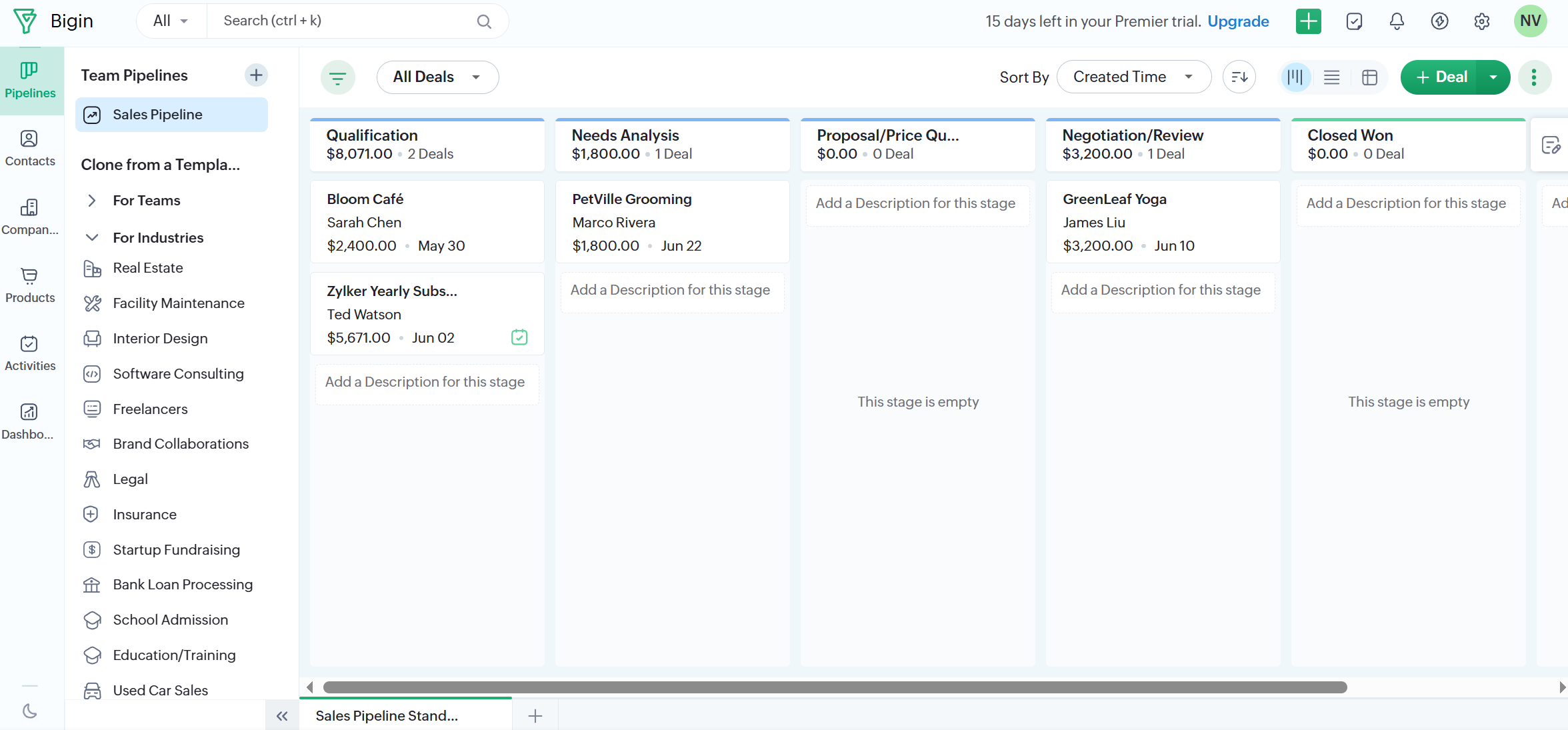 Bigin’s Kanban-style sales pipeline with deal stages, amounts, and due dates — from a 15-day free trial account
Let’s take a quick look at Bigin’s feature list:
- customizable pipelines for sales, marketing, and service;
- unified view of customer records;
- task management and product lists;
- mass scheduled emails;
- native self-sufficient AI agents (coming soon);
- email workflow and pipeline action automations;
- multi-channel inbox (email sync with Gmail, Outlook, and others);
- lead capture from ads on Instagram, Facebook, LinkedIn, and TikTok;
- integration with WhatsApp;
- transparent document sharing system;
- appointment booking pages, payment links, and invoices;
- lead capture forms for web;
- built-in and third-party phone system support;
- sync with Google and Microsoft Calendars;
- dedicated app for iOS, Android, iPadOS, and macOS;
- dashboards and integration with Zoho Analytics;
- integrations with Zoho Books, QuickBooks, and all major payment gateways.
Best for. Small businesses in different niches, from real estate and eCommerce to education and recruitment, that need a real CRM system but find full-scale Zoho CRM and similar tools overwhelming in both complexity and cost.
Limitations. Bigin’s only obvious downside is that it is deliberately kept simple — fast-growing businesses will likely outgrow it and need to migrate to Zoho CRM sooner than expected.
Pricing. Bigin offers a 15-day free trial, free onboarding, and a free plan with 1 pipeline and up to 500 records. Pricing plans start at around $11 per user per month, billed monthly. Annual billing gives you 35% off.
Our take. Think of Bigin as a stepping stone, not a destination. It gets you off spreadsheets quickly and painlessly, with a clear upgrade path to Zoho CRM when you’re ready.
Folk
Ratings. G2: 4.5/5 | Capterra: 4.5/5
Folk is a relationship-first CRM tool for small teams that offers a clean, uncluttered workspace, AI-powered contact enrichment, and a full picture of every relationship across channels.
We tried Folk on a free trial and found it pre-loaded with sample contacts already set up in different pipeline stages. They included source tags, deal sizes, and company info, so you can get a feel for the workflow before importing your own data. Also, Folk offers three built-in AI assistants for follow-up, research, and recap, and you can create custom ones to automate your workflows.
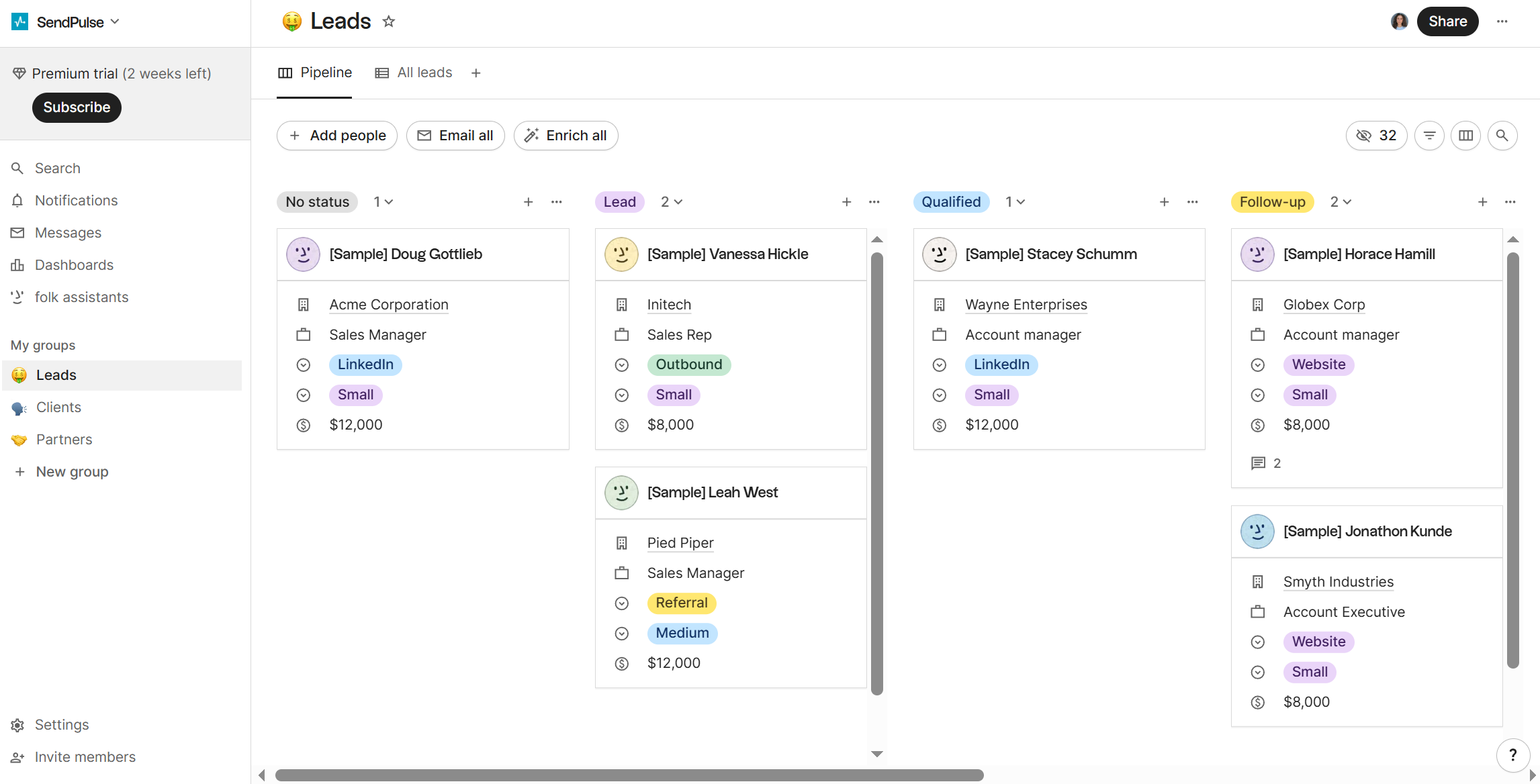 Folk’s Leads pipeline with sample contacts from a trial account
As one of the best small business CRM tools, Folk has a lot to offer:
- customizable pipelines with collaborative sharing and role-based permissions;
- unified contact profiles aggregating email, calendar, WhatsApp, LinkedIn, and 6,000+ other sources;
- folkX Chrome extension for one-click contact import and enrichment;
- AI writing assistance and message templates;
- mass email campaigns and automated multi-step sequences;
- AI-personalized outreach based on shared interaction history;
- AI assistants for follow-up, recap, research, and workflow automations running 24/7;
- automatic follow-up detection across email and WhatsApp with drafted reply suggestions;
- automated company research and enrichment powered by People Data Labs;
- sales dashboards, team performance tracking, and funnel analytics;
- integration with Gmail, Outlook, Google Calendar, WhatsApp, LinkedIn, Zapier, and more;
- native API for custom integrations.
Best for. B2B sales teams, agencies, startups, and partnership managers who need to track hundreds of contacts across email, LinkedIn, and WhatsApp without anything falling through the cracks.
Limitations. With Folk, there is no mobile app, which is a real friction point for anyone who needs CRM access on the go. At the time of writing, advanced pipeline management, forecasting, and detailed reporting are also absent.
Pricing. Folk comes with a 14-day free trial. Paid plans start from $30 per user per month, with yearly billing being 20% cheaper.
Our take. The contact enrichment is genuinely impressive, but Folk is betting that you’ll do all your CRM work from a desktop. If that matches your workflow, it’s one of the most thoughtfully designed CRM systems at this price point.
Daylite
Ratings. G2: 4.5/5 | Capterra: 4.6/5
Daylite is an Apple-native all-in-one CRM tool built specifically for service-based small businesses. The platform is available on Mac, iPhone, and iPad.
Reviewers point out how easy it is to turn any email into a task, appointment, or project with just one click, and have it linked to the right client automatically. Service businesses managing long client lifecycles often cite this email-to-action feature as the reason they stay with Daylite over more popular CRM systems.
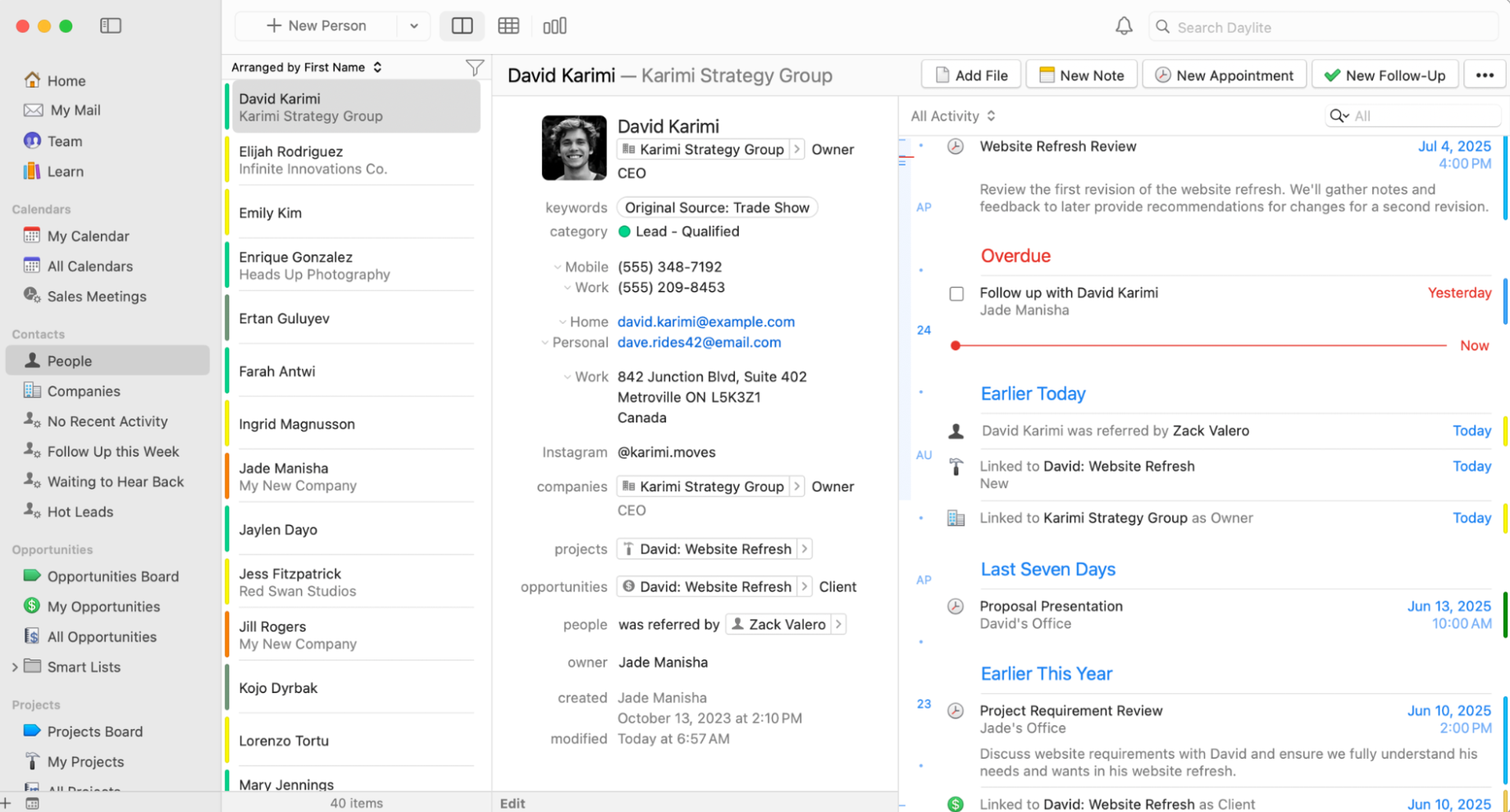 Daylite’s CRM with detailed contact profiles; source: Daylite
Let’s look at Daylite’s key selling points:
- contacts with full activity history, tied to the right agent, sale, or project;
- sales pipelines with deal tracking, lead source tracking, and referral monitoring;
- email management with Priority Inbox, Smart Suggestions, and Auto-Linking to clients and projects;
- customizable checklists, pipelines, task delegation, and progress tracking;
- one-click conversion of emails into tasks, opportunities, appointments, or projects;
- deep Apple ecosystem integration (Apple Calendar, Siri, FaceTime, Caller ID, FaceID/TouchID, Pages, etc.);
- offline mode with automatic sync when back online;
- integrations with Mailchimp, HubSpot, Slack, Google Calendar, and others;
- open API for custom integrations and third-party add-ons.
Best for. Service businesses like consultants, lawyers, realtors, financial planners, coaches, and agencies that want to manage the entire client lifecycle, from first touchpoint to completed project and repeat business, without ever leaving the Apple ecosystem.
Limitations. Windows and Android users are entirely excluded, so Daylite is a poor fit for teams with mixed device setups. Integrations with some important third-party platforms outside the Apple and Google ecosystem are also missing.
Pricing. Daylite can be explored during a free trial. Paid plans start at around $20 per month for a single user seat. An annual subscription gives you a discount.
Our take. Daylite is a polarizing choice by design. It gives up cross-platform compatibility to offer a level of integration on Apple devices that generic CRM tools cannot match. You will either love it or have zero use for it.
Best website-building and eCommerce tools for small businesses
Wix and Squarespace are on everyone’s lips right now, but for a small business, paying $40 a month just to keep a website online is hard to justify. The smarter move is either finding a lean builder that covers the basics without the bloat, or going all in on a platform with real eCommerce muscle. Let’s look at some of the best tools for small business owners that satisfy either of these requirements.
Pixpa
Ratings. G2: 4.6/5 | Capterra: 4.7/5
Pixpa is an all-in-one, no-code portfolio and website builder intended for creators and small businesses. The platform offers monetization tools, zero transaction fees, and fast and secure hosting.
We signed up for Pixpa’s free trial and were impressed by the onboarding. It asks your profession upfront and serves a curated set of templates tailored to that field. The templates are genuinely stylish and modern, and you can fully build and customize your test site before purchasing a plan. Though site settings are spread across multiple menus, expect some clicking around at first.
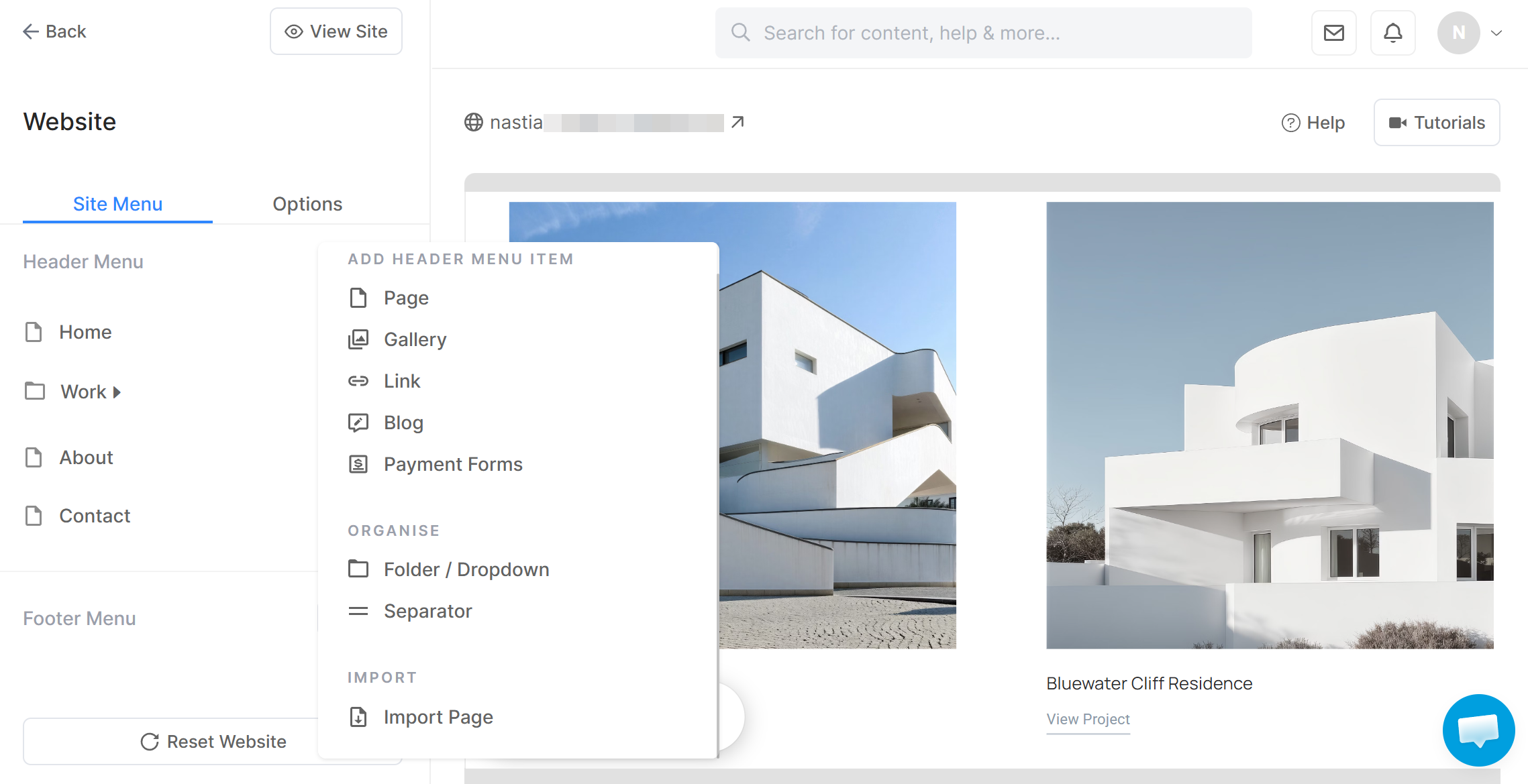 Pixpa’s site menu editor with header options from an architecture portfolio built during our free trial
Pixpa’s features include:
- 200+ professionally designed responsive templates for diverse niches;
- AI website copy generator;
- drag-and-drop website builder with 25+ gallery layouts;
- embedded videos, slideshows, and audio for interactivity;
- full eCommerce store builder with payment processing via Stripe and PayPal;
- physical products, digital downloads, and services;
- automated print and digital order fulfillment;
- CRM-like contact management feature;
- WhatsApp chat widget;
- abandoned cart recovery flows;
- discount codes, inventory management, and shipping tools;
- built-in SEO manager with automatic sitemaps, meta tags, and image alt text;
- built-in pop-ups, announcement bars, and lead capture forms;
- integrated blog with full content management;
- integrations with Google Analytics, Mailchimp, Shopify, Weglot, and 100+ other apps;
- free custom domain for the first year on annual plans;
- free SSL certificate and cloud hosting included on all plans.
Best for. Photographers, illustrators, and independent authors who need a polished portfolio website with basic eCommerce features and don’t want to manage hosting, plugins, or separate subscriptions.
Limitations. Pixpa may not have the right infrastructure for any business that needs serious eCommerce beyond selling prints, digital files, and creative services.
Pricing. The website builder offers a 15-day free trial and a 30-day money-back guarantee. Pricing plans start from $9 a month, billed monthly. You can get up to 55% off by paying annually or biannually.
Our take. Pixpa offers great visual control for the price. If your primary goal is a professional online presence that also happens to sell — rather than a store that happens to look good — Pixpa overdelivers at under $10/month.
Shopify
Ratings. G2: 4.4/5 | Capterra: 4.5/5
Shopify is the world’s leading eCommerce platform for businesses of all sizes, combining an online store builder, a powerful sales engine, AI-powered tools, and a vast app ecosystem.
Users who switched from WordPress or self-hosted platforms consistently report faster page loads and fewer things breaking — no plugin conflicts, no manual security patches. For small businesses weighing Shopify against Elementor or another WordPress-based setup, that trade-off is worth considering.
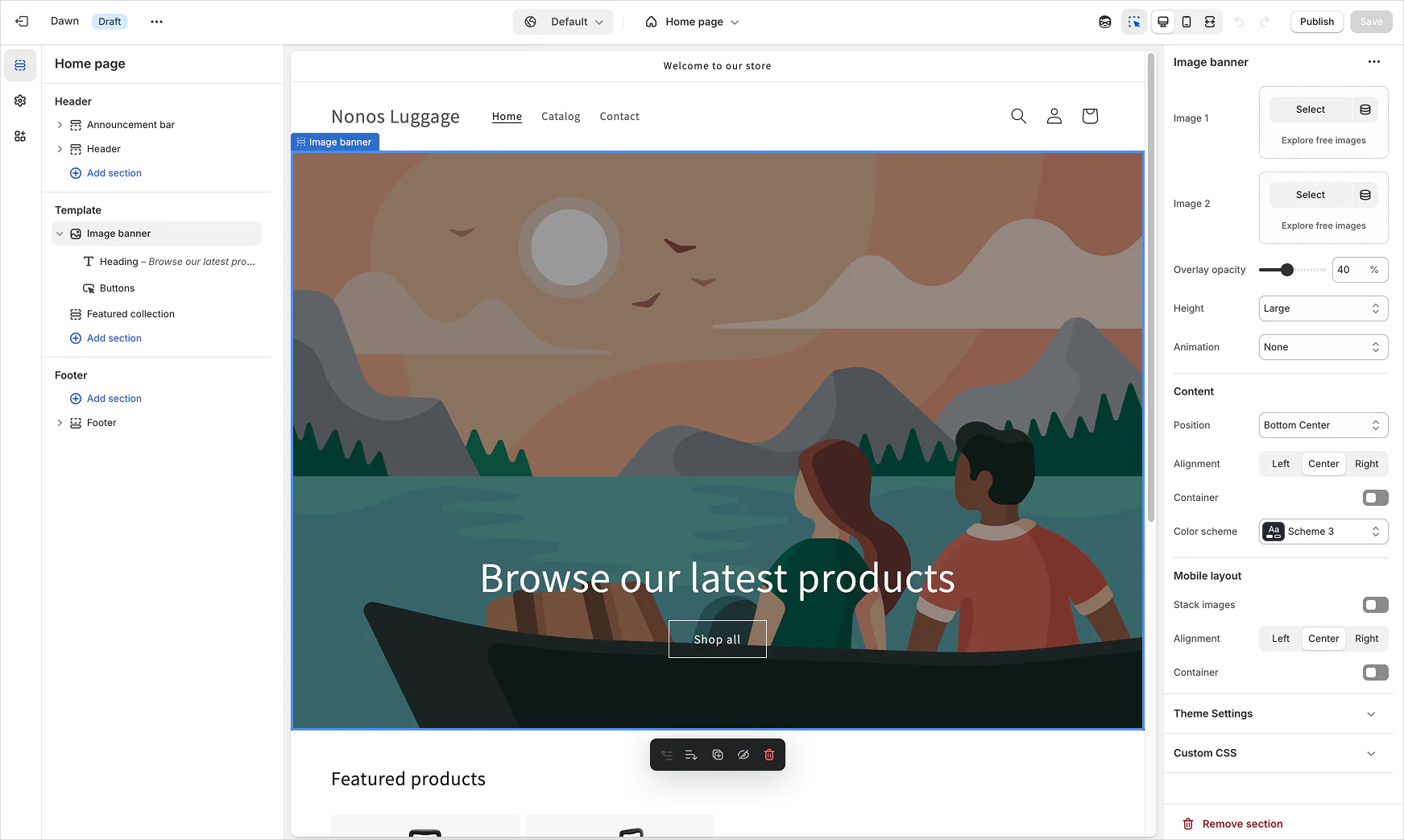 Editing a website theme in Shopify; source: Shopify
Here’s why it’s considered one of the best eCommerce tools for small businesses:
- unlimited products with full inventory, variants, and order management;
- customizable online storefront with 100+ themes and a drag-and-drop editor;
- built-in checkout with Shop Pay (instant one-tap purchasing);
- Shopify Payments with built-in fraud analysis;
- integrated AI agent for content creation and admin work;
- POS system for in-person selling synced with the online store;
- selling on TikTok, Instagram, Facebook, Pinterest, Amazon, eBay, and Google Shopping;
- agentic AI tools for automating live chat interactions and order flows;
- abandoned cart recovery, discount codes, gift cards, and upsell tools;
- email marketing, automation flows, and audience segmentation built in;
- Shopify Shipping with discounts of up to 77% on major carriers;
- 8,000+ apps in the Shopify App Store for virtually any added functionality;
- detailed sales analytics, product performance reports, and customer dashboards;
- Shopify Markets for multi-currency, multi-language international selling;
- dedicated apps for iOS and Android.
Best for. Shopify is the obvious choice for small businesses that are serious about selling, as it delivers unmatched long-term flexibility. Features like Shop Pay’s one-tap checkout, native multi-channel selling across TikTok, Instagram, and Amazon, and AI-powered storefront tools mean that a small team can operate with the commercial infrastructure of a much larger brand.
Limitations. The real monthly cost often exceeds the plan price. Using a third-party payment gateway adds an extra transaction fee on top of what Shopify Payments charges, and most stores end up needing 5 to 10 paid apps, which adds $50 to $150 per month.
Pricing. Shopify offers a free 3-day trial and a discount for the first 3 months. Paid plans start at $39 a month, billed monthly. Even on the Basic plan, you can run a fully featured online store. There’s a 25% discount for annual subscriptions.
Our take. Shopify is the safest long-term bet for product-based businesses. You’ll pay more upfront than with less feature-rich alternatives, but the ecosystem means you’re unlikely to outgrow it — and that avoids a painful re-platforming later.
Elementor
Ratings. G2: 4.4/5 | Capterra: 4.6/5
Elementor is the world’s most popular WordPress page builder plugin, powering over 21 million websites. Its WooCommerce Builder extension turns any WordPress site into a fully custom, conversion-optimized online store.
The platform stands out for the amount of control it gives users over page design. You can set custom breakpoints, use dynamic content, and adjust layouts down to the pixel. Many users say it is one of the few builders that does not limit your design ideas.
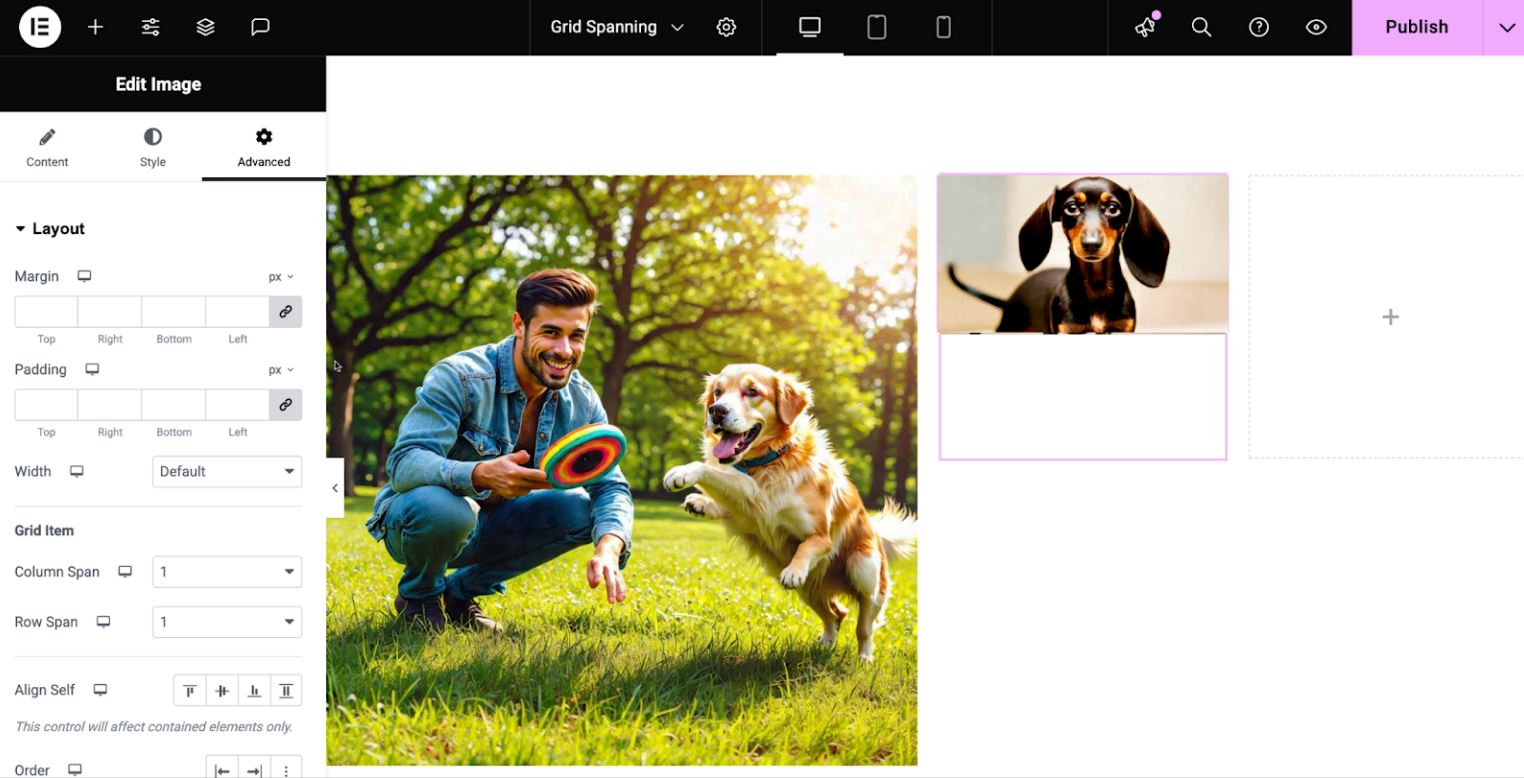 Elementor’s drag-and-drop editor with advanced layout settings; source: Elementor
The plugin addresses most website-building needs for businesses, agencies, and enterprises:
- drag-and-drop visual editor with 100+ widgets, 300+ templates, and full mobile editing with custom breakpoints;
- WooCommerce Builder with custom product pages, shop layouts, product archive, etc.;
- 25+ WooCommerce-specific widgets (Add to Cart, Product Price, Menu Cart, Upsells, and more);
- countdown timers, stock meters, wishlists, trust badges, and upsells at checkout;
- dynamic tags to display live product data anywhere on the site;
- powerful multi-column website menus with images, products, and banners;
- Theme Builder for custom website elements;
- pop-ups and forms with targeting rules, triggers, and display conditions;
- AI-powered content and layout generation, image editing, and custom code writing;
- bulk image compression to WebP and AVIF;
- AI Site Planner and Angie AI agent for generating full site wireframes and assets;
- integrations with Mailchimp, HubSpot, and 100+ other tools;
- site management dashboard for updates, security monitoring, and database optimization;
- website speed optimization via element caching, local fonts, clean markup, and lazy load content;
- AI-managed hosting with a CDN, enterprise security, and 24/7 all-in-one support;
- transactional email deliverability tools with open rate tracking.
Best for. This is an excellent tool for small business owners, freelancers, and creatives who are already on WordPress, or willing to move to it, and want maximum design control over both their site and their store without hiring a developer.
Limitations. To use Elementor, you need a separate WordPress installation and hosting plan in addition to your Elementor subscription. This extra setup can be frustrating for non-technical users who simply want to get a store online quickly. The WooCommerce Builder is only available with the Advanced plan or higher. More critically, third-party Elementor add-on plugins have been actively exploited by hackers, which can make it harder for small business owners without a developer to keep their site secure.
Pricing. Paid plans for personal use start at $6 a month (billed annually) for 1 website. There’s a 30-day money-back guarantee.
Our take. Elementor is the most powerful website builder on this list, but it is also the only one that expects you to handle the technical setup. If you are comfortable with that, no other option here offers this much control for the price.
Best accounting tools for small businesses
Keeping finances in order is one of the quietest challenges of running a small business. Hiring a bookkeeper or accountant makes sense at a certain scale, but for most early-stage businesses, the right software usually does the trick. These tools handle essentials like invoicing, expense tracking, and cash flow monitoring for a fraction of the cost. And when you’re ready to bring in a bookkeeper, there are also tools that make the transition easy.
Wave
Ratings. G2: 4.3/5 | Capterra: 4.4/5
Wave positions itself as an accounting and invoicing platform built specifically for small business owners, freelancers, and solopreneurs.
Users without bookkeeping experience say they can reconcile accounts, send professional invoices, and create tax-ready reports within their first month.
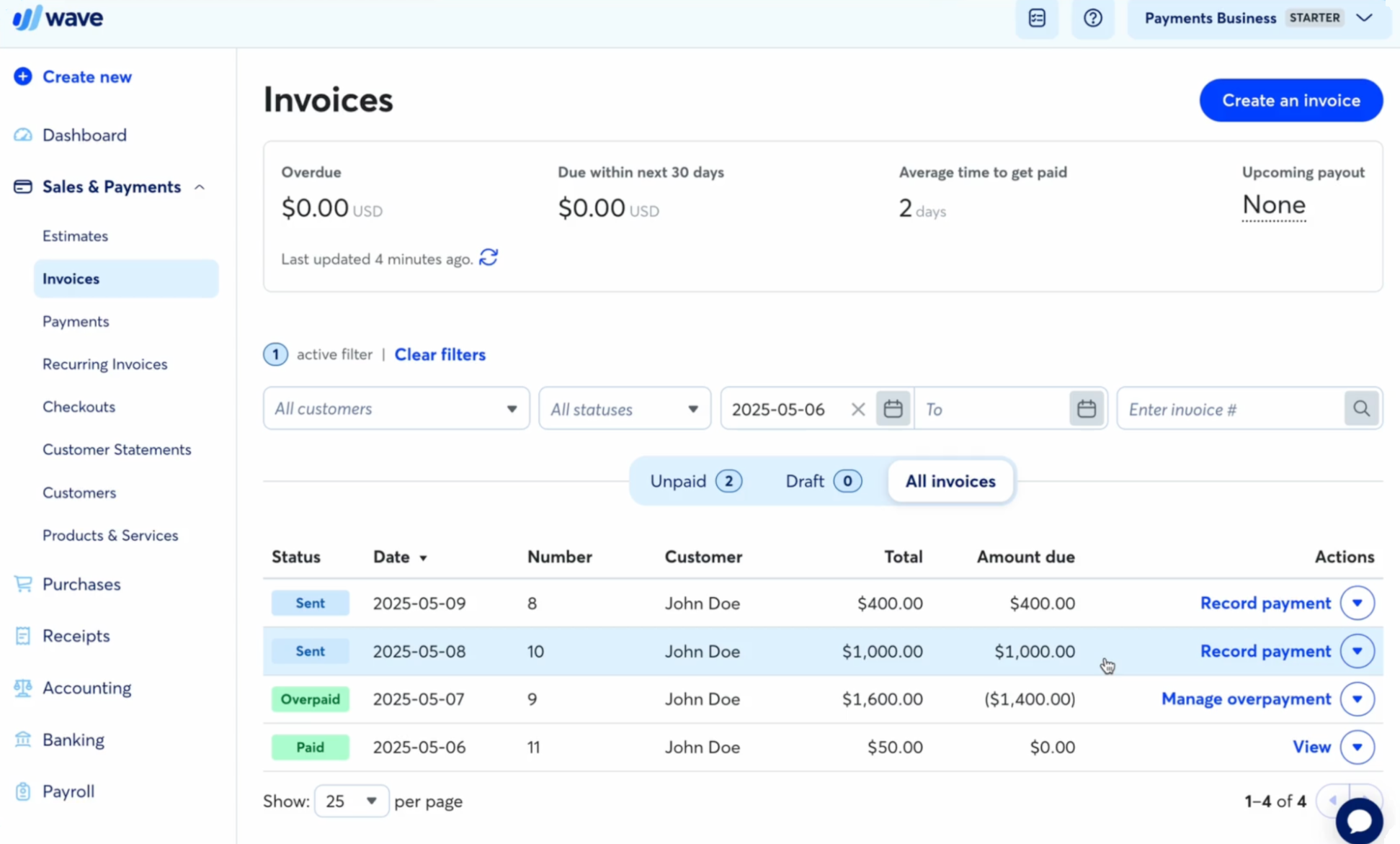 Wave’s invoice dashboard with payment statuses, overdue tracking, and average time-to-payment; source: Wave
Among its key features are:
- intuitive all-encompassing dashboard for a quick overview of financials;
- double-entry accounting with income and expense tracking, bank reconciliation, and reporting;
- invoices with custom branding and automated payment reminders;
- sales and inventory tracking;
- estimates and deposit collection to secure projects before work begins;
- flexible online payments via credit card, bank transfer, and Apple Pay;
- automatic bank transaction import, categorization, and merging;
- receipt scanning and upload by photo, desktop, or email;
- payroll for employees and contractors with automated tax calculations;
- access to in-house bookkeepers and accountants for coaching or full done-for-you services;
- cash flow and profit dashboards with key business health reports;
- integrations with Google Drive, PayPal, Stripe, Shoeboxed, and 6,000+ apps via Zapier;
- dedicated mobile app for iOS and Android;
- 256-bit SSL encryption and PCI-DSS Level 1 compliance.
Best for. Freelancers, solo operators, and micro-businesses under five people who need real double-entry accounting and invoicing without the cost or learning curve of enterprise-grade software.
Limitations. Wave is currently available only to businesses based in the US and Canada. Businesses with inventory management needs, project tracking, or plans to scale beyond the micro-business stage are likely to quickly outgrow Wave due to its focus on the needs of independent contractors. In addition, not all financial institutions are supported, so there’s a chance you won’t be able to connect your bank account.
Pricing. Wave has a free plan with unlimited estimates, invoices, bills, and bookkeeping records. The Pro plan costs $19 a month, billed monthly. With an annual subscription, you’ll save $38.
Our take. Wave offers a lot of accounting features for free. If your needs fit within its scope, there’s simply no reason to pay for another tool at the micro-business stage.
QuickBooks
Ratings. G2: 4/5 | Capterra: 4.3/5
QuickBooks is the world’s most widely used small business accounting platform, trusted by over 7 million businesses globally. It combines bookkeeping, invoicing, payroll, inventory, reporting, and an array of AI agents.
Small business owners consistently cite the same reason for choosing QuickBooks — their accountant or bookkeeper already uses it. That shared ecosystem eliminates double entry and makes tax season significantly smoother.
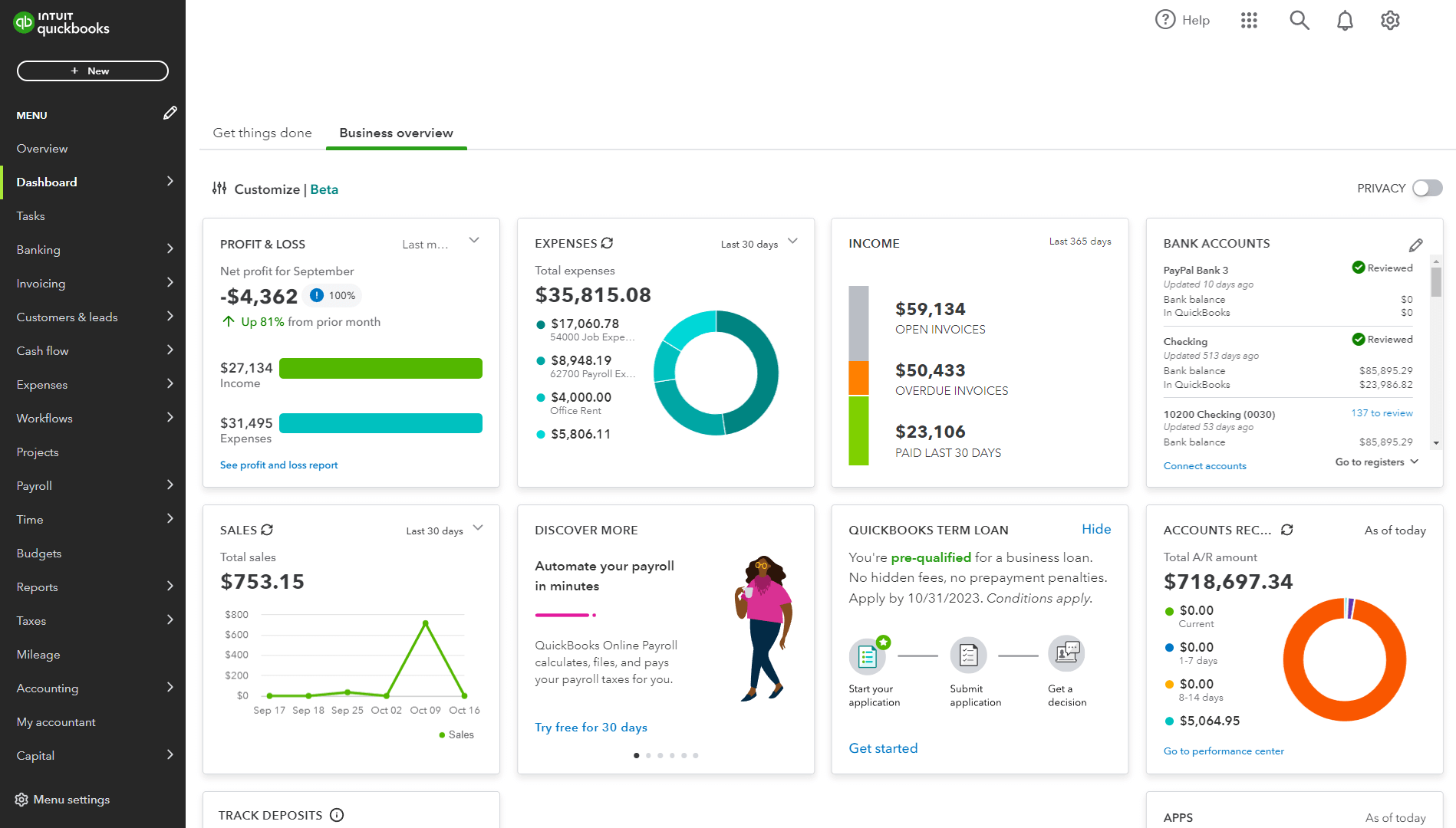 The QuickBooks Business Overview dashboard with profit & loss, expense breakdown, income tracking, and bank account status; source: QuickBooks
Here are the platform’s most important features at a glance:
- double-entry accounting with automatic bank transaction import, categorization, and reconciliation;
- branded invoicing, estimates, recurring billing, and payment reminders;
- online payments via credit card, bank transfer, and digital wallets;
- accounts payable and receivable management with bill tracking and vendor payments;
- inventory tracking with low-stock alerts, purchase orders, and vendor management;
- project profitability tracking (assigning income, expenses, and hours to specific jobs);
- time tracking with billable hours and employee timesheets;
- income and expense tracking for multi-department or multi-location businesses;
- appointment scheduling, contracts, and proposals;
- custom reports, scheduled email reports, and charts;
- AI-agents for anomaly detection, lead management, troubleshooting, and project management:
- budgeting, forecasting, and financial scenario planning tools;
- payroll for employees and contractors with automated tax filing;
- on-demand done-for-you bookkeeping by certified experts;
- 800+ third-party integrations, including Shopify, Amazon, PayPal, and HubSpot;
- free accountant access and collaboration on all plans;
- mobile app for iOS and Android.
Best for. Product-based businesses that need inventory tracking, growing teams managing multiple users and departments, and service businesses that need to track billable hours and project profitability in one place.
Limitations. The platform might be an overkill for small businesses in their infancy, which will likely end up paying for features they never use.
Pricing. There’s a free 30-day trial. Paid plans start at $38 a month (billed monthly) with access for 2 accountants. QuickBooks also offers plans for self-employed users. Occasionally, the platform runs limited-time offers with up to 50% off all plans for the first 3 months.
Our take. Not the cheapest or the simplest, but the platform you’re least likely to outgrow. QuickBooks scales from solo invoicing to multi-department payroll without forcing a migration to a different tool.
Dext
Ratings. G2: 4.6/5 | Capterra: 4.3/5
Dext is an AI-powered bookkeeping automation platform that claims 99.9% accuracy when it comes to receipt, invoice, and expense capture and categorization.
Bookkeepers and accountants highlight that Dext’s OCR learns over time, recognizing recurring suppliers and even matching receipts to the specific card used for payment. Multiple reviewers describe the same workflow: their clients snap a photo of a receipt on the go, and by the time the bookkeeper logs in, it’s already categorized and ready to publish to accounting software.
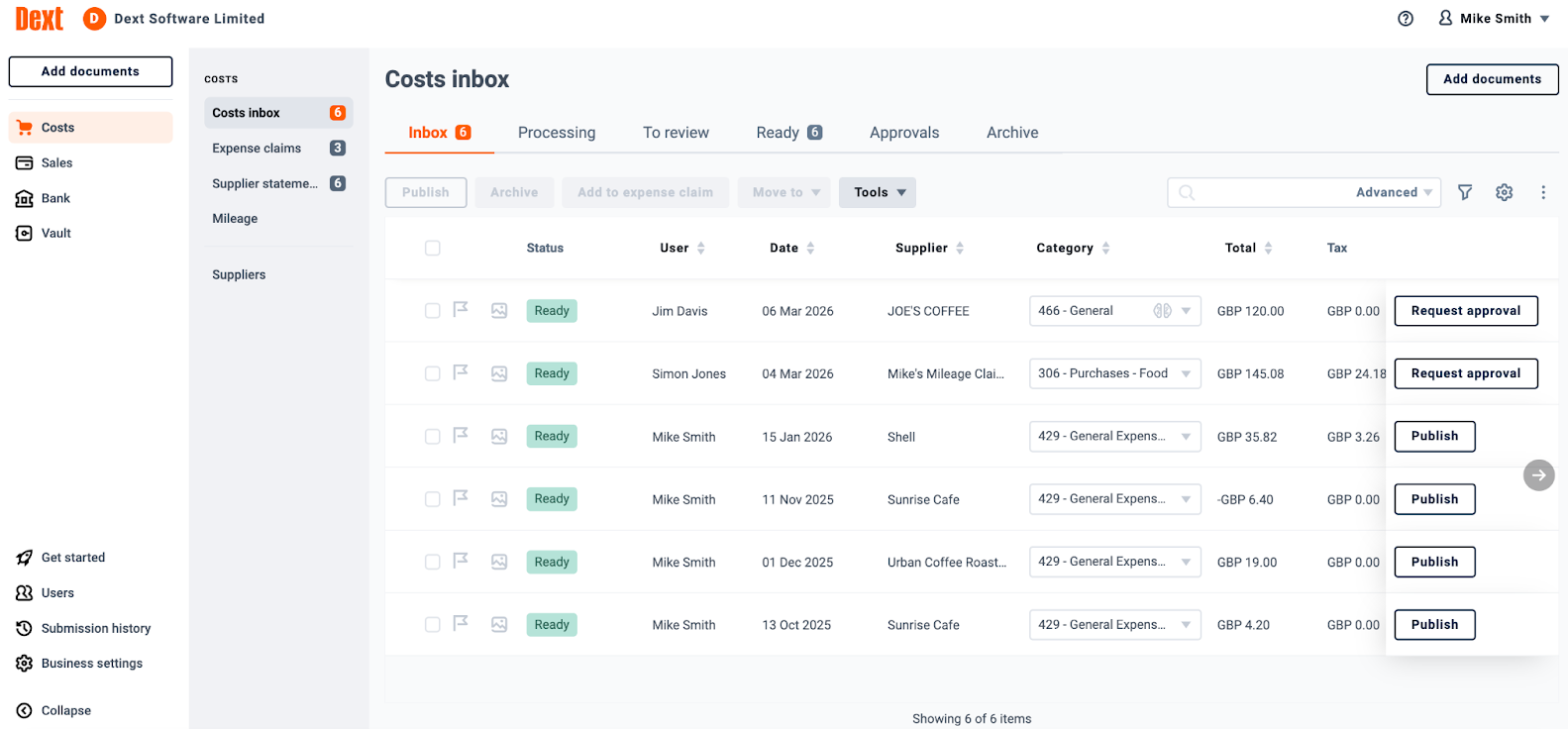 Dext’s Costs inbox showing auto-extracted receipt data with supplier, category, amount, and approval status; source: Dext
Here are Dext’s most prominent features:
- automated bookkeeping with AI assist (data entry, categorization, and reconciliation);
- receipt and statement submission via scanner app, email, or upload;
- expense management (review, approval workflows, and mileage tracking);
- online sales data tracking (as an add-on);
- secure, searchable cloud storage for all financial documents with full audit trail;
- line item extraction for a detailed breakdown of individual items on receipts and invoices;
- client data health monitoring and flagging for accountants and bookkeepers;
- GDPR-compliance with enterprise-grade security;
- 30+ accounting app integrations and connections with over 11,500 banks.
Best for. Dext is an ideal fit for small business owners who spend too much time on paper-chasing and manual data entry, and for businesses that already work closely with an accountant or bookkeeper.
Limitations. Dext is not a standalone accounting platform — it has no invoicing, reporting, or payroll features of its own, and must always be used alongside a separate accounting tool.
Pricing. The platform comes with a 14-day free trial. Monthly plans start at around $31.50 per month (billed monthly) for 5 users. The AI Assist feature is available as an add-on for $10.50 per month. Annual billing gives you 20% off.
Our take. Dext is a single-purpose tool that justifies its cost through volume. The more receipts and invoices you process, the faster the ROI.
Best productivity and automation tools for small businesses
Time is the one resource a small business owner never has enough of, and the hours lost to tedious tasks, disorganized workflows, and missed follow-ups add up fast. Let’s look at some of the best AI tools for small businesses that ensure fewer things fall through the cracks.
Notion
Ratings. G2: 4.6/5 | Capterra: 4.7/5
Notion is a collaborative workspace combining notes, documents, databases, project management, wikis, and AI-powered automation. Notion is model-agnostic and can be powered by any popular LLM of your choice.
We signed up, and Notion’s onboarding assistant asked a few questions about our team, then generated a ready-made Marketing HQ workspace with linked Projects and Tasks in under five minutes — a much faster start than building from a blank page.
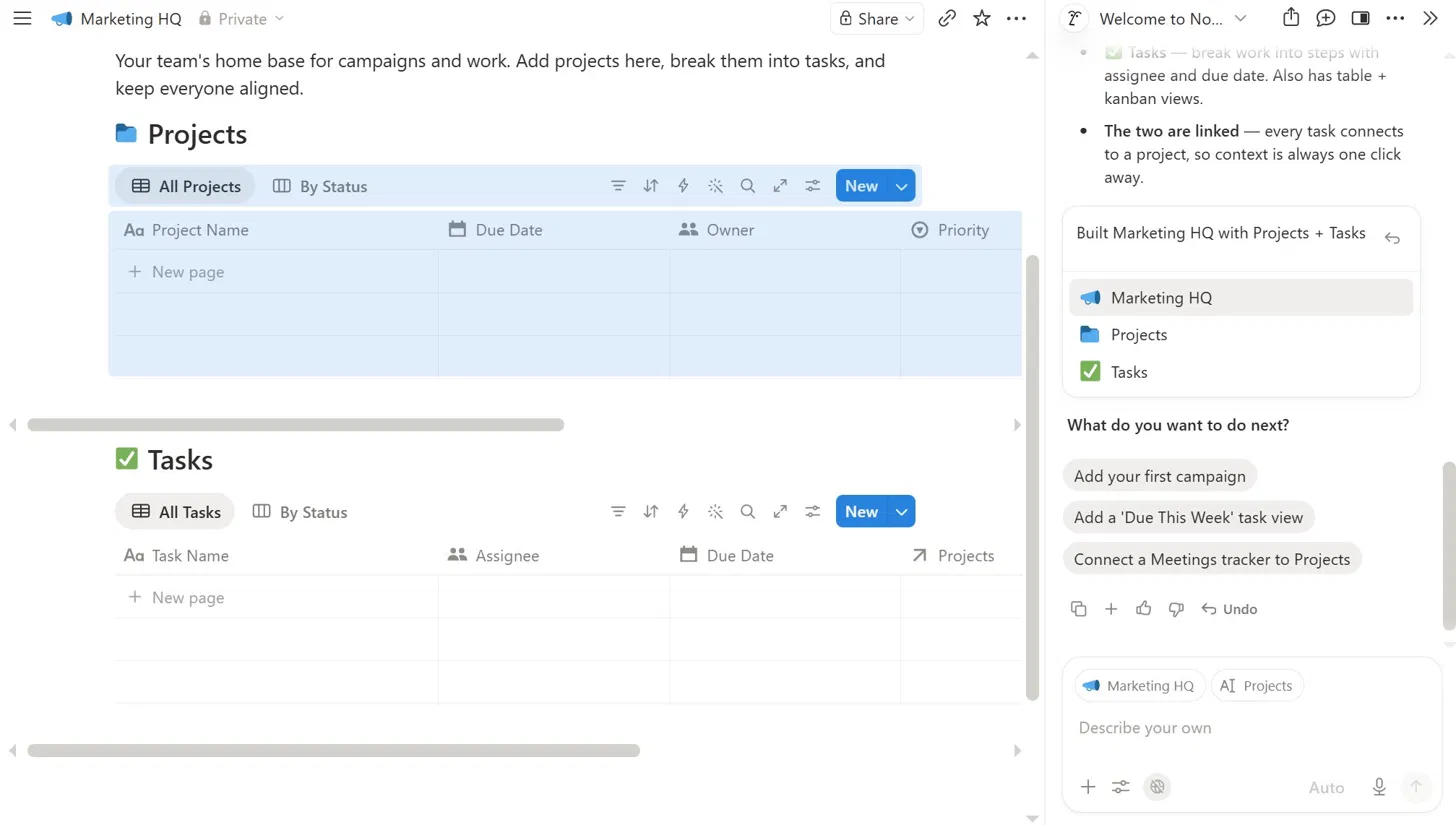 Marketing HQ workspace generated by Notion’s AI assistant – from our test account
The platform is considered an irreplaceable tool for small business owners due to its unmatched feature list:
- clean, intuitive, and customizable drag-and-drop interface;
- custom 24/7 AI agents for building, editing, and taking actions;
- branded knowledge bases with search filters and self-updating synced blocks;
- AI meeting summaries and transcripts;
- Notion Site landing page builder;
- streamlined custom CRMs for navigating a client database;
- docs with flexible building blocks, collapsible sections, code snippets, and live charts;
- project and task management tools with custom Gantt and Kanban setups;
- customizable templates for all possible use cases, from fundraising to product launch;
- AI-powered, self-organized Notion Mail with automated email drafting and scheduling;
- unlimited pages, documents, and blocks for notes, wikis, meeting notes, etc.;
- time management tools (planning, habit tracking, and more);
- instant AI search across all your apps and work data;
- Notion Calendar for navigating work and personal events;
- unlimited guests on paid plans for seamless collaboration;
- GDPR compliance & SOC 2 Type 2 and ISO 27001 certifications;
- integrations with Slack, Google Drive, GitHub, Zapier, Make, Figma, etc.
Best for. Small teams that need a single workspace for building roadmaps, tracking sprints and to-do lists, self-paced learning, or anything else in between. It works best as a central hub where you can store brand assets, project pipelines, team SOPs, calendars, and meeting notes.
Limitations. The platform doesn’t replace a proper CRM system, nor does it offer outreach automation, built-in invoicing, or any sort of financial tracking. It’s better approached as a complement to your existing tool stack rather than a substitute.
Pricing. There’s a free plan for personal use. Paid plans start from $12 per user per month (from $24 if you need Notion AI), billed monthly. Annual subscriptions are up to 20% cheaper.
Our take. Notion is the most versatile tool on this list, with the widest gap between its potential and what most teams actually use. Start small, use templates, and resist the urge to over-engineer.
Lindy
Ratings. G2: 4.9/5
Lindy is an AI work assistant built to handle the repetitive coordination layer of professional life, from inbox management, meeting prep, and note-taking to scheduling, follow-ups, and cross-app tasks.
Users often mention how quickly Lindy agents can be built without coding, almost closer to an app generator than a traditional automation tool. It’s most commonly used for connecting a calendar trigger to a set of actions that record meetings, email notes, and post summaries to Slack. Each agent is created visually in a flow editor, so you can see and edit every step.
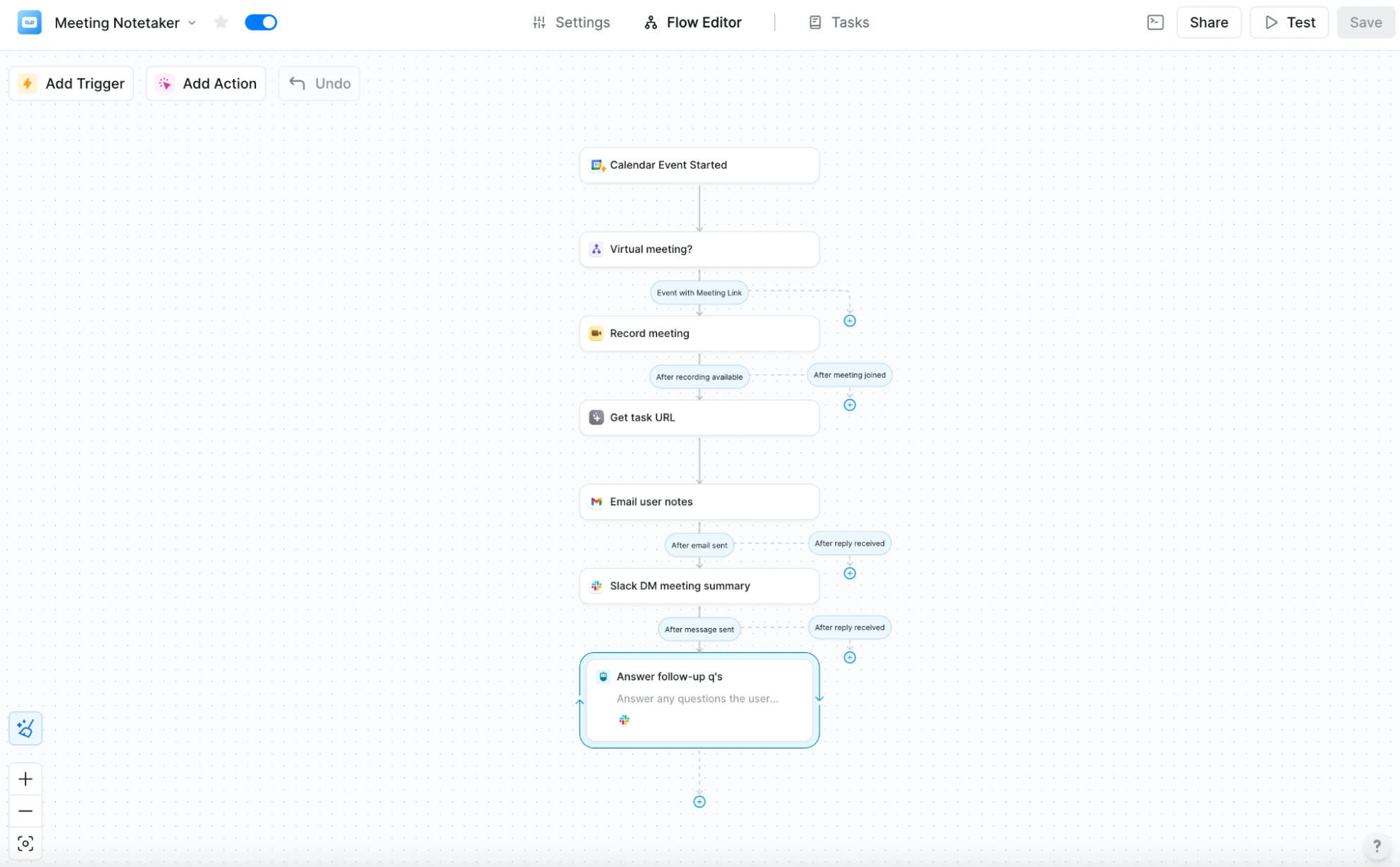 Lindy’s Flow Editor showing a Meeting Notetaker agent — from calendar trigger to recording, email notes, and Slack summary; source: G2
Here’s what Lindy has to offer as a small business tool for productivity:
- conversational interface that works across iMessage and SMS;
- trainable AI for matching your unique voice;
- drag-and-drop editor for multi-step automations;
- scheduling assistant (finds time slots, sends invites, and handles rescheduling);
- AI inbox management for automated email labeling and drafting in your voice;
- pre-meeting prep briefs generated from calendar, email, and connected app context;
- AI meeting assistance (recording, transcriptions, summaries, and follow-ups);
- automated to-dos-tracking, reminders, and follow-ups;
- SOC 2 Type II, HIPAA, GDPR, and PIPEDA compliant with AES-256 encryption;
- hundreds of integrations with Slack, Gmail, Salesforce, Notion, and other apps.
Best for. Lindy is the right tool for small business owners, solopreneurs, and consultants who spend a disproportionate amount of their day on coordination work and want an AI layer that handles it autonomously across their existing apps.
Limitations. Lindy is not a general-purpose AI chatbot or a workflow automation builder. If you’re looking to design complex, logic-heavy automations, you will be better served by tools like Make or n8n. The software also has no built-in document editing, project management, or financial tools, so it requires integration with other apps.
Pricing. Lindy offers a 7-day free trial. Paid plans start at $49.99 a month, billed monthly.
Our take. Lindy is the most high-risk, high-reward option on this list. If its AI features improve as promised, early adopters will gain a real advantage. If not, paying $50 a month could end up being a costly test.
Superhuman
Ratings. G2: 4.7/5
Superhuman is a premium AI-powered email client built on top of Gmail and Outlook, combining AI drafting, smart triage, and keyboard-driven shortcuts.
The two features reviewers mention most are AI-drafted replies that are surprisingly accurate in tone, and a keyboard-first workflow that lets you clear an inbox without touching the mouse. Together, they eliminate what one user described as “email anxiety” — the feeling of a backlog growing faster than you can manage it.
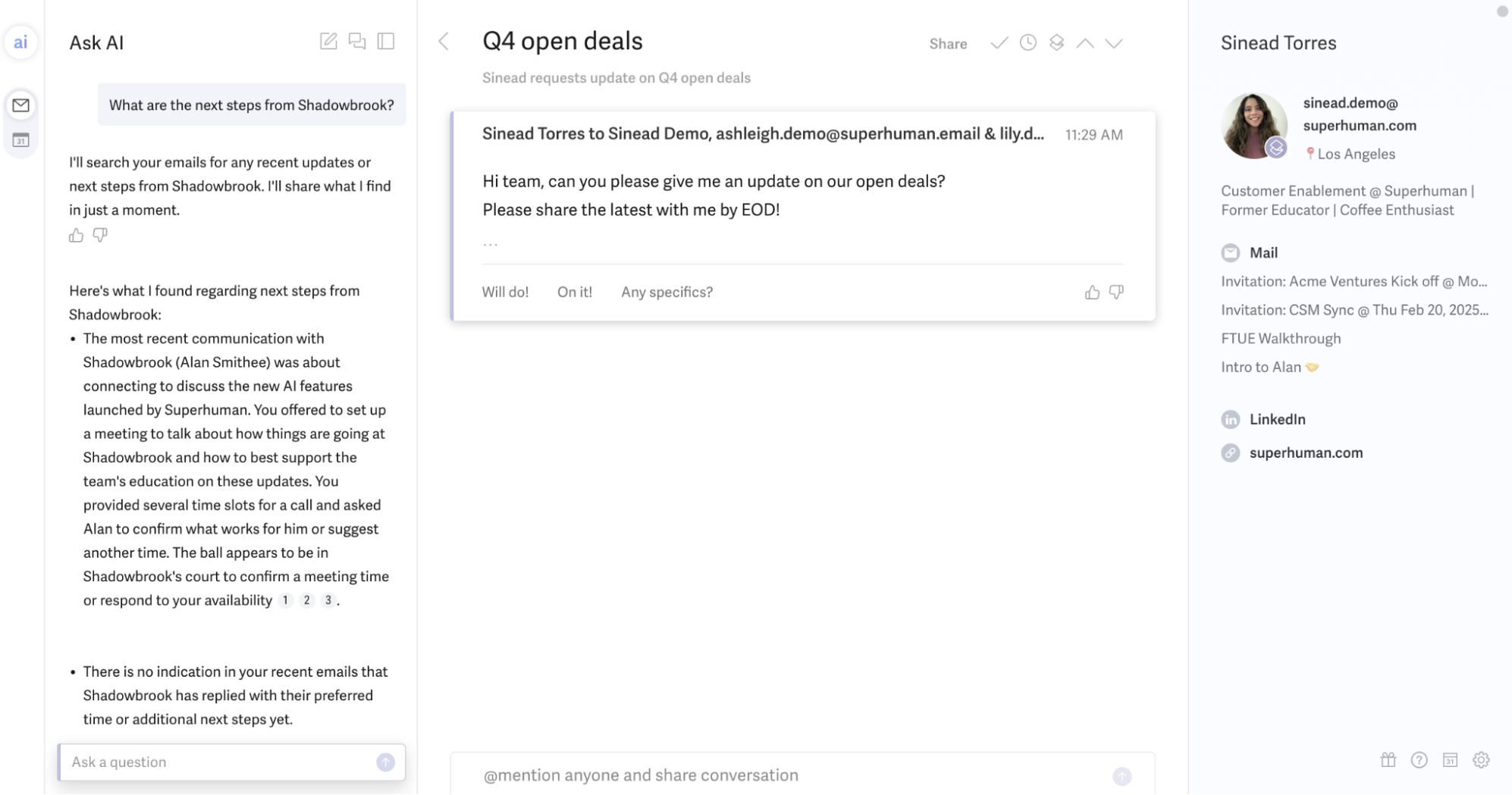 Superhuman’s three-panel view with AI-powered Ask AI sidebar, email thread, and contact context card; source: Superhuman
Superhuman rightfully deserves its place in the list of best AI tools for small businesses due to its:
- 100+ keyboard shortcuts, custom labels, and Split Inbox for categorizing email by type;
- AI email drafting in your own voice and tone;
- one-click thread summaries for long email chains;
- AI search across your inbox, calendar, and the web;
- AI-generated reply suggestions surfaced before the user opens an email;
- Go, a proactive AI assistant that surfaces relevant context across apps and web;
- email read statutes for better transparency;
- instant availability sharing and one-tap scheduling;
- reusable text templates for common replies;
- Grammarly and Coda natively built into the app;
- 100+ integrations with HubSpot, Salesforce, and other apps;
- offline-capable native desktop app with local message caching.
Best for. Superhuman is the right tool for freelancers, founders, consultants, and sales professionals whose primary productivity bottleneck is their inbox, specifically those processing 100 or more emails per day.
Limitations. The software sits on top of Gmail or Outlook, so users still pay separately for Google Workspace or Microsoft 365 — and it does not support iCloud, Fastmail, or any other email provider. There is no unified inbox across multiple email accounts, and the shortcut-driven workflow comes with a learning curve.
Pricing. There’s a limited free plan. Advanced plans, including Superhuman Mail, start from $40 per month, billed monthly. Annual subscriptions are around 50% cheaper.
Our take. At $40/month, Superhuman is the most expensive email client most small businesses will ever consider. However, if your revenue depends on fast, polished replies (sales, consulting, client services), the AI drafts and speed alone can recover that cost in a single closed deal or retained client.
Having it all isn’t always the answer, especially when your budget is limited. Carefully pick three to five tools for your small business – make sure they cover your core needs without overlapping, integrate well with each other, and let them do the heavy lifting.
Recommended stack for solopreneurs and founders
Notion + Dex + Lindy + Wave + Pixpa
Notion serves as the central operating system for client notes, project pipelines, and content planning, all in one place. Dex handles the relationship layer that a full CRM system would overkill, keeping track of every contact and prompting follow-ups at the right time. Pixpa provides a polished portfolio site and professional online presence without a separate hosting subscription.
Lindy takes the coordination burden off the founder’s plate, managing the inbox, prepping for meetings, and drafting follow-ups autonomously. Wave covers essential invoicing and cash flow.
Recommended stack for local service businesses
Daylite/Bigin + Wave + SendPulse
Daylite is the operational core. It manages clients, projects, appointments, and follow-ups in one place, purpose-built for exactly this kind of service-based work. Wave handles invoicing and bookkeeping. SendPulse covers website building, email campaigns, and chatbot automation for WhatsApp, Telegram, and Instagram DMs for 24/7 presence.
If somebody on your team doesn’t use Apple devices, you can swap Daylite for Bigin. You won’t have the same Apple Mail integration, but you’ll get access on any platform and a clearer upgrade path.
Recommended stack for eСommerce brands
Shopify + SendPulse + Loomly + QuickBooks
Shopify is the natural foundation — purpose-built for product-based selling across multiple channels. SendPulse plugs directly into the sales funnel with automation flows, transactional emails, and SMS campaigns that Shopify’s native tools don’t fully cover.
Loomly manages the social content calendar across every platform the brand is active on. QuickBooks handles the financial complexity of eCommerce — inventory, multi-channel revenue reconciliation, and tax readiness.
Recommended stack for small B2B teams
Folk + Notion + Superhuman + Dext
Folk sits at the center as the relationship and pipeline CRM, tracking every deal, contact, and conversation thread across the team. Superhuman ensures that client-facing team members never drop the ball on high-stakes email threads, with shared visibility into who has seen what.
Behind the scenes, Notion acts as the team’s shared brain — proposals, client wikis, meeting notes, and internal knowledge all live there. Dext keeps the financial paper trail clean — it’s worth adding once the team processes enough invoices and receipts to make manual entry a time sink.
Final thoughts
The right tools can’t fix a broken process, but they can help keep things running smoothly as your business grows. Start with the problem — look for areas where you lose time or make mistakes, then choose the smallest set of tools that fills those gaps. Most platforms on this list offer free trials, so test before you commit, and don’t be afraid to swap something out if it doesn’t click within the first two weeks.
Not ready to invest in multiple tools just yet? SendPulse can address most of your small business needs, from CRM and email automation to landing pages and chatbots for social media. We offer 24/7 human support, personalized onboarding, and a no-code, template-based interface. Create your free account today and see how it works!